These sites used to burn money straight into the sky.
Wasted energy. Fire with no buyer. Power with no purpose.
Then we show up.
We bring the infrastructure, the steel, the generators, the networks, and the proof-of-work machinery to turn stranded energy into sovereign compute and the hardest asset mankind has ever known: #Bitcoin.
Then we stack another layer on top.
Sovereign Hybrid Compute.
https://t.co/rtCDXg2B5a
VPS/VPN services. Privacy-oriented/KYC-free. Bitcoin-native payment rails. FOSS-aligned stack. Distributed compute infrastructure built for sovereign builders, by men who actually know what it takes to keep machines running in the field.
This is not cloud cosplay.
This is energy becoming money.
Money becoming infrastructure.
Infrastructure becoming freedom.
Not willing to bend the knee, or break bread with the Fed.
LFG. ⚡🏴☠️🏆
🎉 Public-Pool Announcements: 🎉
1⃣ With the release of Stratum V2 support on Bitaxe/ESP-Miner (v2.14.0),
https://t.co/dsQi9DoqXh now supports Stratum V2!
Simply configure your miner for SV2 in advanced pool options and provide the public key 9c4zpyJ2ndm4e8sP2uNc1VNCGxYjqaxWS6wUCjk8zFj6njFquH6
Special thanks to warioishere + https://t.co/t606fgM6gj for the implementation details and respecting the open source license 💪
2⃣ The last several months of improvements have been merged into the main sqlite branch and pushed to @umbrel and @start9labs app stores. Pending their approval, upgrading is recommended for those running public-pool at home!
Hash on.
tldr: the only way to lose your own money as a result of bip-110 is if your intention is to lose your own money
It's always going to be possible but that doesn't mean you get to hold the network to ransom insisting that they not permit you the ability.
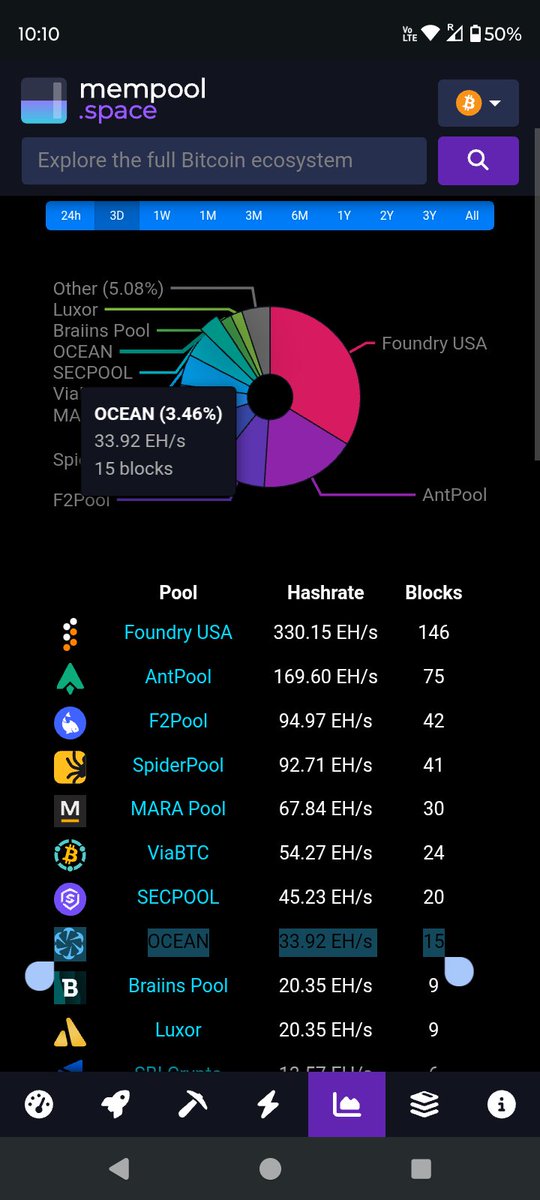
Ocean is now a top 8 mining pool
- more miners are discovering how to make their own block templates
- and that Ocean pays out more than other pools, since it has lower admin fees
- plus they offer LN payouts
- and, for large miners, coinbase payouts
Ckpool rework for yyjson. Whilst ckpool is very low overhead and scalable due to being coded in multithreaded C, one of the largest overheads within the code is the json parsing library. Libjansson has been included since 2014 and it touches approximately 5,000 lines of code with ckpool.
Since that time a number of higher performance json libraries have come out, with yyjson proving to be the fastest - 10-100x faster depending on the workload. I've resisted reworking the code for a long time, but the benefits are substantial - not only would ckpool be much lower overhead and even more scalable, it would lead to much faster block template changs which are a critical performance measure in mining pools.
I've embarked upon a major rewrite of all the performance critical components of ckpool to use yyjson. It is unfortunately far from a drop-in replacement and has required some significant surgery. Some of the safer code has already been merged into the master branch on git, but the massive rewrite has been committed to a yyjson branch. I'm currently testing the existing code on testnet4, and will continue refining it further before eventually merging it into the master branch and deploying it on the solo ckpools. The solo ckpool currently would probably safely handle 10x its current load (which is 40,000 clients).
I don't know how much of a real world improvement it will work out to, but I'm hoping for good things. At the very least, faster block changes are always worth pursuing. Watch this space, as I'll be announcing when I'm deploying it on solo.
And no, this isn't a modification any existing AI has a hope in hell of vibe coding, so it's all done by hand. Current code:
https://t.co/D9XYhHx16x
THE LINE ITEM NO ONE AUDITS: their pool.
Mining companies model their electricity cost per BTC to the cent. They track fleet efficiency in tenths of a joule. They present quarterly earnings with decimal precision.
But ask a CFO to verify their pool's rake and you'll get silence.
We published our 2025 OCEAN hashprice vs FPPS comparison data. Over 365 days, OCEAN miners earned 6.27 more BTC per exahash, or 3.6% more, than comparable FPPS pools. Not theoretical. Auditable.
In a post-halving world where margins are measured in basis points, 3.6% is not a rounding error. It's often the difference between a profit or loss.
The spreadsheet is public. (Below)
We'd welcome any pool to publish theirs.
Ready to start earning more?
OCEAN
Nobody knows why Iran is actually being bombed.
Iran mines Bitcoin at $1,320 per coin. Sells it at $68,000. A 50x profit margin using state subsidized electricity. 700,000 mining rigs. $7.8 billion crypto shadow economy. All run by the IRGC.
It’s the only revenue stream sanctions can’t touch.
Last time the US hit Iran, Bitcoin’s hashrate dropped 15% overnight. That wasn’t a side effect. That was a proof of concept.
Trump created a Strategic Bitcoin Reserve. His son launched a Bitcoin mining company. He wants America to be the “crypto capital of the world.”
You don’t become the crypto capital by competing with a country that mines Bitcoin for $1,320.
You bomb their grid.
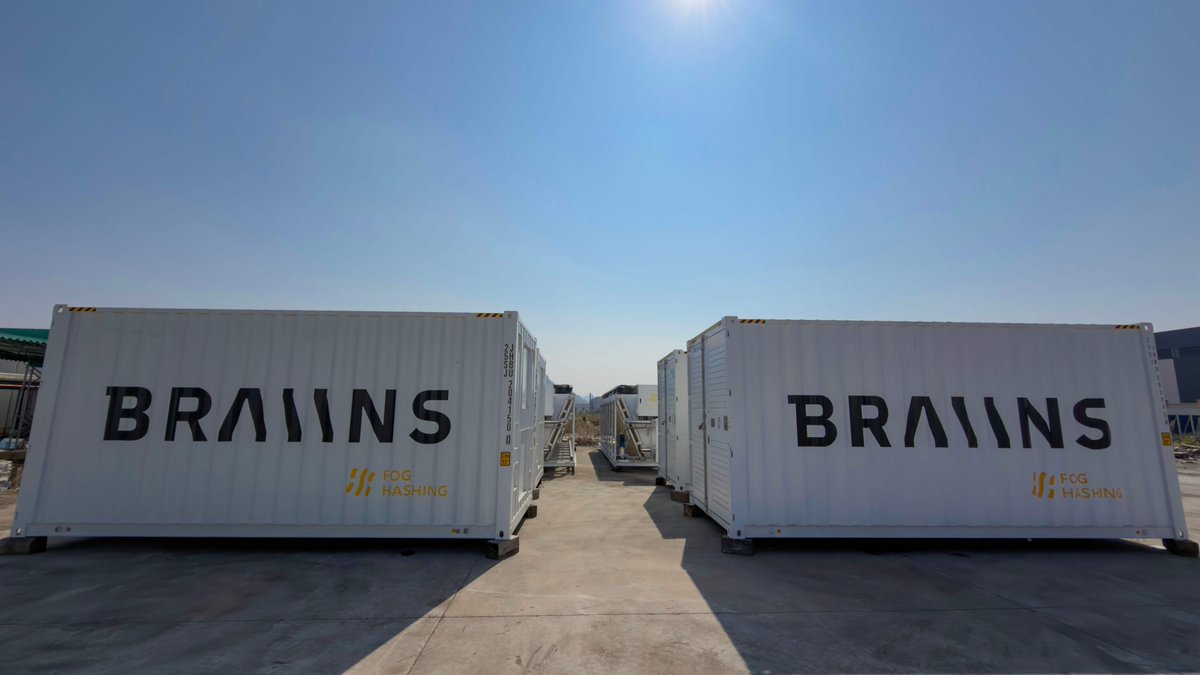
We are building a 6 MW facility. Same suppliers, same prices, are now available to you ⤵️
BRAIINS MARKETPLACE: FULL STACK SOURCING
We are building our own data center in Houston from scratch. Containers, dry coolers, miners, transformers, cables, CCTV. Every piece sourced through our own supply chain.
🗓 HOUSTON, come to the Grand Opening BBQ on April 23.
We have been in this industry since 2010. We buy at scale for ourselves. That means long-standing supplier relationships and competitive pricing on everything.
MINERS IN STOCK NOW:
🇺🇸 US warehouse: domestic shipping, no customs or tariffs
🇭🇰 Hong Kong warehouse: global stock, ships worldwide
Need something else?
Transformers, containers, and more: send us an inquiry and we will source it.
Browse the marketplace at https://t.co/HOEIJHrkhW
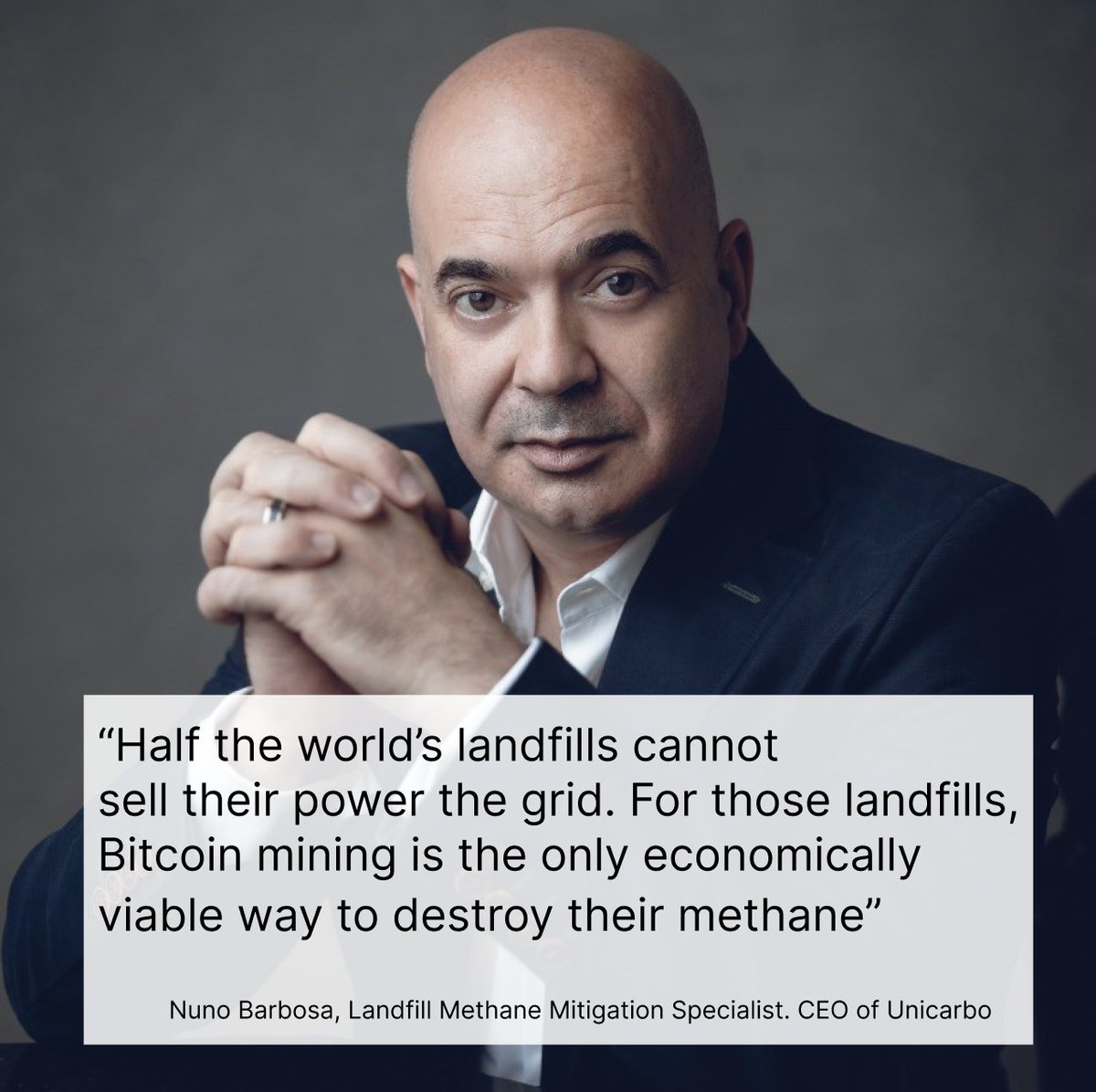
One of the world's most respected LGFTE (Landfill Gas To Energy) specialists with 20+ years and 100+ landfill project experience just said that Bitcoin mining is the only profitable solution for mitigating half the world's landfill methane emissions.
Probably nothing
I’m looking for people to help test something cool we’ve been working on for @StratumV2.
I’m forming a small tester group, all you need to have is miner (can be a home miner like bitaxe).
DM me if you want to join testing crew.
Jason is being diplomatic in this quoted post. @foundry_service I'm not going to be. 🧵1/
Bitcoin can survive a 2-block reorg.
What it may not survive, over time, is a mining culture that treats block-withholding-reorg-games as the norm. That is how you poison the golden goose.
I'm unsure what exactly happened here with Foundry.
@b10c's post has the nitty gritty details... but I guess I can add some interesting points:
⁉️None of the nodes I run or have access to ever saw Foundry blocks or headers for 941881 or 941882 until after 941883 was mined and came through... including nodes peered directly with some known Foundry-controlled nodes.
⁉️No DATUM miner on OCEAN ever built work on top of either Foundry block 941881 or 941882 (around a thousand globally diverse nodes).
Now for some commentary... While the former point above is interesting in itself, it's certainly an incomplete picture.
The latter point is quite intriguing, though, since this is NOT how other splits have shown up in that data to-date... and for a two-block split I'd have expected something quite noticeable.
For background, DATUM miners all run their own nodes to generate their own mining templates from their own view of the network and mempool policies.
During a race on the network between multiple blocks, generally some % of the DATUM miners will see different sides of the chain and work on it as they see it until the eventual convergence brings everyone back to the same block to build on. From the pool's perspective, this is all fine, since both chains are valid and contain all of the pool's blocks. With around a thousand unique nodes run by different miners around the world, this is to be expected and gives some insight into forks overall.
This latest two block reorg was different, though, as not a single DATUM miner was building on either of the two eventually-winning Foundry blocks at 941881 or 941882. From my POV, there was zero indication of a race happening until Antpool and ViaBTC's blocks were poofed out of the chain.
I do see in @b10c's data that some of his nodes eventually got headers for Foundry's first block after ViaBTC's block, which makes this even more interesting since I'd presumed headers would propagate pretty quickly. If some of his nodes saw it before 941883, that makes this even more of a mystery to me.
A disturbing bit is that this is actually what a 51% attack targeting removal of a couple of blocks could actually look like. Generally you wouldn't need to give a public indication of success or attempt until you were successful. That's what seemed to happen here if viewed in a bit of a vacuum. (I'm not saying this was an attack, just that this is what one would look like.)
Important to know you really don't need 51% to pull off a few blocks of reorg consistently. For example, Foundry has more than enough centralized hash rate to have a _very_ high chance of success if they were to do something like this intentionally.
It's one of the reasons solving mining (de)centralization is so important. A centralized pool with 30-40% of the network has a solid chance of being able to "unconfirm" transactions they don't like or want to censor, do double spends, etc.
With miners working on decentralized templates using DATUM, this is basically impossible because there's no centralized control of transaction selection, even if 100% of the network were on the same DATUM pool.
Anyway, I take this as a reminder that mining centralization is a problem we should keep working to fix. Let's keep Bitcoin permissionless and censorship resistant. Mine with DATUM.