BREAKING: The United States now has 5,159 data centers, more than the next 9 countries with the most data centers combined.
This includes operational facilities as well as projects that are planned, under construction, or land-banked.
The US also accounts for 38.5% of the 13,384 facilities listed worldwide.
The UK and Germany rank next, with 608 and 583, respectively.
At the same time, China, France, and India have 488, 402, and 360 data centers, respectively.
Among US states, Virginia leads with 728 data centers, followed by Texas and Georgia with 605 and 308, respectively.
America is at the forefront of the global AI infrastructure expansion.
Last week Jensen messaged me offering to join me on the road trip I'm doing, riding two motorcycles across country. I regret not taking him up on that. Now he is busy again.
Jokes aside (though he probably meant it 😂), I'm excited for the future. Humanity needs more Jensens in leadership positions, not less. Most of our leaders suck. Jensen is one of the good ones. Protect the good ones.
Also, I agree with Elon: stand up for people when they are down. We don't do enough of that for each other. We're human, we're flawed, but there is a lot more good in people than bad. We need to celebrate the good more.
Also, in terms of China, they should be a competitor not an enemy. The latter is the goal of warmongers. War destroys, competition creates.
My previous post last week was about Jensen's character. But even if we forget all that. Selfishly, as an American, I want America to win. And Jensen is essential to us winning, in the space of friendly competition, not military conflict and escalation.
Beware of the military industrial complex fueling hate of China. Warmongers want to create enemies, to fuel hate, division, fear. Warmongers want war, because it makes more money than anything else, they don't give a shit about the suffering it creates, or the cost it has for everyday people. Beware of the warmongers. Celebrate peacemakers. Jensen is a peacemaker.
Alright, just felt like writing this, while sitting at a gas station in the middle of nowhere. Hyped up on coffee.
I took a bit of a break, and now am back on the motorcycle. And just have to say, holy fuck is the feeling of freedom unlike anything else. Plus I had a very nice older lady a few minutes ago say I look sexy on the bike. And now I'm the meme of the guy who remembers a compliment for months/years.
Alright, back on the road. I love you all ❤️
Anthony, the "spy" story appears to be as fake as Russiagate. Here are the facts as I understand them.
(1) First, Alice Huang was at a company called Megaspeed[1], which everyone agrees bought Nvidia chips to sell to Southeast Asian companies called neoclouds. This is in itself completely legal under US law.
(2) However, some both inside and outside the admin didn't like this. They want to block Chinese nationals from accessing cloud services with Nvidia GPUs even if those servers are located outside China. Fine, but the so-called Remote Access Security Act (RASA) to block this has passed the House but not the Senate, and is not law[2].
(3) Singapore's government also looked into this when Alice Huang was on their soil[3] and didn't find any evidence that Megaspeed was actually selling chips to China illegally — let alone that she was a "Chinese spy." They did give her an entry ban, but that's like a visa denial.
(4) The related point is that it's not actually illegal to sell Nvidia chips to China! Since the Biden admin, there has been a complex and constantly-shifting set of export restrictions on chips. As of right now, Nvidia is allowed to sell H200s[4] to China, and indeed has designed these to comply with applicable law.
(5) But you know what...China actually also doesn't want Nvidia chips in China [5,6], because they want to build up their homegrown chip industry. The Nvidia chips are so good that China doesn't want to remain dependent on American chips, or vulnerable to possible US backdoors.
(6) The broader point is that this is an argument between nationalists and capitalists. Nationalists argue that US companies shouldn't even get close to selling to China, and shouldn't even be selling to neoclouds, even if it's "technically" legal. Capitalists argue that it's impossible for American companies to dominate world markets without, you know, being allowed to dominate world markets by actually competing in them. And that it's one thing to restrict physical sales to China, and quite another to require proof-of-citizenship for every single cloud access.
(7) Here's the thing: it doesn't make sense for one of the (few!) industries where America has a trade surplus with China to be summarily cut off, if you're worried about trade surpluses. It doesn't make sense to remove your number one AI CEO, if you want to be number one in AI. And it truly doesn't make sense to do to Jensen Huang what the communists did to Jack Ma[7], if your goal is fighting communism.
(8) So, to summarize: there's no proof of spying, as Blanche at DOJ has admitted[8], which rebuts your FBI/DOJ points. The Wachtell investigation you raise is just an in-house thing[9] ordered by the Nvidia board. And so all that's left is some affairs, which society has agreed is not disqualifying, given the realities of both Clinton and Trump.
In short: do you want a communist society like China, where Jack Ma's company can be stolen from him overnight on false pretenses? Or do you want some semblance of rule of law? If so, you should support the restoration of Jensen Huang to the company he built.
Citations follow in the next tweet.
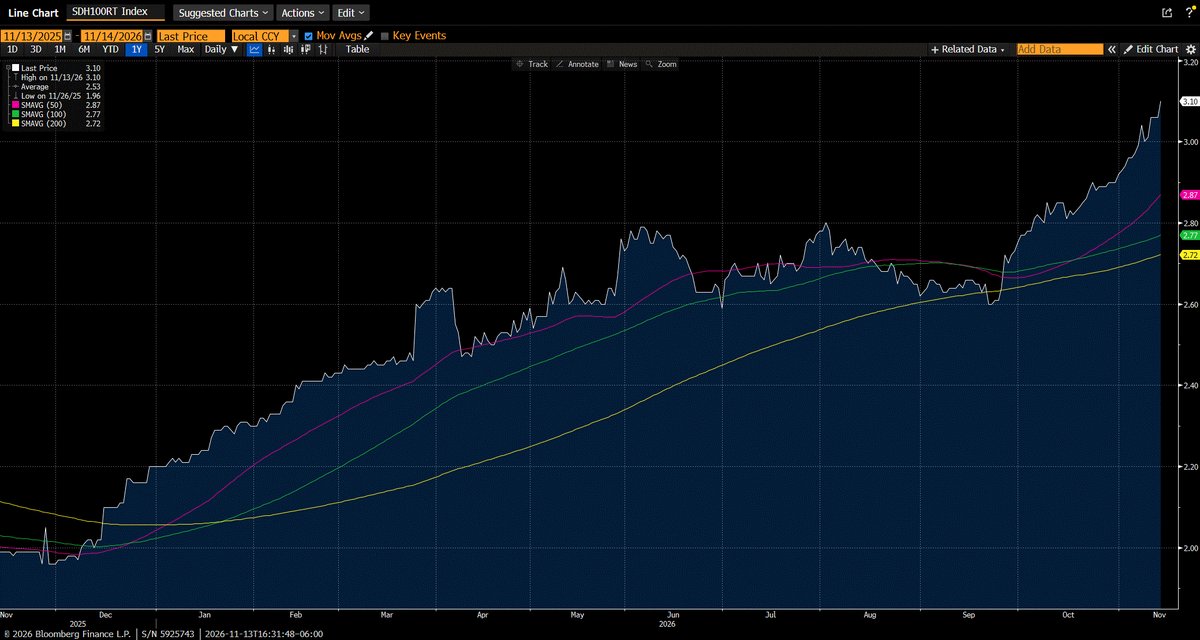
We started shipping the Nvidia H100 in 2022.
A year ago it rented for $1.96/hour.
Today: $3.10.
+58%, on a chip that was supposed to be obsolete by now.
So much for GPU depreciation.
The craziest part about neoclouds ($NBIS , $IREN, $CRWV) crashing is the timing.
Stocks crash. That's normal and healthy market behavior. But what's remarkable here is that neocloud are collapsing precisely as their underlying market is experiencing explosive growth at an unprecedented pace.
Part of the reason for this crash is a distorted supply/demand view.
Neocloud and hyperscaler earnings gave us a glimpse into the supply side of the equation. That's what the street is focused on now. But the Anthropic's S-1 gave us the first look into the demand side, and that's what many investors are completely missing.
In Q2'26, $ANT was spending $5.6B on compute to support $11.6B in revenue. By Q3, revenue had climbed to $17B, and compute costs grew to $9.9B.
That's a 77% increase in compute costs in a SINGLE quarter, outpacing even revenue growth.
Understanding the source of growth makes this even more interesting.
Much of this growth is coming from enterprise customers, which usually have a significant step up in usage after joining.
So in Q2, Anthropic had 6,000 customers spending more than $100K annually. By Q3, that number had nearly doubled to 11,900. By the end of Q4, it's expected to approach 18,000.
That's potentially a tripling of large enterprise customers in just six months.
By my estimates, these additional customers alone will require at least $3B in incremental compute spending, bringing Anthropic's FY26 compute bill to roughly $31B.
By 2027 compute spending will be AT LEAST $55B, assuming revenue growth slows dramatically (after three consecutive years of roughly 10x growth). Very likely, compute will be MUCH higher because there is no evidence to show that growth is actually slowing this much.
So Anthropic's compute needs are set to nearly double AGAIN next year, while existing capacity is already stretched to its limits.
Where is all this additional compute going to come from?
AI labs cannot grow without compute. They can sign all the customers they want, but without the infrastructure to serve them, that revenue simply cannot materialize.
This is precisely why $ANT is reportedly willing to pay $SPCX as much as $50M per MW of compute capacity, roughly 3x the prevailing one-year spot rate.
Because the alternative is far worse: They either secure the capacity, or they stop growing.
This is the disconnect I find so extraordinary. It's fine for stock to drop in price. It's just odd for that to happen in the middle of this historic demand explosion.
Please comment and share if you enjoyed this read.
NVIDIA letting Jensen go is a huge mistake, for America and for humanity. It's Apple firing Steve Jobs all over again, but much bigger, given the role of AI in defining the future of our world.
I've been keeping quiet on this out of respect for Jensen's family and team, who I've met and who are amazing humans, and because I personally hate infidelity. So my heart goes out to them in this difficult personal family moment.
But I can also say that Jensen is human, and makes mistakes like all of us do. Not that I matter at all, but I've known Jensen for a long time and have gotten the chance to spend a lot of time with him, behind the scenes, away from mics and cameras. I have seen him show kindness, humility, care to everyone around him, including strangers, including from the poorest most struggling parts of society, treating all the same with the same thoughtfulness and attention, because they are fellow humans and not because he has something to gain from them. That shows rare character, to maintain humility and humanity through all of it.
Another data point is what people who know him well have said privately to me about Jensen over the years. I've never had anyone tell me anything but how awesome he is or how much they love him. Probably over a thousand people at this point. This includes hundreds of engineers, CEOs, colleagues, friends, etc.
Also, since there was some spy talk. Jensen is as proud an American as it gets. I'm in shock frankly at all of this, including the mass hysteria around it. I love America, and I think NVIDIA letting Jensen go is terrible for America.
I stand with Jensen.
Love you all ❤️
Our message to Nvidia's board:
Do not fire Jensen Huang.
There is no clear replacement for Jensen Huang. We are confident that his departure would ultimately be a net negative for Nvidia, its shareholders, and the AI Revolution.
First, take a look at the data. History also suggests that removing a successful CEO will come with a significant cost.
A study of 187 forced CEO departures from S&P 1500 companies found that removing outperforming CEOs resulted in negative long-term stock returns. This case would be no different, in our view.
Jensen Huang is the definition of an outperforming CEO. Nvidia's board must not make a decision in the heat of the moment.
The board should take the time to conduct a thorough investigation and consult with shareholders, with a strong emphasis on the latter.
Quite literally, Nvidia's board should convene a special shareholder meeting and hold an advisory vote on this decision. This is the most consequential CEO controversy in world history. Shareholders deserve a say.
In addition, Nvidia's stock, $NVDA, is now down -35% in 26 trading days, nearly half of which is a result of the recent scandal.
We believe Jensen Huang's potential removal as CEO is now ~80% priced in.
Why take an action with massive downside potential when the market has already priced in much of that risk?
The downside of retaining Huang may be limited, while the potential upside is tremendous.
Lastly, history shows that retaining Jensen Huang could still lead to a favorable outcome. In 2019, Amazon retained Jeff Bezos as CEO after his extramarital affair became public, and the company's stock subsequently surged +108% by 2021.
Personal misconduct should not be ignored, but it must also be distinguished from corporate wrongdoing and weighed against the consequences of removing an executive who is instrumental to the company's success.
We believe Jensen Huang is an irreplaceable part of Nvidia and the AI Revolution more broadly.
Once the dust settles, firing Jensen Huang would prove to be a costly mistake.
It is time to pause and consult your shareholders.
.@washingtonpost reports a new joint Harvard University and the University of Pennsylvania study finding data centers have "only a small effect on residential electricity prices."
Data centers were responsible for "just 4 percent of the utility rate increases over the last five years."
**Weak Connection Between Data Centers & Overall Electricity Prices**
"Multiple studies by different researchers and organizations have failed to find a strong connection between data centers and the overall trajectory of U.S. electricity prices in recent years."
https://t.co/aWKWU9Y6Eh
We are heading into an absolutely MASSIVE expansion in AI data center power demand, and I don't think investors fully appreciate the scale of what's coming.
According to these estimates, annual data center power additions driven by AI accelerator sales are expected to increase from just 9 GW in 2024 to a staggering 104 GW by 2030. That's more than an 11-fold increase in just six years. And what's even more interesting is that this growth isn't coming from NVIDIA alone. We're seeing Amazon aggressively expand Trainium, Google scale its custom TPUs, AMD push further into the accelerator market, and other chipmakers develop their own AI silicon. NVIDIA is expected to remain the largest contributor, but the entire accelerator ecosystem is expanding.
At the same time, the amount of power required per rack is also expected to skyrocket. Average rack-level power density could increase from roughly 40 kW in 2024 to more than 280 kW by 2030. That means data centers are going to need significantly more advanced cooling systems, power distribution equipment, networking infrastructure, and entirely new approaches to how these facilities are designed and operated. And this is exactly why I remain so bullish on the broader AI infrastructure trade. We're talking about a multiyear investment cycle that extends FAR beyond GPUs. Companies involved in optical networking, liquid cooling, electrical infrastructure, power generation, and data center construction all stand to benefit as the industry races to accommodate this growth. We're still in the early innings of this buildout, and if these projections come anywhere close to materializing, the infrastructure required to support AI in 2030 will look completely different from what we have today.
@RepYassAnsari@zerohedge You are an elected official and instead of learning about AI to try to understand how can use it to improve your community, you want to ban it…Ignorance cannot be an excuse at this point
Markets have been talking about AI bubble for so long that they manufactured a fake one - digital infrastructure are highly profitable and eventually market will realize that the past 30 days were not a “healthy correction” but an irrational over reaction
🚨 NOMURA: THE MARKET MAY BE MISREADING THE ENTIRE AI DATA CENTER BOOM.
Big Tech is spending hundreds of billions on AI infrastructure. Free cash flow is under pressure. Investors are worried the AI boom isn't profitable.
But Nomura argues something very different:
AI infrastructure is already highly profitable. The cash flows simply haven't caught up with the investment cycle.
Here's the breakdown 🧵👇
1/ The profitability numbers tell a different story.
According to Nomura's November 2 report:
• AWS revenue: $46B, +39% YoY
• AWS operating margin: 38.7%
• Google Cloud revenue: $30.7B, +103% YoY
• Google Cloud operating margin: 36.2%
• Azure growth: +48%
These are not the numbers of an industry struggling to generate operating profits.
2/ The real issue is timing, not necessarily profitability.
Big Tech pays for data centers, GPUs, networking and memory upfront.
Revenue and cash generation arrive over subsequent years.
That creates a classic free-cash-flow J-curve:
CAPEX accelerates → FCF deteriorates → Infrastructure generates revenue → Investment growth moderates → FCF recovers.
3/ Nomura expects operating income to surge before free cash flow.
Its illustrative forecasts suggest operating-income growth could peak around 2029, while FCF growth accelerates later.
That distinction matters enormously for investors valuing AI infrastructure businesses.
4/ Why can't hyperscalers simply stop spending?
Because AI increasingly threatens their existing businesses.
Search, advertising, shopping, software and cloud services are being reshaped by AI agents.
Companies that underinvest today risk surrendering customers, data and market share tomorrow.
5/ Demand may not be the primary constraint. Capacity is.
Nomura cites enormous contracted cloud backlogs:
• Google Cloud: $560.8B
• AWS: ~$496B
• Microsoft commercial RPO: $677B
These figures have different reporting definitions, but collectively illustrate substantial contracted demand.
6/ Big Tech has financing alternatives to cutting CAPEX.
Nomura identifies four paths:
① Accelerate investment
② Freeze CAPEX
③ Use joint ventures and operating leases
④ Monetize contracted future cash flows
Its preferred expectation is continued investment supported by increasingly sophisticated financing structures.
7/ Oracle offers a real-world example.
Nomura highlights Oracle's combination of long-term leases, project financing, customer prepayments and customer-provided hardware.
The broader message: hyperscalers can restructure who finances infrastructure without necessarily reducing how much infrastructure gets built.
8/ This distinction is critical for semiconductors and memory.
Negative hyperscaler FCF does not automatically imply collapsing demand for GPUs, DRAM, HBM or other data-center components.
If spending continues through financing structures, semiconductor demand can remain resilient even while hyperscalers optimize their balance sheets.
9/ What could invalidate the thesis?
A genuine compute oversupply.
Watch:
• Cloud revenue growth
• GPU rental pricing
• Contracted backlog growth
• Data-center utilization
• Memory supply commitments
• Hyperscaler investment guidance
These are more useful indicators than negative FCF alone.
10/ The investment takeaway:
The key question is not simply:
"Why is Big Tech burning so much cash?"
It is:
"Will the infrastructure being built today generate enough durable cash flow to justify its cost of capital?"
Nomura is optimistic.
But the answer ultimately depends on pricing, utilization, investment discipline and the durability of AI demand.
The AI infrastructure cycle may be a cash-flow timing problem rather than a profitability crisis.
$NVDA $MU $GOOGL $MSFT $AMZN $META $ORCL
Is @CrusoeAI an AI supermajor?
Exxon famously doesn’t hedge oil because when wellhead margins compress, refinery margins expand.
According to @ChaseLochmiller, owning the stack from electron to token is the hedge.
Kinda hard to be angsty about debt when the demand side looks like this 📈
Link to my interview of Chase on Long Strange Trip, in the comments.
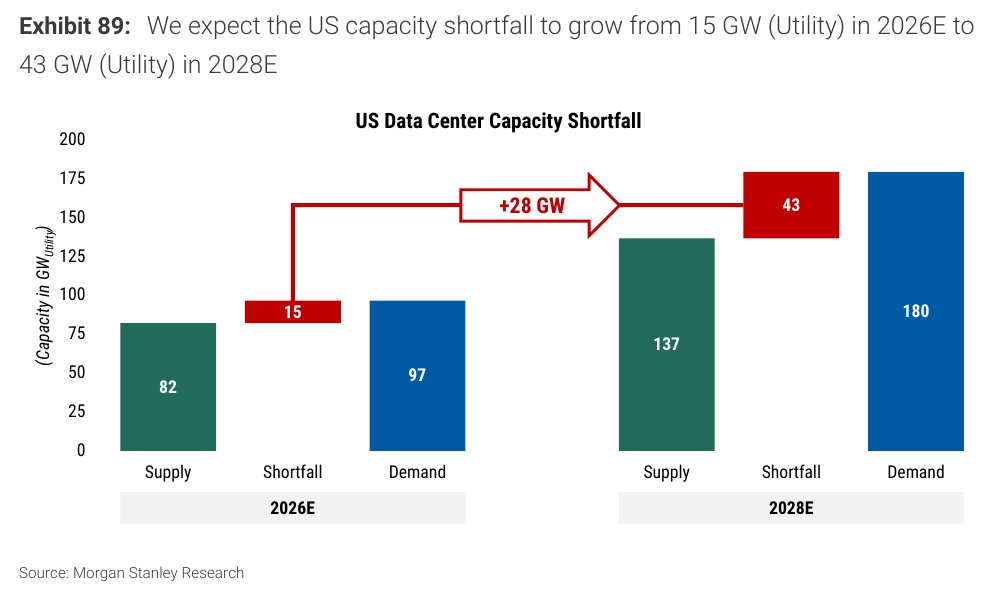
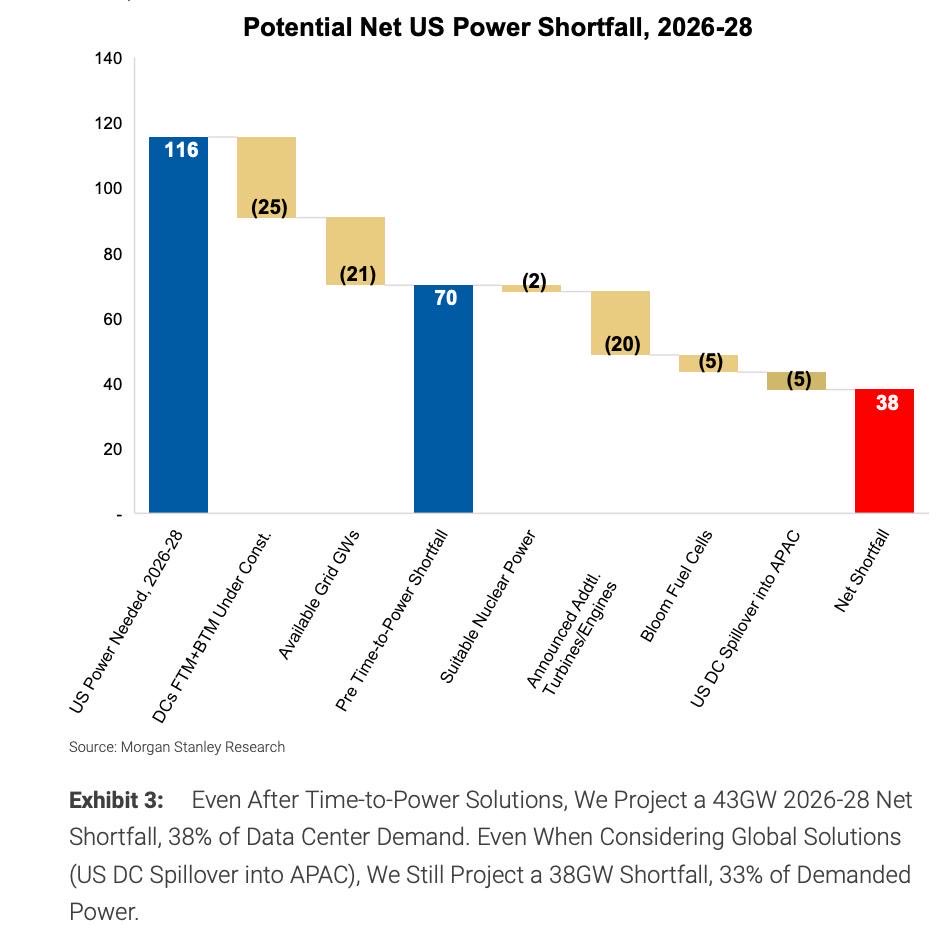
MORGAN STANLEY PROJECTS 43 GW NET SHORTFALL OF DATA CENTER DEMAND
If considering global solutions, the firm still projects a 38 GW shortfall which is 33% of demanded power.
$IREN $CIFR $HUT $SLNH $CLSK $WULF $NBIS
From Sunday, Sept. 27 through Saturday, Oct. 3, New York used about 2,700 gigawatt-hours of electricity. Gas made 45% of it, the most of any source by far.
Hydro made 18%, nuclear 15%, imports 11%, solar 5%, and wind and the new CHPE line from Quebec 3% each.
The number that stands out is nuclear. It usually supplies about a fifth of New York's power. This week it was 15%, and you can see why in the reel: the dark band at the bottom stays flat at about 2.5 gigawatts all week.
That's because FitzPatrick, the 842-megawatt reactor on Lake Ontario, was at zero for the entire week. It shut down for refueling on Sept. 14, and NRC status reports still showed it at 0% on Oct. 2. Refueling is routine and planned. But it shows what that capacity does when it's running, because for a week all of it had to come from somewhere else.
Mostly it came from gas.
Then the heat came back. On Friday, Oct. 2, New York City hit 87°F, and statewide demand peaked at 21.1 gigawatts at 3 PM. At that hour:
Gas: 9.9 GW, nearly half of everything
Hydro: 3.4 GW
Imports: 2.9 GW
Nuclear: 2.5 GW
Solar, rooftop included: 1.9 GW
Wind: 0.6 GW
Solar did its job on the sunny days. It covered 12% of Saturday's demand, the best day of the week. But on Friday afternoon, when the state needed the most power, solar was just under a tenth of supply, and wind was barely visible.
This is the pattern every week makes clear: the hours that decide whether the lights stay on are carried by plants that run whenever they're called. This week one of the biggest wasn't available, and gas filled the hole.
FitzPatrick will come back. Some of the other plants New York used to count on won't. The question for the state's energy plan isn't whether solar and wind can grow. It's what runs at 3 PM on an 87-degree day in October, and at night, and when the reactor is refueling.
Data: NYISO real-time fuel mix and load, with behind-the-meter solar estimates; NRC daily power reactor status reports; NYC temperatures from Open-Meteo.