Haiku 5.5 just shipped. About 75% cheaper to run than the last Haiku.
It changes the Agent world forever.
Most agents still run one big model for everything.
Haiku 5.5 makes the split worth doing. The big model decides, and the small model carries the volume. Anthropic is pitching exactly this pairing: Haiku as a subagent for Opus 5.5 and Sonnet 5.5.
What it actually changes for your agent:
Shrink tool outputs before the big model sees them. In my agent receipt, tool outputs were 66% of the bill. A Haiku subagent can condense a 3,000-token result to a few hundred before Opus re-reads it on every turn after.
Routing gets almost free. "Which tool, which agent, done yet?" can run on the cheapest model in the family.
Live agents become practical. Haiku 5.5 is fast enough for customer support and browser use, where latency used to rule out a capable model.
Opus finally gets to do only Opus work.
One thing to check: "75% cheaper" is an average. Run your own workload before you move everything over.
Wrote the full breakdown on agents, loops, and graphs for anyone building one below.
Your Claude setup might be full of broken instructions
Run /doctor prompt-audit to catch dead paths, outdated commands, and conflicting instruction files before they hurt Opus 5.5.
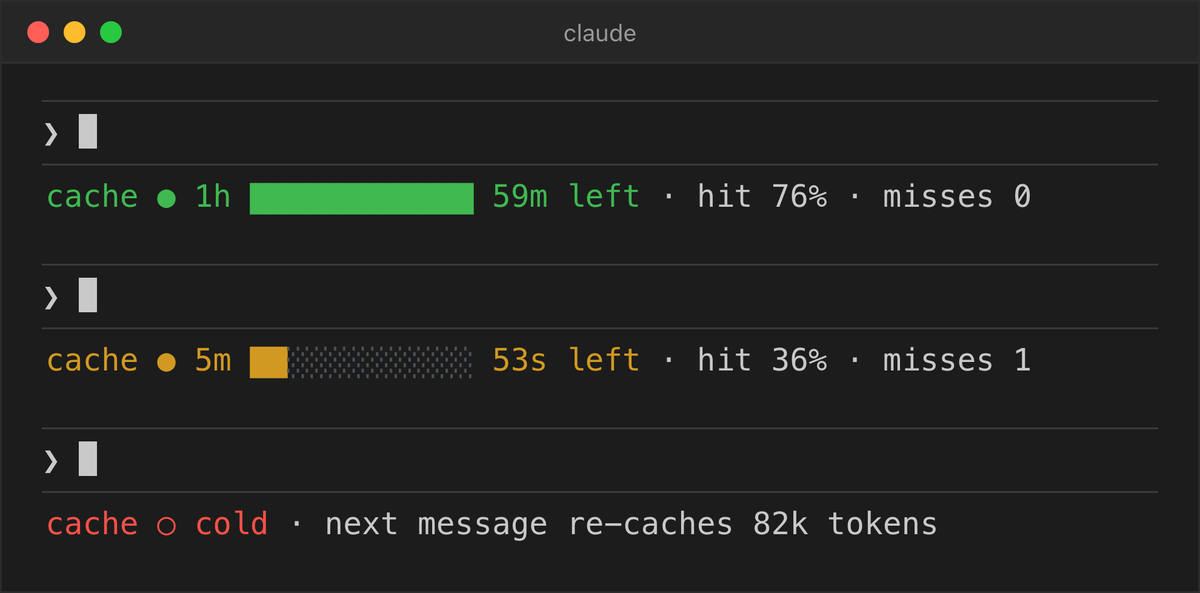
Highly recommend adding a 𝗰𝗮𝗰𝗵𝗲 𝗰𝗼𝘂𝗻𝘁𝗱𝗼𝘄𝗻 to your Claude Code status line.
Simply put, every time you send a message, Claude Code sends the whole conversation to the model again. The cache lets it skip reprocessing everything that came before, so replies come back faster and count less against your usage limits. But the cache expires, and the first message after that makes it process 𝘁𝗵𝗲 𝘄𝗵𝗼𝗹𝗲 𝗰𝗼𝗻𝘃𝗲𝗿𝘀𝗮𝘁𝗶𝗼𝗻 𝗳𝗿𝗼𝗺 𝘀𝗰𝗿𝗮𝘁𝗰𝗵. Normally you can't see how much time it has left. With this, your status line always shows the minutes left, and once the cache expires, it tells you how many tokens your next message will re-cache. If it's about to run out and you still have something to ask, ask it now.
The official docs have a few more things I didn't know:
→ On a subscription, within your plan's usage, the main conversation's cache lasts 1 hour, while subagents and workflows get 5 minutes. On an API key, or once you're past your limit and on usage credits, the main conversation gets 5 minutes too
→ Switching models mid-session recomputes everything, and with opusplan, every move into or out of plan mode counts as a switch
→ Editing CLAUDE.md mid-session doesn't break the cache, but the edit doesn't apply either until /clear, /compact or a restart
→ Went down the wrong path and want a redo? /rewind back and it can pick up the cache you already had; /compact builds a new one
Send this prompt and the link below to Opus 5.5 👇
"Read this doc, plus the status line field reference it links to, and add a cache segment to my Claude Code status line.
1. If I already have a status line, don't replace it. Save stdin first so the original command and the cache segment read the same input, leave the original output as is, and put the cache segment on its own line after it. If I don't have one, create one.
2. Get the data from prompt_cache in the input: warm, ttl, expires_at, hit_ratio, misses, last_miss_cause, recache_tokens_if_cold. Show nothing until prompt_cache appears, and skip any field my version doesn't have.
3. While the cache is warm, show it in green with a progress bar and the time left, like "cache ● 1h ████░░ 38m left · hit 91% · misses 0". Turn it yellow when less than 20% of the time is left.
4. When it's cold, show it in red as "cache ○ cold · next message re-caches 82k tokens", with the token count rounded to k. Add the miss cause only when there is one.
5. In the settings file where my statusLine already lives, add "refreshInterval": 30 inside the statusLine object, next to command, so the countdown keeps moving.
If my Claude Code is older than 2.1.251, tell me. Don't upgrade it yourself. When you're done, run sample JSON for warm, about to expire, and cold, and show me the output."
https://t.co/wrgjot0602
Claude can now help you build evaluations and hillclimb on them.
In this article, we share guidance on eval design & skills that Claude Code can use to improve your applications.
https://t.co/PgKFC2DWth
It’s now easier to build plugins for Claude.
We built a new portal to submit your plugin, track review, and see usage.
Plugins package MCP and skills, and are becoming the way to build for Claude. MCP usage across Claude products is up 110x this year!
https://t.co/kHgJqjQWrj
Today we’re opening applications for the Life Sciences Verification Program.
Through the LSVP, life science professionals can use our models—including, for the first time, Mythos—with a new set of safeguards designed to enable the full range of biology-related work. We designed these new safeguards to provide a better experience for biologists and more protection from risk of misuse.
The program is launching in beta for teams of all kinds—from academic labs to startups, pharma companies, and more. We will continue to improve the program and expand access to individual Pro and Max plans over time.
Learn more about these access grants and apply: https://t.co/uALS2lZuN4
Claude Mods are landing now. Someone already built a Tetris-in-Claude mod 🤯
See issue for the latest community update, technical details, and more cool demos
https://t.co/A15qGUZ6nx
Fable 5.1 is our best model yet for coding, data analysis, computer use, design, presentations, Tag, and the hardest long-running agentic work.
This model is a pleasure to work with, and I've been using it for everything.
🚨 Claude Sonnet 5.5 Leaks
> Sonnet 5.5 is reportedly close to release
> Could launch as early as next month
> Internal codename reportedly “Fennec”
> Faster responses and lower latency
> Rumored 2M-token context window
> Expected to approach Fable 5-level performance while keeping Sonnet pricing
Would you switch from GPT-5.6 Sol to Sonnet 5.5?
Boris Cherny, creator of Claude Code:
"Opus 5 does in a day what used to take your team a month. Most people will keep using it wrong."
In 12 minutes he explains why Opus 5 needs less prompting than any model before, and why your old detailed prompts now work against you.
Watch it, then read the article below on how to prompt Opus 5 👇
your AI agent can watch any video now - paste a URL and it sees every frame, hears every word, all for free 🤯
bradautomates/claude-video gives Claude the ability to watch YouTube, Loom, TikTok, local files - anything yt-dlp supports
what people actually use it for:
→ analyze a competitor launch - what hook, what visuals, what structure
→ debug from a screen recording - Claude reads the exact frame where it breaks
→ summarize a 49-min talk in 30 seconds with frame-accurate timestamps
→ strip the hype from product videos - "what's actually new, skip the pitch"
the mechanism: yt-dlp pulls free captions first (zero cost). ffmpeg extracts frames at scene-aware intervals - not uniform sampling, so you don't waste tokens on 12 identical frames of the same slide. Claude reads every frame as an image with timestamp markers. Groq Whisper only kicks in when a video has no caption track
how to set up (3 min):
> claude code: /plugin marketplace add bradautomates/claude-video then /plugin install watch@claude-video
> or npx skills add bradautomates/claude-video -g for codex, cursor, gemini cli
> dependencies auto-install on macOS via brew
two caveats: free captions cover most but not all videos. past 10 min use --start/--end for focused sections or the token-burner mode for full coverage
your buddy still watches every tutorial at 2x speed taking manual notes. you paste a URL and your agent extracts the substance in seconds for $0
Acaban de FILTRAR el método MÁS FÁCIL para hacer dinero en 2026:
Claude + YouTube = 62.000$ al mes💰
Sin complicaciones. (Solo 13 minutos)
Subtitulado a español e inglés.
Guárdate este post para no perderlo.🔖
🚨ATENTOS A ESTA LOCURA🚨
Alguien ha creado Un harness de código abierto que convierte a Claude Code y Codex en modelos 3D de CAD reales a partir de lenguaje natural.
Se llama text-to-cad, un harness open source que convierte tu agente de código en un ingeniero de CAD.
Construir un robot solía significar combinar 6+ herramientas: software de CAD, exportadores URDF, solucionadores de cinemática, visores. Días de trabajo. Pipelines rotos. Archivos que ningún agente puede leer.
text-to-cad elimina todo eso.
→ Exporta STEP, STL, DXF, GLB, 3MF
→ Genera descripciones URDF de robots
→ Corta directo a G-code
→ Envía trabajos a tu impresora Bambu Lab
→ Funciona 100% offline, sin backend
Una demo genera un brazo robótico completo de 7 grados de libertad, con cinemática funcional, GUI personalizada, todo, casi enteramente a través de prompts.
100% open source.
Guarda esto 📩
Breakdown of Anthropic's launch video for Claude Design
64.1M views on X post, one of the most popular launches in 2026 so far
Here is the 6-stage structure used:
[1/6] Prompt → Live typing a complex prompt with attached spreadsheets. It skips the standard voiceover intro and jumps straight to an interactive 3D globe build in under 10 seconds
[2/6] Controls → Zooming in as it builds workable sliders instantly. Claude Design makes all the custom controls you need
[3/6] Edits → Comment dropping directly on mobile screens to toggle dark mode. It shows how easy it is to iterate without writing a single line of code
[4/6] Scale → Fast cuts across apps, posters, and pitch deck charts. It shows the software handles every brand asset, not just web pages
[5/6] Handoff → A quick dropdown click cycling through export as PPTX, Canva, HTML, and Claude Code. It removes buying friction by showing design assets dropping straight into existing dev workflows
[6/6] Outro → Clean zoom out to the full grid workspace ending on the logo. It gives a smooth landing without feeling abrupt
P.S. I produce videos like this for a living. If you have a launch coming up, book a call with me on the Flash Motion website (link in bio) or DM me
Ya no prompteo en Claude Code.
Tengo loops corriendo que promptean a Fable 5, y mi trabajo es solo escribir loops.
Es el método de Boris Cherny, y tengo que decirlo: es una brutalidad.
Todo lo que necesitas para empezar con loop engineering (desde cero):
Don't waste 2 years learning to code.
The man who built Claude Code tells you what to learn instead.
82 minutes. Free:
24:03 - Anthropic's real engineering rules
27:44 - $100k+/month on Claude
40:42 - What to learn instead of coding
Writing code is the old job. Building loops is the new one.
Watch it. Then build your own loop with the guide below.
Something I have been thinking about: in the past, the best engineers I knew spent a lot of time automating their work in various ways. Better vim/emacs automations, writing lint rules to catch repeat code issues, building up a suite of e2e tests so they don't need to smoke test the app manually. These kinds of things were the highest leverage activities an engineer could do, because it multiplied their own output, which in turn meant they could build more things.
I think many of these automations have become even more important now. This is true for a number of reasons.
First, infra and DevX automation speeds you up. And if you are running an army of agents, each of those agents will be sped up also. More automation == more output per unit of time.
Second, moving things to code improves efficiency. Your agent could fix an issue every time it sees that issue happen, but that uses tokens and might miss cases. If Claude instead writes a lint rule, CI step, or routine, that class of issue can be fully automated forever. This is really what people are talking about when they talk about loops -- it's about automating entire types of busywork rather than solving them one off. This isn't a new idea at all. Engineers have been doing this for a long time!
Third and most importantly, automation makes it possible for others to contribute to the codebase more easily. Increasingly what I am seeing is engineers are contributing to codebases on day one because Claude can navigate the codebase for them, and that non-engineers are able to contribute to a codebase as effectively as engineers can. What gets in the way of both of these is domain knowledge that lives in peoples' heads rather than in automation -- the stuff you used to have to learn when ramping up. What has changed thanks to agents is the domain knowledge that can be encoded as infrastructure is no longer limited to what is expressible in lint rules and types and tests; it can now capture nearly all domain knowledge, encoded as code comments and skills and CLAUDE.md rules and memories. If I put up a PR for an iOS codebase I don't know and a code reviewer rejects it because it doesn't use the right framework, or if a designer builds a new feature and it gets rejected because it doesn't follow the right architectural patterns, these are failures of automation.
Every team should be writing the CLAUDE.md's, REVIEW.md's, skills, and docs that enable agents to productively work in their codebase with zero additional context from the prompter. This sounds crazy, and at the same time is a natural extension of the stuff engineers have always done: automate, and encode domain knowledge as infrastructure. As the model gets smarter and as the harness matures, this task becomes easier. In the meantime, it is on every team to look for ways to convert their domain knowledge to infra so that Claude can write code better, so that code review catches issues automatically, and so the next person working on your codebase can contribute more easily.