Putins Strategie
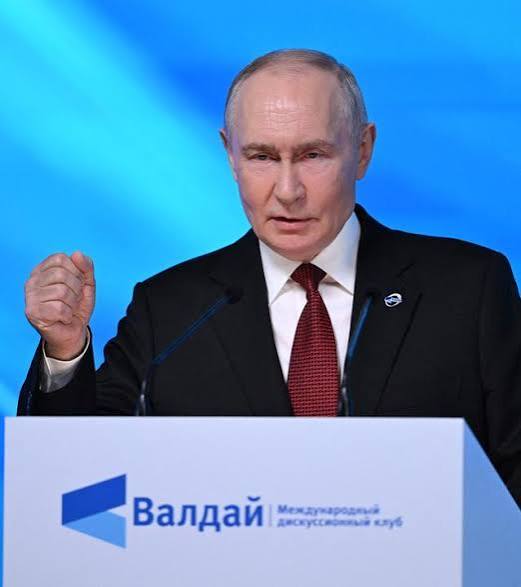
Putin sprach am 1. Oktober 2026 beim Waldai-Forum 3:20 Stunden lang in einer Rede und in einem moderierten Gespräch auf der Bühne. Aus seinen ausschweifenden Formulierungen lassen sich fünf zentrale Punkte seiner Strategie herauslesen:
1. Angriff ist Verteidigung
Putins zentrale Meta-Strategie und sein oberstes Ziel ist die Umdeutung jeder russischer Aggression in defensive Notwendigkeit. Putin behauptet, Russland reagiere lediglich auf westliche Angriffe oder Provokationen.
Diese Erzählung ist das Fundament seiner gesamten Politik:
· Putin rechtfertigt den Angriffskrieg gegen die Ukraine als Verteidigung gegen den aggressiven Westen.
· Putin stimmt die russische Bevölkerung auf eine dauerhafte Konfrontation ein.
· Putin stellt jede russische Eskalation in der Vergangenheit und in der Zukunft als „Antwort“ dar, nie als russische Initiative.
Damit schafft Putin einen ideologischen Rahmen, der seine geopolitischen Ziele verdeckt und moralisch absichert.
2. Kein europäisches Russland, sondern ein russisches Europa
Putin strebt eine europäische Sicherheitsordnung an, in der Russland ein Vetorecht über alle Entscheidungen zur Sicherheit Europas besitzt.
Putin beschreibt den Westen als illegitim und regelbrechend. Hinter dieser Rhetorik stehen strategische Ziele:
· Die NATO schwächen, insbesondere die Ostflanke.
· Die EU politisch spalten und wirtschaftlich destabilisieren.
· Mittelosteuropa wieder in eine russische Einflusszone ziehen.
· Russland in Europa als überlegene Macht etablieren.
Putins Forderung nach „weniger westlicher Dominanz“ ist kein Ruf nach einer fairen Balance. Es ist der Versuch, eine neue russische Dominanz aufzubauen, nachdem Moskau seine Vormachtstellung nach 1991 verloren hat.
3. Die Ukraine ist Russland
Putins Ziele in der Ukraine sind sehr weitgehend. Hinter der Forderung nach „Neutralität“ verbirgt sich der Dreiklang aus: keine NATO, keine EU, keine westliche Orientierung.
Putin will dauerhafte territoriale Kontrolle über große Teile der Ukraine, auch über bisher nicht eroberte Gebiete. Putin will vollständige politische Kontrolle über eine Ukraine, die nicht souverän im eigenen Interesse handeln kann, sondern bei jeder Entscheidung die russischen Interessen vorzieht.
Putins Aussage, die Ukraine könne „nicht existieren“ und werde „von außen kontrolliert“, ist eine klassische rhetorische Figur, um die Ukraine zu delegitimieren. Das soll die Grundlage für eine dauerhafte russische Einflussnahme schaffen.
4. Beihilfe zur Selbstabschreckung (alles für Kaliningrad)
Putin versucht, die russische Bereitschaft zur Eskalation bis hin zu Atomwaffen als bedauerlicherweise notwendige Verteidigung darzustellen. Damit verfolgt er einen militärstrategischen Zweck. Putin weiß, dass eine NATO-Verteidigung des Baltikums gegen einen russischen Angriff zwingend die Ausschaltung der Luftverteidigung, Raketenstellungen und militärischen Infrastruktur im hochgerüsteten Kaliningrad erfordern würde.
Die russische Exklave Kaliningrad ist der am stärksten militarisierte Raum Europas, vollgestopft mit Luftabwehr, Raketen, elektronischer Kampfführung. Eine NATO-Verteidigung des Baltikums und des Ostseeraums würde Kaliningrad massiv treffen müssen.
Deshalb versucht Putin rhetorisch:
· die Logik der Verteidigung der NATO als „Aggression“ umzudeuten,
· die politische Bereitschaft Europas zur Verteidigung der Nordostflanke zu schwächen,
· die Verteidigung des Baltikums als „Eskalation“ darzustellen,
· die Schwelle für westliche Gegenmaßnahmen gegen russische Aggressionen im Baltikum und im Ostseeraum zu erhöhen.
Putins Drohungen und sein vages Herumwedeln mit Atomwaffen sollen die NATO davon abhalten, ihre eigene Verteidigungsstrategie konsequent umzusetzen, weil wichtige NATO-Mitgliedsstaaten in Selbstabschreckung verfallen.
5. Wirtschaft als Waffe
Putin präsentiert die russische Wirtschaft als „stabil“ und „resilient“. Erkennbar ist Wirtschaftspolitik ist für Putin kein Instrument zur Verbesserung der Lebensqualität der russischen Bevölkerung, sondern ein geopolitisches Werkzeug.
Putin spricht nicht über menschliche Verluste, soziale Kosten und wirtschaftliche Schäden seines Krieges. Verarmung, demografische Krise und Abwanderung von Fachkräften kommen bei ihm nicht vor.
Für Putin ist die russische Wirtschaft ein Druckmittel gegen Europa, eine Kriegsressource und ein Mittel zum Aufrechterhalten seines Regimes.
Putin spricht über Wirtschaft als Machtressource des russischen Staates, nicht als Lebensgrundlage russischer Menschen.
*
In aller Kürze: Putin will, dass Russland eine europäische Ordnung dominiert, in der die Ukraine dauerhaft unterworfen ist und in der Moskau Einflusszonen kontrolliert. Die russische Aggressivität bis hin zu Angriffskriegen wird dabei als Verteidigung dargestellt.
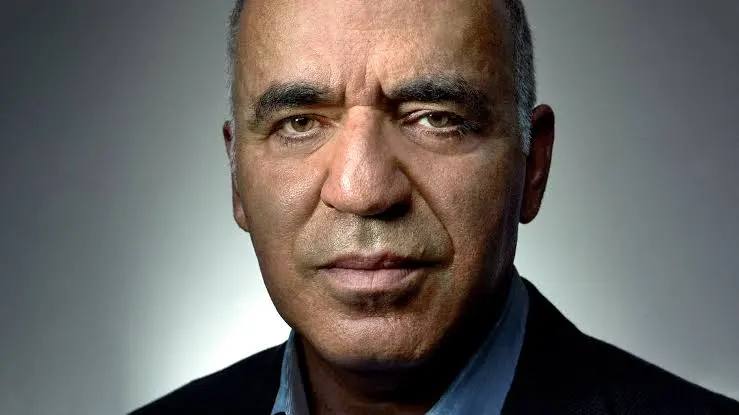
A network associated with Russian special services planned to assassinate Garry Kasparov and Ilya Ponomarev in the United States. El Mundo journalists cite American investigation materials and their own sources in the politicians' inner circles.
This is Putin's usual tactic. Putin has always sought to kill his opponents and opposition figures both in Russia and abroad.
One of the goals is also to intimidate critics of the Kremlin living in exile. Putin wants to show that no borders and passports of other countries guarantee safety.
Attempting to organize assassinations on US territory is a step up to a new level of escalation. Planning special operations like this one in Washington and New York demonstrates the Kremlin's readiness to completely destroy the former containment system.
There must be a clear response from the US and NATO, not only in the form of public legal actions, diplomatic pressure, and the strengthening of internal security.
The only thing Russia understands is strength. And the networks of Russian special services feel increasingly unpunished in NATO countries. This is war. It is necessary to move from passive defense to aggressive countermeasures.
In July 1987, Donald Trump went to Moscow.
He had been invited after contact with Soviet ambassador Yuri Dubinin and the Soviet state tourism agency Intourist. Trump spent the trip looking at potential sites for a luxury hotel in partnership with the Soviet government. (The Washington Post)
Then, less than two months later, something remarkable happened.
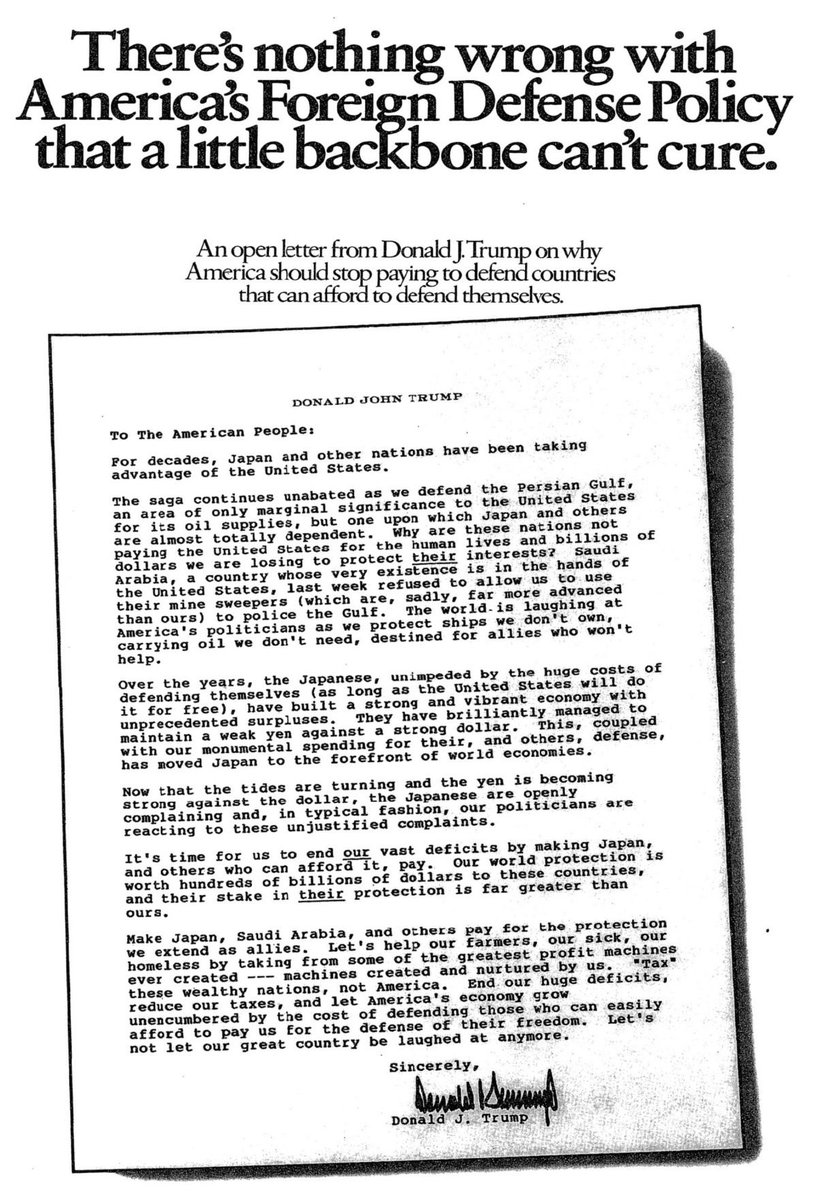
Trump spent $94,801 putting full-page advertisements in The New York Times, The Washington Post and The Boston Globe attacking the cost of America defending its allies.
Western Europe should pay more. Japan should pay more. America was being ripped off.
That was September 1987. (The Washington Post)
Nearly forty years later, the argument is still there.
Trump has repeatedly questioned whether America should defend NATO members that he believes do not spend enough on defence. In March 2025, as president, he said the United States would not defend allies he considered insufficiently paying members. (Reuters)
At Helsinki in 2018, standing beside Vladimir Putin, Trump publicly questioned the conclusions of his own intelligence agencies about Russian election interference. (Reuters)
After returning to office in 2025, his administration opened negotiations with Moscow while Ukraine and European allies were initially excluded, paused American military assistance to Ukraine, and adopted positions European governments feared would strengthen Russia’s negotiating hand. (Reuters)
The more interesting fact is that the Russia story did not begin with Putin, the 2016 election, the Steele dossier or Russiagate.
It was already there in 1987.
Again and again, Trump has argued for things that weaken the architecture built to contain Russian power: less American commitment to European defence, more pressure on NATO allies, greater scepticism toward collective defence, and a willingness to deal directly with Moscow even when European allies object.
You do not need a secret conspiracy to explain the pattern.
You only need to look at the pattern.
Once you do, a remarkable amount of Donald Trump’s foreign policy stops looking like a collection of strange, disconnected episodes.
It starts looking like the same argument, repeated for forty years.
Stay connected,
follow Gandalv @Microinteracti1
at labour party conference, burnham announces uk-eu summit
to explore new “options” for “long-term relationship” w/ europe…
“brexit has done more harm than good”
In response to the deteriorating security situation, 🇨🇭 has three objectives: strengthen resilience, improve protection and enhance defence capabilities. The Federal Council has adopted Switzerland’s Security Policy Strategy 2026. https://t.co/VzEujnJzNr @vbs_ddps
hard for the united states to maintain a global lead in artificial intelligence when most americans don’t think it will benefit them and don’t trust their leaders who tell them otherwise.
getting the tech right and the people wrong is a recipe for failure.
Quando si dice che la toppa è peggio del buco. Lasciamo perdere l'affermazione "la libertà delle donne di indossare o non indossare quello che vogliono" riferita a bambine o minorenni costrette a mettere un burqa. E pure il paragone tra la legislazione in Afghanistan e Iran, che strutturalmente discrimina le donne, con quella in Francia e altri paesi eruopei in cui il divieto del burqa è compatibile con la costituzione ed è stato giudicato legittimo dalla Corte europea dei diritti dell'uomo.
Ma @amnestyitalia arriva a confondere il divieto di "hijab", un velo che lascia scoperto il volto, con il divieto di "burqa" e "niqab" citati da Meloni, e già proibiti da molti paesi europei (da ultimo il Portogallo), che sono veli INTEGRALI. Di quali diritti costituzionali parlate se non sapete neppure di quale velo state parlando?
Non si sa dove finisca l'ideologia e dove cominci l'ignoranza, ma la miscela è davvero ridicola.
Excerpts from my Black Ribbon Day speech in Toronto seven years ago.
"The only problem with hanging von Ribbentrop after Nuremberg was that Vyacheslav Molotov was not hanging next to him. And that the KGB was not condemned along with the Gestapo. Instead, Molotov lived to the ripe age of 96, dying peacefully in Moscow in 1986. …
Unlike today’s leaders, Chamberlain and Daladier had no personal profit motives in their deal with the devil.
There are new Molotov-Ribbentrop pacts going on all around us today, and they are taking place out in the open, not in secret. There is an axis of autocracy with cooperation between authoritarian regimes as well as their would-be imitators in the free world. …
"War" is the correct word, no matter how you qualify it. Call it hybrid war or gray-area war, but it is a war. Putin is attacking not only his neighbors, but the institutions of the free world that he sees as threats to his power. His most dangerous allies aren’t far-right politicians or thugs in Iran and Venezuela. No, Putin’s most dangerous allies are the free world leaders who fail to stand up to him when they have the power to do so. …
It is all well and good to make the record clear on Molotov-Ribbentrop on this anniversary, especially on Stalin’s role as a protagonist in launching World War II. Let us take that lesson to call things as they are. Lies are lies. Murder is murder. Dictators are dictators. And just as we cannot allow history to be revised, we must not allow the distortion of what is happening now, right in front of our eyes. Thank you."
https://t.co/aD5aMNIaTq
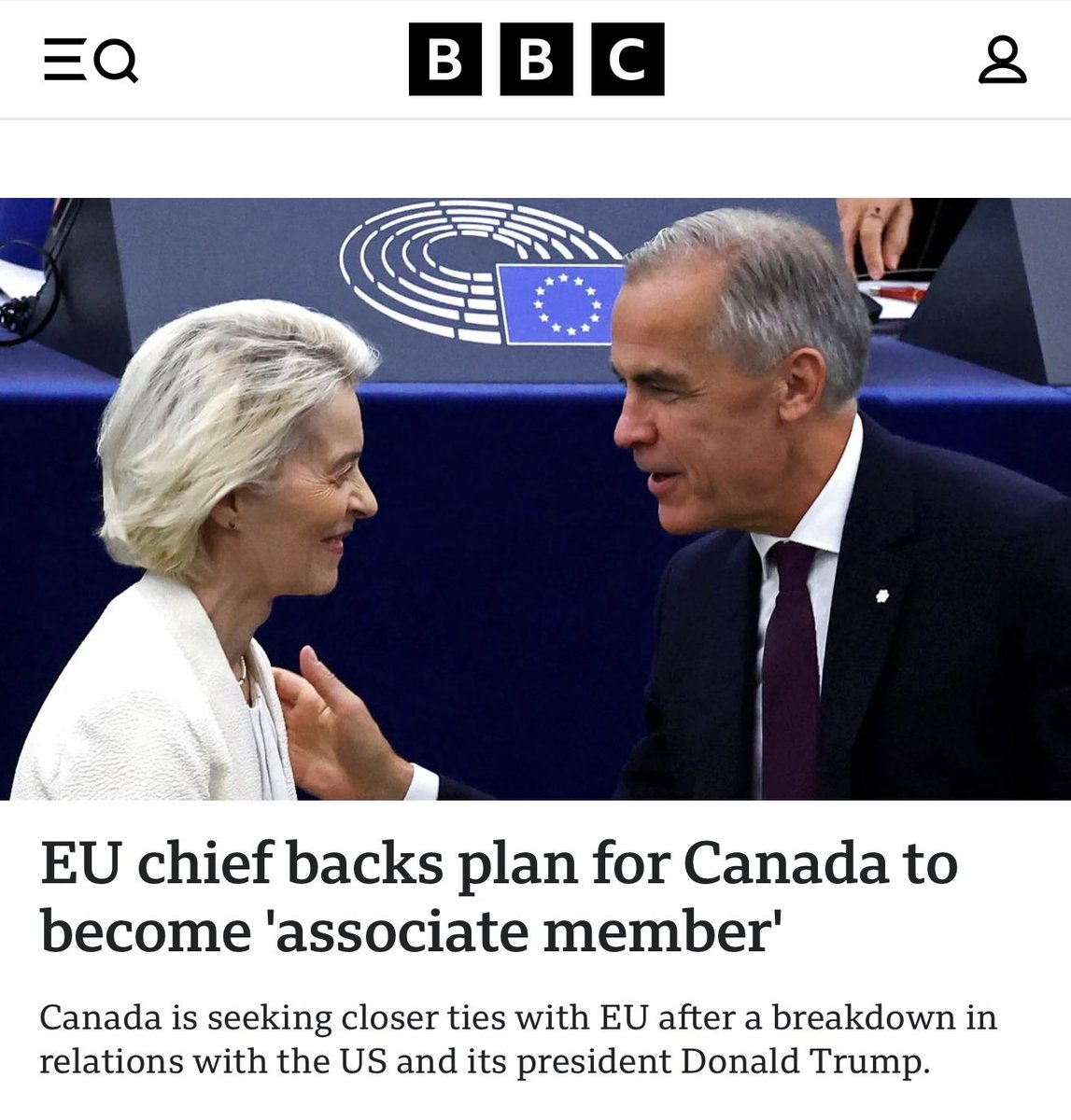
🇨🇦 🇺🇦 Ukraine took one look over the border at Putin's failed regime, a petrol station with nuclear weapons, recoiled in horror and said hell no! Now Canada has peered downstairs at Trump's failed regime, seen the same thing and said hell no!
Ottawa has asked Brussels whether there is room at the table, and Ursula von der Leyen says we love you, opening the door for Canada to become the EU's first associate member.
The comparison is not a cheap one, because the mechanism is identical. Both countries share a border with a country whose leader has said out loud that they should not really exist as independent states. Putin wrote essays explaining that Ukraine was a historical accident. Trump spent years musing about a fifty-first state, slapping tariffs on his closest ally and treating a G7 democracy like its worst enemy.
And before you raise your hand, yes, Canada already borders the EU. Since 2022 it has shared a land border with the Kingdom of Denmark on Hans Island, a lump of rock in the Nares Strait between Ellesmere Island and Greenland, which the two countries split down the middle after a decades-long dispute conducted entirely with flags and bottles of schnapps. That is how civilised neighbours settle territory.
And frankly, why would anyone choose otherwise. Europe beats both Russia and the United States on every measure of a life worth living, from life expectancy to healthcare to the simple ability to send a child to school without a gun drill. Putin offers trenches and conscription, Trump offers tariffs and chaos, and Europe offers the next century.
Welcome, Canada. You picked the obvious winner.
Stay connected,
follow Gandalv @Microinteracti1
Latest in @TheAtlantic . What we are seeing now is US weakness across the board. The American Age is over. What comes next will be very different. Gift link. https://t.co/me8EPGGrms
La guerra di Putin contro l’Europa. Un interessantissimo documentario di ARTE (sottotitoli in italiano). Mentre la TV italiana parla solo di Meloni, in Europa producono di meglio. Ottimo sostitutivo ai talk show di prima serata (ARTE lo è in generale). https://t.co/pgTKDe2gf5
The "Via Panisperna Boys" were a group of Italian scientists who made significant contributions to the field of nuclear physics during the early 20th century. The name "Via Panisperna Boys" comes from the street in Rome, Via Panisperna, where the Physics Institute of the University of Rome was located. This group of scientists, led by Enrico Fermi, played a crucial role in advancing our understanding of nuclear reactions and, eventually, the development of nuclear reactors and atomic bombs.
The key members were:
1) Enrico Fermi: Enrico Fermi was the leader of the group and one of the most prominent physicists of the 20th century. He made significant contributions to nuclear physics, quantum mechanics, and statistical mechanics. Fermi is perhaps best known for his work on the theory of beta decay and his development of the Fermi-Dirac statistics, which describe the behavior of particles with half-integer spin. He also conducted pioneering experiments on neutron bombardment, which eventually led to the discovery of nuclear fission.
2) Emilio Segrè: Emilio Segrè was a physicist who worked closely with Fermi and was a key member of the Via Panisperna Boys. He is famous for his experimental work on the identification of artificial radioactivity, specifically the discovery of technetium and astatine. Segrè later played a significant role in the Manhattan Project, which developed the atomic bomb during World War II.
3) Ettore Majorana: Ettore Majorana was an Italian theoretical physicist who made important contributions to quantum mechanics and particle physics. He is known for the Majorana equation, which describes the behavior of neutrinos, and for his work on the theory of the strong nuclear force.
4) Bruno Pontecorvo: While not originally part of the Via Panisperna Boys, Bruno Pontecorvo joined the group later and made significant contributions to the study of neutrinos and neutrino oscillations. He later defected to the Soviet Union and continued his research there.
5) Edoardo Amaldi: Edoardo Amaldi was an Italian physicist who made important contributions to nuclear physics and particle physics. He later played a crucial role in the construction of the first Italian particle accelerator, the "Ciclotrone." Amaldi also made contributions to the field of cosmic ray research and participated in international collaborations in particle physics.
6) Oscar D'Agostino: Oscar D'Agostino was the only chemist associated with the Via Panisperna Boys. He worked with Fermi and Segrè on their experiments, particularly in the identification of artificial radioactivity.
The other member of the group was Franco Rasetti who made significant contributions to nuclear physics and played a crucial role in the research conducted by the group. However, he did not participate in the Manhattan project.
The Via Panisperna Boys were instrumental in advancing our understanding of nuclear physics and played a pivotal role in the development of the atomic bomb during World War II.
📷 Five members of the group. [L-R] Oscar D'Agostino, Emilio Segrè, Edoardo Amaldi, Franco Rasetti and Enrico Fermi.
photographed by Bruno Pontecorvo, ca. 1930
Ukrainian forces successfully struck Russia's second-largest oil refinery, the Kirishi refinery.
The Kirishi refinery has a capacity of about 20 million tonnes, or around 400,000 barrels per day. 1/
La parabola del governo di Andy Burnham, dopo appena un mese può essere riassunta in quella del neo cancelliere dello scacchiere John Healey, che a giugno si era dimesso da segretario alla Difesa perché l’allora primo ministro Keir Starmer non aveva voluto fissare l’obiettivo del 3 per cento del Pil destinato alla difesa entro il 2030. Nella sua lettera di dimissioni Healey aveva sostenuto che quella scadenza fosse ciò che il Regno Unito «doveva stabilire». Ne valeva della sicurezza nazionale. La sua uscita aveva contribuito in modo determinante a segnare la fine di Starmer.
In breve, l’uomo che si dimette perché il governo non promette ciò che ritiene necessario, una volta seduto al Tesoro del nuovo esecutivo, rinuncia proprio all’obiettivo per il quale aveva provocato la crisi.
Eppure Healey non ha ritenuto che questa inversione imponesse una nuova scelta etica. Nessuna nuova lettera di dimissioni. Quello che da ministro della Difesa era una questione di vita o di morte, da cancelliere sembra essere diventata triviale. E il paradosso è che tutto questo accade mentre la Russia ha minacciato direttamente il Regno Unito e il governo britannico ha dovuto accelerare il piano nazionale di difesa civile. La minaccia che Healey aveva invocato non è dunque venuta meno: al contrario, si è fatta più concreta.
Tra tutte, questa è forse la parte più rivelatrice del golpe istituzionale avvenuto nel Regno Unito: la strumentalizzazione di tutto ciò che è stato tirato in ballo per costringere Starmer a dimettersi e portare Burnham al potere. Una storia fatta di trame occulte, costruzioni mediatiche e proclami. Una macchina narrativa. È infatti bastato un mese di governo perché le promesse assolute si trasformassero in distinguo, i proclami in rinvii e la tanto celebrata discontinuità con Starmer in una sequenza di retromarce.
Link in thread 🧵
A word about Trump’s reckless trade war with Canada. This is happening because Trump’s entire career is based on fraud and grift, which means he simply does not know anything about economics, trade, markets. He never has.
(1/2)
"As Trump's domestic agenda has stalled, Trump has run out of thrilling new initiatives to pivot to. As a result, he has begun to hyperfixate. It’s Trump’s summer of reruns, his summer of lost causes." And don't it feel good - for us.
https://t.co/yto0OeTanM
Incredible that some Americans still believe that Trump supports Ukraine contrary to all evidence.
Why has Trump stopped all financing & arms supplies to Ukraine?
Why has ignorant Putin-lover Witkoff gone to Moscow to see Putin 8 times, but never to Ukraine?
Why does Trump cheat Ukraine, claiming that he will deliver Patriot missiles and then lies that he has not done so?
Why did Trump invite war criminal Putin to Anchorage? What did he promise Putin there?
Why has Trump never criticized Putin but even called him a genius for attacking Ukraine?
Why does the US support Putin's war in Ukraine in repeated UN votes, against the whole West?
Trump's bottomline appears to be that he wanted Zelensky to lie about Biden's dealings in Ukraine.
Alternatively, Trump wants to make money on both Russia and Ukraine.
Budanov: The world is not divided into allies and enemies. There are those who make the rules and those forced to live by them.
Only Ukrainians need a strong Ukraine. To everyone else, we are competitors. That is the mature view. 1/
МИД России о странах Балтии: «Они процветали во время СССР, а теперь стали нищими задворками Европы»
Средняя зарплата
🇱🇹 Литва: €2527
🇪🇪 Эстония: €2135
🇱🇻 Латвия: €1831
🇷🇺 Россия: €559
Минимальная зарплата
🇱🇹 Литва: €1153
🇪🇪 Эстония: €886
🇱🇻 Латвия: €780
🇷🇺 Россия: €295





![PhysInHistory's tweet photo. The "Via Panisperna Boys" were a group of Italian scientists who made significant contributions to the field of nuclear physics during the early 20th century. The name "Via Panisperna Boys" comes from the street in Rome, Via Panisperna, where the Physics Institute of the University of Rome was located. This group of scientists, led by Enrico Fermi, played a crucial role in advancing our understanding of nuclear reactions and, eventually, the development of nuclear reactors and atomic bombs.
The key members were:
1) Enrico Fermi: Enrico Fermi was the leader of the group and one of the most prominent physicists of the 20th century. He made significant contributions to nuclear physics, quantum mechanics, and statistical mechanics. Fermi is perhaps best known for his work on the theory of beta decay and his development of the Fermi-Dirac statistics, which describe the behavior of particles with half-integer spin. He also conducted pioneering experiments on neutron bombardment, which eventually led to the discovery of nuclear fission.
2) Emilio Segrè: Emilio Segrè was a physicist who worked closely with Fermi and was a key member of the Via Panisperna Boys. He is famous for his experimental work on the identification of artificial radioactivity, specifically the discovery of technetium and astatine. Segrè later played a significant role in the Manhattan Project, which developed the atomic bomb during World War II.
3) Ettore Majorana: Ettore Majorana was an Italian theoretical physicist who made important contributions to quantum mechanics and particle physics. He is known for the Majorana equation, which describes the behavior of neutrinos, and for his work on the theory of the strong nuclear force.
4) Bruno Pontecorvo: While not originally part of the Via Panisperna Boys, Bruno Pontecorvo joined the group later and made significant contributions to the study of neutrinos and neutrino oscillations. He later defected to the Soviet Union and continued his research there.
5) Edoardo Amaldi: Edoardo Amaldi was an Italian physicist who made important contributions to nuclear physics and particle physics. He later played a crucial role in the construction of the first Italian particle accelerator, the "Ciclotrone." Amaldi also made contributions to the field of cosmic ray research and participated in international collaborations in particle physics.
6) Oscar D'Agostino: Oscar D'Agostino was the only chemist associated with the Via Panisperna Boys. He worked with Fermi and Segrè on their experiments, particularly in the identification of artificial radioactivity.
The other member of the group was Franco Rasetti who made significant contributions to nuclear physics and played a crucial role in the research conducted by the group. However, he did not participate in the Manhattan project.
The Via Panisperna Boys were instrumental in advancing our understanding of nuclear physics and played a pivotal role in the development of the atomic bomb during World War II.
📷 Five members of the group. [L-R] Oscar D'Agostino, Emilio Segrè, Edoardo Amaldi, Franco Rasetti and Enrico Fermi.
photographed by Bruno Pontecorvo, ca. 1930](https://pbs.twimg.com/media/HRhibYVbsAAjSLc.jpg)


