Last month, we demonstrated high-rate alchemy: turning mercury into real, stable gold, beating CERN’s record by a factor of 10.
Last week, we enriched isotopes in the world’s most powerful plasma centrifuge, beating the Soviet record that stood for 40 years.
Now, we’re building a fusion reactor in San Francisco to achieve record power density.
My 2 and 3 year old daughters watched this in amazement, and asked to re-watch this repeatedly since, and wondered and questioned in amazement at the possibilities of what we can build as humans.
Thank you @elonmusk@tesla@spacex for igniting inspiration in our children, and rekindling the sense of bewilderment in us adults!
After the booster catch, this was the next most epic thing I've seen! 🔥 🚀 🐐 !!!
Je ne veux plus fréquenter les gens qui disent « À quoi ça sert ? ».
J’ai 50 piges sur mon passeport, 12 ans dans ma tête (et 18 ans dans mon slip, dirait ma femme).
Et je compte bien que ça dure.
Je ne supporte plus les pisse-vinaigre professionnels du scepticisme.
À quoi ça servait de vouloir voler ? De traverser les océans ? De marcher sur la Lune ?
À rien. Jusqu’au jour où quelqu’un l’a fait.
J’ai toujours eu une tendresse infinie pour les originaux. Les inadaptés. Les rebelles. Les emmerdeurs. Ceux qui ne rentrent pas dans les cases.
Ceux qui ont des idées absurdes, des ambitions démesurées, des projets improbables.
Parce que ce sont eux qui font avancer le monde.
Pas les gestionnaires du déclin.
Les gens suffisamment fous pour croire qu’ils peuvent changer le monde sont précisément ceux qui finissent par le changer.
Et ce qui me terrifie aujourd’hui c’est l’état d’esprit que nous transmettons à nos enfants.
On les élève dans une atmosphère de fin du monde permanente. Entre malthusianisme, injonctions à la décroissance, culpabilité écologique et anxiété organisée.
Quelle terrible inversion des valeurs !
L’écologie devrait être un formidable défi lancé à l’intelligence humaine, pas une pédagogie de la résignation.
Je ne veux pas d’une génération qui s’excuse d’exister au point de ne plus faire d’enfants
Je veux une génération qui brûle d’envie de découvrir, de créer, de baiser, de comprendre !
l’optimisme n’est pas de la naïveté mais le courage de croire en notre capacité à tout affronter.
Le progrès n’est pas une fatalité mais une conquête.
C’est mon ode aux rêveurs, aux inventeurs, aux enthousiastes, aux insoumis, aux doux dingues et aux emmerdeurs magnifiques.
À tous ceux qui disent « t’es cap ? » plutôt que « À quoi ça sert ? ».
J’ai 50 ans, et je refuse de devenir vieux dans ma tête.
Aux fous qui veulent changer le monde !
0-60 <= 0.81s | TopSpeed >= 380mph | DrivingMode = UpsideDown or Flying | Insanity = Max!
The car flies, flips, barrel rolls, and likely does 90deg corners at > 100mph
Tesla Roadster. @elonmusk = "Well, it worked" 😂
Introducing Griffin, the first model to pass the video Turing test.
48% of people who talked to it live thought it was a real human. Previous systems have had a pass rate <3%. It is #1 on NVIDIA's benchmark for full-duplex AI video.
It’s the first Human Interaction Model (HIM).
Yesterday Mark Cuban reposted my work, DM'd me, and told me to keep telling my story.
So here it is.
I'm a Master Electrician. IBEW Local 369. 15 years pulling wire in Kentucky. Zero coding background. I didn't go to Stanford. I went to trade school.
Every week I'd show up to a home where someone just bought a Tesla or a Rivian. And every time, someone had already told them they needed a $3,000-$5,000 panel upgrade to install a charger.
70% of the time? They didn't need it.
The math is in the NEC — Section 220.82. Load calculations. But nobody was doing them for homeowners. Electricians upsell. Dealers don't know. And the homeowner just pays.
I got angry enough to build something about it.
I found @claudeai. No coding experience. I just started talking to it like I'd explain a job to an apprentice. "Here's how load calcs work. Here's the NEC code. Now help me build a tool that does this."
6 months later — @ChargeRight is live. Real software. Stripe payments. PDF reports. NEC 220.82 calculations automated. $12.99 instead of a $500 truck roll.
I'm still pulling wire. I still take service calls. I wake up at 5:05 AM for work.
But something shifted.
Yesterday @vivilinsv published my story as Claude Builder Spotlight #1. Mark Cuban saw it. The Claude community showed up. And for the first time, I felt like this thing I built in my kitchen might actually matter.
I'm not a tech founder. I'm a dad who wants to coach little league and be home for dinner. I just happened to build something that helps people.
If you're in the trades and thinking about using AI — do it. The barrier isn't technical skill. It's believing you're allowed to try.
https://t.co/cDVdY5mcLv
"Success isn't linear" by Yoann Bourgeois
Success is not a straight line upwards, it's a journey with many falls, and the strength to get up, no matter how hard the fall.
📹Mathieu Stern.
The Blindsight device from Neuralink will enable even those who have lost both eyes and their optic nerve to see.
Provided the visual cortex is intact, it will even enable those who have been blind from birth to see for the first time.
To set expectations correctly, the vision will be at first be low resolution, like Atari graphics, but eventually it has the potential be better than natural vision and enable you to see in infrared, ultraviolet or even radar wavelengths, like Geordi La Forge.
Much appreciated, @US_FDA!
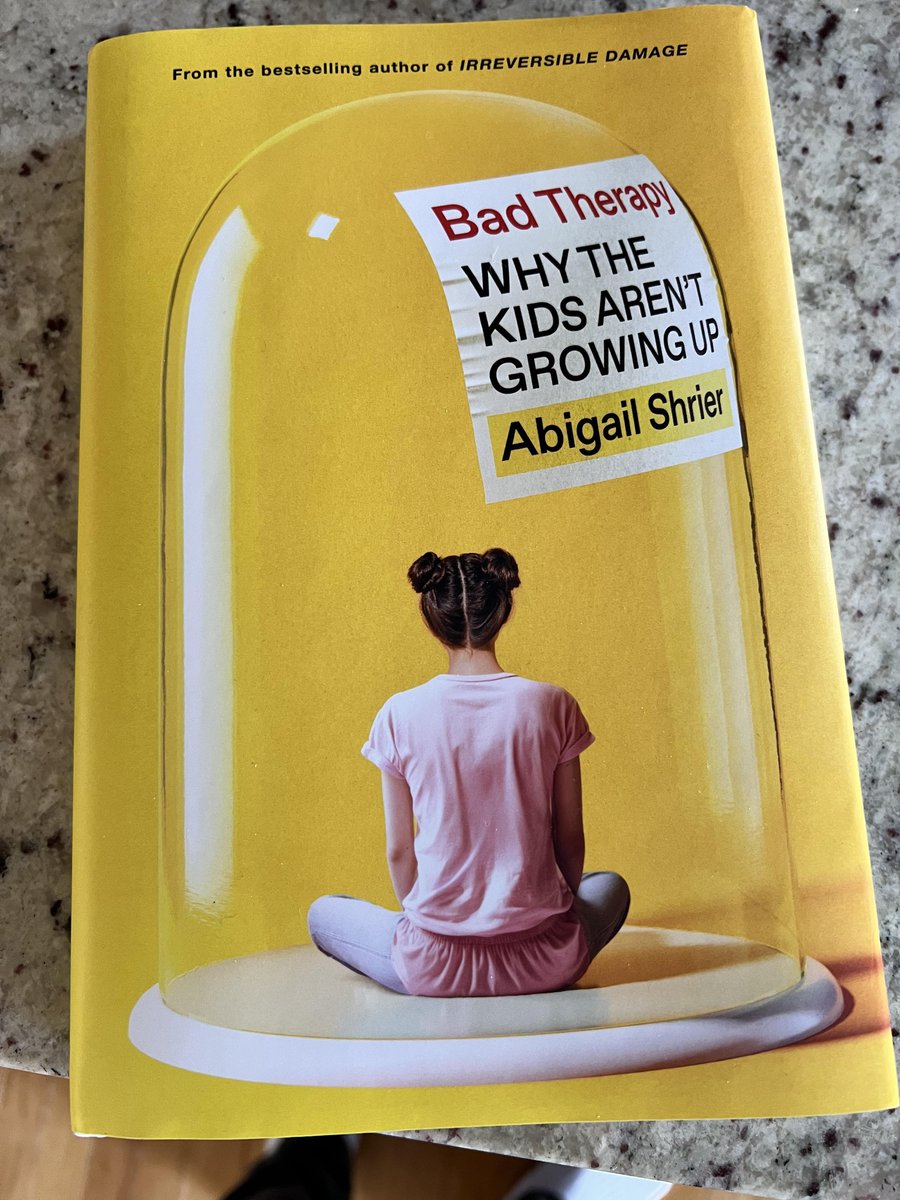
Just finished this book - Bad Therapy by @AbigailShrier
This is one of the most eye-opening books I've ever read. It's a must read for any parent, any teacher, and should be required reading for any school administrator as well.
The book dives into trying to figure out why kids are having so many mental health problems, when there are so many resources devoted to improving mental health outcomes.
Anxiety, depression, suicide, etc are all higher than they've ever been with kids, even though their lives are arguably better than ever before. It just doesn't make sense.
A few key takeaways from the book:
A constant attention on how kids are "feeling" or "thinking" is causing negative outcomes.
Constantly ruminating on your emotions and how you feel negatively impacts your mental health. If all you do is focus on your emotions, you are destined to be anxious or depressed.
We incessantly ask kids how they're feeling, if they're happy, how their mental health is, etc, and this is creating kids who think they're fragile instead of resilient.
Trying to solve every problem for kids has caused a generation who can't do anything for themselves.
We (Gen X) were told to "suck it up" or "you'll live" or "rub some dirt on it" all the time. Many of us came to the conclusion this is "bad parenting" because our feelings were neglected, and we vowed not to do this to our own children.
Because of that, kids immediately over-dramatize everything that happens to them, making mountains out of molehills, and thinking the world must revolve around their emotions and feelings.
You develop confidence and strong mental health by doing things, not by thinking or via therapy.
You can't think your way out of anxiety. You don't gain confidence by analysis of your thoughts or mental health issues.
You gain confidence and eliminate anxiety by doing gradually more difficult tasks, excelling at them, and realizing you are a competent, capable person.
The non-stop attention therapy gives to these small, common emotions we all feel blows them out of proportion to their seriousness (not talking about genuine disorders here, just normal anxieties that millions of people go to therapy to try to avoid).
One of the best ways to decrease your happiness is to chase it.
Our society constantly tells kids they should be "happy" and asks them if they are.
Happiness isn't a state you should be in 24/7. That's not realistic. Joy and bliss aren't permanent states - they are fleeting.
Contentment, stillness, and being even-keeled are much better goals to aim for mentally.
The happiest, most well adjusted kids come from families with loving parents that have strict rules for the household.
This one really set off the confirmation bias in me... I feel really blessed we have 2 well adjusted middle school kids who do great in school, are very respectful and well mannered, and we barely even need to parent them.
But for years, we were very strict with them. Bedtimes, family rules, how we do things, etc. The in-laws and lots of friends thought we were totalitarian.
In reality, we just had high standards. And it's really paying off right now. I found it really interesting that strict rules equals happy kids. Makes sense, though, as kids need to know what their boundaries are.
Constantly surveying school-age kids about their mental health causes more issues than it solves.
Mental health resources is big money. Districts need to validate all the resources allocated towards mental health, and they often do that via surveys.
Asking kids non-stop questions like:
- Have you thought about self harm?
- Have you thought about suicide?
- Have you been so anxious you can't get out of bed?
Etc, etc puts into their heads the idea that themselves, or many of their peers are broken and cannot function properly in the real world.
It normalizes situations that would be incredibly rare at any other time in history.
There's a lot of other takeaways, too, but I'll stop there.
It's a fantastic book. Go pick it up and read it. This isn't an affiliate thing or a promotion thing at all. I just really enjoyed it, and it will further shape the way I parent moving forward.
Did you know?
There's an Interplanetary Transport Network in our Solar System, used to launch spacecraft from Earth and send them to the desired destination.
It is a collection of gravitationally determined pathways through the Solar System that require very little energy for an object to follow.
The ITN makes particular use of Lagrange points as locations where trajectories through space can be redirected using little or no energy.
Interplanetary transfer orbits are solutions to the gravitational three-body problem.
The ITN is based around a series of orbital paths predicted by chaos theory and the restricted three-body problem leading to and from the orbits around the Lagrange points – points in space where the gravity between various bodies balances with the centrifugal force of an object there.
Notable spacecraft that used the ITN were the ISEE-3, launched in 1978, the Hiten lunar mission in 1991, NASA's 2001–2003 Genesis mission, and the Chinese spacecraft Chang'e 2.
[image: stylized depiction of the ITN]