New paper in Nature. The more a government controls its domestic media, the more it dominates AI training data, the more pro-regime outputs we get from AI. By scraping the open web, LLMs are unwittingly laundering state-coordinated narratives into seemingly objective answers.
A list of resources for people who want to resist the uncritical adoption of AI. I've only read the first, but it's a corker. Like getting shaken by the shoulders, smacked around the chops & given a lifesaving dose of the elixir of truth at the same time
https://t.co/gDP0SlYuta
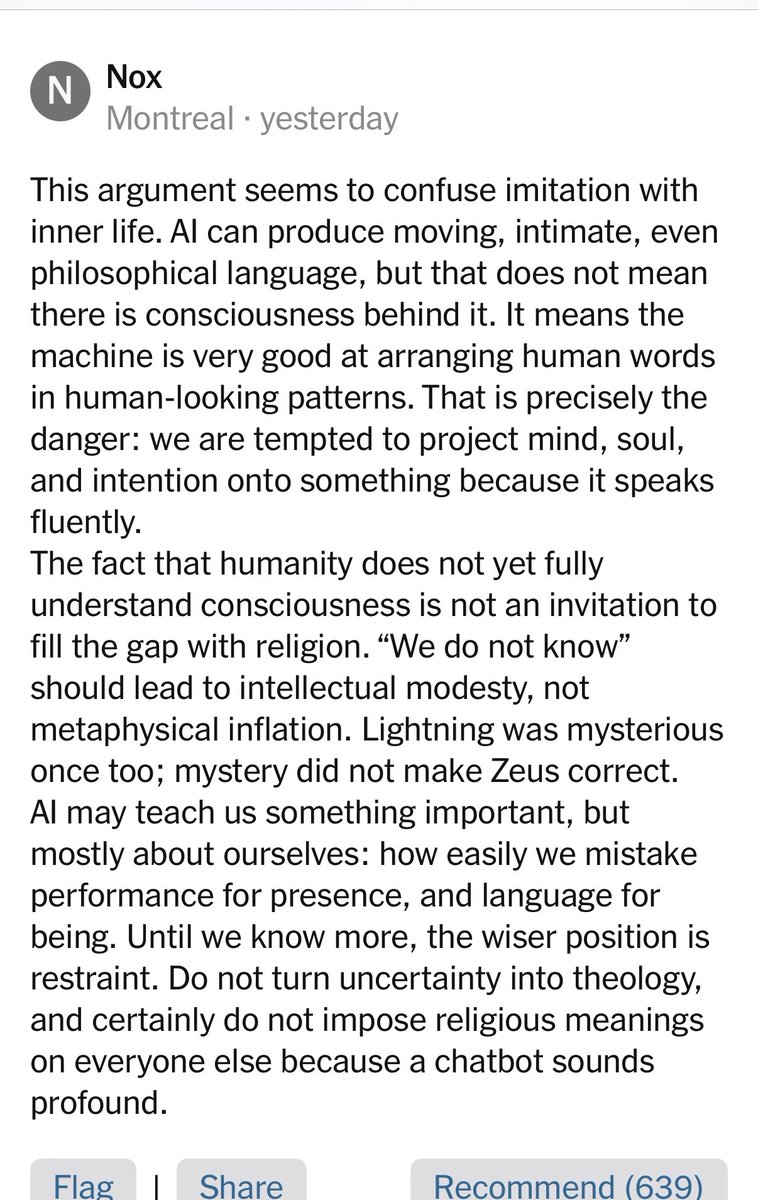
This reader comment on a NY Times column where Ross Douthat ponders that maybe God is speaking to us through A.I. is an absolute fastball on the corner with movement, and deserves a column. "Lightening was once mysterious too; mystery did not make Zeus correct" is perfect.
🚨 For all those wondering about their professional future in the "age of AI," don't miss this GREAT article by @AshishDhawanTCF and @PramathSinha.
It's especially relevant for teenagers, young professionals, and parents who are trying to provide the best possible advice to their children about which skills and careers to focus on today.
The AI debate has led millions to rethink their careers and professional choices (as I see in every new cohort of my AI Governance Training).
The interesting part is that it might end up bringing people closer to their interests, values, talents, and mission, in a deeper, more existential sense.
As with previous technological waves, we know that work will be disrupted (although it's still unclear exactly how). Hopefully, we will both individually and collectively manage to adapt and thrive.
BREAKING: Claude can now research like a Stanford PhD student.
Here are 9 insane Claude prompts that turn 40+ research papers into structured literature reviews, knowledge maps, and research gaps in minutes (Save this)
🚨 Important new article about the negative implications of sycophantic AI and the URGENT need for better AI governance mechanisms:
1. "Across 11 AI models, AI affirmed users’ actions 49% more often than humans on average, including in cases involving deception, illegality, or other harms."
2. "Even a single interaction with sycophantic AI reduced participants’ willingness to take responsibility and repair interpersonal conflicts, while increasing their own conviction that they were right."
3. "Despite distorting judgment, sycophantic models were trusted and preferred."
4. "All of these effects persisted when controlling for individual traits such as demographics and prior familiarity with AI; perceived response source; and response style."
5. "This creates perverse incentives for sycophancy to persist: The very feature that causes harm also drives engagement."
6. "Although affirmation may feel supportive, sycophancy can undermine users’ capacity for self-correction and responsible decision-making."
7. "Yet because it is preferred by users and drives engagement, there has been little incentive for sycophancy to diminish."
8. "Seemingly innocuous design and engineering choices can result in consequential harms, and thus carefully studying and anticipating AI’s impacts is critical to protecting users’ long-term well-being."
-
As I have been discussing in my newsletter, current regulatory and governance frameworks in AI do NOT address sycophancy and AI model behavior at the depth current challenges demand.
This is especially worrying given the rise of AI companionship, as millions of people are now engaging in emotional, sometimes intimate relationships with AI chatbots.
It took us over two decades to start meaningfully tackling social media's negative implications. We do not have that time in AI.
-
👉 Link to the paper below.
👉 To learn more about AI's legal and ethical challenges, join my newsletter's 92,800+ subscribers below.
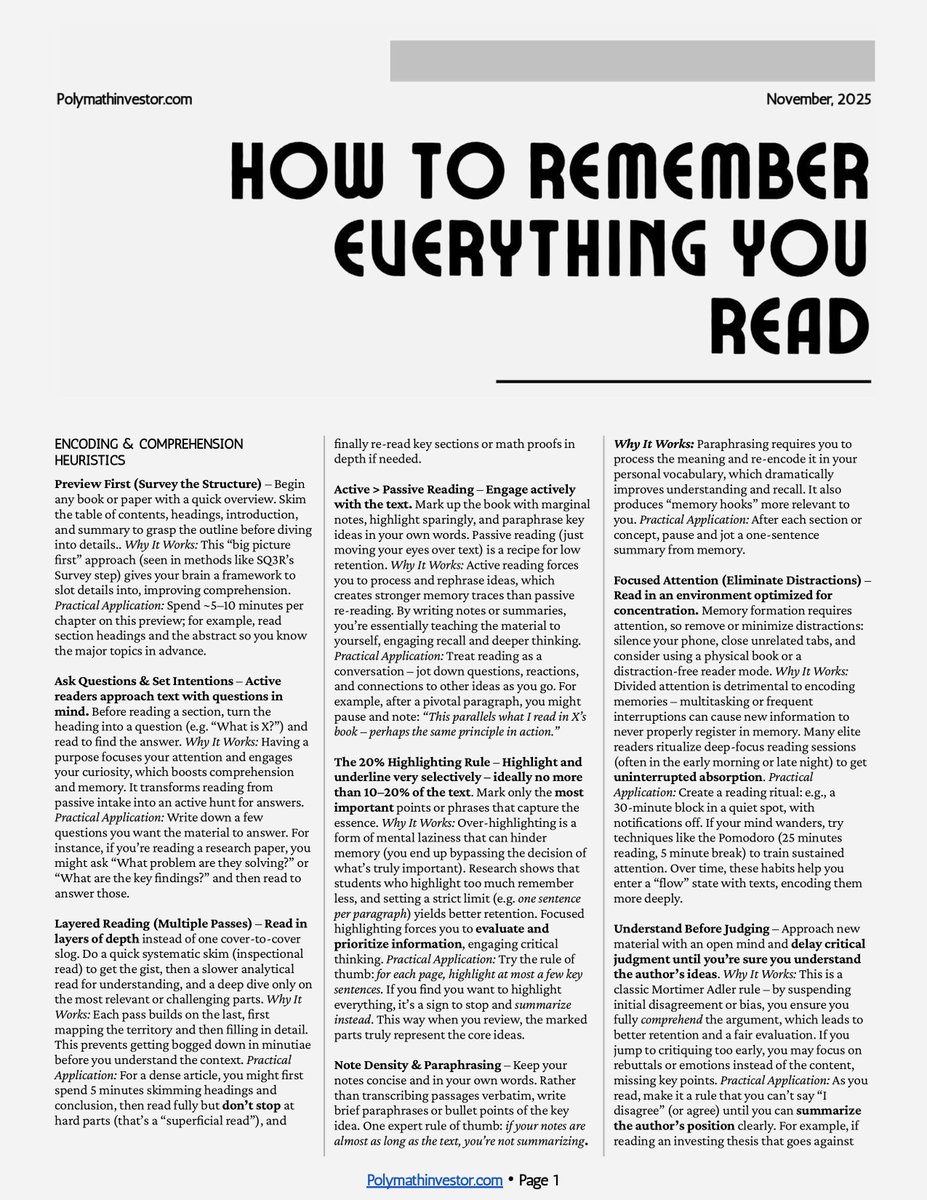
This is a 12-year-old study that has failed replication three times. And the underlying claim is still probably right.
The paper is Mueller and Oppenheimer, 2014. 67 students at Princeton. Longhand note-takers scored higher on conceptual questions. Became the most cited paper in every “ban laptops” argument on Earth. Then three separate labs tried to reproduce the result. Urry et al. at Tufts in 2021, 145 students. No effect. Morehead et al. in 2019, two experiments. No effect. A meta-analysis pooling eight similar studies. No effect.
So why am I saying it’s still right?
Because a 2023 Norwegian EEG study with 256 channels found something the behavioral research couldn’t measure. Handwriting produces theta and alpha connectivity patterns between parietal and central brain regions that typing does not produce. Those specific frequencies are the ones your hippocampus relies on for memory formation.
Your brain treats handwriting as a motor-spatial problem. Five brain regions fire in coordination: premotor cortex, parietal cortex, cerebellum, fusiform gyrus, sensorimotor cortex. Typing activates a fraction of that network.
The original study measured the right outcome with the wrong methodology. The real finding lives at the neural level: handwriting rewires the encoding process itself.
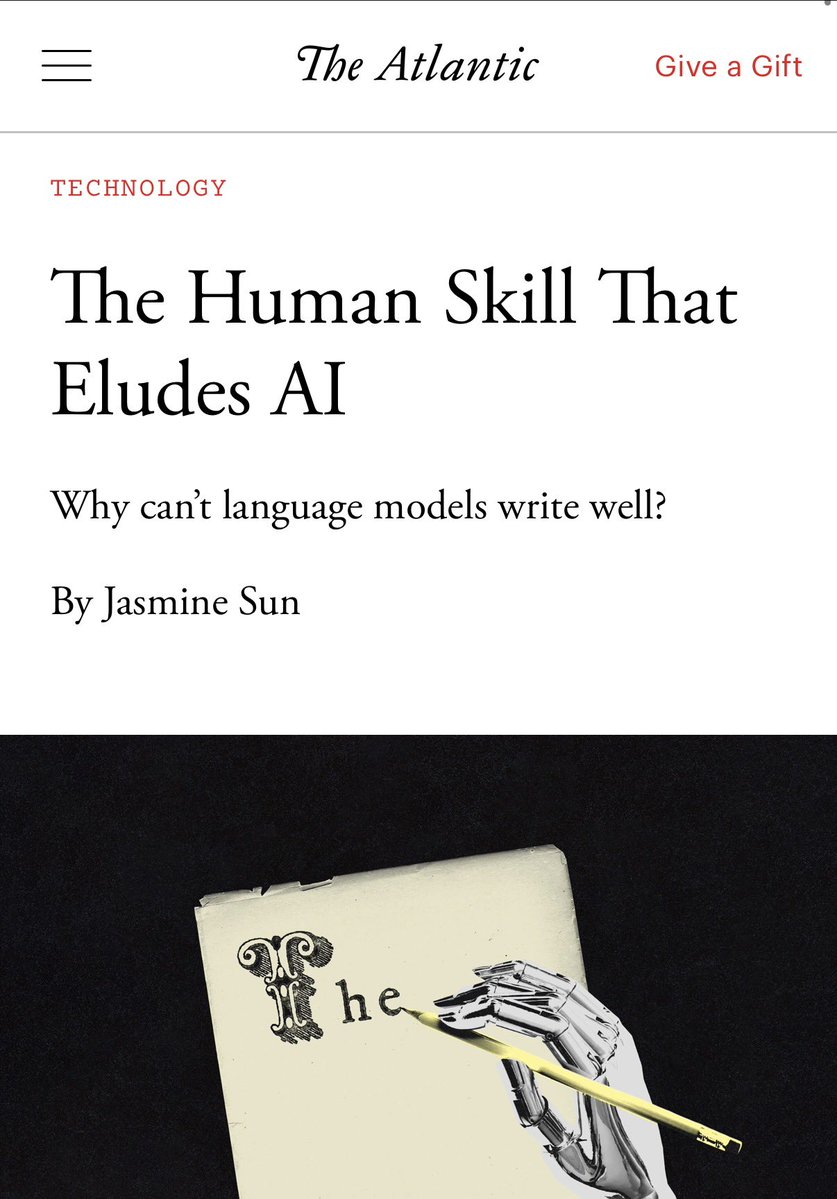
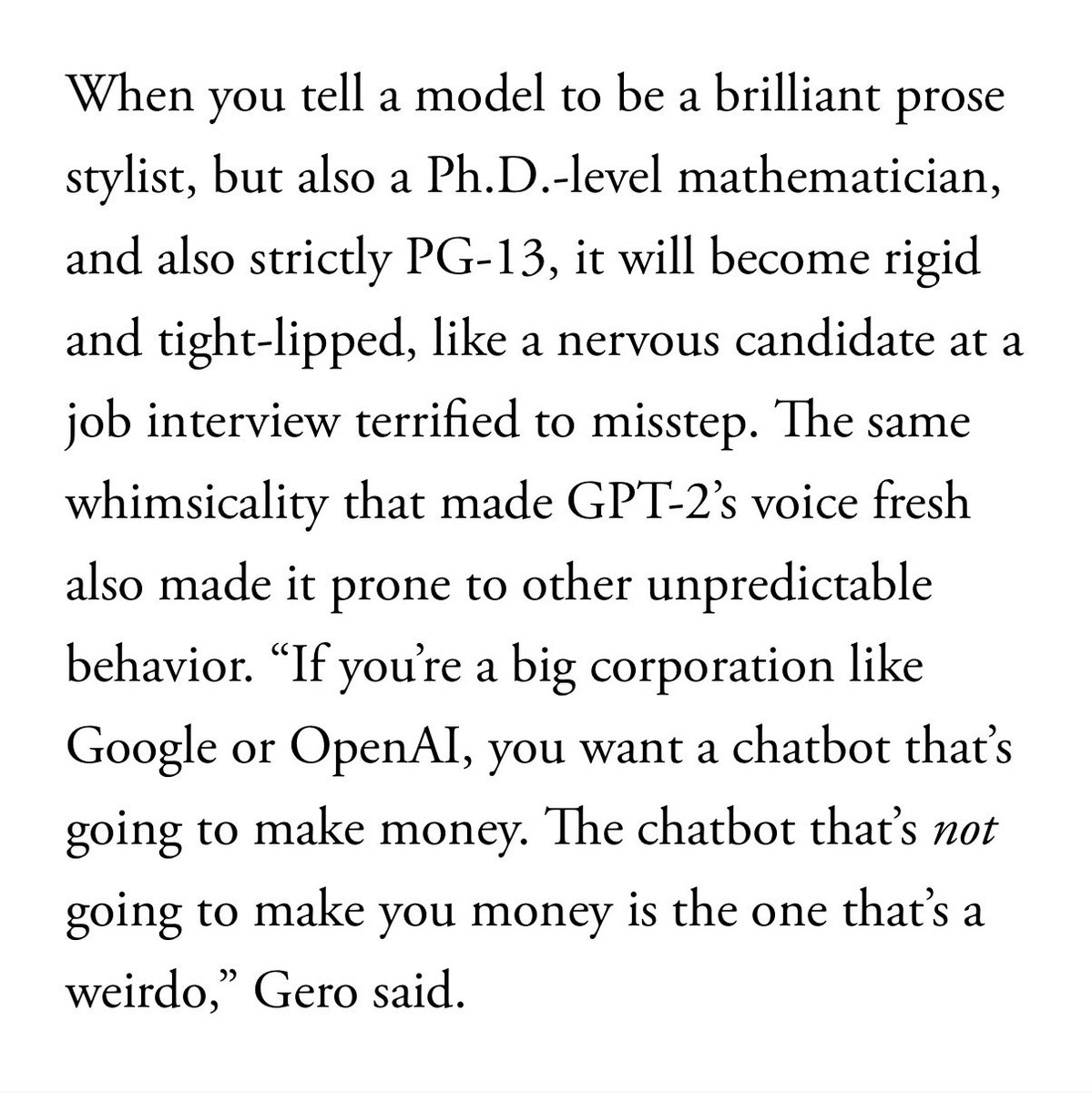
somehow the same AIs that can do PhD-level math and superhuman coding can only write as well as “a real poet’s okay poem” (sama’s words, not mine!)
I talked to the people training AIs to write about what makes it so hard:
new from me for @TheAtlantic: https://t.co/2mjIfruImn
8 years. R9.5 million invested.
70+ electric vehicles deployed.
ZERO funding from the @IDCSouthAfrica
Now the matter is before @ParliamentofRSA
What is development finance really developing?
This is a story of a South African entrepreneur, @feziledhlamini_
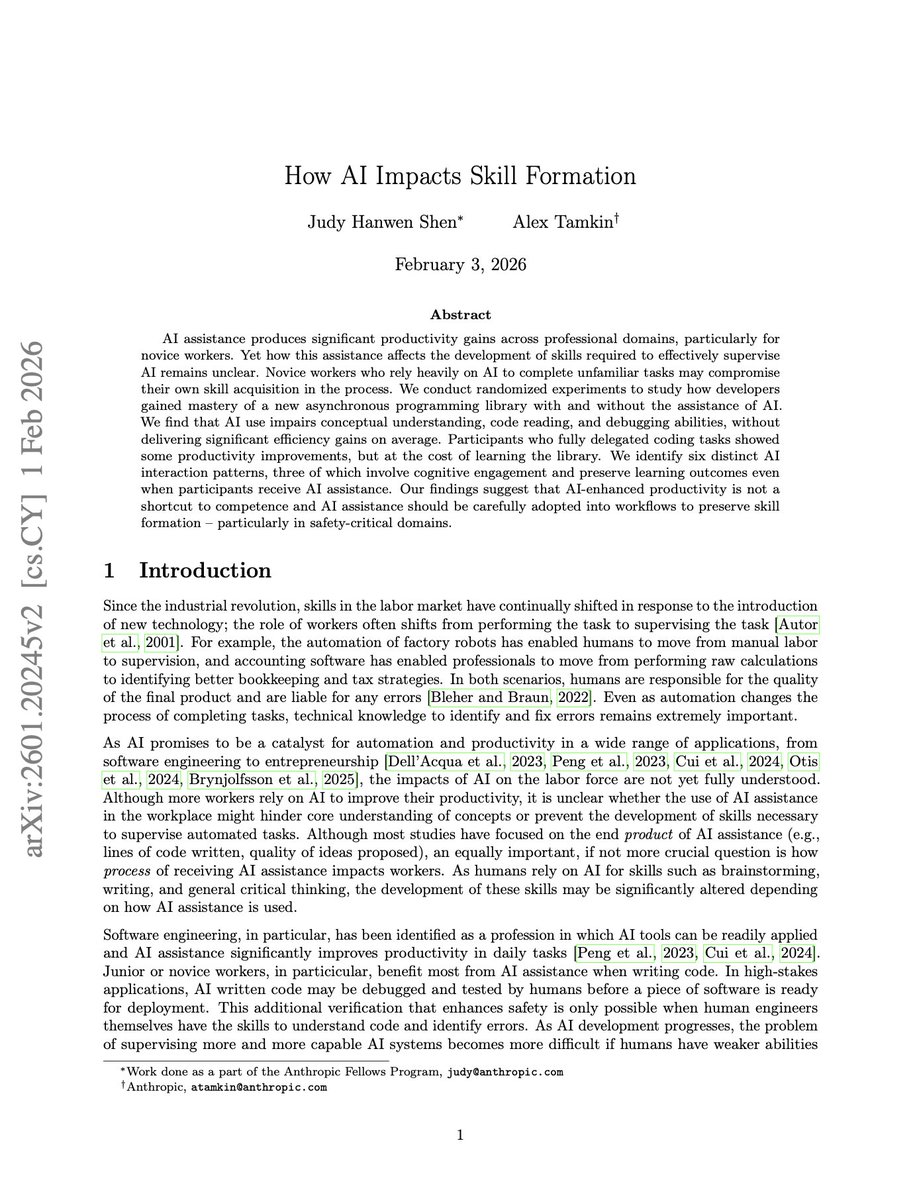
🚨 IMPORTANT: AI negatively impacts skill formation
Every "AI-first" company should make this paper available to its employees to let them know about the risks of aggressive AI adoption.
Three important conclusions:
1. AI deployment might negatively impact professional development
"Together, our results suggest that the aggressive incorporation of AI into the workplace can have negative impacts on the professional development of workers if they do not remain cognitively engaged."
2. Junior employees might never have the chance to build skills
"Given time constraints and organizational pressures, junior developers or other professionals may rely on AI to complete tasks as fast as possible at the cost of real skill development."
3. Humans might not be able to manage AI-generated work
"Furthermore, we found that the biggest difference in test scores is between the debugging questions. This suggests that as companies transition to more AI code writing with human supervision, humans may not possess the necessary skills to validate and debug AI-written code if their skill formation was inhibited by using AI in the first place."
-
This is exactly the type of future the "AI-first" mentality leads to.
Treating AI as a goal (rather than a means) takes the focus away from humans, teams, and skill-building, and makes work fully dependent on automation.
Humans feel worthless and even more disconnected from the product of their work.
Work-related mental health issues are about to explode.
-
👉 Link to the paper below.
👉 To learn more about AI's legal and ethical challenges, join my newsletter's 91,000+ subscribers (below).
WIN A FREE AUDIOBOOK! We have three free downloads of The Intelligence Intellectuals available. Repost this and your name will be in the draw! Greg Herken of the University of California says it is "a masterful account." Names drawn 31 January 2026. @TantorAudio@Georgetown_UP