As the market opens higher this morning, it's important to remain disciplined and avoid chasing an early rally—especially following a significant down day and a weak close on Friday.
One of the most common mistakes investors make is assuming that the first bounce marks the start of a sustainable advance. In many cases, the initial rally is simply an oversold reaction or what traders refer to as a "dead cat bounce."
Historically, after a sharp decline, I prefer to give the market time—often until midweek or even the end of the week—to see whether buyers are truly stepping in with conviction. Very often, after the first reaction higher, the market resumes its downtrend, undercuts the recent lows, and additional damage occurs.
Patience and selectivity are critical. Let the market reveal its true character before becoming overly aggressive. Focus on preserving capital, managing risk, and allowing the price action to confirm whether the move is the beginning of something meaningful or merely a temporary bounce within a larger decline. https://t.co/JXzFFTmMtn
I was stopped out of $MU on 3/9 at 358.
I bought it back (new buy signal) 4/8 at 410, it is +134% since then.
Not all positions are going to work out.
Stops are going to get hit, there will be (manageable) losses and drawdowns at times.
We can try to cap risk through stop placement and position sizing - but the upside potential is often unlimited or at least many multiples of the stop.
I have two high potential upside buys going in the wrong direction now.
If the stops get hit, I'll close them out and reevaluate.
Stops are a cost of doing business, but they will keep you intact to prevent small losses from turning into big losses.
1st year of Trading
Blew the account.
No risk management.
Overtrading every breakout.
2nd year of Trading
Failed again.
Revenge trading.
No stop-loss discipline.
Chasing signals from Telegram gurus.
3rd year of Trading
Still failing.
Ignored market structure.
Didn’t understand liquidity & manipulation.
Emotional entries, emotional exits.
4th year of Trading
Studied price action.
Learned support & resistance.
Discovered supply & demand.
Backtested strategies.
Still inconsistent.
5th year of Trading
Understood risk-to-reward.
Focused on capital preservation.
Mastered patience — waited like a lion for clean breakouts.
Started journaling trades.
Finally profitable.
6th year of Trading
Built a system.
Respected psychology.
Controlled greed & fear.
Compounded small wins.
7th year of Trading
Started sharing knowledge.
Built a brand.
Started selling courses.
And became a Mentor.
We often hear about separating signal from noise.
Signal is what to buy and when, what to sell and when.
To me, ~90% of everything else (opinions, random stats), falls into the noise category.
I learned 15+ years ago that you don't have to know what the market is going to do to know what you are going to do.
I assume any or all of my positions can get stopped out and that pullbacks can happen at any time.
That's how I size my positions, stops and risk, but also how I don't get shaken out of triple digit moves in 5-10% pullbacks.
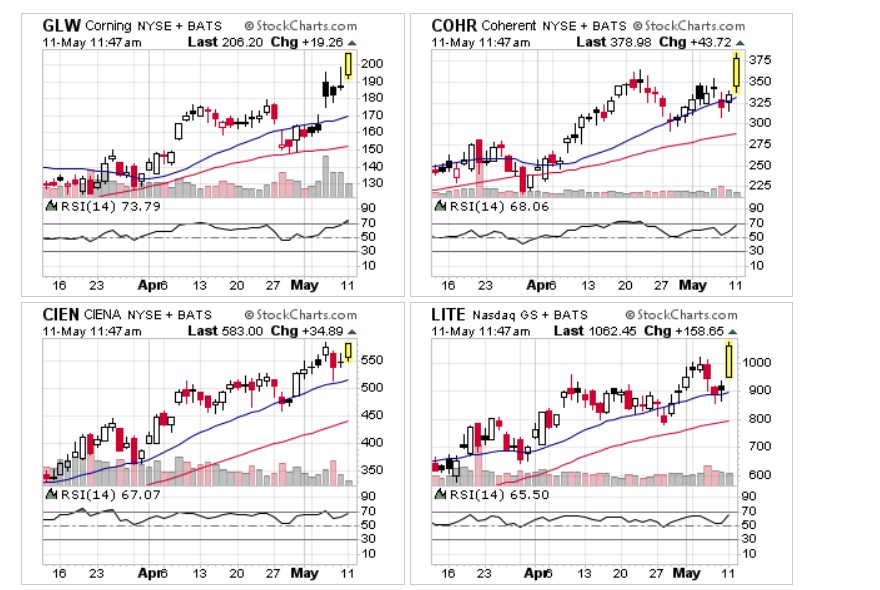
I have a lot of high octane stocks that have led to a strong start for 2026 $CIEN $CRWD $GLW $INTC $MU $SNDK $WDC +++.
I also know that stocks that drastically beat the market will pullback sharply when they do.
I don't think that I can sell the near-term highs and then buy back at the right time, so I scale some gains on the way up, hold my uptrends and build high volatility into my daily expectations.
Price is the truth.
When you open your brokerage account, your P/L is settled based on only one thing - price.
Not volume, or PE, or sentiment, or opinions, or your politics, or random 1987 overlays
When we accept that price is the only thing that matters, things become clear.
@1ChartMaster Study the people you follow. Learn from the people you follow. See what they see and think how they think. Reflect them as perfectly as you can.
If you think blindly following someone into trades is going to make you a trader you have another thing coming. You need to be able to trust what you are seeing and react to your own intuitions if you are ever going to make it in this game. Don't be lazy, put in the work.
Watch the stocks that are the first to hit new highs while the broader market is still correcting. Those are your "tennis balls" and usually become the leaders of the next market leg up. 🎾
THE REAL LESSON BEHIND MINERVINI’S TURNING POINT
Minervini isn’t talking about discipline as a motivational slogan.
He’s talking about the moment a trader stops behaving like a human and starts behaving like a professional.
“Discipline is doing what is hard instead of what feels good.”
That one line explains why he almost never had a down year again.
Here’s the deeper logic:
- What feels good is holding losers, hoping they come back
- What feels good is taking profits too early, afraid they’ll disappear
- What feels good is avoiding stops, pretending the market will forgive you
- What feels good is trading for excitement, not for results
But what is hard?
- Cutting a loss instantly
- Sitting in cash when nothing is working
- Letting a winner run without touching it
- Following rules even when your emotions scream otherwise
- Doing nothing when the market demands nothing
Minervini’s turning point wasn’t a strategy.
It wasn’t a pattern.
It wasn’t a secret indicator.
It was the moment he chose discipline over dopamine.
And that’s why he stayed consistent for three decades.
Everyone wants a complex strategy.
This trader used 2 indicators
and made $321,480.
15 years in the market.
Early start. Real estate career.
Came back semi full-time in 2024.
No secret sauce.
5-minute chart.
10 SMA.
MACD.
That’s the system.
Break above 10 SMA + bullish MACD → Long.
Break below 10 SMA + bearish MACD → Short.
Scale out at 1–3%.
Let the last 25% run.
Move stop to entry or prior day low.
He trades liquid names.
SPY. QQQ. TSLA. META. COIN.
No earnings gambles.
No options.
No CNBC.
Big lessons:
• Size matters more than being right.
• Focus on a few tickers.
• Stop when you hit your weekly goal.
• If you’re off your game, step away.
• Ignore opinions. Follow price.
The difference?
He stopped tweaking.
Stopped chasing.
Stopped listening.
Same setup.
Over and over.
Consistency paid him.
Not complexity.
Bro I am quitting 9-5. I'll start Trading.
🧍🧍🧍🧍🧍🧍🧍🧍🧍🧍🧍
🧍🧍🧍🧍🧍🧍🧍🧍🧍🧍🧍
Trading is easy. Just buy low sell high.
🧍🧍🧍🧍🧍🧍🧍🧍🧍
🧍🧍🧍🧍🧍🧍🧍🧍🧍
No.., Its much harder than I expected.
🧍🧍🧍🧍🧍🧍🧍
🧍🧍🧍🧍🧍🧍
I've lost too much, I'm giving up.
🧍🧍🧍🧍🧍
We believed it,
We made it
🧍🧍
Welcome to the 1%
Successful traders practiced 3–5 years gaining 0$.
Pain.
Losses.
Mistakes.
Failures.
More pain.
After 3–5 years they just need few hours to gain thousands of $.
It’s not about luck.