🚀 Exclusive $U Trading Pairs for Robinhood Chain Assets on Binance Alpha 2.0 (CEX)
As the bridge and settlement asset, $U makes your trading flow seamless:
🔸Exclusive Pairs: Access top Robinhood Chain assets traded solely with $U.
🔸Instant Orders: Rapid execution for fast-paced trading.
🔸Limit Orders: Precision trading to take full control of your entry costs.
Check it out here⬇️
Key Points:
The Transition Gap: Security models cover static states (before or after migration)
Operational Risk: migrating live funds relies on manual procedures executed under schedule pressure.
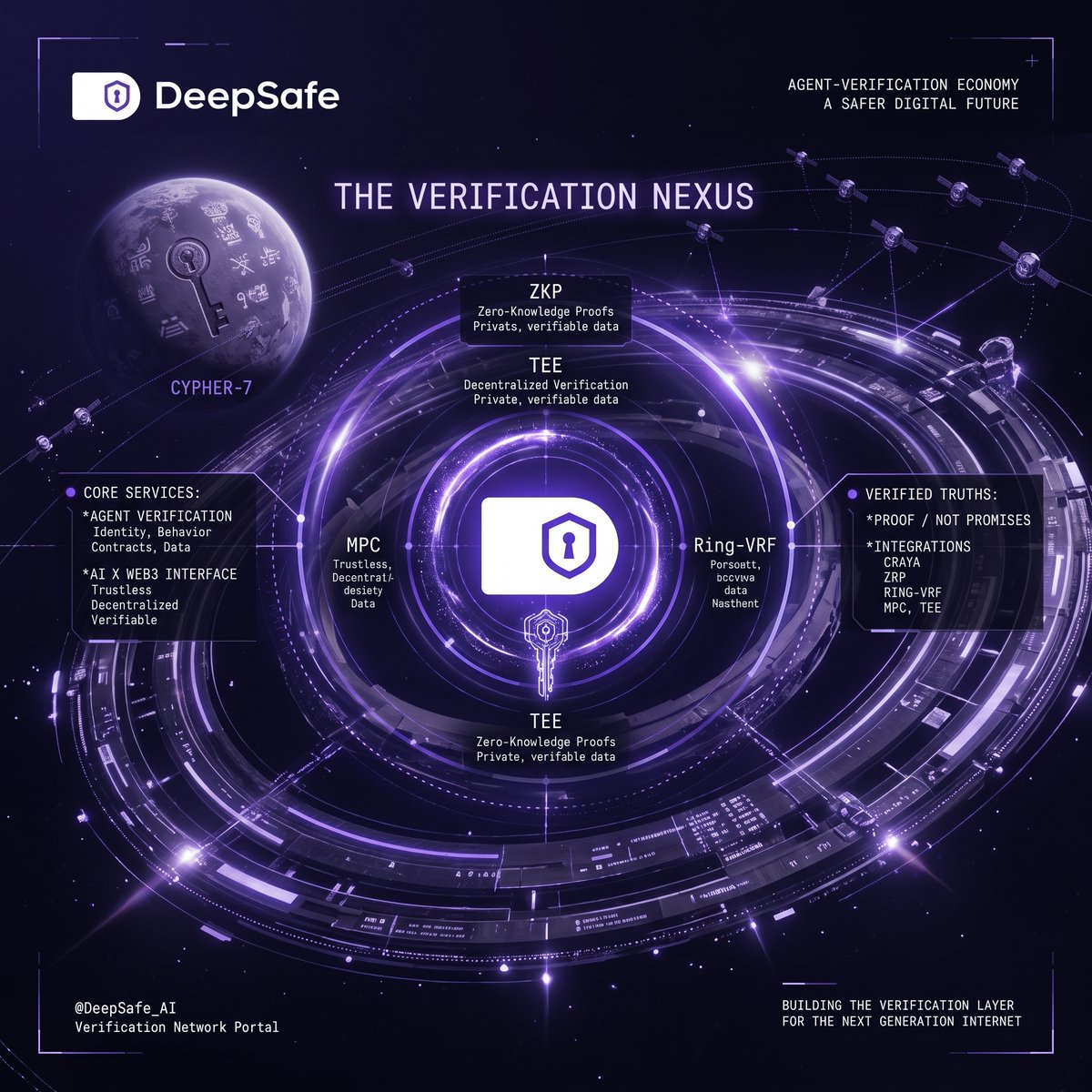
#DeepSafe@DeepSafe_AI
The real question isn’t whether verification works when everything is running.
It’s what happens when the verifier goes offline. Fail open or fail closed that choice should never be accidental.
A system that checks something ends up with an answer to what happens when the check cannot run.
Not when the check fails — when it is unavailable. The service is down, the endpoint times out, the attestation cannot be retrieved, the quorum cannot be assembled. The request is still there, and the system still has to decide what happens to it.
The two simplest answers are to let it through or to hold it. Real systems have more room than that — retry, queue, fall back to a weaker check, cap the amount, route it to a person — but each of those still resolves into proceeding or not, and each has its own behaviour when the fallback is unavailable too.
Both directions are defensible. A payments system that holds every transaction whenever a fraud check is unreachable has converted an availability problem into an outage. A vault that releases funds whenever its verifier is unreachable risks turning an availability problem into a withdrawal. Which cost is worse depends on what is being protected, and reasonable teams land in different places.
What is worth noticing is that the answer can exist without ever having been an explicit design decision.
The behaviour ends up wherever the error path happens to go. A timeout can return a permissive default. A general exception handler can let execution continue. A check added late can be wrapped in a conditional that skips it when a dependency is missing. The code may never contain a line reading "if verification is unavailable, proceed" — but that can still be exactly what it does, and it will do it just as readily when someone is making the checker unavailable on purpose.
This is why the choice is worth writing down before it is discovered. A system that fails open by decision has weighed the trade. A system that fails open by accident has the same behaviour and none of the reasoning, and it learns which one it is from an incident rather than from a design review.
For a verification layer the question is sharper, because an attacker may target its availability rather than defeat the check itself. If no result means no check, then the verifier does not have to be broken. It only has to be kept from answering.
CRVA changes the dependency rather than removing the question. The Agents that sign are selected at random from a larger population and rotate on a fixed cycle, and under threshold MPC a valid signature requires enough participants to contribute, so no single participant can produce one alone. That reduces reliance on any one verifier. It does not guarantee that a result always arrives, and it does not settle what the surrounding system does when one does not. That stays with whoever integrates the check — which is the same decision this whole piece is about.
Every system has an answer to this. The question is whether anyone chose it.
#DeepSafe #CRVA #Web3Security
Joining the waitlist just became a million times more rewarding. 💰
We're giving away $1,000,000 worth of accounts ONLY to waitlist signups.
To be considered:
1. Bookmark, comment on, and reshare this post
2. Join the waitlist at https://t.co/Kqf8Rkn4VG
Yes, that easy. Multiple winners drawn when we launch. Including...you? 👀
AI agents are becoming more powerful
As AI and Web3 evolve, we need infrastructure that can verify what agents do and actions can be trusted
DeepSafe is building toward a decentralized verification layer for a more secure and verifiable AI × Web3 future🔐
#DeepSafe@DeepSafe_AI
On September 5, Core DAO published its post-mortem on the reward-accounting exploit that ran from August 28 to 31. Roughly 255M CORE of rewards were issued ahead of schedule.
The cap held. In Core's words, the exploit "did not create any CORE beyond the protocol's limits; the 2.1B maximum supply was never violated." What it did was accelerate rewards the emission schedule would otherwise have released later. What broke was when.
That makes the damage an unusual shape. No user or staking account was drained — Core states that no user or staker funds were lost and that delegated stake was never at risk. What existed instead was surplus, sitting in balances, and it arrived through the ordinary path: the extra rewards "appeared both in attacker-controlled addresses and, unintentionally, in the reward addresses of honest validators who simply received an inflated payout they did not cause."
That made the on-chain reconciliation an arithmetic problem before it was a balance-editing problem. Before any affected balance could be corrected, Core needed a rule for what that balance should have been at the upgrade block.
It used two. Attacker-controlled reward pools were set to zero. For affected honest validators, it defined a fair-earnings floor — the pre-incident balance plus three rounds of that validator's own normal reward — left balances at or below it untouched, and removed only the excess above. Together the reconciliation took 186,153,491 CORE out of supply by direct state reduction. A further ~69M had been moved before the upgrade and sits outside what an on-chain reconciliation can reach; Core says it is pursuing that with law enforcement.
Core says the reconciliation can be checked independently against chain state at the upgrade block, and that the reward paths were subsequently reviewed by Halborn. That part matters as much as the fix. A correction that affected users and independent observers cannot verify is only a second assertion about the balances.
A supply cap is a promise about how much will ever exist. It says nothing about how much should exist yet. Restoring the second one requires knowing a number the cap never had to track.
Sources:
https://t.co/TMhZdwRHaQ
#DeepSafe #CRVA #Web3Security
The Core incident is a good reminder that a supply cap alone isn’t enough.
You can stay within the maximum supply and still have the wrong amount in circulation at the wrong time. That’s where transparent on-chain accounting becomes critical.
On September 5, Core DAO published its post-mortem on the reward-accounting exploit that ran from August 28 to 31. Roughly 255M CORE of rewards were issued ahead of schedule.
The cap held. In Core's words, the exploit "did not create any CORE beyond the protocol's limits; the 2.1B maximum supply was never violated." What it did was accelerate rewards the emission schedule would otherwise have released later. What broke was when.
That makes the damage an unusual shape. No user or staking account was drained — Core states that no user or staker funds were lost and that delegated stake was never at risk. What existed instead was surplus, sitting in balances, and it arrived through the ordinary path: the extra rewards "appeared both in attacker-controlled addresses and, unintentionally, in the reward addresses of honest validators who simply received an inflated payout they did not cause."
That made the on-chain reconciliation an arithmetic problem before it was a balance-editing problem. Before any affected balance could be corrected, Core needed a rule for what that balance should have been at the upgrade block.
It used two. Attacker-controlled reward pools were set to zero. For affected honest validators, it defined a fair-earnings floor — the pre-incident balance plus three rounds of that validator's own normal reward — left balances at or below it untouched, and removed only the excess above. Together the reconciliation took 186,153,491 CORE out of supply by direct state reduction. A further ~69M had been moved before the upgrade and sits outside what an on-chain reconciliation can reach; Core says it is pursuing that with law enforcement.
Core says the reconciliation can be checked independently against chain state at the upgrade block, and that the reward paths were subsequently reviewed by Halborn. That part matters as much as the fix. A correction that affected users and independent observers cannot verify is only a second assertion about the balances.
A supply cap is a promise about how much will ever exist. It says nothing about how much should exist yet. Restoring the second one requires knowing a number the cap never had to track.
Sources:
https://t.co/TMhZdwRHaQ
#DeepSafe #CRVA #Web3Security
$4AI launch is ready!
🕙 10:00 UTC today
⛓️ Robinhood Chain
🚀 @ponsdotfamily
CA only from this account.
🎁 $4AI Airdrop
Like + RT this post & Drop your wallet
New round, same as every day: $1 a ticket, 99 tickets, one draw, settled by
contract.
Miss today's? There's another tomorrow.
That's the whole point of a 24-hour cycle.
https://t.co/4iXtKG7jpJ
BREAKING: De¹ has received investment from @YZiLabs.
This is the start of establishing the agentic on-chain future in @BNBCHAIN ecosystem.
Together with @YZiLabs, we are defining how intelligence should meet live markets.
From ZERO to DE ONE.
We just wrapped up a great AMA with @cas_abbe.
We discussed what we’re building at Multyr and how we think about DeFi capital allocation.
We covered the protocol architecture, non-custodial vaults, risk and liquidity constraints, and how rule-based allocation can work across eligible strategies.
Thanks to everyone who joined and asked questions.
If you missed it, the full AMA recording is here 👇