How do individual animals and animal collectives process and evaluate sensory information to give rise to behavior? We are investigating this and much more.
New preprint from the lab!
We built an atlas of functional ensembles across the zebrafish hindbrain, linking whole-hindbrain activity to behavior, structural organization, and molecular features.
A few highlights below 🧵
https://t.co/qN3eYlLAsQ
Beyond the tail.
The tail captures only part of hindbrain motor activity.
Recording the eyes, fins and mouth alongside the tail let us see activity linked to these movements too — including fin- and mouth-related activity when the tail was still.
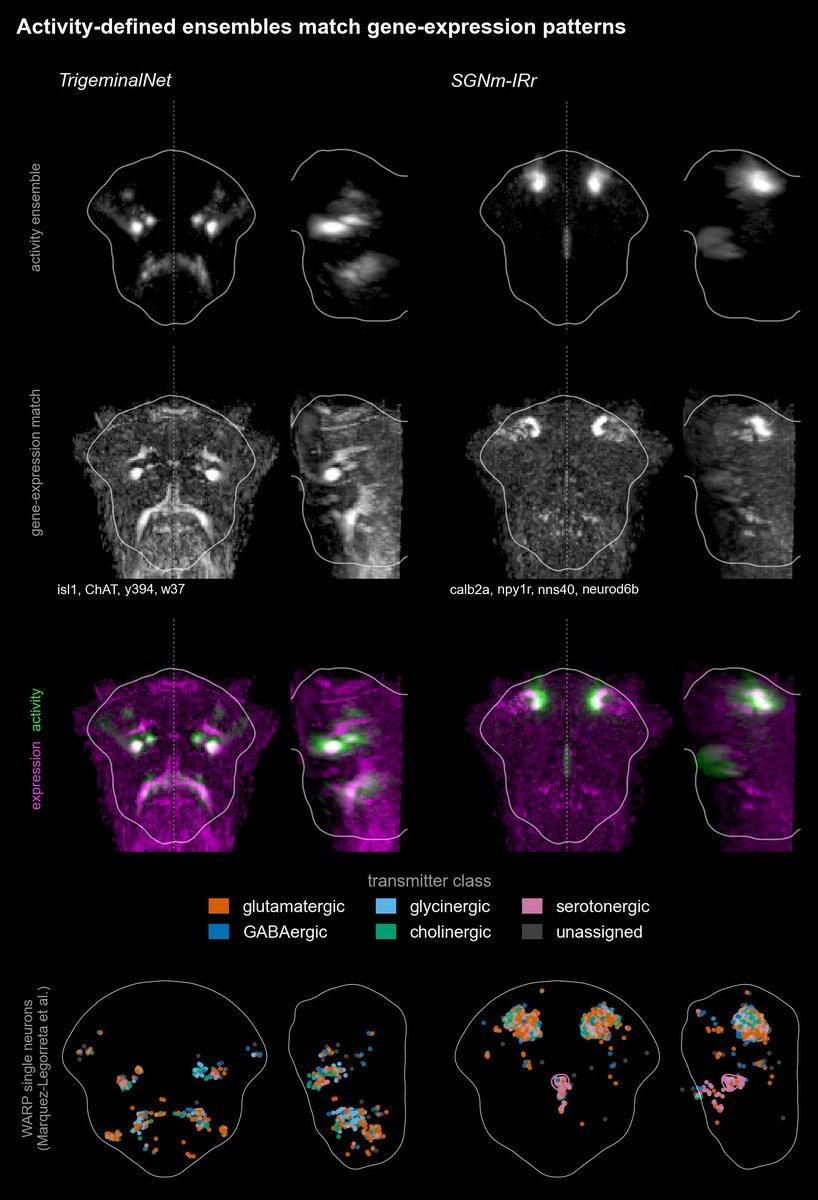
Expression matching.
We can also ask whether the spatial organization of an activity-defined ensemble has a counterpart in gene-expression data. For several ensembles, matching them against expression patterns points to striking candidate molecular identities.
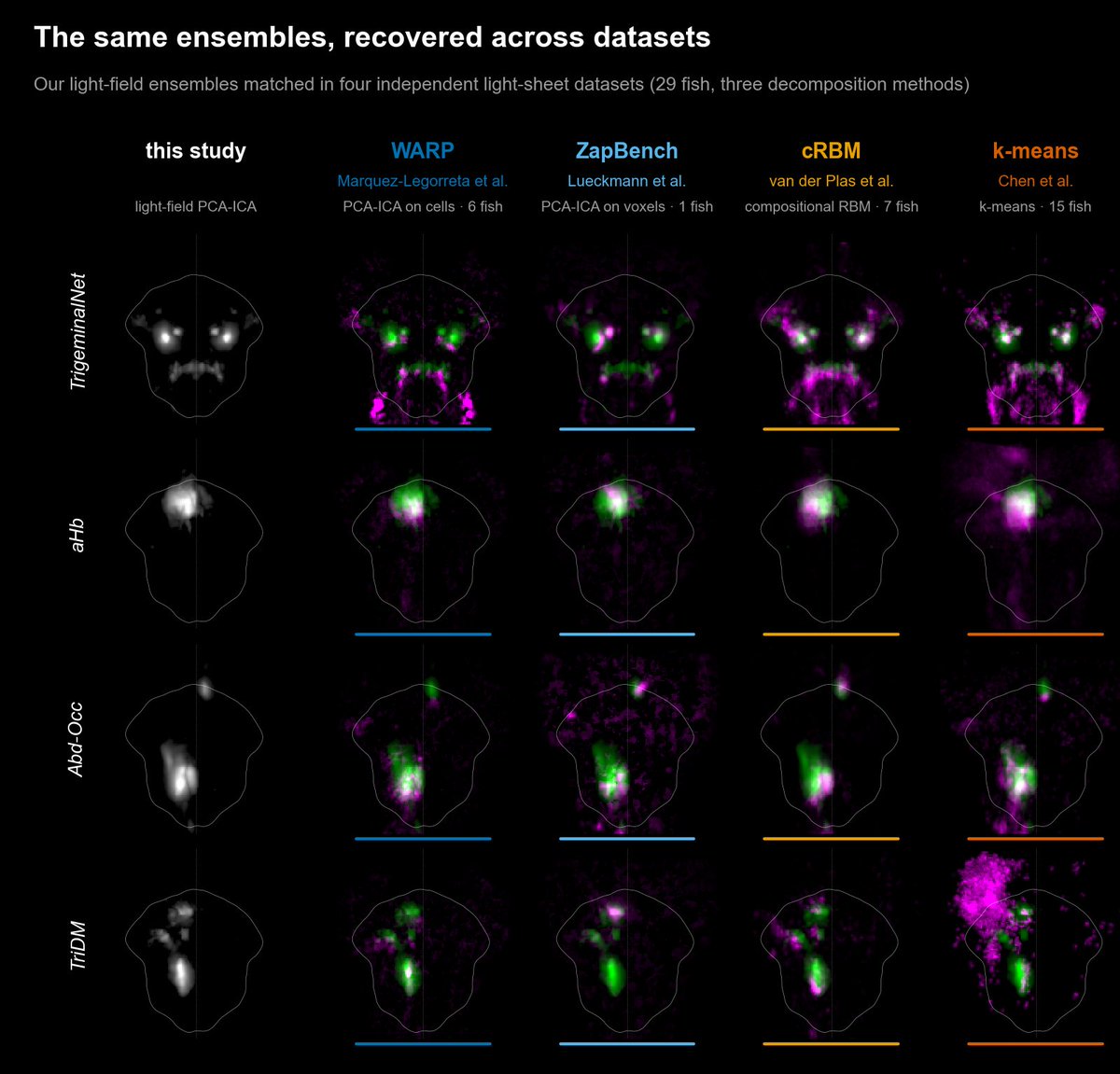
Across datasets.
The same functional ensembles reappear across independent datasets, with remarkably consistent spatial organization. This gives us a common reference for linking activity across experiments and connecting it to structural and molecular datasets.
Functional ensembles.
From these recordings, we can extract reproducible functional ensembles distributed throughout the hindbrain. (Movie idea: thx Alice Wang!)
Whole-hindbrain activity.
One of our favorite things about this dataset: we can watch activity across essentially the entire zebrafish hindbrain while the animal behaves in a virtual-reality environment.
🚨 Four new positions for postdoctoral research available at our @zukunftskolleg in beautiful Konstanz! If you are interested in exploring collective behaviour at the interface of theory and experiment, then consider applying!
⚠️ Deadline October 12
https://t.co/gUYyJOyXWQ
Thanks to the entire Bahl lab for discussions and comments on the manuscript, @icouzin and @vishuguttal, and the fish facility for help with maintenance and raising fish. (7/7)
The animal is the same. The stimulus is identical. Yet the behaviour varies. Why? In our new study, we explore the sources of this behavioural variability under fully controlled conditions, using larval zebrafish performing the optomotor response. (1/7)
https://t.co/FMHvLkIECy
We show opposing sensory/response history effects in a non-cortical animal during an innate task, suggesting this may be more fundamental than previously thought. The optically accessible larval zebrafish brain also enables us to next search for neural correlates. (6/7)
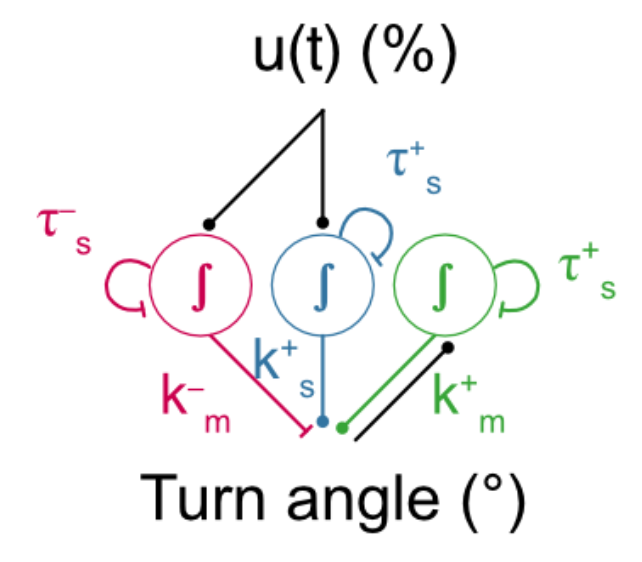
All of this is captured by a simple deterministic model, showing that a substantial share of behavioural variability can be attributed to history-dependence alone. (5/7)
Repetition slowly builds over the course of the experiment, increasing the number of incorrect trials — where fish move opposite to the direction of the stimulus. (4/7)
Surprisingly, the two histories pull in opposite directions. Sensory history is repulsive, promoting response alternation. Response history is attractive, promoting repetition. This pattern has been observed in humans and rodents as well. (3/7)
Combining a classical psychophysics approach with control-theoretic modeling, we found evidence for hysteresis, where the current response is shaped by previous stimuli (sensory history) and previous responses (motor or response history). (2/7)
We thank our collaborators for their guidance and our funding agencies for their support, as well as all colleagues whose feedback shaped this work. If this resonates with your interests, feel free to share and comment! @MPI_animalbehav@Cbehav@UniKonstanz
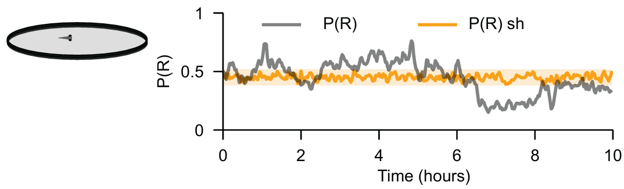
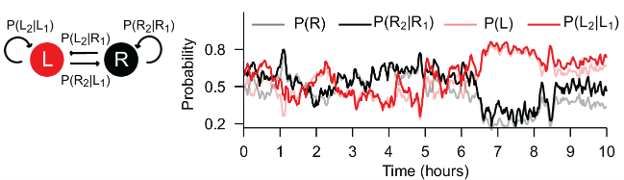
New preprint https://t.co/wjf4ZASLtr. We show that zebrafish larvae exhibit complex, internally generated, spontaneous behavioral patterns in the absence of stimuli. These dynamics can be described by a simple Markov process with transition probabilities that change over time.
Our findings reveal that spontaneous behavior is far from random: zebrafish larvae exhibit rich internal dynamics that continuously shape their swim bias over long timescales and persist across sensory contexts. This will be key to building better models of animal behavior.
Swim bias has long-range temporal structure, with fluctuations remaining correlated over long periods and no single timescale dominating the behavior. These fluctuations persist even in the response to visual stimuli, suggesting that the underlying dynamics are intrinsic.
We find that swim direction bias fluctuates spontaneously, even in spatially uniform environments. The probabilities of consecutive swims can be captured by a Markov model with dynamic transition probabilities. Together, these findings reveal unexpectedly rich internal dynamics.