In my assessment, the risk for #disintegration is the gravest threat #Somalia faces today, driven by zero-sum politics and constitutional gridlock that have eroded governance nationwide. Recent strife in #Mogadishu, #SouthWest State electoral dispute, #Puntland’s growing estrangement from the federal framework, #Galmudug’s growing instability and the prolonged standoff between #Jubbaland and the Federal Government are interconnected symptoms of a deepening crisis. What makes this situation even more alarming is the growing involvement of external actors seeking to advance their own strategic interests within Somalia’s fragmented political landscape. For instance, the recently unholy relationship between #Somaliland region of Somalia and Israel, among other geopolitical developments, risks further complicating an already fragile environment and could accelerate centrifugal forces that undermine national unity. I believe that Somalia’s survival, as a unified nation state, demands genuine dialogue and renewed unity, because unity is now an existential necessity, not a mere objective.
@TheVillaSomalia@Somalia #Somalia @AqalkaSare@golaha_shacabka@aqalkahoose #SharciBaaDalLaguDhisaa @Abdijaliilsamow@somalianalyst@HassanSMohamud
My brother Ismail, respectfully, I findd it surprising that you as a security expert would be so dismissive of the current security and political trajectory in Mogadishu. The concerns being raised didn’t come from "warmongers," but from two respectful former presidents with extensive experience navigating the complexities of state-building, National security and governance. Their remarks were not calls for conflict; they were warnings about the risks of continuing on the current path. History teaches us that ignoring credible warnings does not make problems disappear - it often makes the consequences far more severe. I’m sorry to say but dismissing such warnings outright says about your objectivity than it does the validity of the warnings themselves.
Watching the stark warning issued today by the two former Presidents Mohamed Abdullahi Mohamed (Farmaajo) and Sheikh Sharif Sheikh Ahmed, one cannot simply dismiss it as routine political disagreement. Such warnings, coming from two former heads of state with firsthand experience of Somalia’s complex political landscape, should be viewed as a serious call for reflection on the country’s current trajectory and the potential consequences of continued political polarization and unilateral decision-making.
The Somali people, as well as Somalia’s genuine international partners, must not underestimate the gravity of these warnings. In Somalia’s fragile political environment, such warnings are preventive alarms, not corrective remedies. Somalia’s history painfully demonstrates that preventing a crisis is infinitely easier than repairing the damage after the fact.
In this situation, inclusive dialogue, consensus-based electoral arrangements and strict adherence to constitutional principles are not merely desirable, they are indispensable. In the current circumstances, they represent the only viable path to preserving Somalia’s stability, protecting its democratic gains and preventing a relapse into crisis. Anything less would be a dangerous gamble with the future of Somalia and the security of the entire Horn of Africa.
@TheVillaSomalia@Somalia #Somalia @AqalkaSare @Golaha_ shac_JFS @aqalkahoose@sec_council@UKinSomalia@US2SOMALIA@EU_in_Somalia@AmbWangYu@AsstSecStateAF@ACAfricaCenter@_AfricanUnion@US_SrAdvisorAF@TC_MogadisuBE@tcbestepe @UNTMIS @francescaDM_EU@ymahmoudali
#SharciBaaDalLaguDhisaa
History teaches us a simple but powerful lesson in politics: the best politician is not necessarily the one who holds power the longest, but the one who understands when his political moment has come to an end and manage the transition with dignity.
President Pinochet ruled Chile from 1973 to 1990. Despite the brutality of his regime, he ultimately accepted to negotiate a transition to civilian government. Pinochet did not become a democratic hero, nor was he absolved of the controversies surrounding his rule. However, by recognizing the political reality and allowing a negotiated transition, he avoided a potentially devastating civil conflict and preserved some degree of personal and family security.
Conversely, President Ceaușescu ruled Romania from 1965 until 1989. As public dissatisfaction grew, he still remained convinced that his authority was secure. He failed to recognize that both his domestic support and international environment had fundamentally shifted. The consequences were swift and severe for failing to recognize the political reality.
President Hassan Sheikh Mohamud now faces a choice that many leaders before him have faced. He can interpret recent events in Mogadishu as a warning that immediate dialogue, compromise and consensus-building around the national electoral process are essential to preserving stability and national cohesion. Or he can continue to believe that the instruments of state power alone can contain growing political tensions. History, however, rarely judges leaders by the authority they wielded, but by the wisdom they demonstrated when confronted with moments of national consequence.
@TheVillaSomalia@Somalia #Somalia @AqalkaSare @Golaha_ shac_JFS @aqalkahoose #SharciBaaDalLaguDhisaa @Abdijaliilsamow@somalianalyst@HassanSMohamud
A well-known #experiment by Johns Hopkins University researcher Curt Richter illustrated a powerful lesson about the direct correlation between human endurance and hope. In the experiment, rats placed in water initially gave up quickly. However, after being rescued once and returned to the water, they continued swimming for far longer. The conclusion was simple yet profound; when hope exists - to be rescued in this case -, endurance survives.
Today, many Somalis feel that this sense of hope is being endangered. The #democratic transition and the promise of a more #inclusive #elections have long represented the only source of hope and endurance for Somalis. However, the unilateral moves by Hassan Sheikh Mohamud toward the regional and national electoral processes are causing growing concern among citizens who fear that the only hope they had is being undermined. Therefore, unless Somalis as well as the international partners stand firmly together and reject the unilateral electoral processes, the country risks losing the hope that has sustained its people through decades of hardship and unprecedented suffering.
@TheVillaSomalia@Somalia #Somalia @AqalkaSare @Golaha_ shac_JFS @aqalkahoose@sec_council@UKinSomalia@US2SOMALIA@EU_in_Somalia@AmbWangYu@AsstSecStateAF@ACAfricaCenter@_AfricanUnion@US_SrAdvisorAF@TC_MogadisuBE@tcbestepe @UNTMIS @francescaDM_EU@ymahmoudali
#SharciBaaDalLaguDhisaa
The internationally mediated talks expected to take place in Mogadishu come at a profoundly critical moment for Somalia’s future, particularly with only three days remaining in the mandate of the current government.
Although it is concerning that Somalis increasingly find themselves placing greater trust in international mediators than in their own political leaders nevertheless, there must be clear awareness that influential figures within both the government and opposition camps - many of whom have long benefited from Somalia’s entrenched culture of kakistocracy - may quietly seek to frustrate or dilute the success of the talks in order to preserve their personal interests or political relevance. Therefore, given the repeated failures of previous political negotiations and the very limited time remaining in the mandate of the current government, all other political disputes must now give way to three key national priorities, which must remain the central focus of international mediators as they responsibly use their collective leverage to push both sides toward a credible and timely agreement on three essential issues: a realistic electoral model, the composition and legitimacy of the National Independent Electoral Commission, and a practical implementation timeline.
The new electoral framework however must neither drag Somalia backward into previous contested models nor attempt to impose an unrealistic one-person-one-vote system disconnected from the country’s current political and security realities.
The urgency now is securing a workable national consensus capable of safeguarding stability, institutional continuity and public confidence in Somalia’s future.
@TheVillaSomalia@Somalia #Somalia @AqalkaSare @Golaha_ shac_JFS @aqalkahoose@sec_council@UKinSomalia@US2SOMALIA@EU_in_Somalia@AmbWangYu@AsstSecStateAF@ACAfricaCenter@_AfricanUnion@US_SrAdvisorAF@TC_MogadisuBE@tcbestepe @UNTMIS @francescaDM_EU@ymahmoudali
#SharciBaaDalLaguDhisaa
In the current political climate in #Somalia, time, experience and authority are all placed in the hands of President Hassan Sheikh Mohamud with the expectation that he would rise above his past failures - allegations of @corruption, @nepotism, land grabbing, arbitrary @detention of journalists and activists and the marginalization and @displacement of some of the country’s most vulnerable communities.
Just to remind you Mr. President, the political reality in Somalia is brutal and unavoidable; once power fades, the protection of state machinery disappears with it. Paid media narratives will no longer shield reputations and carefully manufactured propaganda will collapse under the weight of public memory. Political loyalists who today praise you without restraint will reposition themselves overnight for survival, as we are already beginning to witness. The same clan-based elites and patronage networks currently benefiting from your administration - those loudly defending every misstep because they expect unmerited privilege, contracts, influence and political favoritism through narrow interests - will be the first to abandon you the moment the balance of power changes. Their loyalty is not to principle, nationhood or even to you personally; it is loyalty to access, privilege and survival. History has repeatedly shown that when political tides turn in Somalia, yesterday’s loudest defenders often become tomorrow’s loudest accusers in order to protect themselves.
Despite all these, history has not completely closed its door on you Mr. President. That is why this moment may represent the only meaningful exit still available to you. If you genuinely wants history to remember you with any measure of dignity, then you must urgently abandon exclusionary politics and champion a truly inclusive, consensus-based electoral process before the expiration of the current mandate on 15 May 2026. Because in the end, all current controversies may become secondary if Somalia, under your leadership, can peacefully avoid another cycle of fragmentation, violent instability or renewed civil conflict — Allah (GOD) forbid.
@TheVillaSomalia@Somalia #Somalia @AqalkaSare @Golaha_ shac_JFS @aqalkahoose #SharciBaaDalLaguDhisaa @Abdijaliilsamow@somalianalyst@HassanSMohamud
In the current political impasse in @Somalia, as the government and opposition edge toward possible negotiations and the government’s mandate draws to a close, I believe the way forward will not be found in grand declarations or claims of exclusive authority. It must begin with a quieter but firmer understanding: WE WILL NOT RETURN TO THE ABYSS - NEVER AGAIN - a recognition shaped by the memory of a time when violence overtook politics, the state collapsed and the country paid a devastating price - compounded this time by extremist groups and other destabilizing actors poised to exploit the ensuing chaos. That shared restraint is the minimum foundation - an agreement to step away from zero-sum politics and to reject the recurring temptation of unilateral decisions that have so often pushed the country toward breakdown.
Ultimately, I see that only then can a new national imagination take shape organically, not as a blueprint forced through unilateral constitutional changes or political maneuvering, but the sole belief that power can be negotiated rather than seized, legitimacy can be shared rather than claimed and the future can once again belong to all Somalis.
@TheVillaSomalia@Somalia #Somalia @AqalkaSare @Golaha_ shac_JFS @aqalkahoose@sec_council@UKinSomalia@US2SOMALIA@EU_in_Somalia@AmbWangYu@AsstSecStateAF@ACAfricaCenter@_AfricanUnion@US_SrAdvisorAF@TC_MogadisuBE @UNTMIS @francescaDM_EU@ymahmoudali
#SharciBaaDalLaguDhisaa
Investing in @hydrocarbon sector in Somalia requires far more than a commercial calculation, it is a strategic commitment that demands disciplined foresight and a readiness to absorb significant financial and geopolitical risk. These ventures require billions in capital and unfold within fluid international dynamics that can shift with little warning.
@Turkiye is undoubtedly the first to commit @investment at this scale in the country’s extractive sector, yet @investments of this magnitude cannot be driven by projected financial returns alone. They must be anchored in a sober and continuous assessment of the country’s political trajectory, both in the short and long term.
In this regard and without suggesting any form of external interference, it is reasonable to expect that, in its risk assessment, Turkiye should take Somalia’s evolving political landscape into the account, particularly the electoral process. This is especially pertinent given the growing perception among some Somalis that the current administration’s insistence on a unilateral electoral path may, in part, be influenced by an assumption of Turkish support. Whether accurate or not, this is particularly sensitive in a global environment where large-scale investments like hydrocarbons are increasingly exposed to indirect geopolitical pressures.
Ultimately, given the scale of its existing commitments, Turkiye should not hesitate to use its influence, quietly but decisively, to advocate for free, fair and genuinely consensus-based elections. This need not entail overt political intervention, rather, it calls for principled diplomatic engagement that reinforces a simple truth - enduring partnerships are best sustained under governance that is legitimate, inclusive and broadly accepted.
@tcbestepe@TheVillaSomalia@Somalia #Somalia @AqalkaSare @Golaha_ shac_JFS @aqalkahoose@sec_council@UKinSomalia@US2SOMALIA@EU_in_Somalia@AmbWangYu@AsstSecStateAF@ACAfricaCenter@_AfricanUnion@US_SrAdvisorAF@TC_MogadisuBE @UNTMIS @francescaDM_EU@ymahmoudali
#SharciBaaDalLaguDhisaa
What we are witnessing in Mogadishu today should be of deep concern to all Somalis, as well as to the international partners. Unchecked land grabbing, the use of security forces against civilians and the growing pattern of arbitrary detention of citizens for expressing their views all point to a system under increasing strain. Combined with a deepening constitutional crisis and the prospect of an unlawful term extension, this situation also raises the serious risk that national institutions, particularly the armed forces, now strengthened with greater capabilities, could be drawn into internal political divisions, especially if security force is used to suppress opposition candidates. The warning signs are feasible and the consequences of inaction are serious and far-reaching. At such a critical juncture, any ambiguity or hesitation by the international partners, particularly, risks being perceived as acquiescence, with consequences that may be difficult to contain.
@TheVillaSomalia@Somalia #Somalia @AqalkaSare @Golaha_ shac_JFS @aqalkahoose@sec_council@UKinSomalia@US2SOMALIA@EU_in_Somalia@AmbWangYu@AsstSecStateAF@ACAfricaCenter@_AfricanUnion@US_SrAdvisorAF@TC_MogadisuBE @UNTMIS @francescaDM_EU@ymahmoudali
#SharciBaaDalLaguDhisaa
Dr., I’m pleased we agree that a disease cannot be cured by the very cause that created it in the first place. Likewise, if our shared goal as Somalis is to achieve genuine nationhood, it cannot be built on the same foundation - political clanism - that has driven the current turmoil and continues to deepen our divisions, among other factors.
That said, I fully acknowledge that both administrations experienced election delays. However, I believe that the key difference, lies in intent. Without going into detail, as this is widely known, during the tenure of Mohamed Abdullahi Farmaajo, substantial early efforts were undertaken to organize elections with the intention of holding them on schedule. The eventual delays were however largely the result of politically driven challenges and obstruction from other stakeholders, particularly some Federal Member State leaders.
In contrast, under Hassan Sheikh Mohamud, the delay appears to be deliberately manufactured rather than circumstantial, with the intention - at best - of postponing the electoral process. This distinction between constraint and intent is therefore critical to understanding the current situation.
Despite all this, we must remain clear on one fundamental point: regardless of the administration in power, the only viable path forward for Somalia is to uphold the tradition of peaceful transfer of power grounded in agreed constitutional principles. Without it, our challenges will only deepen and polarization and fragmentation will persist.
I have watched on social media, with deep concern, a statement from a key opposition figure stating that a decision was reached during a meeting held in Nairobi, Kenya, where some opposition leaders from the same clan as H.E. President HSM endorsed dividing the opposition along clan lines as a strategy to pressure the federal government into holding elections.
In the Somali context, where the wounds of past civil strife are still deeply felt, this approach is not only misguided, it is dangerous. It shifts the country away from a unified, principled opposition grounded in national interest and instead pushes political engagement into opaque, fragmented sub-channels defined by lineage rather than legitimacy. The implications are profound. Over time, this normalizes a political culture in which opposition movements are organized not around ideas, policies or vision, but around clan identity. In the long run, it may also set a dangerous precedent where opposition parties are defined by clan allegiance, ultimately undermining their credibility, weakening their moral authority and diminishing their ability to effectively hold the government accountable on behalf of all Somalis. This is a disastrous path that Somalia cannot afford to take again!
@TheVillaSomalia@Somalia #Somalia @AqalkaSare @Golaha_ shac_JFS @aqalkahoose #SharciBaaDalLaguDhisaa
@Somalia@Abdijaliilsamow #Somalia
It increasingly appears that #Somali#politicians are grappling with what I would describe as a Fragmented National Vision Syndrome. A condition in which group/self-interest-driven #polarization has produced a deeply entrenched culture of self-righteous governance. In this environment, #political actors, whether at the #federal or the federal member state levels tend to advance narrowly defined agendas shaped by clan or group affiliations, regional loyalties or personal ambitions, each firmly convinced that their vision alone represents the legitimate path toward national recovery and state-building. As a result, the prospect of constructing a shared national vision, anchored in the rule of law as set out in the provisional #constitution becomes increasingly remote, as consensus is perceived not as a collective achievement but as a compromise of principle. While psychologists might interpret this situation through analytical frameworks of behavior and cognition, #theologians, if invited to reflect on the this situation, might go further, describing it as though Somali leaders appear almost #demon-driven, gripped by forces that clouds judgment and fuels division.
Therefore, the only realistic path forward for Somalia, in my view, must rest on collectively shaping and genuinely embracing a shared national vision that decisively removes the dangerous relativity that allows every politician to claim equal #legitimacy for their actions.
@TheVillaSomalia@Somalia #Somalia @AqalkaSare @Golaha_ shac_JFS @aqalkahoose #SharciBaaDalLaguDhisaa
Mr President, you are certainly missing the point!.
Let me remind you, the problem in Somalia right now is not that the people oppose one-person, one-vote election. That narrative is misleading and disingenuous. Somali people are not afraid of democracy - they are demanding a credible, transparent and trustworthy one. The real issue is the TRUST on the election process and right now, there is none. People simply do not TRUST the election process that you are attempting to control unilaterally. They do not TRUST the way the so-called independent electoral commission is being selected. They do not TRUST the electoral model designed without broad consensus and they certainly do not TRUST a process that appears engineered to predetermine the outcome.
Additionally, it is not secret that your political track record marked by reversals, contradictions and expediency has eroded whatever confidence you may have existed.
Therefore, at a moment when only weeks remain in your mandate, any attempt to force a disputed election process forward through coercion, intimidation or the threat of deploying SNA forces against dissent is not only reckless but extremely dangerous. It risks dragging the country back into instability and clan conflict, undoing years of fragile progress. Engaging genuinely with other political stakeholders and rebuilding trust through an inclusive and transparent electoral process is the only way forward. Anything less will be seen as a power grab, with consequences the country can ill afford.
@TheVillaSomalia@Somalia #Somalia @AqalkaSare @Golaha_ shac_JFS @aqalkahoose@sec_council@UKinSomalia@US2SOMALIA@EU_in_Somalia@AmbWangYu@AsstSecStateAF@ACAfricaCenter@_AfricanUnion@US_SrAdvisorAF
@UNTMIS @francescaDM_EU@ymahmoudali
#SharciBaaDalLaguDhisaa
Are we now witnessing Somalia sliding back into the dark chapter of clan-based conflict, this time under the direction of the very Federal Government meant to unite the nation?
The ongoing build-up of clan militias in parts of South West State and potentially other Federal Member States, such as Galmudug and Hirshaballe further deepens fragmentation across the country and raises serious concern. Organizing, arming and financing clan-based militias is not a new experiment in Somalia, it is a painful chapter of our history. It brought no winners then and it will produce none now.
Even more concerning this time is that this trajectory creates fertile ground for extremist groups to regroup, exploit divisions and expand their reach, not only within Somalia but across the region and beyond.
The way out of the current political impasse is inclusive path by holding timely national elections built on broad-based consensus. Only through such a process can trust be restored and the country steered away from yet another cycle of conflict.
@TheVillaSomalia@Somalia #Somalia @AqalkaSare @Golaha_ shac_JFS @aqalkahoose@sec_council@UKinSomalia@US2SOMALIA@EU_in_Somalia@AmbWangYu@AsstSecStateAF@ACAfricaCenter@_AfricanUnion@US_SrAdvisorAF
@UNTMIS @francescaDM_EU@ymahmoudali
#SharciBaaDalLaguDhisaa
https://t.co/pOSkNDzT28
https://t.co/RhMlumE3w7
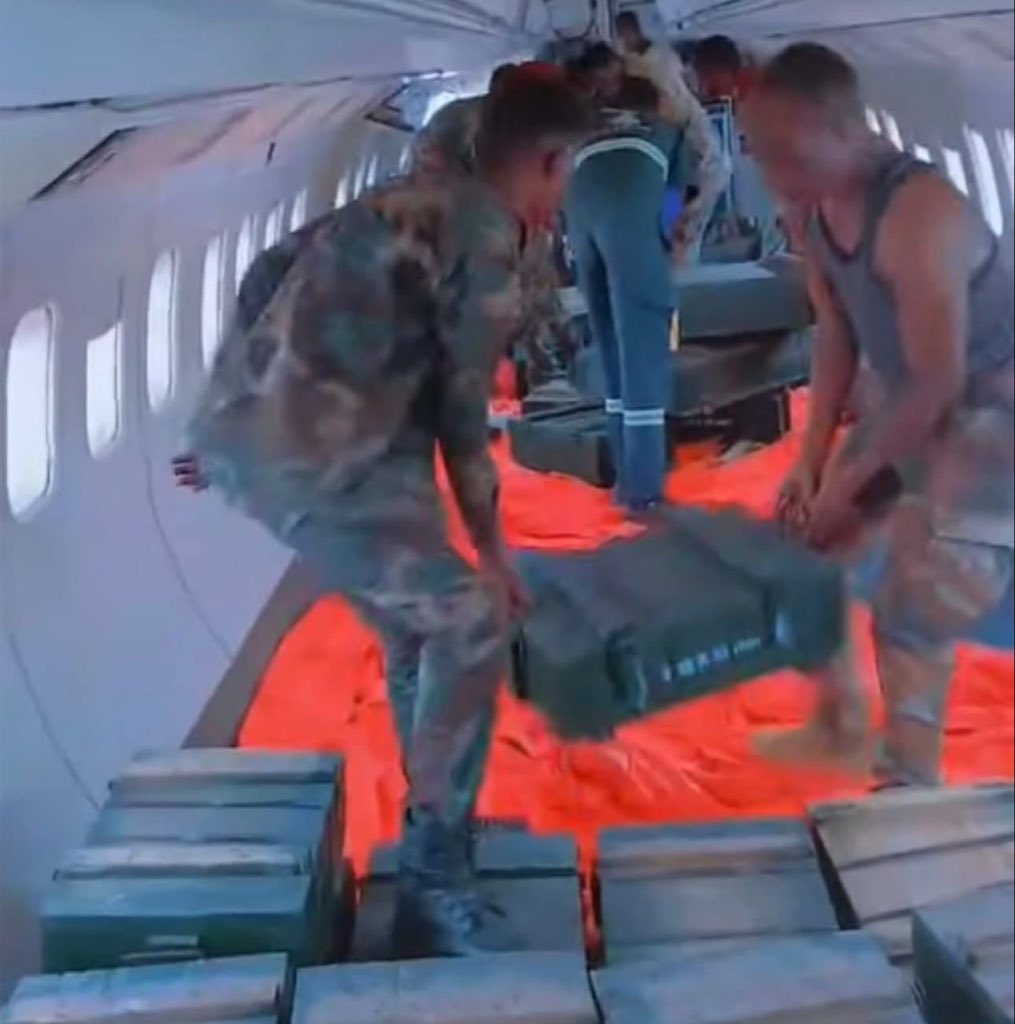
There are deeply troubling reports that the federal government, under President Hassan Sheikh, is loading weapons onto planes for use against Southwest State (see the picture below for proof). These are not just weapons; they belong to the Somali people. They were meant to defend the country and protect its citizens, not to be turned inward.
Seeing them prepared for use in an internal confrontation is painful and unsettling. It raises serious questions about the direction the country is taking. At a time when Somalia needs calm, dialogue, and unity, this kind of move risks pushing the nation toward unnecessary conflict.
No political objective should come at the cost of Somali lives. If this path continues, the consequences will be felt far beyond Southwest State.
@sec_council@UKinSomalia@US2SOMALIA@EU_in_Somalia@AmbWangYu@AsstSecStateAF@ACAfricaCenter@_AfricanUnion@US_SrAdvisorAF
@UNTMIS @francescaDM_EU@ymahmoudali
It is deeply concerning to witness federal government orchestrating a renewed surge of conflict in the South West State at a time when calm, restraint and unity are most needed.
The previous misconduct in Ras-Kanbooni - Jubbaland and what is now unfolding in South West State, alongside the risk of similar patterns emerging in Galmudug and Hirshabelle, paints a troubling picture for the country, particularly as the current mandate of the government approaches its final weeks. This comes at a moment when unity is not just desirable but essential, especially in light of evolving dynamics in the Gulf region that will undoubtedly have direct consequences for the everyday lives of ordinary people.
@SafiaYasin@AbdulkadiraMus2@HassanSMohamud Safiya walaal, while it is important to encourage free speech and the expression of individual views, we must also be careful to avoid language that is divisive or overly generalized.
The collapse of the recent meeting in Mogadishu - more than at any previous moment - underscores the urgent need for a renewed political culture and a higher caliber of leadership, one capable of understanding global and regional dynamics and aligning national strategy with these evolving realities, rather than relying on empty slogans or narrow self-interest. Arguably, the country’s current political class has yet to fully grasp how their decisions shape the nation’s future within a rapidly changing world order, particularly amid intensifying geopolitical competition in the Horn of Africa - forces that could even reshape long-standing regional colonial boundaries.
These trends pose unprecedented risks that could threaten Somalia’s fragile stability and in turn, jeopardize its very existence as a nation-state. Somalis, the time for awakening and decisive course correction is now.
Walaal Safia, I think there’s a bit of confusion here. HSM is not Musa Bixi. President Farmaajo genuinely extended the highest seat to Musa Bixi as a gesture for national unity. HSM, on the other hand, became president with the backing of the current opposition, who now criticize him, rightly or wrongly.