Pashtun G2b1a - G-M283 thread:
Ancestral path (Yfull):
G2b>M3115>M377>Y12304>Y12297>Y12292>M3124>M283
https://t.co/w0bnrya33t
G2b-M283 with a TMRCA around 300 CE accounts for roughly 10–15% of Pashtun Y-DNA and is carried by millions of Pashtun males, with the highest frequencies found among the Karlani tribes (>60%). It is also present at lower frequencies in other Pashtun tribes, but in many cases this can be traced to Karlani substrates. For example, its presence among the Yusufzai may reflect the assimilation of Dilazak populations, while among the Ghilzai in Loya Paktia it may result from the incorporation of Karlani groups.
All identified living carriers of the Y-DNA haplogroup G2b in the region of South-Central Asia are carriers of the descending lineage G-M3115 < G-M377 < G-Y12297 with a TMRCA around 4400 BCE (G2b1a on ISOGG).
G-M377 carriers came out of a long bottleneck, with all carrying a common paternal ancestor only around 6500 BCE, meaning that about 13,500 years of paternal cousin lineages seem not to have survived until the present. Unfortunately there are, as of this writing, no ancient skeletal remains found of a carrier of this Y-DNA haplogroup. Based on regions where it reaches peak diversity today, it seems to have originated close to it’s paternal origin among Pre-Pottery Neolithic farmers in the northern Zagros Mountains and the Iranian Plateau.
The later history of G-Y12292 and its parent clade, Pre-G-M283, remains unclear. The presence of G-Y12292, with a TMRCA of around 3400 BCE, among Ashkenazi Jews, South Italians, Rushanis and Shughnis, together with its apparent absence in South Asia, currently suggests an origin on the Iranian Plateau and a possible association with early Iranic populations. At the same time, the clade is nearly absent among present-day Iranians and lowland Tajiks. This may simply reflect limited sampling, founder effects, or population bottlenecks on the Iranian Plateau rather than its actual historical distribution. It is also worth mentioning that G2b-M377 was absent in the huge Akbari et al. (2026) dataset with more than 10.000 samples published this year.
So it is also possible Pre-G-M283 was already local to the Suleiman mountains/Afghan highlands and the Jewish G2b is directly from Afghanistan or Tajikistan, but based on our current understanding of Iranic haplogroups in Jewish population most of their Iranic haplos seem to be mediated via West Iranics in and around Mesopotamia.
"The History of Hossein the Kurd", a manuscript in the Persian language. Matenadaran, Yerevan, Armenia, 19th century.
Hossein the Kurd is the main character of the adventure epic "The Tale of Hossein the Kurd of Shabistar", popular in the Middle East. The story takes place in Iran during the reign of the powerful Shah Abbas I the Great (late 16th - early 17th century) of the Safavid dynasty.
Hossein the Kurd is a legendary warrior and folk hero who, along with his fellow ayyars (medieval volunteer fighters and protectors of the poor), performs heroic deeds, fights the Shah's enemies (the Uzbeks and the Ottomans), and restores justice.
@BalochGenica1 I believe there is also Askani”results from Sarbaaz sequenced by the Big-700 test level and confirmed so far to the sub-clade E-CTS9997.not sure if this is the same individual or his relatives! This clade has high probability of most recent common ancestry from Arabian Peninsula.
@Gedrosia_DNA I believe this is the same individual. His ancestors were from Sarbaz in Western Balochistan. E-CTS2476 is a downstream branch of E-CTS9997.
This Y-DNA lineage does not appear to have arrived via the African slave trade.
Rather, it likely entered the region after becoming established across the Near East and broader West Asia.
G25 results of an Askani Baloch from Lyari, Karachi.
Y-DNA: E-CTS2476
E-CTS2476 is a downstream lineage of the African haplogroup E-M2 (E1b1a), with subsequent diversification in the Arabian Peninsula and adjacent regions of West Asia.
@ibn_alhindi@ThePakman2026 This Y-DNA lineage does not appear to have arrived via the African slave trade. Rather, it likely reached the region following its diversification across the Near East and broader West Asia.
G25 results of an Askani Baloch from Lyari, Karachi.
Y-DNA: E-CTS2476
E-CTS2476 is a downstream lineage of the African haplogroup E-M2 (E1b1a), with subsequent diversification in the Arabian Peninsula and adjacent regions of West Asia.
@irdgasetf Not all Saraiki speakers are Baloch, but a significant proportion are, particularly in the Greater Dera Jat region.
As for the Almani, they are indeed a Baloch tribe and a branch of the Rind tribe.
@ThePakman2026 Y-DNA and autosomal DNA measure different aspects of ancestry. Y-DNA traces one paternal lineage, while autosomal DNA is recombined every generation. A paternal lineage can persist for millennia even after its founder's autosomal ancestry becomes undetectable.
Balochi Curled Beard (Challa Resh)
The Challa Resh is a distinctive beard style of the Balochs of Koh-e-Suleiman, especially of the Marri tribe. The beard is curled in a manner that bears notable visual similarities to beard styles depicted in several ancient West Asian cultures
@Freedomiimi The Jats are a professional community whose tribes include both Sindhi and Baloch ones. The Jat camelmen featured in the video belong to a Baloch tribe, and the sections they identified are likewise of Baloch affiliation.
The cameleers of Balochistan, locally known as Jat (lighter t), describing their tribes. The Raees identifies as Bahrani, with Budanzai, Mirzai, Panjuzai, & Haguzai as its subsections, and lists Lashari, Hajana, Gulabzai, & Kundani among the Jat sections.
-Mal Gishkori, Sibi
G25 results of a Lasi-speaking Kutra Jamot from Kanraj, Lasbela, Balochistan.
Y-DNA: J-PF4876
This lineage appears to have arrived from West Asia, most likely mediated by Proto-Baloch groups.
Sample courtesy: @Afghan_DNA
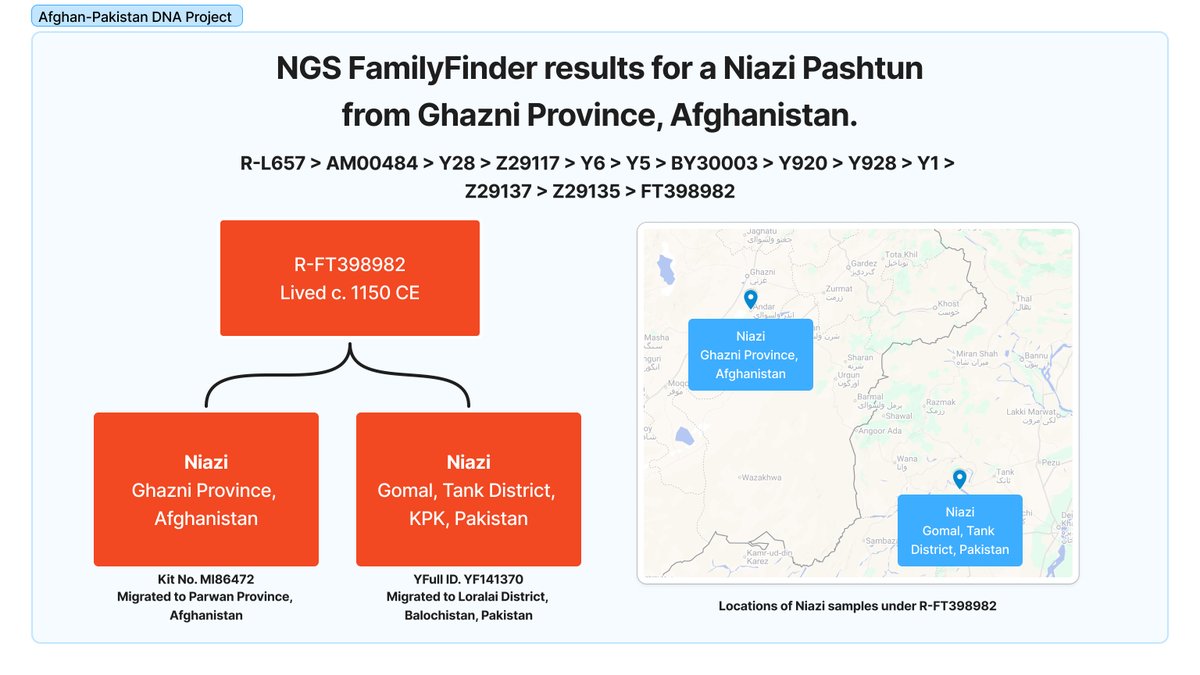
We have received NGS Family Finder results for a R-Y6 (Z29135 > FT398982) Niazi Pashtun from Ghazni Province, Afghanistan.
At a TMRCA of ~1150 CE, this Ghazni Niazi shares his branch with another Niazi tribesman from the Gomal region of Tank District, KPK, Pakistan.
The earliest Niazi tribal memory places the tribe on the outskirts of the city of Ghazni, from where they expanded during the medieval Pashtun tribal expansion into regions such as Bannu, Thal, and Gomal.
R-L657 > AM00484 > Y28 > Z29117 > Y6 > Y5 > BY30003 > Y920 > Y928 > Y1 > Z29137 > Z29135 > FT398982
FTDNA. https://t.co/CoflEsLfdE
YFull. https://t.co/Ub1vcxTEm6
Bangulzai is a Brahui-speaking tribe that claims descent from the Rind Balochs. Historically, the Bangulzais have inhabited the Sarawan (particularly Mastung) and Kachhi regions of Balochistan.