Opinion × Binance Wallet Booster Campaign is now live.
Let’s unlock collective intelligence and shape the next-generation multi-player internet.
Repost this post to join now.
Introducing Bitway: The Internet Capital Gateway for On-Chain Finance
Incubated and backed by @yzilabs via @EASYResidency Season 1, Bitway is founded by early members of Binance Labs and Chainspace, the blockchain scalability project later acquired by Facebook.
Bitway serves as the "Internet Capital Gateway," connecting on-chain liquidity with global financial opportunities. At its core, Bitway offers a suite of specialized products, including Bitway Earn, an on-chain wealth management platform built on the BNB Chain. This platform allows users to access institutional-grade yield opportunities in a transparent and decentralized manner, anytime and anywhere.
To accelerate early adoption, the product launch is supported by the @BinanceWallet Booster Program. In addition to native yield, a Points Program has been introduced, allowing users to earn future rewards in $BTW by staking USDT at https://t.co/8UPjNNuPvA.
# Introduction to #SCASH
## 1. Project Vision
SCASH (Satoshi Cash Network) is a public blockchain based on the Bitcoin architecture, aiming to restore Bitcoin's core concept from 2009: "One CPU, One Vote."
Its core goal is to **allow ordinary users to participate in mining using their home computers**, combating the trend of ASIC centralization and achieving a fair distribution of computing power.
SCASH aspires to be a **decentralized, censorship-resistant, community-driven cryptocurrency network**.
---
## 2. Core Design Principles
1. **Fair Launch**: No pre-mining, no ICO, ensuring fairness in the early stages of network launch.
2. **CPU Friendly**: Employing the ASIC-resistant Proof-of-Work algorithm RandomX, enabling mining with ordinary CPUs.
3. **Fixed Total Supply**: The total supply is capped at 21,000,000 SCASH, consistent with Bitcoin's total supply.
4. **Halving Mechanism**: The block size is halved every 210,000 blocks to control the inflation rate.
5. **Block Time**: Each block lasts approximately 10 minutes, consistent with Bitcoin.
---
## 3. Technical Architecture
### 3.1 Consensus Mechanism
SCASH uses **Proof of Work (PoW)**. Key Features:
* Algorithm: RandomX (ASIC-resistant, CPU-optimized)
* Block reward gradually decreases with each halving cycle
* Network difficulty adjustment ensures a stable average block time of 10 minutes
### 3.2 Network and Nodes
* **Full Node**: Stores the complete ledger and participates in transaction verification
* **Light Node**: Verifies only the block header; usable on mobile devices or lightweight clients
* Supports standard P2P network topology, ensuring rapid information dissemination and network security
### 3.3 Wallet and Transactions
* Supports standard public/private key generation and the UTXO model
* Compatible with Bitcoin addresses and transaction formats for easy ecosystem adaptation
* Provides basic wallet functions: sending, receiving, balance inquiry, and transaction history
---
## 4. Economic Model
| Parameters | SCASH Network |
| ---- | ----------------------------- |
| Total Supply | 21,000,000 SCASH |
| Block Reward | Initial 50 SCASH/block, halving every 210,000 blocks |
Block Time | 10 minutes |
Mining Algorithm | RandomX |
Incentive Objective | Balance security and decentralization, CPU mining is sustainable |
### 4.1 Incentives and Distribution
* All block rewards are directly distributed to miners, with no reservations from the founding team.
* No ICO, no airdrops, generated entirely through PoW mining.
* Objective: To encourage ordinary users to participate in long-term network security maintenance.
---
## 5. Governance Model
SCASH adopts **community-driven governance**:
* The core development team only provides technical support.
* Network upgrades and soft/hard forks require community consensus.
* Node operators and miners indirectly participate in governance by running nodes and voting.
---
## 6. Risk Analysis
1. **Security Risks**
* PoW is still vulnerable to 51% attacks, but CPU... 1. **High Mining Decentralization Reduces Risk**
2. **Economic Risks**
* Token price volatility may lead to decreased miner participation.
3. **Technical Risks**
* With algorithm optimization and hardware upgrades, RandomX may face pressure to be optimized or ASIC-ized.
4. **Community Risks**
* Governance relies on community consensus; community splits may trigger network forks.
---
## 7. Future Outlook
* **Ecosystem Building**: Promoting wallet, exchange, and DApp support.
* **Algorithm Iteration**: Continuously optimizing RandomX's CPU friendliness.
* **Cross-Chain Cooperation**: Exploring interoperability with Bitcoin and other chains.
* **Education and Promotion**: Enhancing ordinary users' understanding of decentralization and PoW.
---
> ⚠️ Note: This content is based on publicly available information and is for reference and research purposes only. It does not constitute investment advice.
The Rayls manifesto just went live. The early passports are disappearing fast! Get yours before the train leaves the station.
#24,051!
https://t.co/BkWr5mAWYH
"It's nice how anyone with just a CPU can compete fairly equally right now"
– Satoshi @scashnetwork
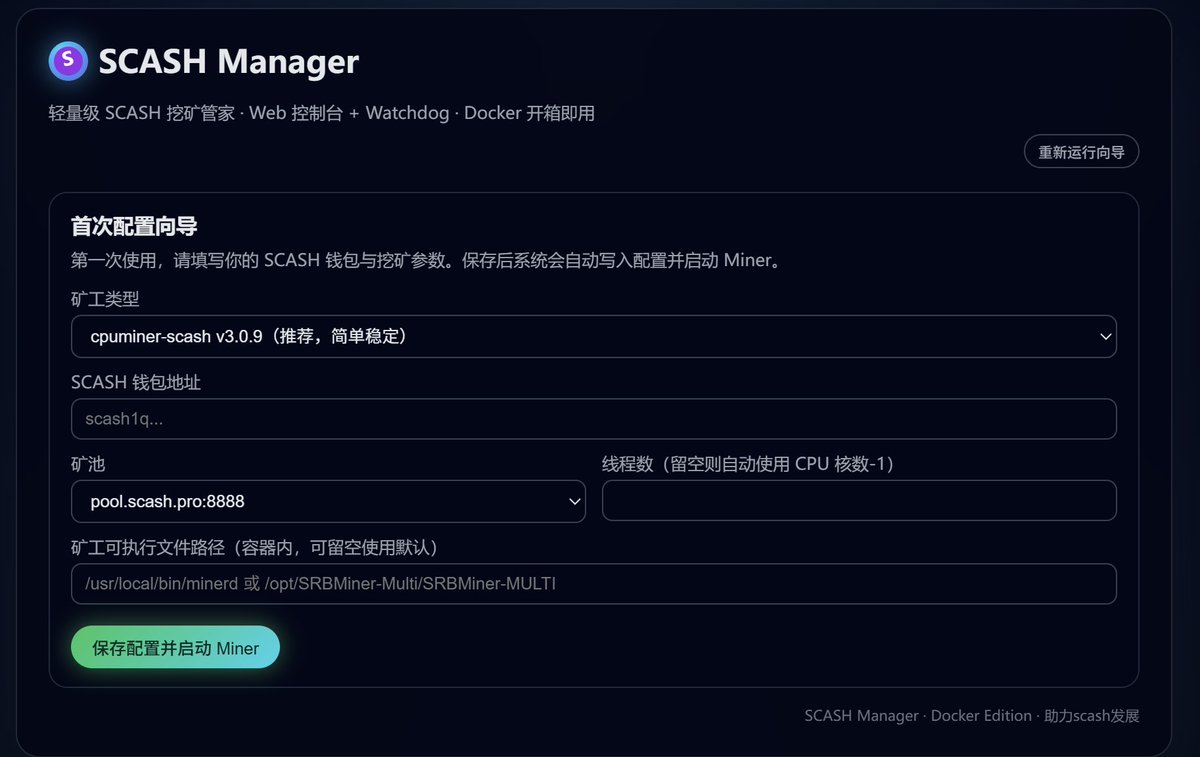
You can mine #Scash for free as long as you have a computer or mobile phone!
Mining tutorial:
https://t.co/7iO6efTn1U
#Mining#BTC#Airdrop#Satoshi