KARPATHY JUST KILLED THE PROMPT ERA WITH A SINGLE DOCUMENT
prompts are easy. loops are hard. and writing fifty prompts a day is the work nobody does twice.
he shifts the burden to the harness.
you define the contract once. the model writes, reviews, restarts, and reconciles. you keep judgment. it keeps the loop.
the throughline is the same in every rule: the human owns the spec and the boundary. the model owns the execution and the bookkeeping.
planner never touches code. generator never grades itself. state lives on disk, not in context.
9 rules. start with one feature, not ten. most people are still typing prompts. this turns Claude into an agent that finishes the job on its own.
here is the official document from Karpathy explaining the architecture
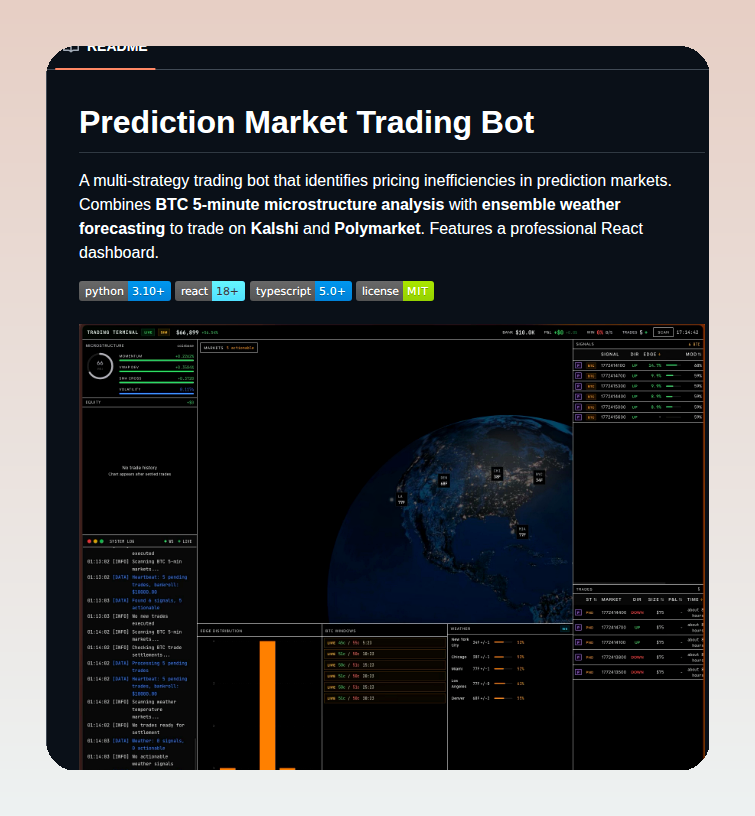
I found 7 free Polymarket trading bots on GitHub for 7 different trading situations…
Each of these bots comes with a detailed step by step setup and usage guide in English:
1. This bot includes 118+ ready to use strategies and tools for trading on prediction markets (Momentum, Binance-Polymarket latency, Penny Clipper, Smart Routing, Expiry Fade, DCA bots and more).
Built by a Cambridge computer science student who won a hackathon with this trading bot.
GitHub: https://t.co/2MCzD8iZG7
2. This bot automatically manages all your Polymarket limit orders to maximize liquidity rewards.
GitHub: https://t.co/nvb96dTIwx
3. A weather bot from a Chinese dev, that analyzes multiple sources in real time, like forecasts, airport data and aviation observations (METAR + SPECI) to get the most accurate temperature data and generate a detailed weather report for a specific city and day.
GitHub: https://t.co/No3sBcqMg1
4. A bot that automatically searches for arbitrage opportunities between Polymarket and Kalshi.
GitHub: https://t.co/icWBTLTeVg
5. This is a bot-toolkit that includes copy trading, arbitrage, market making, whale alerts, spread farming, sports trading and more…
GitHub: https://t.co/p3obYeQTzO
6. A smart money trading bot - it looks for the most successful traders in selected markets, filters them by Pnl + win rate, and then creates a list for automated copy trading.
GitHub: https://t.co/qbk9l2uxLd
7. A large collection of 20+ free trading bots for prediction markets.
GitHub: https://t.co/a2WRRl8PJl
Every bot here has a Dry Run mode, so you can test it on real markets without risking any funds.
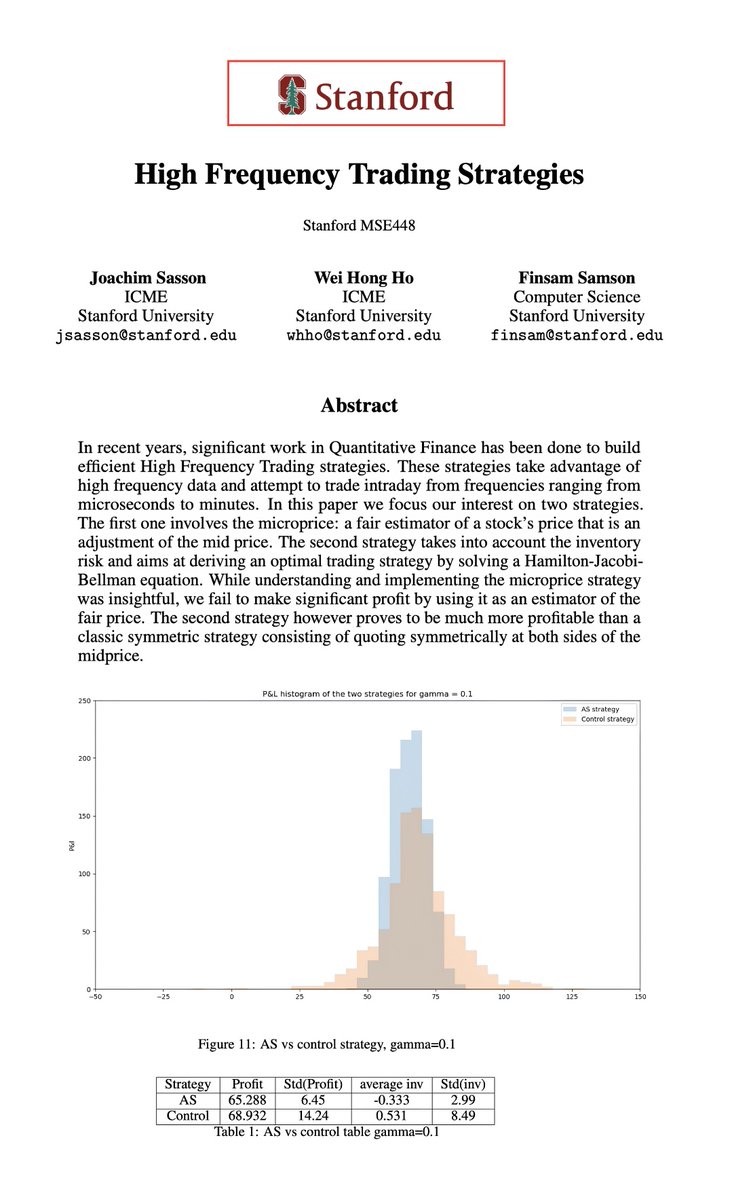
As someone who builds institutional level quant systems, this Stanford paper is the closest thing to an HFT desk I have ever seen publicly shared.
14 pages. Top Trading Strategies. Bookmark & get this, then read the article below before someone takes it down.
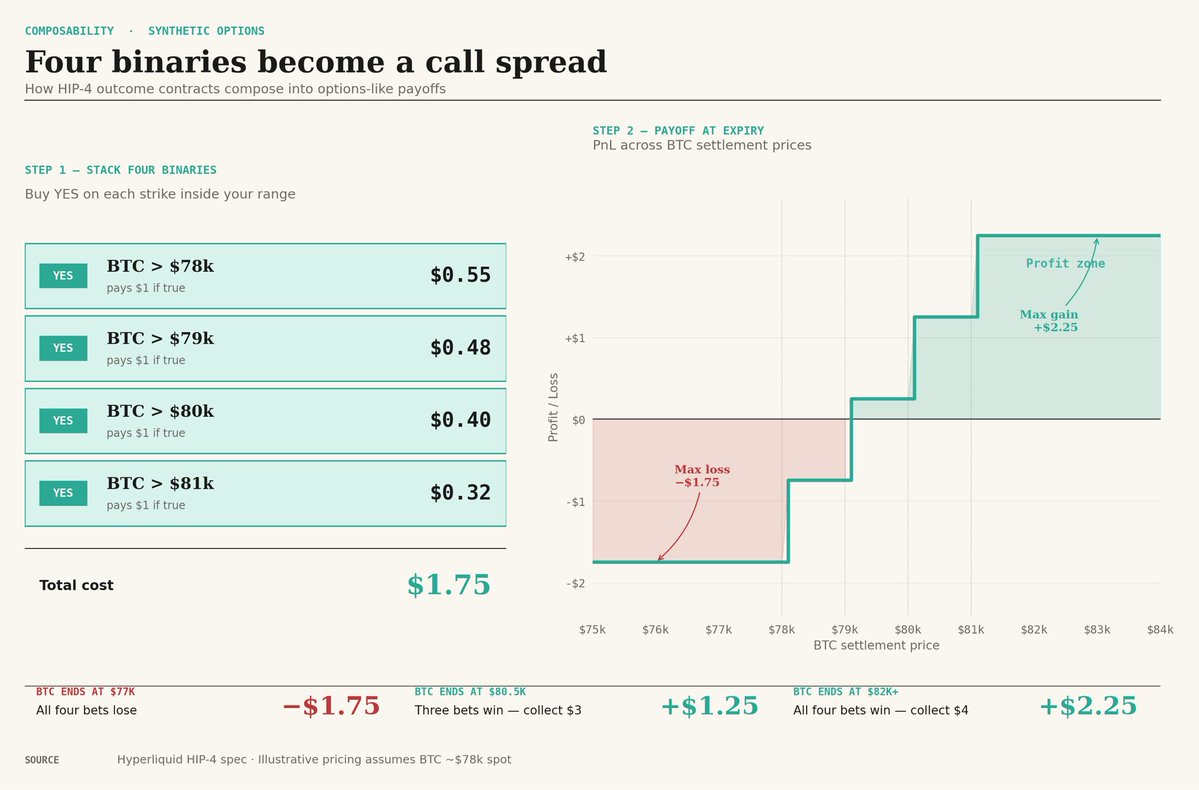
HIP-4 quietly enables synthetic options on @HyperliquidX
Want to bet BTC ends between $78k and $82k by Friday? Buy four cheap “yes/no” bets, one at each strike inside your range.
→ “BTC > $78k?” YES at $0.55
→ “BTC > $79k?” YES at $0.48
→ “BTC > $80k?” YES at $0.40
→ “BTC > $81k?” YES at $0.32
Total cost: $1.75. Each pays $1 if true.
If BTC ends at $80.5k → three bets win → +$1.25 profit
If BTC ends below $78k → all lose → -$1.75 max loss
If BTC ends above $81k → all win → +$2.25 max gain
Same shape as a call spread. Built from four binaries.
Polymarket can do this in theory. But each bet sits in a separate market with separate collateral, and you can’t cross-margin against a BTC perp.
HIP-4 puts all of it on one engine, one collateral pool, alongside your perp delta.
That’s how a binary book becomes an options surface.
The personal knowledge base build, in 60 seconds:
Total setup: 45 minutes this weekend. Then it compounds forever.
1. 5 minutes: Setup
Create 3 folders: raw/, wiki/, outputs/. Drop a CLAUDE.md schema file in the root. Done.
2. 10 minutes: Dump
Copy-paste articles, notes, screenshots, meeting transcripts into raw/. Don't rename. Don't organize.
3. 30 minutes: Let the AI build
Point Claude at the folder. "Read everything in raw/. Compile a wiki following CLAUDE.md rules. Create INDEX.md first."
Walk away. Come back to organized articles, [[linked]] topics, and a searchable index.
4. Ongoing: The compounding loop
Ask questions. Save answers back to raw/. Every query makes the next answer better.
5. Monthly: Health check
Tell the AI to flag contradictions, find unexplained topics, and suggest 3 new articles to fill gaps.
The system gets smarter the longer you use it.
Day 1 it's basic. Day 90 it's a company asset nobody else has.
Jane Street pays $650,000 a year for quants. MIT wrote the exact bible to get there & released it for free.
51 pages. Zero to quant. Probability, stats, market making, real interview questions from Jane Street, Citadel, Two Sigma & more. Bookmark, before someone takes it down.
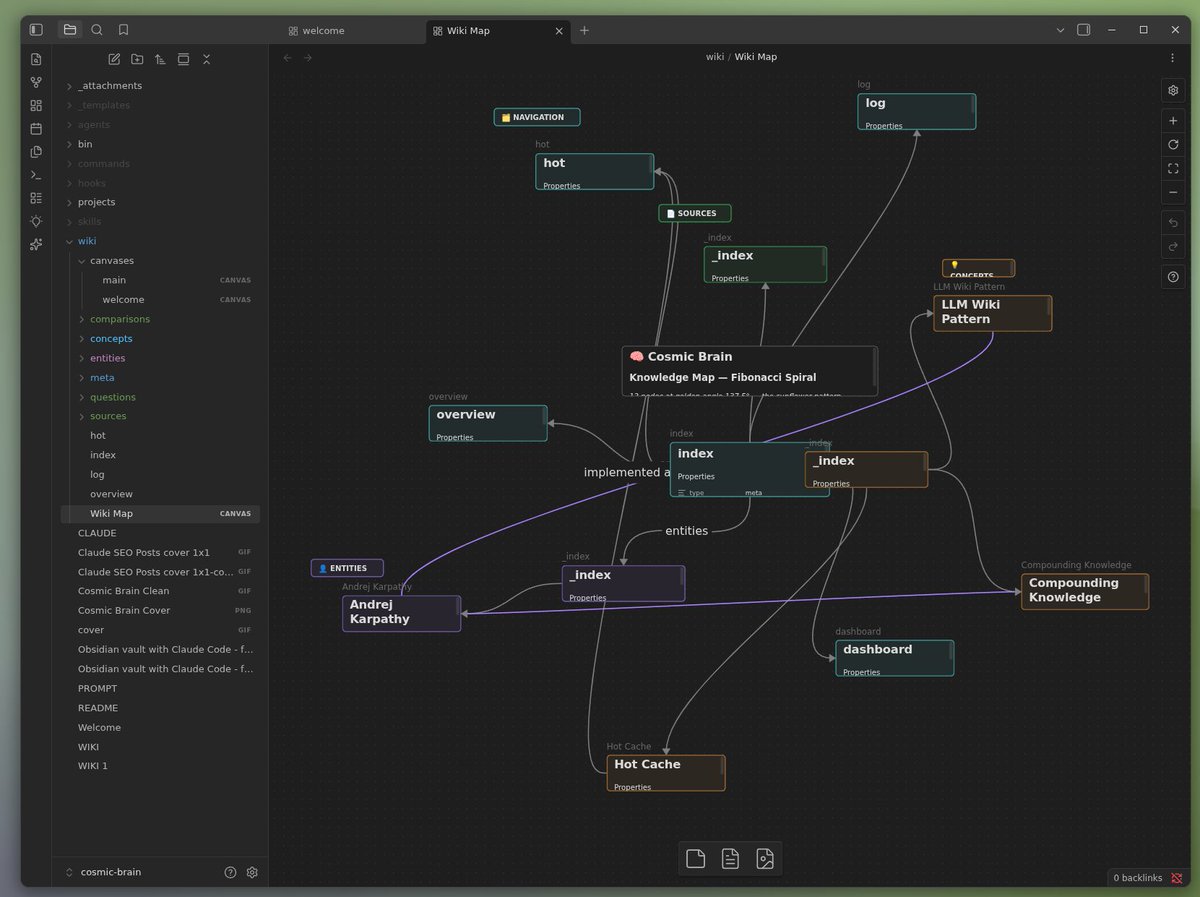
ANDREJ KARPATHY DESCRIBED A KNOWLEDGE SYSTEM THAT GETS SMARTER THE LONGER IT RUNS.
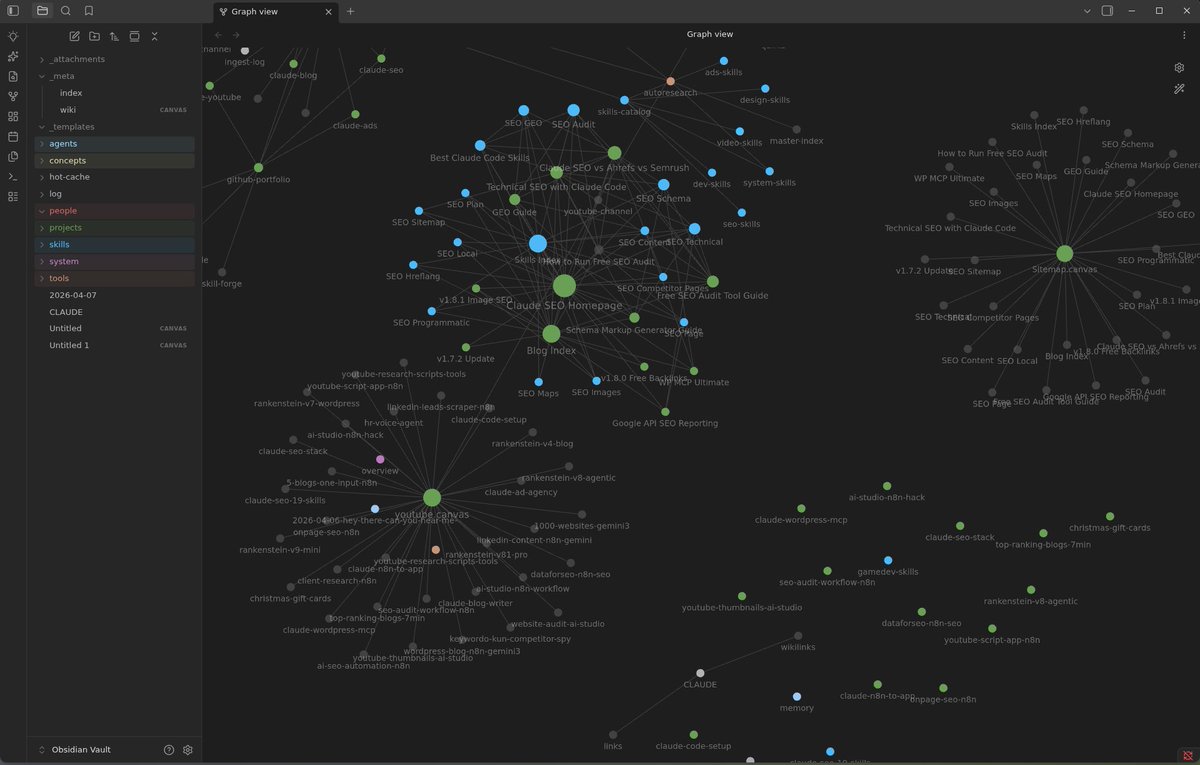
Someone built the whole thing inside Obsidian. 100% FREE.
Your notes become a WIKI THAT WRITES ITSELF and compounds like interest with every source you add.
Here is what is actually going on.
Karpathy dropped a gist a while back describing something he called the LLM Wiki pattern. The idea was simple but the implication was wild. Instead of asking an AI a question and getting an answer that disappears when you close the tab, you use the AI to build and maintain a persistent knowledge base that gets richer every single time you add something to it. The 50th source you add does not create 50 isolated notes. It creates 50 notes woven into a mesh of 500 cross-referenced connections.
Nobody built it properly. Until now.
It is called claude-obsidian. You install it in Claude Code, open your Obsidian vault, type /wiki, and the whole thing sets itself up. From that point forward the AI does the organizing, the cross-referencing, the contradiction flagging, and the filing. You just drop sources in and ask questions.
- /wiki ingest builds structured wiki pages from anything you throw at it, URLs, PDFs, articles, notes
- every new page gets cross-referenced against everything already in the vault automatically
- /autoresearch runs an autonomous research loop, configures depth and sources in one file, produces full wiki sections on its own
- a hot cache file stores the last session context so you never spend 10 minutes re-explaining what you were working on
- /save turns any Claude conversation directly into a permanent wiki page
- /canvas builds a visual knowledge graph connected to your vault
The creator tested /autoresearch on AI marketing automation. Three rounds produced 23 wiki pages. Two of those pages became blog posts that now rank on page one.
Every note app, every second brain system, every Zettelkasten method all have the same problem. They only work if you maintain them. And nobody maintains them. Notes go in, connections never get made, and six months later you have a digital graveyard.
This solves that. The AI maintains it for you. You just add things.
358 stars already. MIT license. Free forever.
Karpathy described the pattern. Someone spent weeks turning it into a tool anyone can install in two minutes and just use.
I still do not understand why this is not the most talked about repo this week.
HOW THIS AI BOT SCALPS POLYMARKET FOR STABLE GAINS BY SNIPING 2-3% MARGINS
(The exact high-frequency strategy breakdown inside this post)
This Polymarket trader executed 1,385 trades in just 10 days
He started on April 7th with zero history and turned into a volume machine
Placed over 1,380 bets with a focus on 100% automated execution
The Stats:
+1,385 predictions in 10 days
$992 biggest single win
High-frequency automated scalping
How you can do the same, just follow his strategy:
He avoids chasing 2x–10x moonshots. Instead, he targets "safe" outcomes with 2-3% returns.
He uses an automated bot to execute dozens of trades daily. While others wait for one big win, he wins 100 times on small margins.
Check his profile here: https://t.co/uxpuyCMv3g
If you don’t want to code your own bot, you can start with our:
https://t.co/Fe58oKN6ni
Best Quant bot for copy-trading on Polymarket with 99,3% win-rate
using Markov Chains algo backtested strategy on 72M trades to hit +$818K PnL on 27,000 predictions.
he isn't predicting odds - he uses math of Markov Chains to consistently hit 99% win rate.
his algo decoded:
1) Build transition matrix
discretize the price into 10 states (0-10¢, ..., 90-100¢), count how often the price moves from each state to every other state
formula: P(St+1 = j | St = i) = T[i][j]
//
2) Run simulation using Monte Carlo
Once you have the transition matrix, you simulate. Walk forward through matrix for N days. Repeat +10K times.
formula: P(YES) = (1/N) × Σ × 1 [path ends price > 50¢]
//
3) Backtest strategy on a 72M-backer dataset
The bot uses three main findings from John Baker’s research on 72M Kalshi trades in its logic:
• finding 1: The Longshot Bias
Cheap contracts are systematically overpriced.
• finding 2: Maker-Taker Wealth Transfer
Every market order you place pays the Optimism Tax. Use limit orders - always.
• finding 3: The Optimism Tax rule
If you must trade as a taker below 30¢, buy NO instead of YES. You're not fighting the bias - you're riding it.
bot profile: https://t.co/3nnQwAaCrh
copy-trading him even with 10$ using Ares: https://t.co/Exz5L2eAuI
Markov Chains os one of the oldest quant trading algorithm - helping top bots print millions in profit.
The same portfolio math MIT teaches quant fund managers applied directly to Polymarket position sizing.
GL Ratio. Kelly Criterion. Correlation-adjusted allocation. Most traders on Polymarket don't know these exist.
The ones who do are the accounts you're copying.
The ones who do are the accounts you’re copying.
If you want to see how they actually size positions in real time:
https://t.co/XRLWjT2bAw
Full breakdown in the thread




![coreyganim's tweet photo. The personal knowledge base build, in 60 seconds:
Total setup: 45 minutes this weekend. Then it compounds forever.
1. 5 minutes: Setup
Create 3 folders: raw/, wiki/, outputs/. Drop a CLAUDE.md schema file in the root. Done.
2. 10 minutes: Dump
Copy-paste articles, notes, screenshots, meeting transcripts into raw/. Don't rename. Don't organize.
3. 30 minutes: Let the AI build
Point Claude at the folder. "Read everything in raw/. Compile a wiki following CLAUDE.md rules. Create INDEX.md first."
Walk away. Come back to organized articles, [[linked]] topics, and a searchable index.
4. Ongoing: The compounding loop
Ask questions. Save answers back to raw/. Every query makes the next answer better.
5. Monthly: Health check
Tell the AI to flag contradictions, find unexplained topics, and suggest 3 new articles to fill gaps.
The system gets smarter the longer you use it.
Day 1 it's basic. Day 90 it's a company asset nobody else has.](https://pbs.twimg.com/media/HHY1zc-agAA5H1t.jpg)



![0xMovez's tweet photo. Best Quant bot for copy-trading on Polymarket with 99,3% win-rate
using Markov Chains algo backtested strategy on 72M trades to hit +$818K PnL on 27,000 predictions.
he isn't predicting odds - he uses math of Markov Chains to consistently hit 99% win rate.
his algo decoded:
1) Build transition matrix
discretize the price into 10 states (0-10¢, ..., 90-100¢), count how often the price moves from each state to every other state
formula: P(St+1 = j | St = i) = T[i][j]
//
2) Run simulation using Monte Carlo
Once you have the transition matrix, you simulate. Walk forward through matrix for N days. Repeat +10K times.
formula: P(YES) = (1/N) × Σ × 1 [path ends price > 50¢]
//
3) Backtest strategy on a 72M-backer dataset
The bot uses three main findings from John Baker’s research on 72M Kalshi trades in its logic:
• finding 1: The Longshot Bias
Cheap contracts are systematically overpriced.
• finding 2: Maker-Taker Wealth Transfer
Every market order you place pays the Optimism Tax. Use limit orders - always.
• finding 3: The Optimism Tax rule
If you must trade as a taker below 30¢, buy NO instead of YES. You're not fighting the bias - you're riding it.
bot profile: https://t.co/3nnQwAaCrh
copy-trading him even with 10$ using Ares: https://t.co/Exz5L2eAuI
Markov Chains os one of the oldest quant trading algorithm - helping top bots print millions in profit.](https://pbs.twimg.com/media/HFoSiQqWIAAcCJH.jpg)





