Translational epilepsy research in an academic setting | neuroscience, drug discovery, zebrafish, electrophysiology, cell therapy, precision medicine and more
My lab is currently recruiting a MSc or PhD student with experience in slice electrophysiology to study hippocampal circuit dysfunction in a mouse model of autism spectrum disorder (field potentials, whole cell patch, optogenetics). Please reach out if interested! #neurojobs
We are hiring! The Wang Lab is looking for a postdoctoral fellow with strong computational neuroscience/neural engineering background who is interested in working on human translational neuroscience projects on closed loop neuromodulation! Pleas email me if interested!
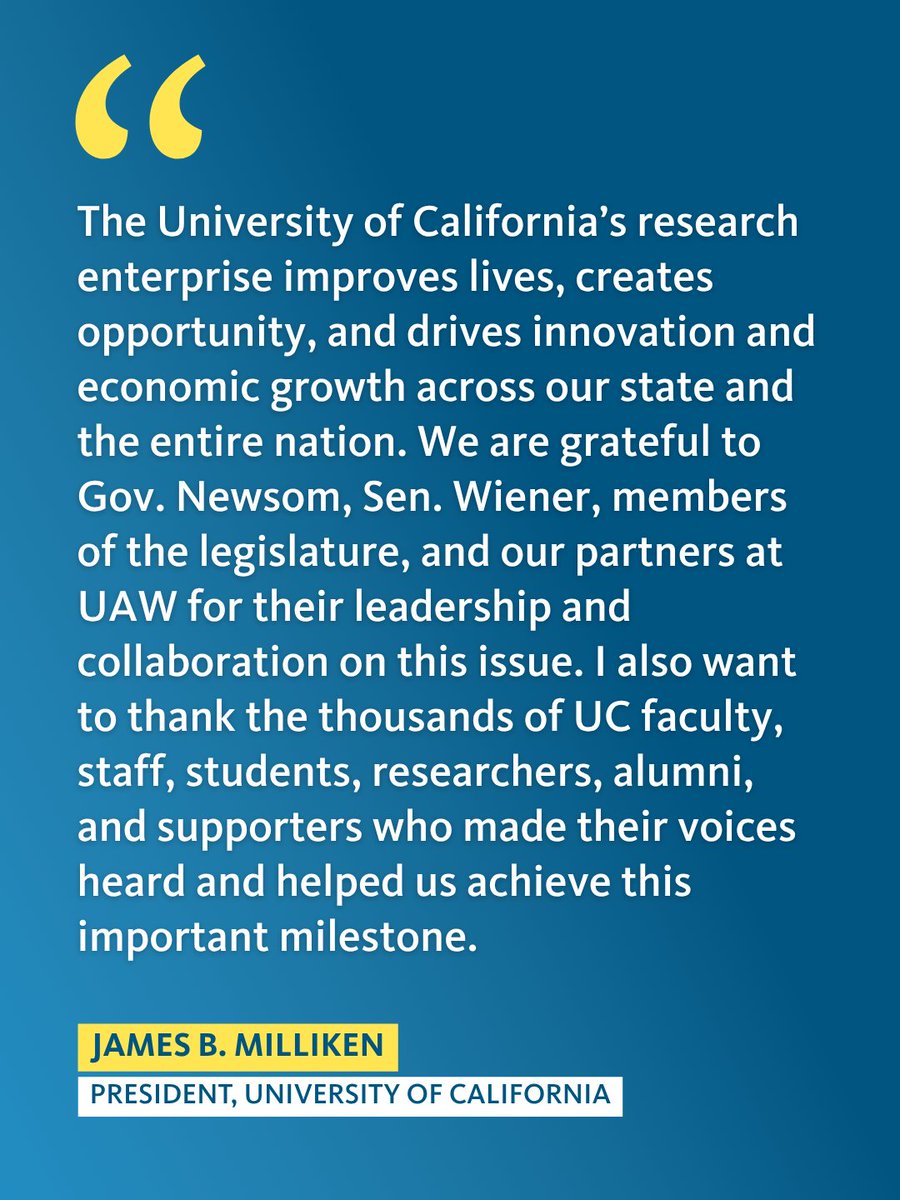
A major milestone for California research — @CAGovernor Newsom has signed SB 895, the California Science and Health Research Bond Act, placing $7.5 billion in research funding before California voters on the March 2028 ballot.
Reaching this point took an extraordinary effort from researchers, students, patients, and advocates from across California.
To everyone who spoke up in support of investing in California research: thank you.
Thrilled to share our study is out at @NeuroCellPress ! @Xiaoling3113@jingliang_zhang did a fantastic job using human brain organoids to understand SCN2A disorder and advance therapeutic development. Thanks to NIH and @FamilieSCN2A for the tremendous support!
UVA Pharmacology is looking for new faculty colleagues to join an exciting and collaborative group.
Posting and information at:
https://t.co/QVMzagRBfo two open rank tenured/tenure-track faculty positions
A pig kidney transplant worked for a record nine months. This enabled the recipient to stay off dialysis for longer while waiting for a suitable human donor's kidney to become available https://t.co/QdMvmltefh
Jennifer Doudna won the Nobel Prize for gene editing and went on Bloomberg to say the chatbots everyone is betting on cannot innovate at all. Every promise Silicon Valley is making about AI curing disease just hit the one person qualified to check it.
She has spent her whole career inside the actual frontier of curing disease.
So when she talks about what AI can and cannot do in biology, she is not guessing. She is reporting from inside the lab.
Her words were blunt. She is not seeing chatbots innovate. They summarize data. They write reports. They do not come up with a brand new idea nobody has ever had.
Then the interviewer pushed. So you're saying AI can't innovate?
Doudna did not flinch. She does not know if it can't. She just does not see it doing it right now.
This lands harder when you remember who is making the opposite case. Sam Altman says AI will eliminate disease within five years. Larry Ellison says AI will cure cancer in a 48 hour window.
An OpenAI executive even floated that the company should get a cut of sales on any drug discovered through ChatGPT. Doudna answered that in two words. Good luck.
Even the cancer specialists Altman is selling to keep warning that cancer is not one disease but hundreds, each needing its own cure, and that compute does not skip the years of lab work.
Her reason is simpler. Biology is hard. You cannot simulate your way to an understanding of the human body.
The people promising cures are the ones selling the tool.
The person who actually won a Nobel building them is telling you it has not happened yet.
Source: Bloomberg Originals
Watch the full video on their official channel.
@KoswasCrypto Anybody can write a grant that *proposes* "significant and rigorous" science. Many fewer actually *do* significant and rigorous science. If the latter is not considered, then why bother establishing a good track record anyway?
Salk Institute scientist Shrek Chalasani has been awarded up to $41.3 million from ARPA-H to advance a breakthrough technology he pioneered, sonogenetics, which uses ultrasound to precisely control cells within the body.
This funding will help transform the Chalasani lab’s discovery into a potential noninvasive therapy for a range of conditions, including peripheral neuropathies. By enabling targeted control of mammalian cells without surgery, sonogenetics could redefine how we treat disease.
Learn more: https://t.co/BjzB32CbaK
#SalkInstitute #ARPAH #Sonogenetics #Neuroscience #BiomedicalInnovation
This #FluorescenceFriday comes from the @BarabanLab at UCSF: a new paper by @joseanemarafiga et al. sheds light on how dysregulation in the C1qa gene, which has been linked to neurological disorders like #epilepsy, affects inhibitory neural circuits. (1/4) 🧵
A researchers’ propensity for risky projects is passed down to their doctoral students — and stays with trainees after they leave the laboratory
https://t.co/I71N9jl5sz
More than five years later, @Cronutt1 is still seizure-free and living his best life @sixflagsDK after receiving an experimental therapy with transplanted interneuron progenitor cells developed by the @BarabanLab: https://t.co/1Mx01gBImz
@UCSF@Claire_Simeone@UCI_EpiCenter
Example of the cost of the government shutdown. The NIH study panel I'm serving was postponed. Ended up running with Dec 24, 29, and Jan 2 deadlines. My wife of 30+ years has drawn the line - no more NIH panels. She tolerated weekends, but holiday time was a bridge too far.