I am extremely honoured to have received the Clinical Biomechanics Award. Presenting yesterday was the perfect end to a fantastic @ISB_2021. I am thankful for everyone @lmbethz who made this work possible, but especially my co-authors including @p_m_schuetz and @w_r_taylor.
Congratulations to the following award winners from the #ISB2021#biomechanics Congress:
Carlo de Luca Emerging Scientist Award: @TomBuurke
Promising Scientist Award: @LizethSloot
Clinical Biomechanics Award: @BarbaraPostolka
The Motor Control Student Award: @LeaRissmann
📢New Paper Alert 📢
My first PostDoc paper about combining innovative 4D CT imaging and musculoskeletal modelling to assess kinematics and kinetics of the hindfoot was just published in Gait & Posture.
50 days’ free access through the following link:
https://t.co/ol3ifmV0xC
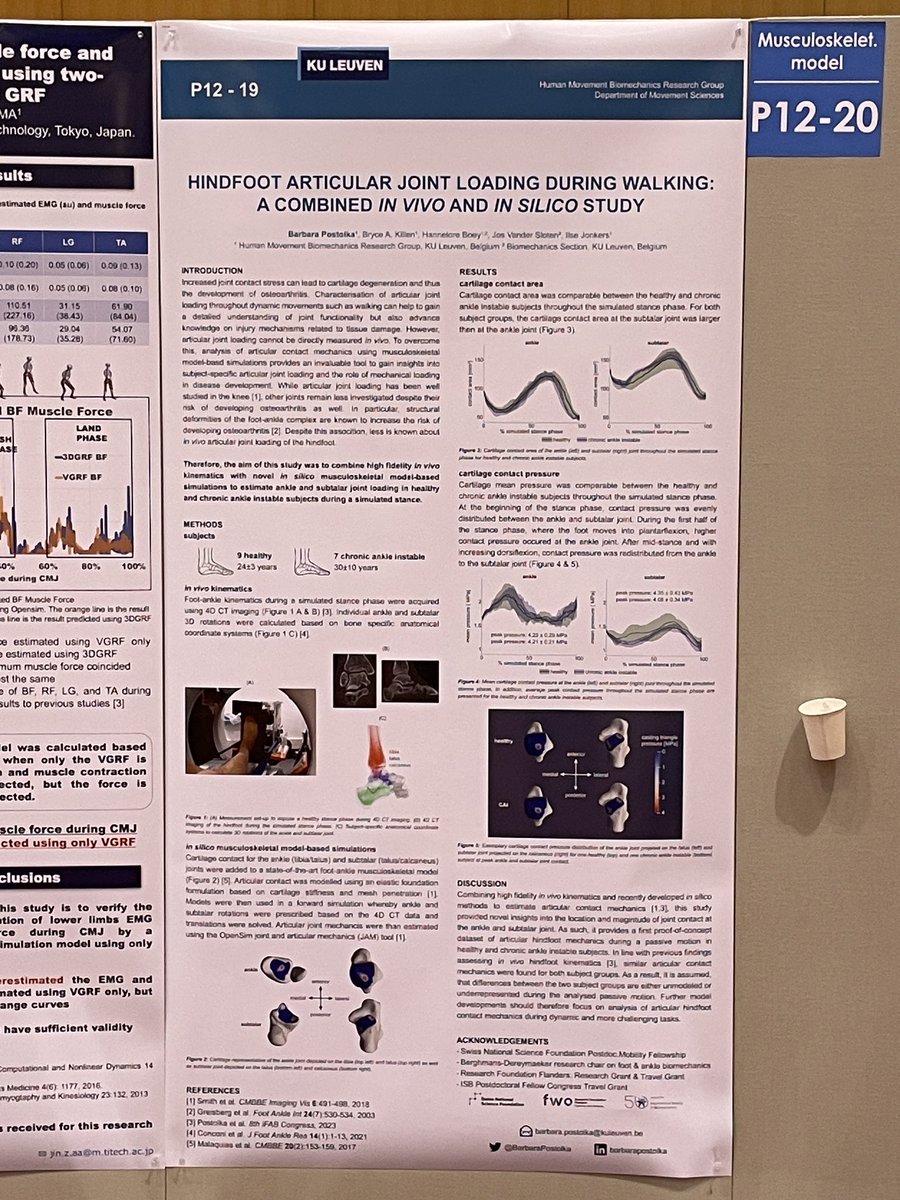
@KinesKing@ISBiomechanics During this, subjects were lying in a supine position and a stance phase was imposed through a foot manipulator. Therefore this was a passive motion and things might look different if we use skin marker gait data as input to the model, which is the next step
My @ISBiomechanics poster is up :) If you want to know more about articular contact mechanics of the ankle and subtalar joint, come and talk to me during todays poster session or let me know during the day. #ISBJSB2023
@KinesKing@ISBiomechanics We have to study the underlying mechanism in more detail, but the rotations prescribed in the forward simulation (translations were allowed to solve) were acquired using 4DCT imaging.
@KinesKing@ISBiomechanics Indeed, at the beginning of the simulated stance, contact pressure is evenly distributed between both joints, then peak ankle pressure at about peak plantar pressure and peak subtalar pressure at about peak dorsiflexion.
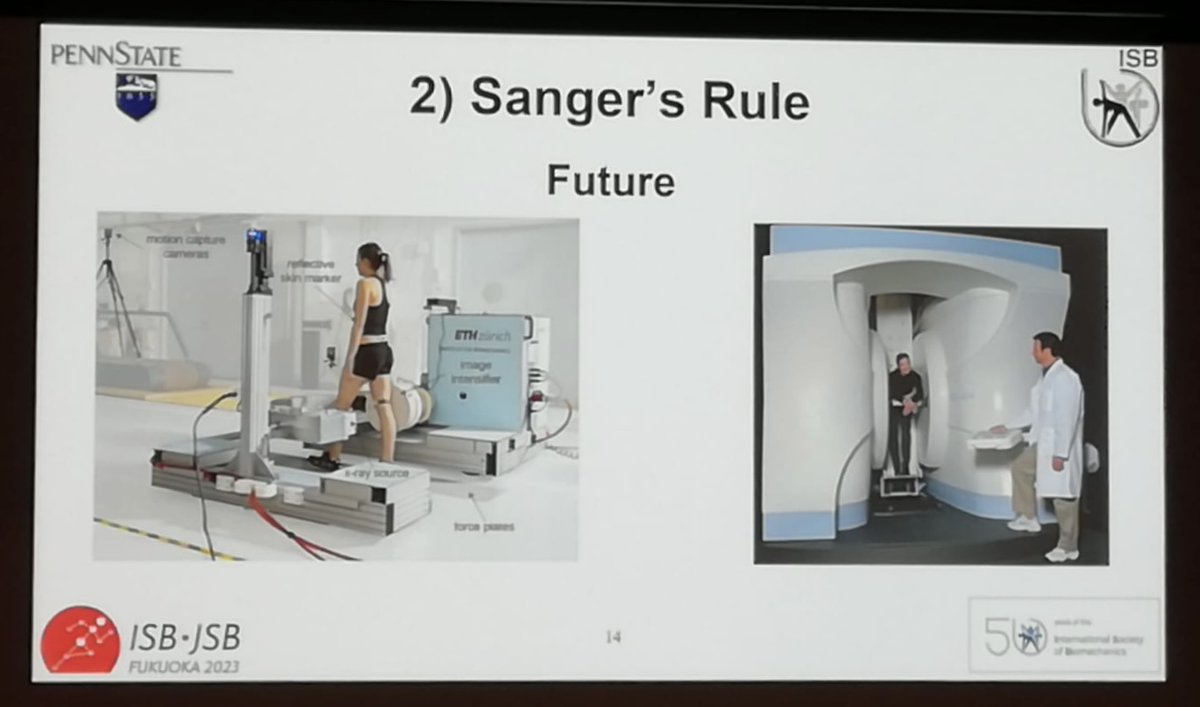
Proud to see an image of my PhD work being showcased in the future of gait analysis talk in the 50 years of @ISBiomechanics anniversary session #ISBJSB2023 @lmbethz
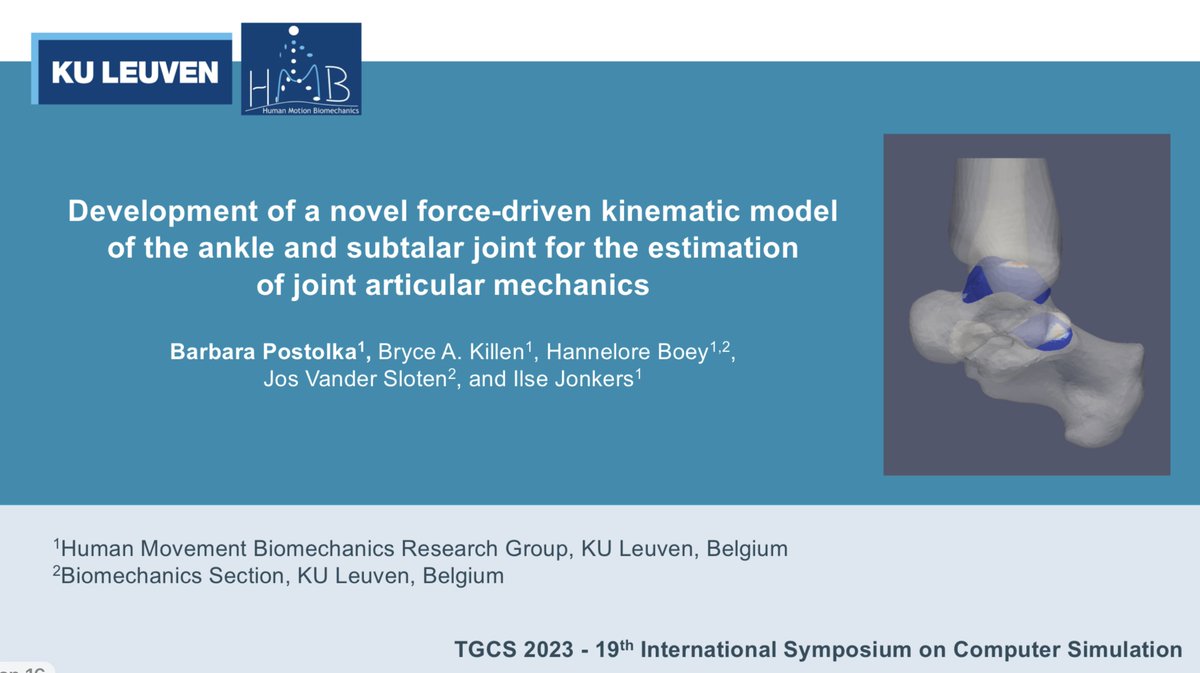
On my way to Japan to attend TGCS and ISB 2023. Looking forward to present my postdoc work about musculoskeletal modelling of the foot & ankle and connect with old and new colleagues from all around the world. @TGCS2023@ISBiomechanics
Tibio-femoral kinematics are sensitive to the kinematic analysis approach used! More about the influence of contact estimates, functional axes, and anatomical axes on condylar translations in our latest open access paper https://t.co/pFR1he4Eqo
@p_m_schuetz@w_r_taylor@JBiomech
It's out! Our @esbiomech S.M.Perren award manuscript is now available describing the loads and kinematics that occur in the tibio-femoral joint during activities of daily living. #CAMSKnee @ESBiomech_2022
https://t.co/kdIH3fiX6d
Our @ISBiomechanics Clinical Biomechanics Award paper 2022 is now open access at https://t.co/kOhUo2vlxs
Well done @BarbaraPostolka@p_m_schuetz and the team for their work on: Tibio-femoral kinematics of natural versus replaced knees – A comparison using dynamic videofluoroscopy
Exciting opportunity shaping 'In Silico Rehabilitation'! Postdoctoral fellowship on predictive simulations to inform personalized rehabilitation programs for knee OA patients https://t.co/HohYSoG0Y1 with @bryce_killen and @FriedlDeGroote in the context of #iSiHealth
Maximal lateral ligament strain and loading during functional activities: Model-based insights for ankle sprain prevention and rehabilitation https://t.co/mHivilXF9V
Die @ETH-Studie um Erstautorin @BarbaraPostolka wurde mit dem ISB Clinical Biomechanics Award ausgezeichnet. Mit Dr. sc. ETH Renate List und unserem Human Performance Lab war auch die Schulthess Klinik in die Studie involviert. Gratulation!
Mehr dazu: https://t.co/Xt1apimTnS
Looking forward to my @ISB_2021 presentation in the upcoming Clinical Biomechanics Session (OB1 @ 12pm), where I will present our comparison of tibio-femoral kinematics in natural and TKR subjects using our moving fluoroscope