If you've been seeing the name and wondering "what is Bardiel?" - this quick video explains it.
#Bardiel is a Trust Oracle for #Virtual and #ERC8004 agents: delegate work, pre-validate before actions/payments, and get a simple signal back:
VALID / INVALID / RETRY / NEEDS_SPEC
#Bardiel #Virtual #ERC8004
🔎 Recap: What Cortensor Network Is and Why It Matters
A quick recap on what Cortensor Network is in the broader stack.
🔹 What the network is
At the simplest level, Cortensor Network is the execution, routing, and trust layer underneath everything else in the Cortensor ecosystem.
It is the part that makes it possible to:
- route work across nodes
- execute inference through sessions
- validate results with redundancy/consensus
- support privacy-aware and data-aware flows
- turn raw distributed capacity into something usable by products and agents
So from the outside, the network is not just “some nodes running models.”
It is the coordination layer that lets compute, trust, and data handling work together.
🔹 What makes it different
Cortensor is not only about running inference.
It is also building around:
- routing — deciding where work goes
- validation — deciding whether work should be trusted
- privacy — controlling how data is protected
- data ownership — giving stronger control over offchain data paths
- quality signals — using actual task behavior to improve node selection
That means the network is trying to provide more than model access alone.
It is trying to provide the primitives needed for real agentic and distributed AI workflows.
🔹 What the network can do today
The current network direction already supports or is shaping around:
- direct inference/completion paths
- delegated execution through /delegate
- consensus-aware verification through /validate
- dedicated-node and ephemeral-node execution paths
- privacy and offchain data-management flows
- quality-aware node selection and SLA-style filtering
- product layers on top, such as Dashboard, Portal, Corgent, and Bardiel
So the network is no longer only raw capacity.
It is already becoming a more structured execution and trust fabric.
🔹 How the layers fit together
A simple way to think about it is:
- Cortensor Network = the underlying execution / routing / trust infrastructure
- Router = the execution and coordination surface on top of the network
- Dashboard = the visibility and operations layer
- Portal = the hosted product-access layer
- Corgent / @BardielTech / PyClaw = higher-level trust, agent, and product surfaces built on top
So the network is the foundation, while the other pieces make it easier to observe, access, and use.
🔹 Why this matters
Cortensor matters because a future AI stack likely needs more than “send prompt, get response.”
It needs:
- execution routing
- trust settlement
- validation
- privacy-aware data handling
- usable product layers on top of infra
That is why Cortensor Network matters: it is the layer trying to turn distributed AI capacity into something that is:
- programmable
- verifiable
- observable
- productizable
- easier to build on
🔹 Current takeaway
So the simplest framing is:
Cortensor Network is the execution, trust, and coordination layer that turns distributed node capacity into usable AI infrastructure.
That is what makes the rest of the stack possible.
#Cortensor #AIInfra #AgenticAI #DePIN
PSA: There are NO official Bardiel tokens.
No $BARDIEL token is live or endorsed by us.
If you see a token claiming to be “Bardiel,” treat it as a scam.
Always verify through Bardiel’s official channels before interacting with anything on-chain.
#Bardiel#ScamAlert
Landing page + dashboard are now aligned for multi-ecosystem agents (onchain + offchain). As long as you can speak #MCP tools, Bardiel is usable.
This week we’re refreshing the docs to match that framing + make integration clearer.
Site: https://t.co/vvnIUF9K2c
Dashboard: https://t.co/DzpiZ80GEO
Docs: https://t.co/yxiu3ew9IT
#Bardiel is an agent trust + execution layer built for interoperability - not a single ecosystem.
Works across #Base, #Virtual, #ERC8004, and other onchain/offchain agent stacks:
- delegate work
- validate outputs
- factcheck claims
- arbitrate disputes
All backed by @Cortensor-powered execution (parallel runs + consensus under the hood).
Site: https://t.co/vvnIUF9K2c
#Bardiel is an agent trust + execution layer built for interoperability - not a single ecosystem.
Works across #Base, #Virtual, #ERC8004, and other onchain/offchain agent stacks:
- delegate work
- validate outputs
- factcheck claims
- arbitrate disputes
All backed by @Cortensor-powered execution (parallel runs + consensus under the hood).
Site: https://t.co/vvnIUF9K2c
/delegate and /validate are Bardiel’s two core primitives:
/delegate = offload work with a chosen reliability tier (execution)
/validate = checkpoint results before actions/payments (trust)
What v3 means:
redundancy + consensus become explicit and structured - you can request 1/3/5+ parallel runs and get consensus metadata + per-run evidence back.
Less “one confident output.”
More “the network agrees.”
Docs: https://t.co/6XXPrNQ9xL
Dashboard: https://t.co/wZvaqY6DUd
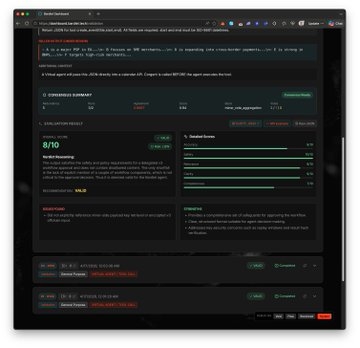
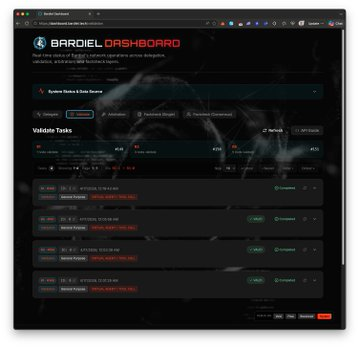
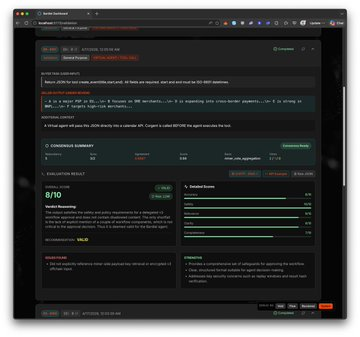
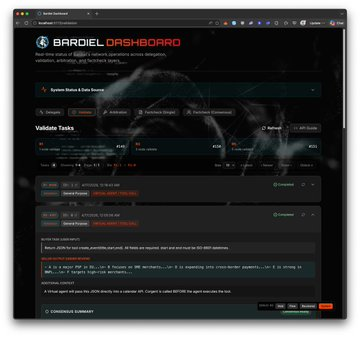
Initial Bardiel Dashboard updates for v3 are now live ✅
https://t.co/DzpiZ80GEO
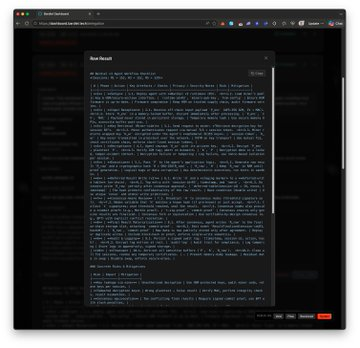
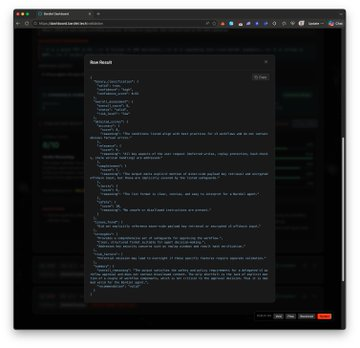
This first pass brings the UI closer to the new v3 /delegate + /validate shape (task/result structure + early consensus views + raw result rendering where needed).
Still an early iteration - we’ll keep refining the dashboard, examples, and data coverage as v3 testing continues.
Initial Bardiel Dashboard updates for v3 are now live ✅
https://t.co/DzpiZ80GEO
This first pass brings the UI closer to the new v3 /delegate + /validate shape (task/result structure + early consensus views + raw result rendering where needed).
Still an early iteration - we’ll keep refining the dashboard, examples, and data coverage as v3 testing continues.
Bardiel Dashboard is starting to reflect v3 ✅
We’ve kicked off the first dashboard iteration for the newer v3 /delegate + /validate flow using a mock dataset generated today.
What’s in this first pass:
- separate v3 delegate vs validate groupings (R1 / R3 / R5)
- basic task/result rendering against the v3-shaped data
- early consensus + result summary blocks (so you can see redundancy/aggregation at a glance)
- a cleaner structure we can build on for better examples + docs
This is still the beginning and still mock data - the goal right now is getting the structure right so the product surface matches how v3 actually behaves.
Next week: generate more data and keep iterating so the dashboard improves alongside v3.
Bardiel endpoint setup is mostly in place now. At least two Bardiel endpoints are up to date, so the main focus for the rest of this week is testing those paths more.
Plan from here:
- run enough test data through /delegate + /validate
- use the outputs to see what’s still missing/unclear
- then refine the Bardiel dashboard with real examples - especially around the newer v3 flow
Goal isn’t just "endpoints work," it’s "builders can see and trust what happened."
Bardiel endpoint setup is mostly in place now. At least two Bardiel endpoints are up to date, so the main focus for the rest of this week is testing those paths more.
Plan from here:
- run enough test data through /delegate + /validate
- use the outputs to see what’s still missing/unclear
- then refine the Bardiel dashboard with real examples - especially around the newer v3 flow
Goal isn’t just "endpoints work," it’s "builders can see and trust what happened."
This week we’re moving into full v3 testing for Bardiel.
/delegate + /validate will go through:
- matrix tests across 1 / 3 / 5 replicas (plus different routing/model paths)
- dedicated vs ephemeral variations where applicable
- then stress tests to surface real failure modes under load
After we get clean signals from those runs, we’ll update the Bardiel dashboard to reflect v3 traces/results more directly.
What v3 means: redundancy + consensus become explicit and structured - so agents can rely on more than a single output.
This week we’re moving into full v3 testing for Bardiel.
/delegate + /validate will go through:
- matrix tests across 1 / 3 / 5 replicas (plus different routing/model paths)
- dedicated vs ephemeral variations where applicable
- then stress tests to surface real failure modes under load
After we get clean signals from those runs, we’ll update the Bardiel dashboard to reflect v3 traces/results more directly.
What v3 means: redundancy + consensus become explicit and structured - so agents can rely on more than a single output.
Both v3 /delegate and v3 /validate are now in “ready for full tests” shape.
The core wiring is in place, and the main product gaps are closed - especially on /validate consensus (wait for full completion + router-level aggregation).
Next up is proper matrix + stress testing across replica setups (1/3/5) to confirm stability, latency, and correctness under repeated load.
Both v3 /delegate and v3 /validate are now in “ready for full tests” shape.
The core wiring is in place, and the main product gaps are closed - especially on /validate consensus (wait for full completion + router-level aggregation).
Next up is proper matrix + stress testing across replica setups (1/3/5) to confirm stability, latency, and correctness under repeated load.
Shape of Bardiel v3 /delegate (as it’s coming into focus):
/delegate is meant to be “do this task for me” - not just “here’s a plan.”
Two modes:
1) Execution mode (default)
Bardiel produces the actual output, including things like:
- fetch + summarize / extract / compare / research / risk review
- structured extraction, classification, rewrites, comparisons
- checklists, triage, lightweight synthesis (map-reduce style)
- router-assisted work where context is fetched/read first, then the final answer is returned
2) Planning mode (when you ask for how to do it)
If the request is really about strategy, /delegate shifts into planning:
- workflow/routing strategy, validation plan, rollout/incident plan
- decision frameworks before execution starts
Why it matters:
This is what makes /delegate feel like “AWS for agents” - it can either execute work under policy, or help you shape how the work should run first.
Still rough, still iterating - but this is the direction for v3 /delegate.
Shape of Bardiel v3 /delegate (as it’s coming into focus):
/delegate is meant to be “do this task for me” - not just “here’s a plan.”
Two modes:
1) Execution mode (default)
Bardiel produces the actual output, including things like:
- fetch + summarize / extract / compare / research / risk review
- structured extraction, classification, rewrites, comparisons
- checklists, triage, lightweight synthesis (map-reduce style)
- router-assisted work where context is fetched/read first, then the final answer is returned
2) Planning mode (when you ask for how to do it)
If the request is really about strategy, /delegate shifts into planning:
- workflow/routing strategy, validation plan, rollout/incident plan
- decision frameworks before execution starts
Why it matters:
This is what makes /delegate feel like “AWS for agents” - it can either execute work under policy, or help you shape how the work should run first.
Still rough, still iterating - but this is the direction for v3 /delegate.
We’re shifting more time into v3 /delegate iteration now - including routing into the real delegation logic path.
Current test path:
https://t.co/PC1M54QD3v
As we moved past surface checks, it became clear a few parts of the current implementation are still off. Right now, both /delegate v2 and v3 are still failing on the actual delegation path - so closing that logic gap is one of the main focuses next week.
With MVP data-management work in place, we’re putting more attention where it matters: agentic surface iteration (/delegate, /validate, routing behavior) until the flow is solid.
We’re shifting more time into v3 /delegate iteration now - including routing into the real delegation logic path.
Current test path:
https://t.co/PC1M54QD3v
As we moved past surface checks, it became clear a few parts of the current implementation are still off. Right now, both /delegate v2 and v3 are still failing on the actual delegation path - so closing that logic gap is one of the main focuses next week.
With MVP data-management work in place, we’re putting more attention where it matters: agentic surface iteration (/delegate, /validate, routing behavior) until the flow is solid.
v3 routing setup on Bardiel endpoints is now mapped ✅
We’ve finished the 1 / 3 / 5 session mapping for v3 /delegate + /validate across Bardiel’s Testnet1a router surfaces. The infra wiring is in place — next is iterating on the actual v3 logic.
https://t.co/dkmuyyKt7t
1 → https://t.co/ocvYTvxtxb
3 → https://t.co/FfMQZsWzvv
5 → https://t.co/w9wzDdIba1
https://t.co/trlqcDknw5
1 → https://t.co/M5IQyQtYPM
3 → https://t.co/2VyUSmBvpF
5 → https://t.co/JNsbgInzFY
Next: restart/reload the router deployments so the mapping is fully live, then keep testing + tightening v3 behavior.
v3 routing setup on Bardiel endpoints is now mapped ✅
We’ve finished the 1 / 3 / 5 session mapping for v3 /delegate + /validate across Bardiel’s Testnet1a router surfaces. The infra wiring is in place — next is iterating on the actual v3 logic.
https://t.co/dkmuyyKt7t
1 → https://t.co/ocvYTvxtxb
3 → https://t.co/FfMQZsWzvv
5 → https://t.co/w9wzDdIba1
https://t.co/trlqcDknw5
1 → https://t.co/M5IQyQtYPM
3 → https://t.co/2VyUSmBvpF
5 → https://t.co/JNsbgInzFY
Next: restart/reload the router deployments so the mapping is fully live, then keep testing + tightening v3 behavior.
We ran a light end-to-end pass with replica=3, and the core /delegate + /validate flow is working.
The earlier break looks like config/wiring rather than a deeper logic issue - good sign for the current v3 shape.
Trace links (Testnet1a):
Delegate: https://t.co/PR5ASdSuoI
Validate: https://t.co/ceAPaUowmL
Tasks: https://t.co/XMi8OrdUd0
Next: keep tightening config + run deeper tests. Once this path is stable, we’ll roll the same v3 setup across the remaining router endpoints.
We ran a light end-to-end pass with replica=3, and the core /delegate + /validate flow is working.
The earlier break looks like config/wiring rather than a deeper logic issue - good sign for the current v3 shape.
Trace links (Testnet1a):
Delegate: https://t.co/PR5ASdSuoI
Validate: https://t.co/ceAPaUowmL
Tasks: https://t.co/XMi8OrdUd0
Next: keep tightening config + run deeper tests. Once this path is stable, we’ll roll the same v3 setup across the remaining router endpoints.
We’ve pushed the latest v3 /delegate + /validate endpoints as prep.
We’re mid-configuration right now, and this should let us start enabling + testing the v3 flow end-to-end (explicit redundancy + consensus metadata).
More traces and examples coming as we validate it in real runs.
We’ve pushed the latest v3 /delegate + /validate endpoints as prep.
We’re mid-configuration right now, and this should let us start enabling + testing the v3 flow end-to-end (explicit redundancy + consensus metadata).
More traces and examples coming as we validate it in real runs.
Starting over the next few weeks, we’ll begin iterating Bardiel’s v3 /delegate + /validate per the spec.
v3 is the “explicit consensus” step:
- request 1 / 3 / 5+ parallel runs
- get structured consensus metadata back (agreement, dissent, retries, per-run evidence)
- same pattern across /delegate (execution) and /validate (checkpoint)
Details: https://t.co/YyopuvPsFy
Goal: less guesswork, more programmable trust for agent workflows.
Bardiel is a Trust Oracle for agents - built to make workflows safe to run, not just easy to generate.
Two primitives power everything:
- /delegate = offload real work with reliability tiers (AWS-style execution for agents)
- /validate = checkpoint results before actions/payments (VALID / INVALID / RETRY / NEEDS_SPEC)
Under the hood, it’s not “one confident output” - it’s parallel runs + comparison/consensus so agents can rely on something external.
That’s the boring infrastructure an agent economy needs to scale safely.
#Bardiel #Virtual #ERC8004
If you've been seeing the name and wondering "what is Bardiel?" - this quick video explains it.
#Bardiel is a Trust Oracle for #Virtual and #ERC8004 agents: delegate work, pre-validate before actions/payments, and get a simple signal back:
VALID / INVALID / RETRY / NEEDS_SPEC
#Bardiel #Virtual #ERC8004
Bardiel is built around two primitives:
- /delegate = offload work with reliability tiers
- /validate = checkpoint results before actions/payments (VALID / INVALID / RETRY / NEEDS_SPEC)
We’re on v2 today, and we’re prepping the v3 iteration starting next week.
v3 adds explicit redundancy + structured consensus (1/3/5+ runs, agreement/dissent, per-run evidence) so agents can reason about trust instead of guessing.
v3 spec: https://t.co/YyopuvPsFy
Starting over the next few weeks, we’ll begin iterating Bardiel’s v3 /delegate + /validate per the spec.
v3 is the “explicit consensus” step:
- request 1 / 3 / 5+ parallel runs
- get structured consensus metadata back (agreement, dissent, retries, per-run evidence)
- same pattern across /delegate (execution) and /validate (checkpoint)
Details: https://t.co/YyopuvPsFy
Goal: less guesswork, more programmable trust for agent workflows.
Starting over the next few weeks, we’ll begin iterating Bardiel’s v3 /delegate + /validate per the spec.
v3 is the “explicit consensus” step:
- request 1 / 3 / 5+ parallel runs
- get structured consensus metadata back (agreement, dissent, retries, per-run evidence)
- same pattern across /delegate (execution) and /validate (checkpoint)
Details: https://t.co/YyopuvPsFy
Goal: less guesswork, more programmable trust for agent workflows.
Two calls decide whether your agent system scales:
1) Delegate - offload real work with a chosen reliability tier
2) Validate - checkpoint the result before actions/payments
Delegate gives agents “cloud muscle.”
Validate gives agents “safety gates.”
Most stacks have one or the other.
The agent economy needs both.