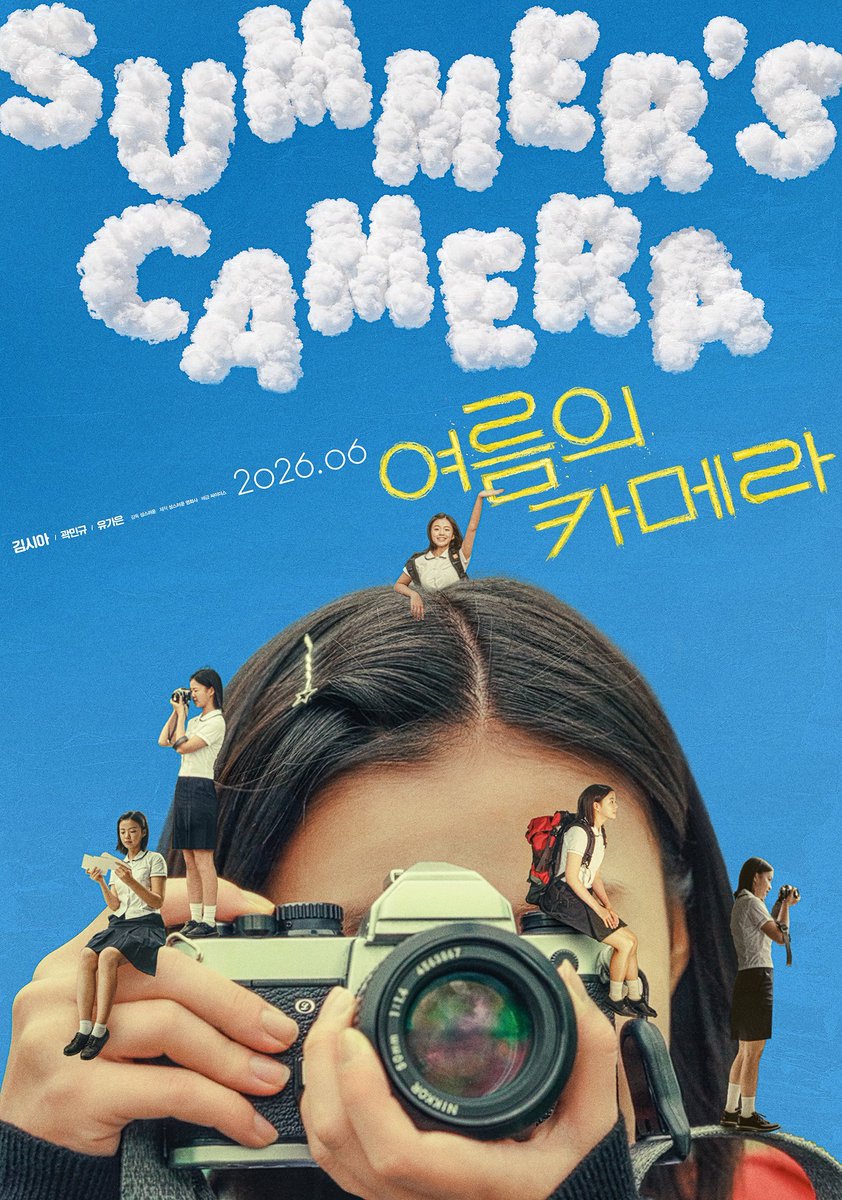
Summer’s Camera is finally being released — starting in Korea, and soon in the United States!
Please help spread the word so the film can reach even more countries around the world 🎞️
The 22M+ people who saw this tweet are missing the real story here.
This research is from 2019. Dr. Eva Ramón Gallegos at Mexico’s National Polytechnic Institute published these results six years ago. It went viral then too. Salma Hayek posted about it on Instagram. ABC News ran a fact check. It resurfaced in January 2025 across Mexican media. And now it’s recycling through your feed again as “BREAKING” with 22 million views, because an engagement account slapped a siren emoji on six-year-old science.
The actual study treated 29 women in Mexico City using photodynamic therapy, a technique where you apply a light-sensitive chemical to the cervix, wait four hours, then hit it with a laser. HPV cleared in 100% of patients who had the virus without lesions. In patients with both HPV and premalignant lesions, it cleared in 64.3%. Those numbers are real and published in peer-reviewed journals.
Here’s what 22 million people aren’t asking: why hasn’t this scaled in six years?
Three reasons. First, the sample size. Twenty-nine women is a pilot study. The FDA requires thousands of patients across multiple sites before approving a therapy. Gallegos ran earlier studies on 420 women in Oaxaca and Veracruz with similar clearance rates, but nobody has funded the Phase III trials needed to move this toward approval.
Second, PDT has a physics limitation. The light that activates the drug can only penetrate about one centimeter of tissue. That means it works on surface-level cervical HPV, but the virus also hides deeper in tissue and in other parts of the body. The National Cancer Institute flagged this exact constraint years ago. You can clear what you can see. You can’t guarantee you’ve cleared what you can’t.
Third, 50% of high-risk HPV infections clear on their own within one to two years without any treatment. A 100% clearance rate in 29 patients with no lesions, measured at six months, sits in a window where spontaneous clearance is already happening. Without a proper control group, which this study lacked, you can’t isolate how much the therapy did versus what the immune system would have done anyway.
A separate Chinese study in 2024 randomized 60 patients and found PDT hit 100% HPV clearance at six months versus conventional treatment. That’s more rigorous. Multiple research groups worldwide are now publishing PDT results for cervical HPV. The science is real and progressing.
The gap between “promising pilot results in 29 women” and “successfully eliminates HPV” is about a decade of clinical trials and a few hundred million dollars in funding. Gallegos has been doing this work for 20 years. The bottleneck was never the science. It’s that nobody writes the check for Phase III trials on a non-patentable therapy that competes with a multibillion-dollar vaccine market.
That’s the actual story worth 22 million views.
it’s funny how everything that goes viral on tiktok y’all try to ruin. ao3 existed for years without ads or algorithms and it worked perfectly. if your first instinct is to monetize or police it, just proves you don’t understand fandom spaces and you’re not the target audience
The production team lacks accountability; the hosts are careless opportunists; a young woman is getting harassed by bots, misogynists, and professional trolls. It seems people have forgotten about Terrace house. I hope she sues.
#SoloHell5#소로지옥5
[Byun Young-joo]
Even if we set aside film and video as industries… when we look at one of the key pillars of Korean K-culture—K-pop—I think the situation can be summed up by the fact that we’ve been saying for years now, “We can’t see NewJeans.”
So the real question is: what kind of system is this, and why do situations like this keep happening over and over again?
This is obviously different from artists who start out independently in the underground scene and eventually become singers on their own. These are artists who were trained by agencies and created within that system.
But when something like this keeps happening on a regular basis, doesn’t that mean we need to seriously examine the system itself?
⸻
[Jung Joon-hee]
When you mentioned NewJeans earlier, I thought about this: they’re artists—hugely loved artists—so why did they end up being reduced to a question of who’s right and who’s wrong in a fight between HYBE and Min Hee-jin? Why are these artists constantly unable to do anything of their own? Is it because they chose the “wrong side”?
But it’s not that. Fundamentally, this comes from the structure of the industry—the music industry itself. Talented artists only get to shine if the industry supports them. If it doesn’t, they can’t. That’s the structure we’ve ended up with.
⸻
[Byun Young-joo]
Exactly. NewJeans could be continuing their activities while those parties fight their legal battles among themselves. But instead, artists are always the ones being held in place—unable to do anything.
And music, in particular, is an industry that’s extremely sensitive to trends.
⸻
[Jung Joon-hee]
Right.
⸻
[Byun Young-joo]
If you think about how damaging it is for an artist to be unable to work for over a year—or what that means for consumers, for the audience—it’s honestly disrespectful.
Let companies fight companies, and individuals fight individuals in court. But artists should have both the right and the responsibility to keep working and to keep exchanging their creative output with the public.
Yet the first thing that gets blocked every time is the artist themselves. That doesn’t feel fair at all.
⸻
[Jung Joon-hee]
If we dig a bit deeper, this is actually the very force that created K-pop. Big agencies train artists from a young age, attach massive production systems to them, carefully engineer everything, make them popular, extract maximum profit for about five years, and then move on to the next artist.
Because it’s become an industry where legal rights matter so much, artists who are excluded by those legal rights end up being treated less like artists and more like assets under management.
⸻
[Byun Young-joo]
Suddenly, the question of “who owns them” becomes the most important thing.
⸻
[Jung Joon-hee]
That’s the core structure behind all of this. So this isn’t about whether HYBE or anyone else decides to be “nice” to fans and let NewJeans promote again. We need to take a hard look at the very structure that made K-pop successful in the first place.
⸻
[Byun Young-joo]
Exactly.
⸻
[Jung Joon-hee]
That’s how it feels to me.