@imetatronink It's war men are going to die. Losing 20 to 30 sailors is more acceptable than losing 5000. The arsenal ship is the best tool for the current war. Admiral Boorda was right. His enemies in the Pentagon drove him to suicide for his trouble. He had the mentality of a samurai.
@imetatronink The automated arsenal ship with their 20 to 30 man crews was designed to work having taken a few hits. If the US also had scraped the IRBM treaty it could even conduct counter battery strikes hitting the mobile launchers before they could pack up and leave.
@SnowyKnoller@imetatronink It would also entail building the mass production capacity to rearm the ships. This can be done with automated factories. The flyboys wanted their joyrides & stuck with the CVN. The automated arsenal ship with their 20 to 30 man crews are the better option.
Seyed Mohammad Marandi (Political Analyst): If the United States targets Iran's power plants, that would be like a nuclear strike. If this happens, everyone on the other side of the Persian Gulf will lose everything.
Love this!
🇨🇳 “Your question is full of prejudice and arrogance.” Foreign Minister Wang Yi completely shut down the Western media script.
For decades, the MSM have weaponized selective narratives, ignoring that a country’s own people are the true judges of its progress. 🚄⚡️
A los 18 años, mientras el resto del pop francés celebraba el baile y la euforia del movimiento yé-yé, Françoise Hardy decidió romper el molde y cantar sobre el vacío de un domingo por la noche...
@imetatronink@Tehsin_Amlani The US oligarchy could draft a few million men and throw them into the meat grinder to save their Middle East investments or at least attempt it. Depends on how vital they think the resources under Central Command are to the empire.
The banana.
It seems too small. Too absurd.
But in 1954, the U.S. government organized the overthrow of Jacobo Árbenz, the democratically elected president of Guatemala, substantially because his land reform program threatened the United Fruit Company's holdings.
United Fruit. Bananas.
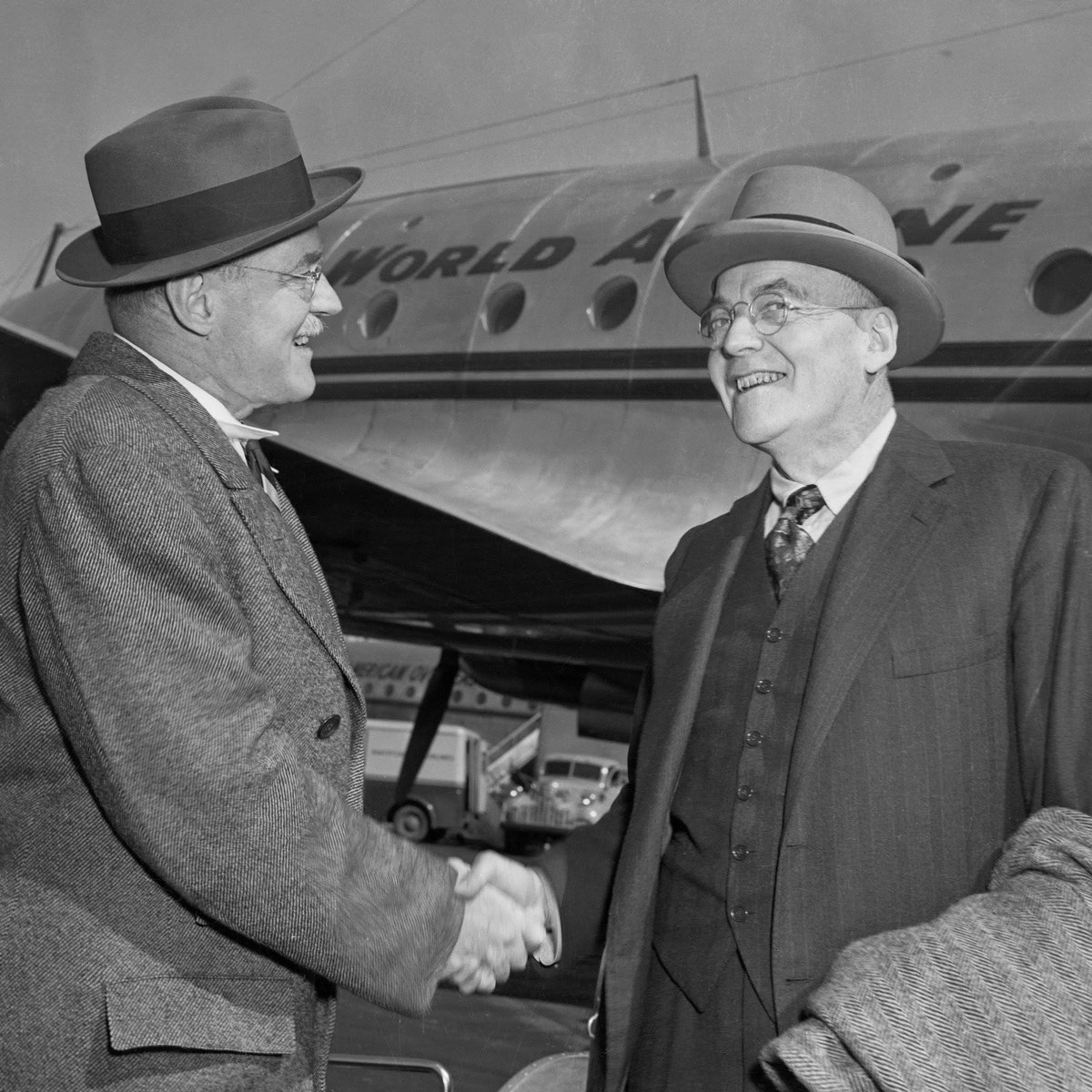
The Secretary of State at the time, John Foster Dulles, had previously worked for a law firm that represented United Fruit.
His brother, CIA Director Allen Dulles, had previously been on United Fruit's board.
The coup was called Operation PBSUCCESS.
It succeeded.
What followed was four decades of military governments and civil war that killed an estimated 200,000 Guatemalans.
Two hundred thousand people.
For bananas.
For the specific financial exposure of specific men who moved between corporate boards and government offices and back again.
This is not the exception.
This is the business model operating at its most visible, most documented, most embarrassingly literal level.
If you want to understand the rest, start with the banana.
People who believe capitalism is working out great are just sloppy thinkers who’ve fallen victim to survivorship bias and the just-world fallacy.
Survivorship bias is when your analysis focuses on those who made it while ignoring those who didn’t. You got a decent job, bought a house, and are now living comfortably, which means the system works fine and there must be something wrong with anyone who can’t thrive under it.
All the people who work just as hard as you do but still find themselves struggling go completely missing from your perspective. All the people who are just as clever and resourceful as you but haven’t found financial stability are conveniently overlooked. Everyone whose business venture failed instead of thriving, everyone who got laid off instead of promoted, everyone whose family circumstances were less fortunate than yours, everyone who has a race, gender, disability, or socioeconomic situation which makes their life harder than your own, simply doesn’t factor into your understanding of the way things work.
You got lucky, and you can point to other people who got lucky, and you use those examples to hide from the inconvenient reality that it could just as easily have been you who got the shit end of the capitalism stick. You see a guy out your window sleeping on the sidewalk and you tell yourself there’s a perfectly good reason why you’re in here while they’re out there, and in order to make that cognitive tango work inside your head you have to tell yourself a fairy tale.
That’s where the just-world fallacy comes in. The just-world fallacy is a cognitive bias which assumes that everyone gets what they deserve: that good things happen to good people and bad things happen to bad people.
The appeal of this fallacy is that it gives us a sense of control. It allows us to believe that nothing bad will happen to us if we just do the right thing and avoid making stupid mistakes. It also allows us to believe that we deserve all the good fortune life has brought us, and that the poor exist because they’re not as virtuous and wise as we are.
The trouble with the just-world fallacy is that it only works if you don’t think about it too hard. Anyone who’s been alive for a few years knows that bad things happen to good people and good things happen to bad people. We’ve all seen it countless times, with people we know personally. The world simply is not fair. If you are doing well under the current system, it’s only because your luck has held out. You have what you have because of sheer dumb luck.
If you can get real with yourself about this, you will understand why the system needs to change. A system which insists upon maintaining a very large tier of society who must stress and struggle throughout their lives is not a just or moral system. It cannot be defended by anyone with a rational mind and a well-formed conscience.
People who oppose the movement toward a more equitable society often accuse socialists of “jealousy” and “greed”, but that’s just projection; it is their own greed and selfishness which prevents them from sincerely reckoning with the unjust nature of the society they coincidentally wound up on top of. It is true that those who support socialism are frequently less economically privileged than the average capitalism proponent, but that’s only because they have a reality-based perspective on the abusive nature of the capitalist status quo.
Those who have been fortunate under capitalism often have a harder time forming a reality-based understanding of the system they live under, because they have to fight their way through all the comfortable cognitive biases which insist that everything’s more or less fine the way it is. If they still insist that capitalism is great, it’s only because their own intellectual laziness, ego, and moral cowardice have prevented them from getting real about their circumstances.
A lot of the discourse about AI revolves around the ugliness we can see, but much uglier consequences of this technology are currently unfolding in secret.
We can all see generative AI taking people's jobs and turning everyone into artless, incompetent idiots who can't do anything without their chatbot, but what we can't see is all the horrifying shit going on behind the veil of government secrecy. Artificial intelligence can comb through huge amounts of data to make mass surveillance far more practical and effective than surveillance overseen by human thought police. It's also what's going to make autonomous weapons systems possible.
Ordinary members of the public are getting shamed for using AI, and rightly so; it's a menace to our environment and to the very fabric of our society. But someone in your group chat making novelty AI graphics is of infinitely less consequence than the rich and powerful bastards who are presently using artificial intelligence to plunge our civilization into a digital surveillance panopticon patrolled by autonomous murder drones and militarized robots.
Nobody should use AI. But the people who should MOST not be using it are the oligarchs and empire managers who are trying to use these new technological developments to trap us in this abusive dystopia forever. They should be the primary targets.
"Humans are a warring species."
This is stated as if it settles something.
It doesn't.
Humans are also a cooperating species. Humans built irrigation systems that required coordinated labor across generations. They developed writing to maintain complex trade relationships. They created legal codes, religious institutions, diplomatic protocols, all technologies for managing conflict without violence.
The anthropological record does not show a species defined by war.
It shows a species capable of war and cooperation in roughly equal measure, with the balance determined by specific material and political conditions rather than fixed biological destiny.
More precisely: the periods of most intense human violence correlate strongly with specific conditions, resource scarcity, state formation, colonial expansion, ideological competition between organized powers.
These are not expressions of human nature. They are expressions of specific social arrangements.
Calling humans a "warring species" does more than describe violence.
It turns violence into destiny.
It says: this is what we are, therefore this is what we must be, therefore the people trying to build something different are naive, therefore the people who accept the killing as inevitable are the realists.
That conclusion, that acceptance of violence is sophistication and resistance to it is naivety, serves specific interests.
It always has.