A necessary critique of Ireland's green transition, with inquiry into climate change modelling, and climate alarmism:
https://t.co/sm0rNzoIml
(By Kieran O'Brien: Ex-Managing Director of ESB National Grid (now EirGrid). Member of the Irish Academy of Engineering and lead author of March 2021 report 'National Energy and Climate Plan The Challenge of High Levels of Renewable Generation In Ireland’s Electricity System)
The headline is somewhat misleading and arguably clickbait, as it presents a national issue through a Dublin-centric lens.
Domestic electricity tariffs are broadly the same across Ireland, meaning that Dublin is effectively acting as a proxy for the country as a whole.
Framing the story around "Dubliners" therefore risks creating an artificial urban–rural divide where none exists, despite households across Ireland facing broadly similar electricity costs.
The article is also based on the Household Energy Price Index for Europe (HEPI), which compares the final price paid by households, including energy charges, network costs, standing charges, taxes and VAT.
HEPI is useful for measuring household electricity prices, but it does not explain why those prices are high. It measures the outcome rather than the underlying causes. The article therefore moves from reporting a price ranking to discussing possible causes without adequately distinguishing between the two.
A further issue is that the article conflates several distinct topics, including electricity tariffs, household bills, recent supplier price increases, wholesale gas market movements and data-centre electricity demand.
It does not clearly distinguish between short-term market fluctuations, such as recent changes in gas prices, and the longer-term structural drivers of electricity prices, including fuel dependency, network investment, market design, regulatory decisions and taxation.
The placement of comments about data centres immediately after the discussion of Ireland's high electricity prices may also encourage readers to infer a causal relationship.
However, no evidence is presented to demonstrate that data centres are the primary reason Ireland has some of the highest household electricity prices in the EU.
While data centres undoubtedly increase electricity demand and create challenges for grid planning and infrastructure investment, household electricity prices are influenced by a much broader set of factors, including fuel costs, network charges, taxes, market structure, regulatory decisions and supplier pricing strategies.
As written, the article risks oversimplifying a complex energy policy issue. By combining multiple unrelated factors within a single narrative, it may lead readers to draw conclusions that are not supported by the evidence presented.
In particular, it risks attributing causation where only correlation is shown and encouraging a debate centred on data centres without adequately considering the wider economic, regulatory and energy-system factors that contribute to Ireland's high electricity prices.
We all want to "blame something" for having the highest electricity prices in the world. The report by Dr. Fearon blaming datacenters is extremely weak and has wild assumptions.
If demand growth is matched by adequate/abundant supply, there would be NO price increase
(& in a market with no price gouging, which is the case)
Either we blame the demand growth itself, or we blame the supply unable to keep up with demand.
If you want degrowth, you blame "too much demand" and try to curb it, ban it, smash it all down.
If you are pro-industrial growth you advocate for higher supply to match that new demand, and blame goes to the supply (generation) side for not keeping up.
Reposting this today. A day where media articles (written by Friends Of the Earth) are in circulation blaming everything on data centre demand, while our network/system costs are the actual culprit.
There is NOT ENOUGH demand, and TOO MUCH intermittent supply. There is time mismatch between supply (generation)and demand for power.
The only thing these articles got right is that intermittent renewable energy and baseload demand from datacenters, are totally incompatible.
From one of the founders of Eirgrid itself, and a member of Ireland's Academy of Engineering (IAE)
On Wind & Solar:
"While the fuel is free, the system required to manage it is eye-
wateringly expensive"
https://t.co/etYDDm3Mws
1. Noticed this narrative from @CCACIreland a few times:
"Data centre demand is offsetting any gains from new wind projects"
However, examining the actual energy delivered from wind in the past 6 years indeed shows no gains... but this is REGARDLESS of any new demand.
The actual volumes of energy have flatlined and this had absolutely nothing to do with datacenters or any other forms of new demand.
🌬Actual Wind Generation in TWh
Year | NI | Ireland | All-Island(SEM)
2020 | 2.6 | 11.1 | 13.7
2021 | 2.2 | 9.5 | 11.7
2022 | 2.8 | 10.9 | 13.7
2023 | 2.3 | 11.4 | 13.7
2024 | 2.1 | 11.1 | 13.3
2025 | 2.3 | 11.3 | 13.6
2. Another persistant narrative from them, and from WEI, is:
"Wholesale electricity prices halved on recent windy days..." This of course is true but should follow up with "only spot prices are lowered at these times, not retail prices"
Barry O’Sullivan: Ireland’s energy debate has, for too long, focused almost exclusively on decarbonisation – at the expense of security, availability and affordability.
https://t.co/Kuf3zKjzb5
I often forget what it was like having a serious, progressive grown up with an international outlook as Prime Minister.
Outstanding from Tony Blair this evening. I hope the last line embarrassed the current crop of right wing Tories in the room. 👏
#GFA25#NorthernIreland
👷🏻♀️👩🏽🍳👨🏻🔬👮🏽After the huge success of last year, another Jobs Fair has been arranged for this Thursday evening down in the Bays from 6-8! A huge variety of employers will be there to speak to everyone interested. Great opportunity to ask some questions and extend your opportunities!
.@IDAIreland celebrates Ireland Day at the NYSE. 🇮🇪 @TrinityChavez speaks to Interim CEO @MaryBuckleyIDA about why some of America’s most innovative companies thrive doing business in the Emerald Isle.
Good to speak with @EdConwaySky on @SkyNews about my agenda here in Davos, about the Irish economy and Brexit.
You can watch back the first part of the interview here:
On January 1st, here’s to all the firsts – big and small – that 2023 will bring. And to making Ireland your first port of call for business in Europe. Happy New Year from https://t.co/md73EvP5Z0
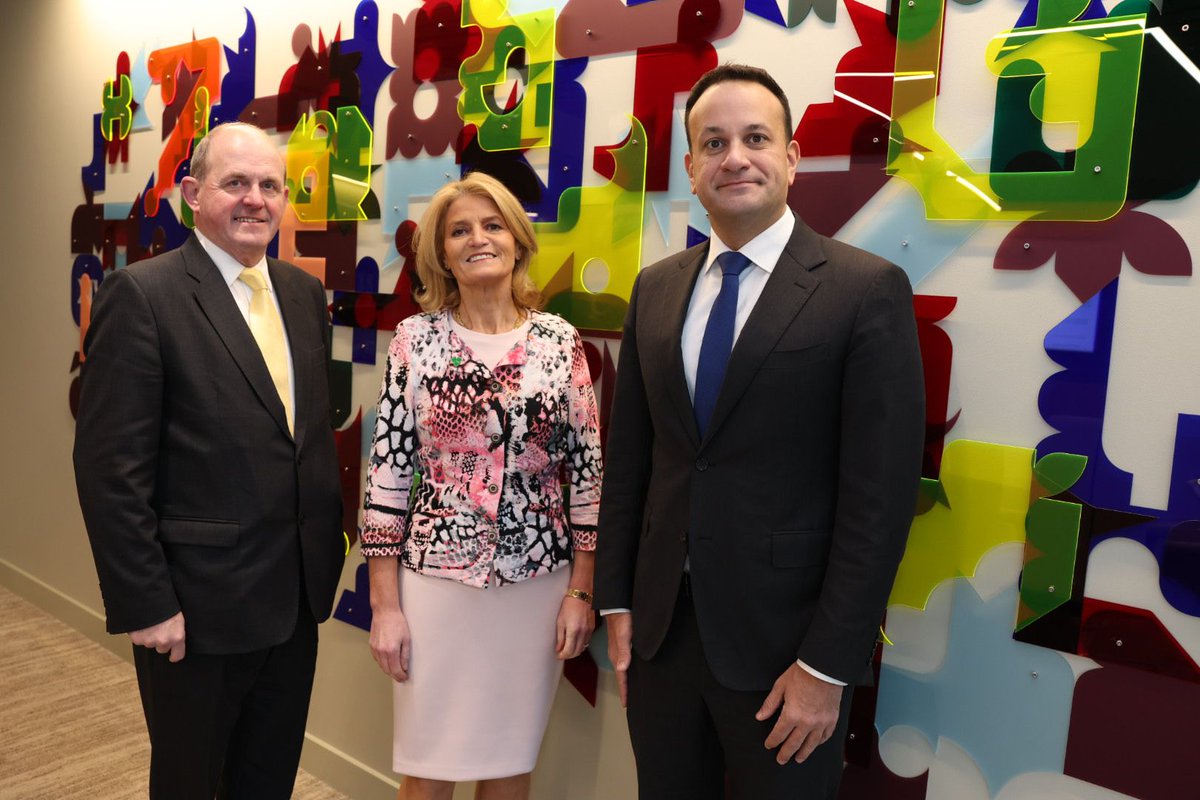
Tánaiste @LeoVaradkar published the Interim Report of the Shannon Estuary Economic Taskforce which sets out how the region can become a renewable energy powerhouse 🔋
Find out more about the report below 👇
https://t.co/SxYVKP9fTd
This morning IDA Ireland published its annual results, with numbers directly employed in the multinational sector reaching over 301,475. Net jobs growth exceeds 24,000. To read our annual results, go to https://t.co/d13WsYCpAV
#IDAannualresults22#InvestinIreland
Yesterday I met the Shannon Estuary Economic task force and helped launch a @ShannonFoynes 2041 strategy report on developing a new offshore industry & bringing power back ashore to create new industrial & export opportunities. Read the report here https://t.co/oyejRg1LKq
IDA Ireland is seeking to recruit a Chief Executive Offer (CEO) to lead the organisation, ensuring that FDI continues to play a crucial role in the Irish economy and growing and deepening FDI impact in Ireland. For further information, please see https://t.co/kW88xiuw8E