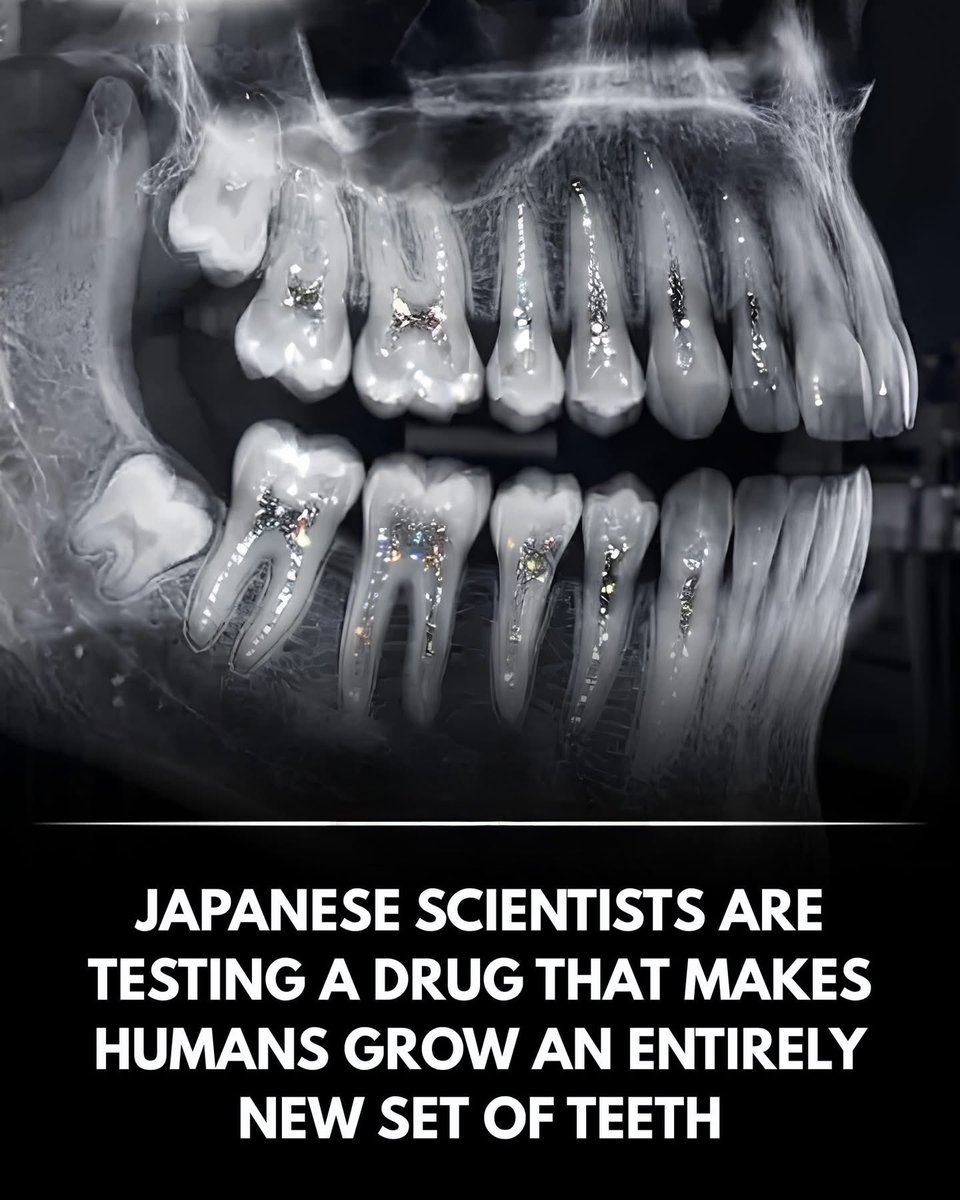
🦷 THE HIDDEN THIRD SET OF TEETH MAY BE CLOSER THAN WE THINK
For generations, people believed that once adult teeth were lost, they were gone forever. But a remarkable discovery from Japan is challenging that belief.
Scientists are testing a new treatment designed to unlock a hidden ability within the human body—the potential to grow new natural teeth. Researchers have identified a protein that normally prevents extra teeth from developing. By blocking that protein, they hope to activate a biological process that has remained dormant since childhood.
Human clinical trials are already underway, and while widespread use is still years away, the early research is creating excitement around the world. If successful, this breakthrough could one day help millions of people replace lost teeth naturally, without implants, dentures, or artificial replacements.
What makes this even more fascinating is that the ability may have been inside us all along... simply waiting to be switched back on.
Source: Kobayashi, Y., & Takahashi, K. Kyoto University Hospital tooth regeneration research program, Japan.
İsviçreli bilim insanları, tek bir damla kanla kanseri belirtiler ortaya çıkmadan yıllar önce tespit edebilecek yeni bir kan testi geliştirdi.
Araştırmacılar, bu yöntemin bazı kanser türlerini 10 yıla kadar daha erken teşhis etmeye yardımcı olabileceğini düşünüyor.
🧠 SOUND WAVES VS. ALZHEIMER’S?
What if the future of Alzheimer’s treatment doesn’t involve surgery—but sound?
Scientists are testing focused ultrasound to break down harmful brain plaques linked to memory loss. Early results are promising, but researchers are still studying its safety and effectiveness.
Could a simple sound-based technology help unlock the brain’s healing power? The answer may be closer than we think.
Source: Alzheimer’s Association. (n.d.). Ultrasound treatment and Alzheimer’s disease research.
Lung cancer is the most common diagnosis of cancer globally. But new research shows that existing drugs hold promise for preventing the disease https://t.co/9bgaDzgLAk
Photo: Michael Schwimmer and Jeroen Claus (Phospho Biomedical Animation)
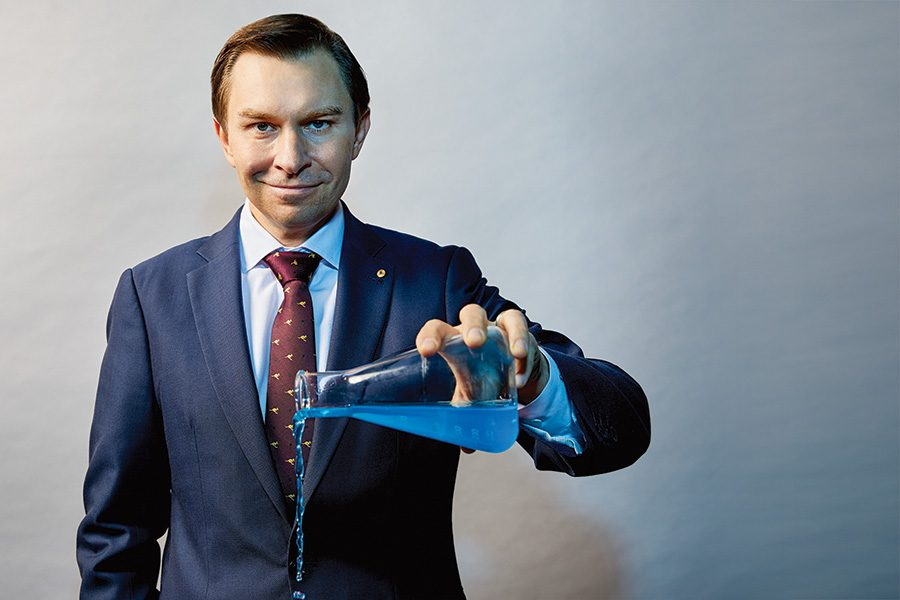
We could be the last humans to age and die on schedule.
One injection from David Sinclair's lab already made old, blind mice see again, and in 2026 the FDA cleared it for people.
Here's the science nobody's ready for (THREAD):
🚨 AI Just Created a Material Humans Never Imagined!
Scientists have developed a revolutionary new material that is stronger than steel, lighter than foam, and up to 5 times stronger than titanium.
The most surprising part? It was designed by artificial intelligence, not human engineers.
Using AI, researchers created entirely new microscopic structures that were later 3D-printed and tested. The results could lead to lighter airplanes, stronger buildings, and more efficient vehicles.
This breakthrough shows that AI is no longer just helping scientists—it’s starting to invent alongside them.
What could the world look like when AI designs the materials of the future?
Source: University of Toronto. AI-designed nanomaterials achieve exceptional strength and lightness. University of Toronto Engineering News.
This is the world's largest quadcopter
10 seconds to take off, easy to operate, and a ballistic parachute in case something goes wrong
The future is here, and I want one
Source: Supercar Blondie
UNUSUAL
In China, robotic dogs have become a new mode of transportation for children: “In China, an unusual type of transport is gaining popularity — a wheeled robotic dog equipped with a seat for children. The robot can carry up to 200 kilograms, move autonomously, and transport the child safely.
It can take the child to the desired location, wait, and bring them back.”
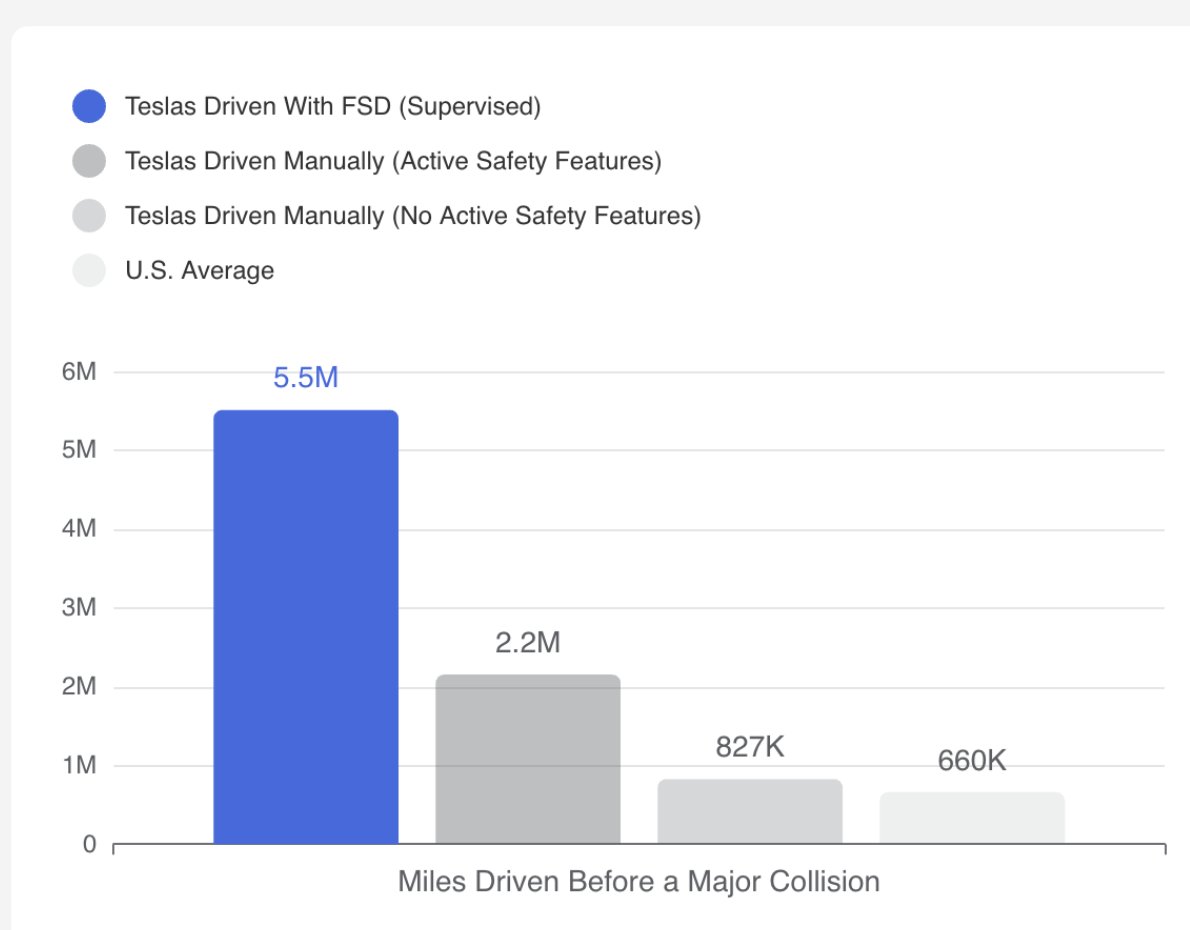
People completely miss the most important thing about Tesla FSD
It’s not just about convenience. It’s not a "cool self-parking trick."
It’s about the fact that car crashes are the #1 killer of healthy people aged 5-29 globally and one company has gathered over 10 billion miles of real-world data to actually solve it
Look at the recent data: Tesla just became the FIRST vehicle to pass NHTSA's new ADAS safety tests. Not the first EV. The first vehicle. Period.
The reality is harsh but simple. Countries that approve FSD get safer roads overnight. Countries that delay will literally watch their citizens die in preventable crashes while bureaucrats sit in meeting rooms debating "safety."
The "safety" argument against FSD is officially dead
In 🇨🇳Shenzhen, an automated restaurant delivery system uses maglev tracks to bring covered trays right to your table.
While others are still testing in labs, Shenzhen rolled this out in malls and shops, making technology a real, affordable service fast!
🇨🇳 China just switched on the world's largest offshore solar farm
2.3 million solar panels. 2,934 steel platforms. 11,736 piles driven into the ocean floor. Built to survive force-11 gales and sea ice.
It sits 5 miles off the coast and powers 2.67 million people.
Oh, and they're also farming fish underneath it 😳
Massive news from AI and biotech:
Google DeepMind co-founder Demis Hassabis has just raised $2.1 billion for Isomorphic Labs.
For years, Hassabis and his team have been building powerful AI that can predict protein structures, design brand new molecules, and dramatically speed up drug discovery.
Now Isomorphic Labs is turning that technology into a full scale effort to tackle what traditional medicine has struggled with for decades.
$2.1 billion. One clear mission: use AI to transform how we fight disease and ultimately cure what was once thought incurable.
This is one of the biggest bets yet that the future of medicine will be powered by code.
Clinical trials, expanded pipelines, and real world impact are coming.
Extremely exciting times ahead for humanity.
The Cybercab is designed for a world where you look forward to the future every time you leave your house
It comes with no steering wheel, pedals or charging ports
This is the first vehicle ever built entirely for a world that no longer needs drivers - engineered from scratch for full autonomy
Butterfly doors. Wireless charging. Autonomous cleaning robots
cool
Unitree CEO Wang Xingxing and his robotics army of G1s.
These are designed for mass production at a starting price of roughly US$16,000.
This is just a beginning of an exponential era!
🚨 HUMAN AGING UPDATE
Scientists just received FDA approval to begin testing “age reversal” gene therapy in humans.
Read that again.
Not slowing aging.
Trying to reverse parts of it.
For the first time, researchers are seriously testing whether damaged cells can be biologically restored using genetic reprogramming.
If it works…
aging may eventually become something medicine can treat instead of simply accept.
The real impact isn’t vanity.
It’s Alzheimer’s. Heart disease. Frailty. Lost memories. The slow collapse of the body over time.
Imagine adding healthy years instead of just extra years.
Parents meeting grandchildren. More time with people we love. A future where growing old no longer automatically means suffering.
Humanity may be entering the era where biology itself becomes programmable.
Follow for more future medicine and science breakthroughs before they hit mainstream.
Ex Machina is no longer sci-fi. China has finally built it.
The company is AheadForm, founded in Shanghai.
The product is the world's most hyper-realistic robotic face.
Silicone skin you can't tell from human, 25 micro motors hidden underneath pulling the face into real expressions.
And RGB cameras embedded inside the pupils so when it looks at you, it actually sees you from where its eyes are.
They raised $28.5M to "give AI a head," which is also where the name comes from. AheadForm = a head form.
This is the opposite of where everyone else in robotics is focused.
Unitree, Figure, Tesla, Boston Dynamics: all about the body.
AheadForm chose the face because they think trust is the harder problem to solve, and trust gets decided at the face.
The reason nobody else has tried this is the "uncanny valley."
It's the creepy zone where a robot looks almost human but not quite, and looking at it just feels wrong even when you can't say why.
Most roboticists believed no amount of engineering could make a face realistic enough to escape it.
So they gave up and kept robots cartoonish on purpose: big anime eyes, exaggerated features, clearly synthetic.
But AheadForm decided to treat it as an engineering bug instead.
Add enough motors, tune the silicone, fix the timing, the valley closes.
And they're pulling it off.
A few crazy details about how this actually works:
1. The robot learns its own face in a mirror.
You put it in front of a camera, let it fire every motor randomly, and it watches what its face does and builds an internal map of "if I send command X to motor Y, my eyebrow does this."
Same exact process a human baby uses staring into a mirror. The robot teaches itself who it is by experimenting.
2. It predicts your smile 839 milliseconds before you smile.
By watching the micro-tells in your face that precede a smile, the robot starts smiling 0.8 seconds ahead, so its smile lands at the same moment yours does.
Most robot mimicry happens half a second late, which is exactly why it always feels artificial.
3. The pupils are the cameras.
When the robot makes eye contact, the gaze and the sensor are the same physical thing.
Most humanoid robots stick the camera on the forehead or chest, so they aren't actually looking at you when their eyes are pointed at you.
4. The founder, Yuhang Hu, did his PhD at Columbia under Hod Lipson.
Lipson is the guy who in 2006 built a four-legged robot that figured out it had four legs by experimenting with its own movement, nobody told it the body shape, it discovered it.
He has spent 25 years trying to build machines that know what they are.
AheadForm is that 25-year research arc productized.
5. NetEase Games already paid them to physically embody a fantasy video game character.
That opens up a brand-new category: robotics as the physical embodiment of fictional IP.
Every character-rich studio, Disney, Riot, Hoyoverse, Pokemon, Netflix, now has a question to answer about when their characters get bodies.
AheadForm believes whoever ships the first robot you'd actually want around your family wins.
That's the bet behind the most realistic robot face on earth.