Mastering SOLID Principles in C# — [1/5] Single Responsibility Principle (SRP)
Most developers know SOLID principles, but few truly apply them.
Let’s break down the Single Responsibility Principle (SRP) in simple terms — with examples you can use even in interviews 👇
As a Backend Developer,
Please slap yourself if you cannot clearly explain atleast 10 of the following:
HTTP vs HTTPS
TCP vs UDP
DNS resolution flow
What happens when you type a URL
REST vs GraphQL
Idempotency in APIs
Rate limiting strategies
Authentication vs Authorization
JWT vs Sessions
Cookies vs Tokens
Caching (Redis, CDN, cache invalidation)
Database indexing
SQL vs NoSQL trade-offs
ACID vs BASE
Normalization vs Denormalization
Connection pooling
N+1 query problem
Pagination (offset vs cursor)
Load balancing (L4 vs L7)
Horizontal vs Vertical scaling
CAP theorem
Event-driven architecture
Message queues (Kafka vs RabbitMQ)
Async vs Sync processing
WebSockets vs HTTP
API versioning strategies
Retries, backoff & circuit breakers
Distributed systems basics
Consistency models (strong vs eventual)
Database transactions
Sharding & partitioning
Cold start problem
Observability (logs, metrics, tracing)
Monitoring vs alerting
Docker basics
CI/CD pipelines
Graceful shutdown
Timeouts & retries
Security basics (XSS, CSRF, SQL injection)
API gateway role
I have 12 years of experience and working as a Principal Engineer @Atlassian and I have seen concurrency scaring the hell out of a lot of junior engineers.
It’s one of the most feared topics in system design & backend interviews — race conditions, deadlocks, thread pools… you name it.
But once you internalize these 20 must-know concepts, everything clicks.
Save this thread. Read till the end.
Your future interviews and production systems will thank you.
.𝗡𝗘𝗧 𝟭𝟬 𝗶𝘀 𝗳𝗮𝘀𝘁𝗲𝗿 𝘁𝗵𝗮𝗻 𝗝𝗮𝘃𝗮, 𝗚𝗼, 𝗣𝘆𝘁𝗵𝗼𝗻, 𝗡𝗼𝗱𝗲𝗝𝘀 𝗮𝗻𝗱 𝗣𝗛𝗣
Why .NET is the best platform in build projects in .NET 2025
Why is .NET so fast?
- 𝗔𝗱𝗮𝗽𝘁𝗶𝘃𝗲 𝗦𝗲𝗿𝘃𝗲𝗿 𝗚𝗖 adjusts in real time, reducing pause frequency and sustaining throughput during traffic spikes.
- 𝗦𝗺𝗮𝗿𝘁𝗲𝗿 𝗝𝗜𝗧 trims warm‑up time and accelerates hot methods, producing consistently shorter response cycles.
- 𝗔𝗱𝘃𝗮𝗻𝗰𝗲𝗱 𝘃𝗲𝗰𝘁𝗼𝗿𝗶𝘇𝗮𝘁𝗶𝗼𝗻 leverages AVX10 and Arm SVE, letting loops process multiple data points per tick.
- 𝗡𝗮𝘁𝗶𝘃𝗲 𝗔𝗢𝗧 further cuts binaries and startup cost, ideal for containers, IoT, and edge workloads.
- 𝗢𝗽𝘁𝗶𝗺𝗶𝘇𝗲𝗱 𝗻𝗲𝘁𝘄𝗼𝗿𝗸𝗶𝗻𝗴 improves socket handling and HTTP/3 support, delivering lower latency for high‑connection services.
- 𝗙𝗮𝘀𝘁𝗲𝗿 𝗝𝗦𝗢𝗡 processing in System.Text.Json reduces allocation, enabling leaner APIs and real‑time data streams.
- 𝗟𝗼𝘄𝗲𝗿 𝗮𝗹𝗹𝗼𝗰𝗮𝘁𝗶𝗼𝗻𝘀 via spans, inline arrays, and pooled buffers lighten GC pressure and memory footprint. 🧩
- 𝗧𝗵𝗿𝗲𝗮𝗱‑𝗽𝗼𝗼𝗹 logic minimizes contention, ensuring asynchronous operations remain smooth under mixed loads.
- 𝗘𝗻𝗵𝗮𝗻𝗰𝗲𝗱 𝗺𝘂𝗹𝘁𝗶𝘁𝗵𝗿𝗲𝗮𝗱𝗶𝗻𝗴 schedules tasks more evenly, unlocking full core capacity for parallel workloads.
- 𝗖𝗿𝘆𝗽𝘁𝗼𝗴𝗿𝗮𝗽𝗵𝘆 𝗿𝗼𝘂𝘁𝗶𝗻𝗲𝘀 are streamlined, providing robust security without incurring excessive computational overhead.
- 𝗖𝗹𝗼𝘂𝗱‑𝗻𝗮𝘁𝗶𝘃𝗲 tooling reduces cold starts and aligns neatly with Kubernetes, simplifying microservice deployment.
- 𝗙𝗶𝗹𝗲 𝗜/𝗢 now buffers intelligently, boosting throughput for applications that read or write extensive data.
- 𝗥𝗲𝗳𝗹𝗲𝗰𝘁𝗶𝗼𝗻 𝗮𝗻𝗱 𝗘𝘅𝗰𝗲𝗽𝘁𝗶𝗼𝗻 pathways are optimized, cutting overhead for dependency injection and dynamic object scenarios.
- 𝗠𝗶𝗻𝗶𝗺𝗮𝗹 𝗔𝗣𝗜𝘀 advance performance in .NET 9, pairing concise code with leading throughput, making .NET 9 more than 15 % faster
.NET 9 outruns these 10 popular web frameworks:
- Java (Spring) – about 2.5× slower
- Go (Fiber) – 1.3× slower
- Node.js (Fastify) – 4× slower
- Python (FastAPI) – 10× slower
- Ruby (Rails) – 20× slower
- PHP (Laravel) – 15× slower
- Kotlin (Ktor) – 2.8× slower
- TypeScript (Deno) – 3.5× slower
- Swift (Vapor) – 2× slower
- Elixir (Phoenix) – 1.7× slower
You will find links to the benchmarks in the comments.
What web framework do you use for your production apps? What are the main reasons you like your current framework?
👉 Subscribe to my newsletter to improve your .NET Skills
—
♻️ Repost to help others learn how fast .NET is
➕ Follow me ( @AntonMartyniuk ) for more
I have been working 7+ years with microservices
Here is what I will ask during the interview 👇
Most candidates focus just on tools: Docker, Kubernetes, and messaging libraries.
But they forget that Microservices Architecture is about boundaries, scalability, resilience, and trade-offs.
Take a few minutes and check how many you can answer with confidence.
Your gaps will show you exactly what to learn next.
👉 Download my free .NET Microservices roadmap, with highly valuable resources: https://t.co/LxvQDGRX4H
📌 Save this post for future reference!
——
♻️ Repost to help others master microservices
➕ Follow me ( @AntonMartyniuk ) to improve your .NET and Architecture Skills
What I see in most Java resumes:
- Java
- Spring
- Microservices
Great, I see you know Java. But as a senior, can you build, run, scale, observe, and secure Java systems in production?
A few tips and topics with accurate subskills that you need to mention if you need your resume to stand out:
1. Distributed Caching – mention Redis/Memcached
2. Monitoring & Observability – most popular ones are Splunk, Dynatrace, Grafana, ELK
3. Messaging – list one among Kafka, JMS or RabbitMQ
4. Testing – most popular frameworks/methods are TDD, Mockito, JUnit
5. CI/CD & Containers – devops skills like Jenkins, GitHub Actions, Docker, Kubernetes make your profile distinct
6. Frameworks – no prize for guessing: Spring Boot, Spring MVC, Apache Camel
7. Microservices Internals – try to mention one or two at least from Config Server, API Gateway, Service Discovery, Resilience4j
8. Multithreading & Concurrency – do not skip, mention a few of Executors, ForkJoin, CompletableFuture
9. Security – most used and popular ones are Spring Security, OAuth2, JWT
10. Persistence – you should have been using Hibernate, JPA or MyBatis so put one
11. API Development – basics of APIs: REST, Swagger, OpenAPI
12. Reactive Programming – your resume shines with words like WebFlux, Reactor or RxJava
13. Build Tools – mention Maven/Gradle
14. Code Quality – mentioning SonarQube, PMD, Checkstyle shows you care about quality
15. Cloud – shouldn't miss one from AWS, GCP, Azure
16. Java Versions – list a few Java 8 to 21 features you used
17. Design Principles – foundations of large codebase: SOLID, Design Patterns, Clean Architecture
If you are targeting Senior, Staff, or Lead roles:
- Focus on impact, not buzzwords
- Show production ownership
- Highlight architecture and reliability thinking
Good luck
As a Backend Engineer in 2026 aiming for Staff, please learn:
1. One language deeply (Go/Rust/Java)
Not “I can write APIs”, but runtime model, memory, concurrency, profiling, GC behavior (if any), and how to read stack traces like a native.
2. Data modeling and storage fundamentals
Relational modeling, constraints, isolation levels, indexes, query plans, locks, deadlocks, migrations, backup/restore, partitioning. Most “scaling” problems are schema + query shape problems.
3. Distributed systems basics that actually show up in prod
Consistency vs availability, timeouts, retries, idempotency, backpressure, message ordering, leader election, clock skew, eventual consistency, and what happens during partial failures.
4. API design and contracts
Versioning, pagination, filtering, error models, idempotency keys, rate limits, backwards compatibility, and how to avoid breaking mobile clients for months.
5. Performance and capacity engineering
Latency budgets (p50/p95/p99), tail latency causes, load testing, queueing theory intuition, connection pools, CPU vs IO bound, and capacity planning with real numbers.
6. Reliability engineering
SLOs/SLIs, incident response, postmortems, alerting that does not spam, error budgets, graceful degradation, feature flags, circuit breakers, bulkheads.
7. Observability like a pro
Structured logs, metrics, tracing, correlation ids, RED/USE metrics, sampling strategies, and how to debug “it is slow sometimes” without just guessing.
8. Security fundamentals
AuthN/AuthZ, least privilege, secrets management, token expiry, OWASP basics, SSRF, injection, secure defaults, audit logs, threat modeling for your own services.
9. Messaging and async systems
Kafka/Rabbit/SQS semantics, at-least-once vs exactly-once (and why “exactly once” is mostly a marketing term), consumer groups, retries, DLQs, replay, dedupe.
10. Caching with correctness
Cache invalidation strategies, TTLs, stampede protection, read-through/write-through, negative caching, and when caching makes bugs harder than latency.
11. Infrastructure literacy
Linux basics, networking (DNS, TCP, TLS), containers, k8s concepts, autoscaling, deployment strategies (blue/green, canary), and what your cloud bill is really paying for.
12. System design, but with tradeoffs
Designing is picking pain. Learn to write down constraints, failure modes, data growth, and operational cost. Staff is judged on tradeoffs, not diagrams.
13. Codebase leadership
Design docs, RFCs, review quality, mentorship, aligning teams, reducing complexity, owning a subsystem end-to-end, making boring systems that do not wake people at 2am.
14. Pick ONE domain to go deep
Payments, search, streaming, identity, infra, data platform, etc. Staff engineers are “the person for a hard area”, not generic API writers.
Stop hopping stacks every month. Pick a lane, build proof of reliability, and become the person people call when prod is on fire. That is Staff.
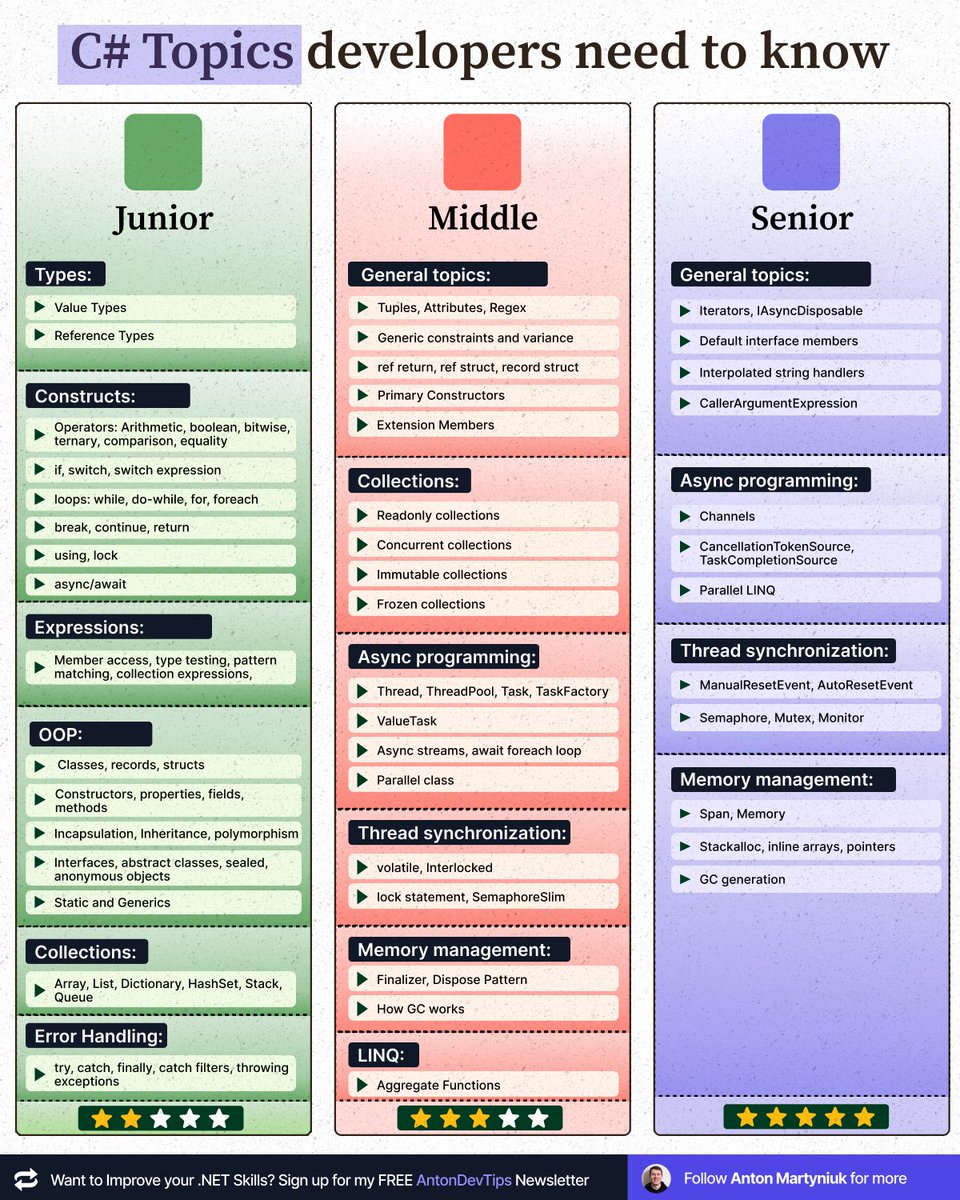
Junior developer needs to know 4 patterns
Middle dev needs to know 12 patterns
Senior developer needs to know 20 patterns
Design patterns help you solve common problems and improve code quality if used properly.
Ever wondered which design patterns you should focus on as you grow as a developer?
This could be the difference between writing good code... and building great software.
👉 𝗝𝘂𝗻𝗶𝗼𝗿 𝗗𝗲𝘃𝗲𝗹𝗼𝗽𝗲𝗿:
You don’t need to know everything at once.
Focus on the essentials — the patterns that show up everywhere.
1️⃣ Builder
2️⃣ Factory Method
3️⃣ Singleton
4️⃣ Decorator
These four patterns help you create, organize, and extend objects efficiently.
Master these, and you’ll write cleaner, more flexible code from day one.
👉 𝗠𝗶𝗱𝗱𝗹𝗲 𝗗𝗲𝘃𝗲𝗹𝗼𝗽𝗲𝗿:
Ready to step up?
Now it’s time to add more versatile tools to your toolbox.
1️⃣ Strategy
2️⃣ Adapter
3️⃣ Abstract Factory
4️⃣ Template Method
5️⃣ Facade
6️⃣ Bridge
7️⃣ Command
8️⃣ Mediator
These patterns teach you how to swap behaviors, simplify complex systems, and make your code more modular.
👉 𝗦𝗲𝗻𝗶𝗼𝗿 𝗗𝗲𝘃𝗲𝗹𝗼𝗽𝗲𝗿:
You've mastered the basics.
Now it's time to tackle patterns that solve the toughest architectural challenges.
1️⃣ Prototype
2️⃣ Composite
3️⃣ Chain of Responsibility
4️⃣ State
5️⃣ Flyweight
6️⃣ Proxy
7️⃣ Visitor
8️⃣ Interpreter
These patterns give you superpowers for working with complex structures, dynamic behaviors, and resource optimization.
You'll notice: as you start solving bigger problems, these patterns show up again and again.
📌 Important note:
Don't try to learn everything all at once!
Follow a progression — master the basics, then level up with more advanced patterns as you grow.
Which design pattern was the hardest for you to learn, and how did you finally "get it"?
——
📌 Save this post for future reference!
♻️ Repost to help others learn design patterns that matter
➕ Follow me ( @AntonMartyniuk ) to improve your .NET and Architecture Skills
40 concepts to master Modern Backend Engineering:
1. System Design Fundamentals: Load balancing, replication, and fault tolerance.
2. API Design: RESTful principles, GraphQL schemas, and gRPC/protobuf.
3. API Versioning Strategies: URL, header, and media type versioning.
4. Authentication & Authorization: JWT, OAuth 2.0, OpenID Connect, and RBAC/ABAC.
5. Database Design & Modeling: Relational normalization and NoSQL schema patterns.
6. SQL Mastery: Complex queries, indexing strategies, and query optimization.
7. NoSQL Databases: Document (MongoDB), Key-Value (Redis), Wide-Column (Cassandra), Graph (Neo4j).
8. Database Transactions & ACID Compliance: Isolation levels and handling concurrency.
9. Caching Strategies: In-memory (Redis/Memcached), CDN, and database caching layers.
10. Message Queues & Brokers: Kafka, RabbitMQ, and AWS SQS for asynchronous communication.
11. Event-Driven Architecture: Designing systems around events and choreography.
12. Microservices vs. Monoliths: Trade-offs, decomposition patterns, and bounded contexts.
13. Containerization & Orchestration: Docker, Kubernetes, and service mesh (Istio/Linkerd).
14. Serverless Architecture: Functions-as-a-Service (AWS Lambda, Azure Functions) and its limits.
15. API Gateways: Routing, rate limiting, and request aggregation.
16. Rate Limiting & Throttling: Token bucket, fixed window, and distributed rate limiting.
17. Data Streaming: Real-time processing with Apache Kafka, Apache Flink, or Apache Pulsar.
18. Search Engine Integration: Implementing full-text search with Elasticsearch or OpenSearch.
19. Background Job Processing: Designing reliable systems with Celery, Sidekiq, or BullMQ.
20. File & Object Storage: Handling uploads and serving static assets at scale.
21. WebSockets & Real-Time Communication: Building live dashboards and chat features.
22. Configuration Management: Environment-based configs and feature flag services.
23. Health Checks & Readiness Probes: Building resilient systems with proper lifecycle management.
24. Distributed Tracing: Using Jaeger or Zipkin to track requests across services.
25. Centralized Logging: Aggregating and analyzing logs with the ELK Stack or Loki.
26. Metrics & Monitoring: Implementing Prometheus, Grafana, and crafting meaningful alerts.
27. CI/CD Pipelines: Automated testing, building, and deployment strategies.
28. Infrastructure as Code (IaC): Terraform, Pulumi, and AWS CDK for reproducible environments.
29. Secret Management: Securely storing and accessing API keys and credentials.
30. Database Migrations: Managing schema changes safely and rollback strategies.
31. Disaster Recovery & Backups: Designing for data durability and business continuity.
32. Performance Profiling & Optimization: Identifying bottlenecks in application code and databases.
33. Scalability Patterns: Horizontal vs. vertical scaling, sharding, and consistent hashing.
34. Security Best Practices: SQL injection, XSS, CSRF prevention, and security headers.
35. Testing Strategies: Unit, integration, contract, and end-to-end testing for backend services.
36. Blue-Green & Canary Deployments: Minimizing risk during releases.
37. Graceful Degradation & Circuit Breakers: Building systems that fail well.
38. Internationalization (i18n) & Localization (l10n): Designing APIs for a global audience.
39. Cost Optimization: Right-sizing resources and managing cloud spend.
40. The Backend Engineer's Mindset: Problem-solving, trade-off analysis, and continuous learning.
Master these concepts, and you’ll be equipped to architect and build the robust engines that power modern applications.
Grab this Ebook to master Backend Engineering:
https://t.co/t9mqUuRbjx
𝗕𝗶𝗴-𝗢 𝗡𝗼𝘁𝗮𝘁𝗶𝗼𝗻 𝗖𝗵𝗲𝗮𝘁 𝗦𝗵𝗲𝗲𝘁
Big O notation is a mathematical shorthand used to describe the runtime of algorithms.
It's a fundamental concept in computer science that helps us understand how an algorithm's performance changes as the input size grows.
𝗕𝗶𝗴-𝗢 𝗡𝗼𝘁𝗮𝘁𝗶𝗼𝗻 expresses the upper bound of an algorithm's runtime (in terms of space or time complexity). It tells us how the algorithm's runtime grows as the input size increases in the worst case.
Time complexity measures how long an algorithm takes to run, while space complexity measures how much memory an algorithm requires.
To analyze the Big O notation of an algorithm, we need to identify the dominant term in the runtime function.
The dominant term is the term that grows the fastest as the input size increases. All other terms can be ignored.
Examples of time complexity using Big-O notation:
🔵 𝗢(𝟭): 𝗖𝗼𝗻𝘀𝘁𝗮𝗻𝘁 𝘁𝗶𝗺𝗲. The runtime of the algorithm does not depend on the input size. An example is accessing a specific element of an array.
🔵 𝗢(𝗹𝗼𝗴 𝗻): 𝗟𝗼𝗴𝗮𝗿𝗶𝘁𝗵𝗺𝗶𝗰 𝘁𝗶𝗺𝗲. The runtime of the algorithm grows logarithmically with the input size. An example is using binary search to find an element in a sorted array.
🟡 𝗢(𝗻): 𝗟𝗶𝗻𝗲𝗮𝗿 𝘁𝗶𝗺𝗲. The runtime of the algorithm grows linearly with the input size. An example is finding an element in an unsorted array.
🟡 𝗢(𝗻 𝗹𝗼𝗴 𝗻): 𝗟𝗼𝗴-𝗹𝗶𝗻𝗲𝗮𝗿 𝘁𝗶𝗺𝗲. The runtime of the algorithm grows log-linearly with the input size. Examples include efficient sorting algorithms such as Quicksort and Heapsort.
🟠 𝗢(𝗻^𝟮): 𝗤𝘂𝗮𝗱𝗿𝗮𝘁𝗶𝗰 𝘁𝗶𝗺𝗲. The algorithm's runtime grows quadratically with the input size. Simple sorting algorithms, such as insertion or selection sort, are examples.
🔴 𝗢(𝟮^𝗻): 𝗘𝘅𝗽𝗼𝗻𝗲𝗻𝘁𝗶𝗮𝗹 𝘁𝗶𝗺𝗲. The runtime of the algorithm grows exponentially with the input size. An example is the recursive Fibonacci method.
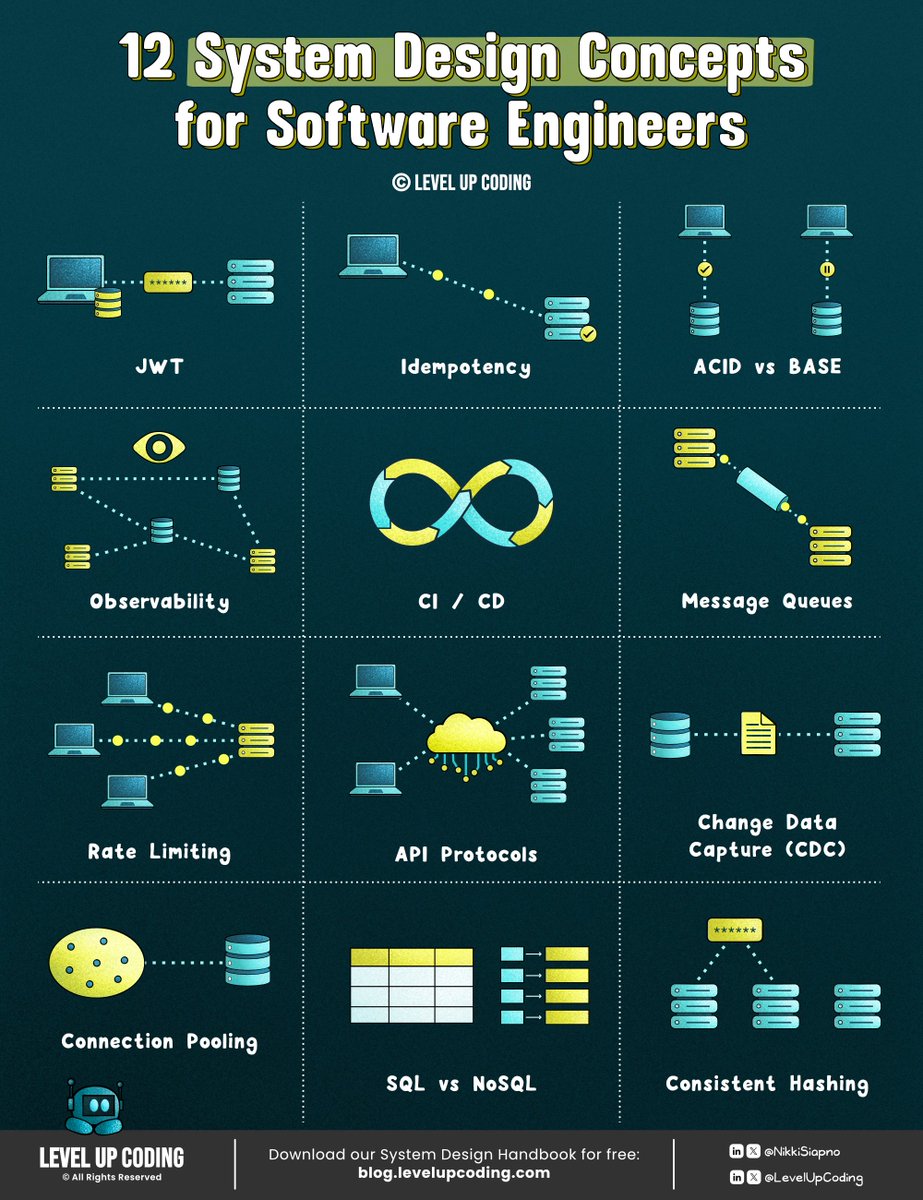
If you’re serious about system design this year,
learn these 12 concepts:
1. How JWT Works
↳ https://t.co/Kuv7DAj6B9
2. Idempotency in API Design
↳ https://t.co/2sItwlz1oe
3. ACID vs BASE
↳ https://t.co/a7nOyylUxk
4. How Observability Turns Alerts Into Insight
↳ https://t.co/VjfECfyB9d
5. Rate Limiting Explained
↳ https://t.co/wr0UAh4sJm
6. Message Queues Explained
↳ https://t.co/7Tz5sevNA8
7. Change Data Capture (CDC)
↳ https://t.co/tgwwoTitCA
8. Connection Pooling
↳ https://t.co/39SsEo4kk3
9. How Consistent Hashing Works
↳ https://t.co/8d8o74EsaS
10. SQL vs NoSQL
↳ https://t.co/oDTRpsnQUn
11. Health Checks vs Heartbeats
↳ https://t.co/r5SalP6CCh
12. API Protocols
↳ https://t.co/2CEu4Wnhsv
What other concepts should be on this list?
--
👋 PS: Want my 𝗦𝘆𝘀𝘁𝗲𝗺 𝗗𝗲𝘀𝗶𝗴𝗻 𝗛𝗮𝗻𝗱𝗯𝗼𝗼𝗸 𝗳𝗼𝗿 𝗳𝗿𝗲𝗲?
Want my 𝗔𝗿𝗰𝗵𝗶𝘁𝗲𝗰𝘁𝘂𝗿𝗲 𝗣𝗮𝘁𝘁𝗲𝗿𝗻𝘀 𝗣𝗹𝗮𝘆𝗯𝗼𝗼𝗸 𝗳𝗼𝗿 𝗳𝗿𝗲𝗲?
Join my newsletter with 26,501+ software engineers: https://t.co/OQtXb4zMoe
--
🔖 Save for later.
♻️ Repost to help others learn system design.
➕ Follow Nikki Siapno + turn on notifications.
Most people waste hours hunting for quality AI resources.
This GitHub repo quietly drops 13 free AI books. all solid, no fluff.
Here’s what you’ll find inside 👇
LLM Foundations
→ Tokenization to safety
→ Training explained simply
→ Beginner-friendly deep dive
Reinforcement Learning
→ Value-based methods
→ Policy-gradient approaches
→ Practical implementation tips
Deep Learning Interviews
→ 400+ curated Q&As
→ CNNs → Transformers
→ Perfect for last-minute prep
Math for Machine Learning
→ Linear algebra essentials
→ Calculus & probability
→ Worked examples included
OpenAI Agent Guide
→ Proven design patterns
→ Agent orchestration tricks
→ Real-world guardrails
Pen-and-Paper ML
→ Theory-first problems
→ Step-by-step solutions
→ No keyboard required
Fine-Tuning LLMs
→ Basics to breakthroughs
→ Best practices explained
→ Applied research challenges
Multi-Agent RL
→ Game theory × learning
→ Foundational concepts
→ Cutting-edge research
ML Systems Engineering
→ Harvard’s latest guide
→ Distributed training
→ AGI-scale systems
🔗 GitHub repo: https://t.co/m4HzQCiBSY
Save this for later 📌
Repost ♻️ if you’re building in AI.
👉 Check my profile for more AI resources & learning drops 👋
10 Secret keywords in C# that Senior developers use, that middles and juniors don't know.
What are they? 👇
1️⃣ extension
New keyword in C# 14 😍
Allows adding methods to existing classes without modifying their source code. Perfect for adding new behavior cleanly with new enhanced capabilities.
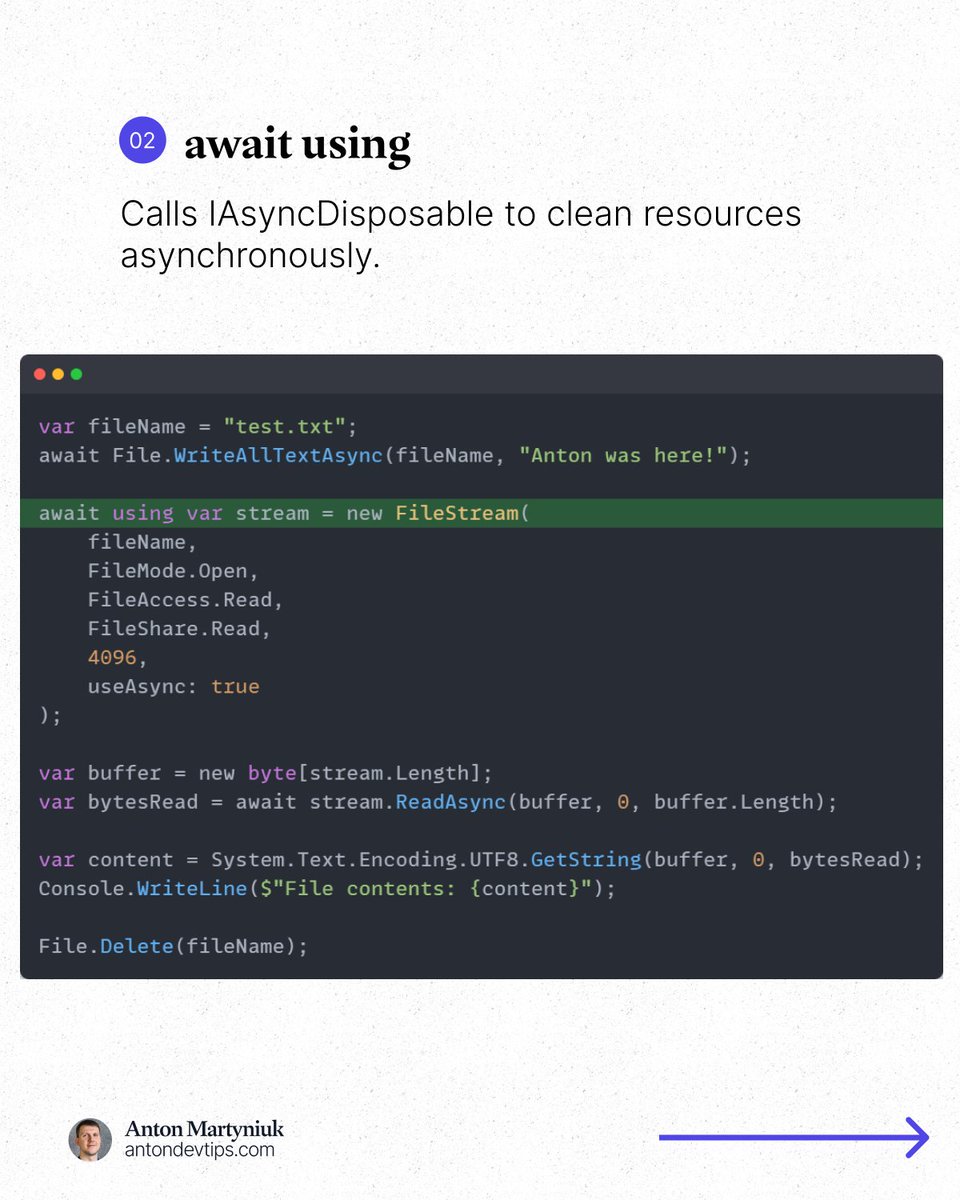
2️⃣ await using
Calls IAsyncDisposable to clean resources asynchronously.
3️⃣ when (catch)
Filters exceptions in catch blocks based on conditions.
4️⃣ partial
Splits class definitions into multiple files. Ideal for source-generated code or logically organizing large classes into manageable pieces.
5️⃣ readonly struct
Defines an immutable value type, with value comparison by default.
6️⃣ in
Passes parameters by reference as read-only. Avoids unnecessary copying of large structs, boosting performance without sacrificing safety.
7️⃣ extern
Indicates that a method is implemented externally, typically using native code (DLL). Allows integration of unmanaged libraries directly into your C# app.
8️⃣ volatile
Ensures the latest value of a field is always read from memory, crucial in multithreaded contexts. Helps prevent subtle concurrency bugs.
9️⃣ unsafe
Enables pointer arithmetic and direct memory manipulation.
🔟 stackalloc
Allocates memory directly on the stack instead of the heap, ideal for short-lived, high-performance scenarios.
Did you know these secret keywords? Which one surprised you the most? 👇
——
♻️ Repost to help others learn about these C# keywords
➕ Follow me ( @AntonMartyniuk ) to improve your .NET and Architecture Skills
As a backend developer, if asked - What is the difference between an API Gateway and a Load Balancer?
Cover these points:
1. What is a Load Balancer?
Imagine you have 3 copies of the same app running.
A Load Balancer sits in front and distributes user traffic evenly to all 3.
It makes sure no single app is overloaded.
If one app crashes, it skips that and sends traffic to the others.
Purpose: Distribute load across multiple same servers
Common in monolithic or replicated service setups
2. What is an API Gateway?
Now imagine you have different microservices:
/login → Login Service
/orders → Order Service
/cart → Cart Service
An API Gateway acts as a single entry point.
It checks the path and routes to the right service.
It also does authentication, logging, rate limits, etc.
Purpose: Route traffic to different services, add features
Common in microservice architecture
3. Can they be used together?
Yes!
You first hit the API Gateway
Then inside, it may use a Load Balancer to talk to multiple instances of one microservice.