The Braves pitching staff was so dominant sometimes Fred McGriff would make phone calls at first base. “Yo, Crime Dog here. No, the game’s not over yet. Maddux is pitching, it’s under control.”
How hard is it to smoke a bomb and get around the bases without showing your ass? The damage has been done! You hit a bomb!
There’s way too much of this stuff and it filters down to HS ball and the lower levels. Respect for the game has been spiraling. It’s not good.
Hello Coach, nice to meet you!!
You name it, I’ve probably experienced every type of coach, and coaching style, out there. Who are you??
Happy go lucky…
Everything is good! The results don’t matter. “Just have fun!”
The drill Sargent…
Everything is done in unison. We do everything as a team. Running is a punishment. There’s always an angry tone. It’s never good enough.
The over-thinker…
They have something to say ALL THE TIME!! They critique every little thing. Their mind and mouth run on high octane constantly. They feel the need to control every aspect of everything.
How can I help YOU…
They are all in on YOU. They are there to help YOU. And will do anything to help YOU.
The red a**…
Bitter, bitter, and more bitter. There’s a good chance they feel they didn’t reach the next level because someone screwed them. Athletes will struggle to live up to their standards. They are often loud and salty.
The legend…
They live up to the hype. They only speak when it will be impactful. They sit back and observe. Their demeanor speaks to their experience and knowledge.
The front runner…
They love you when you’re doing well and want to talk to you but when you’re struggling, you’re their enemy.
Mr. Negative…
All they talk about is everything you’re doing wrong. Rarely, if ever, is there something positive coming out of their mouth. Every team meeting is consumed with everything to fix, change, and mistakes made.
The mechanics guy…
They are going to bombard you with every mechanical movement they know all at the same time because they feel it’s their job to.
Your buddy…
They want to be your friend. Give you a bro shake. But at the same time, want you to take them serious.
High energy…
They bring the energy!! Jumping up and down, often very loud, enjoy the spotlight, love to be heard.
Jekyll & Hyde…
Beware, we don’t know who coach will be today. Happy yesterday, angry today. Positive one minute, flipped a switch in the next. Players, be careful!!
Me, me, me…
They think the game is about them. They feel they are the reason for wins (but not the losses). They see you and your ability as a ticket to their advancement.
Coaching isn’t an easy gig and there are many ways to go about it. Different player respond to different coaching styles. In the end it’s about improvement and enjoying your sport. There is a lot of personal responsibility that goes into to that but the coaching piece can help too.
I feel the good ones are a mix of things but no matter who you end of being around, learn something, even if that means how you DON’T want to be if you coach someday.
Coach: "He did enough to be ejected... He made remarks to our dugout..."
Reporter: "What did he say?"
Coach: "...3633 people yelling at the top of their lungs, I'm not sure, but it wasn't good."
Reporter 2: "What did he say? What made you so mad?"
Coach: "I couldn't hear it."
Should Georgia Bulldogs star Tre Phelps have been ejected for what you see in the video? The answer is...if he was taunting? Yes. If he was celebrating? No. The problem is there are many who claim when he pointed in the direction of the Liberty dugout, he wasn't pointing or taunting the opponent but was simply pointing at his parents who were sitting in the crowd above that dugout. The Flames head coach and players saw it differently. And so did the umpires (the ones whose opinions mattered most in this story because they were put into a position where they now had to judge intent). One of the biggest problems we have in sports right now at every level is the question of sportsmanship. "Celebrations" often look like taunting and then it becomes an interpretation of the beholder and that includes the umpire. Why leave it to chance? One can celebrate without all that stuff. It could be very costly and rightly or wrongly it has become a potentially very costly issue for Georgia. Unfortunately this story today has distracted from the bigger story that Georgia is now just two home wins from going to the College World Series for the first time since 2008. And then there's a potentially bigger story. Georgia will have to play Game One of the Super Regional (a best two-of-three series) without Phelps and Coach Wes Johnson (who was also ejected). And if the ejections impact who wins that game and perhaps who wins that series, it will lead to an even bigger question. Was a home run celebration to beat Liberty worth it if it costs you a chance (even in the slightest way) to go to the CWS? Hope that's a question that doesn't have to be asked this time next week because this Georgia team can win the national championship. Would hate to see that derailed by something so trivial as a "HR Celebration" to beat a team they were expected to beat anyway.
It’s absurdly obvious that there’s an epidemic in college baseball where players and coaches can’t control their emotions.
I like people playing with passion, but it’s WAY beyond putting that spin on it.
Why does everyone think it’s ok to act like a jackass???
One thing that’s been lost culturally is the satisfaction of hanging up on someone. You’d slam this fucker down and if you were mad enough you might even get a little “ding” from the ringer. Trust me when I say it felt fucking great.
Pitchers, here are some things that can separate you from the rest…
• Change-Ups in FB counts.
• 3-2 Change-Ups.
• Unpredictable first pitches.
• Off speed pitches behind in the count.
• Fake shakes.
• Quick tempo.
• Slide step Change-Ups (slide step with no one on base).
• Multiple pitch types for put away pitches.
• Ability to throw your FB inside off the plate on purpose.
• Knowing when you can pitch on the corners and when you need to attack the middle.
• Command the inside part of the zone.
Easier said than done but if you can get to the point where all of these are part of your game, you will be a different type of competitor than what we tend to see in young arms (yes, even HS and college arms are considered young to us old guys).
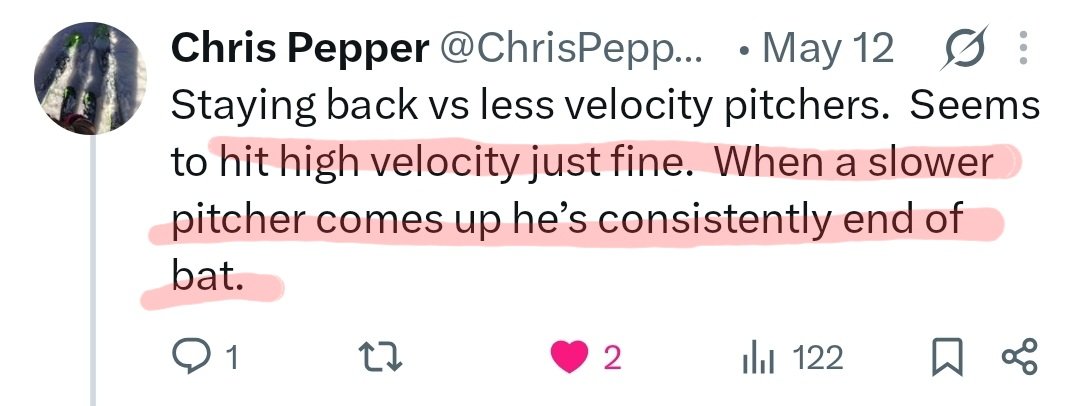
A parent asked me:
“My son crushes higher velocity…
but against slower pitching he keeps hitting balls off the end of the bat.”
One adjustment I learned as a player that I now teach my hitters:
A lot of hitters hit balls off the end of the bat against slower pitching…
because their trigger starts too early for the pitcher’s tempo.
Your trigger = when you begin getting ready to hit off the pitcher.
One thing Dusty Baker used to tell me was:
“When the pitcher shows his back pocket… you show yours.”
Against average velocity…
that worked great for me.
But against slower pitchers…
I learned to delay my trigger until later in the delivery... sometimes around hand separation.
Against higher velocity…
I might start getting ready as the pitcher lifts his leg.
The point is:
you can’t use the SAME trigger for every pitcher speed.
That’s why some hitters:
-pull off
-get out front
-hit balls off the end
-struggle staying through the baseball
against slower pitching.
So here’s something players can work on TONIGHT:
During batting practice:
-mix in different pitching tempos
-consciously delay your trigger against slower speeds
-focus on letting the baseball travel deeper
One thing I also use with this is the Barry Bonds drill I talked about earlier:
-catching the baseball with the top hand
-tracking the ball deeper
-training adjustability
Because great hitters don’t just have good swings…
they learn how to match timing to different tempos.
Thank you for reading,
Jermaine Curtis
P.S. - my goal is to help players play in high school, college, and pro...just like I did.
P.S.S. - if you found this helpful and enjoyed it, please share it. That tells me you want more content like this.
The Scouting Classroom #15
WHAT SCOUTS WATCH IN BATTING PRACTICE
One of the biggest misconceptions in baseball is what people think scouts are watching during batting practice.
Fans watch where the ball lands.
Scouts watch how it gets there.
Anybody can get fooled by one loud round.
One long home run. One ball hit over the scoreboard.
One swing that gets people talking.
But scouting has never been about chasing highlights.
It’s about identifying repeatable ingredients.
Because batting practice gives scouts something valuable:
A controlled environment.
No velocity. No breaking balls. No two-strike count. No game pressure.
Just the hitter and the swing.
And when you remove the variables, the swing starts telling a story.
Scouts begin asking questions:
Is there rhythm?
Is there balance?
Is there bat speed?
Is the barrel accurate?
Does the ball jump differently?
Can the hitter create easy carry?
Is the swing efficient?
Can he repeat it?
Does he stay through the middle of the field?
Can he backspin the baseball?
Can he manipulate the barrel?
Does the body actually work?
Those things matter.
Because tools show themselves before production does.
You can hit a long BP home run and fool people.
I've seen players put on unbelievable batting practice shows and completely fall apart once the game started.
And I’ve also seen future big leaguers take quiet rounds where the average fan saw nothing special.
But scouts noticed. Why?
Because the ingredients were there.
The rhythm.
The bat speed.
The timing.
The barrel accuracy.
The ease of operation.
The body control.
The foundation.
Good scouts learn to separate results from ingredients.
Because distance is easy to see.
The swing underneath it takes experience.
The swing tells you a story long before the stat line ever does.
That’s Scouting
#BehindTheRadarGun 🔎
Well coached teams.
Play with tempo.
Back up bases.
Have an unselfish offensive approach.
Are great at situational hitting.
Make pitchers work to get them out.
Run balls out.
Take the extra base.
Take aggressive turns.
Line up correctly defensively.
Throw to the right place.
Play with class.
Play with energy.
Make the routine play look routine.
Know what to say and when to say it.
Play with moxie.
What else?
Here’s a great look at the 1979 Braves with Bob Horner. For those of us who had cable back then, this was one of the first teams we fell in love with, even though they finished just 66-94. Bobby Cox was 38 and Phil Niekro was 40.