Tired of chasing stock tips across YouTube & newsletters?
We built Popular Strategy to use AI to:
✔️ Pull out the key points from videos/posts
✔️ Keep ideas sorted by stock
✔️ Compare them side by side to decide smarter
Try it here 👉 https://t.co/feWBjzHelh
We built ZeroTube because YouTube is incredible for learning and terrible for staying focused.
ZeroTube lets you watch the videos you choose, without recommendations, rabbit holes or distractions.
🚀 https://t.co/c2rWtWXoXR
#Productivity#YouTube#BuildInPublic
Ezra Klein: "Having AI summarize a book or paper for me is a disaster.
It has no idea what I really wanted to know and wouldn't have made the connections I would've made. I'm interested in the thing I will see that other people wouldn't have seen, and I think AI typically sees what everybody else would see.
I'm not saying that AI can't be useful, but I'm pretty against shortcuts.
And obviously, you have to limit the amount of work you're doing. You can't read literally everything. But in some ways, I think it's more dangerous to think you've read something that you haven't than to not read it at all.
I think the time you spend with things is pretty important."
@ezraklein
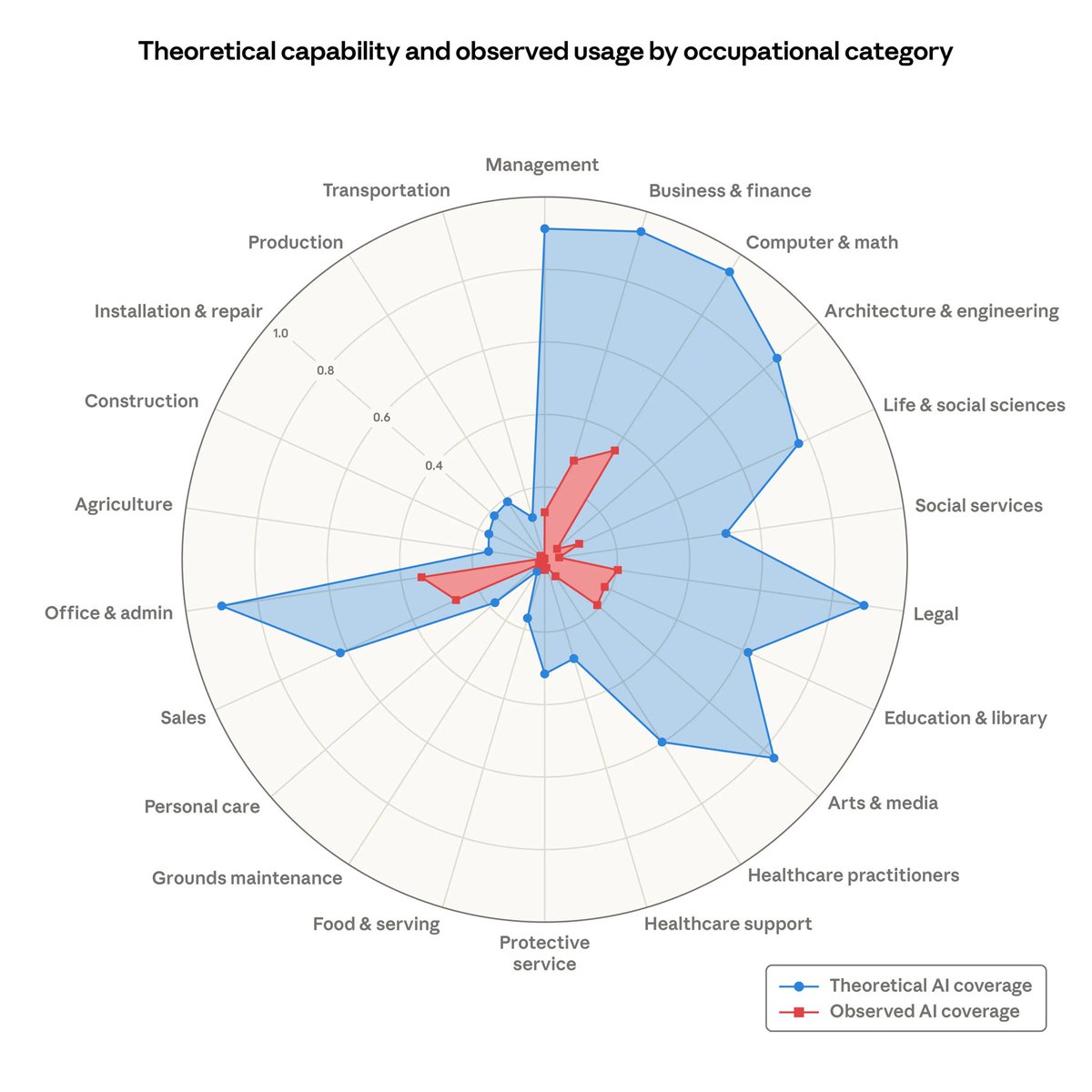
Anthropic’s labor market report is out.
The gap between AI capability and observed usage is the gap between intelligence and judgement.
AI spikes on intelligence. Human spike on judgement.
For now.
Just shipped the first version of Popular Strategy 🚀 — an AI tool that turns noisy stock tips from YouTube & blogs into structured insights investors can use. Built on @Replit ⚡️ Huge thanks for making it possible to go from idea → app so fast.
👉 https://t.co/feWBjzHelh
Google may be worth $1T more than its current valuation
We built Popular Strategy to help extract insights like this from YouTube & social. Using AI, it pulls out the thesis + metrics so you can track and compare ideas more clearly.
👉 https://t.co/tnLBLA2XhJ
Hey @agazdecki ,One idea: would be great if buyers could share their background + goals, and sellers could detail ops & KPIs like automation level. Could really help match the right founders to the right buyers. Keen to upgrade, just not sure if the listings are a fit for me yet
@prathammittal This is awesome. That’s an insane amount of wisdom packed into one list.
Would love to hear which 1–2 books surprised you the most.
We’re building something similar at @brainfeed_fun to make big ideas easier to absorb. This is gold.
@Replit
🚀 Built with @replit: Brain Feed — an AI-powered platform to study books interactively with quizzes, flashcards, and learning feeds.
A smarter way to learn from great books, one concept at a time. 📚✨
👉 https://t.co/QzkteVAKkE
#MadeWithReplit#LearnSmarter
You certainly can outsource many things (if you have the money) and this frees up time.
But not all of it, because you still manage it and think about it and etc..
Only saying “no” completely, wins you ALL the time.
List everyone you know who started by launching a startup every month, and the ninth one was really successful.
List everyone who has 1 really good idea / year, and obsessed over it, and was successful.
The second is 100x more common.
We can all list the people in the first category, exactly because there’s so few of them. Whereas the latter describes every single unicorn startup, as well as nearly all bootstrappers. So many you can’t even name a small fraction.
This is because startups are hard, good ideas are few, there needs to be good reasons for it to work, they are not haphazard A/B tests, they take 6-24 months to really get going even in the success case, they require obsession and dedication.
It’s like thinking you’re going to become a concert pianist by getting 5% through a piece and then moving on to the next one, 20 times. That doesn’t add up to 100%. That means you’re probably pretty good at the 5%, and a shit musician, and unsuccessful.
Doing 10 reps of failed startups gives you “reps” in setting up default infrastructure and having AI make a Next.js template with auth. That is not a “rep” at building products that people want to buy.
Doing 10 reps of failed “marketing” where people aren’t attracted, and the ones who are attracted bounce off, and the ones who don’t bounce off don’t buy, and of the 12 that ever bought, 8 cancelled, is not “learning.” You still have no idea how to market or sell products that people want to buy.
Being at a small, successful startup for 1 year would teach you 100x more than all those “reps” at failure. You 𝘤𝘢𝘯 learn from failure, but you learn 10x more from success. Failure doesn’t even teach you “what not to do;” some people do that same stuff and succeed.
Now list all the people on this website who have launched 7 ideas they knew were weak from the start, thinking they will be the next @levelsio, where their products are all doing $670 in MRR, just a string of failures, getting no closer to “success.”
Don’t try to mimic outliers. Outliers are very interesting, exactly because they’re rare and uncopyable. So why are you trying to copy the strategy that works 1/100th as often? Getting “reps” at failure and calling it “learning?”
And before you say “What about 𝘺𝘰𝘶! Why should we copy you!”, remember that for nearly two decades I have been saying “do not copy me.” I’ve written about rampant survivor bias in business advice including my own, and my “path” to PMF calls 𝘮𝘺𝘴𝘦𝘭𝘧 out for not necessarily walking that path.
You shouldn’t copy anyone. You should cherry-pick things you like -- attitudes, frameworks, tools, insights, prioritization schemes, decision philosophy -- and further change them to match yourself. That’s good; you should accelerate yourself using others’ wisdom. That’s not a “copy.”
Try to find a good idea that’s actually worth doing. Get obsessed and stay obsessed. Get inspired by others, cherry-picking things that make you a better version of yourself, but be yourself.
Stop building 1% of a bad idea and calling it “learning.”
Hi @MaxBrodeurUrbas , will you consider offering a white labelled edition for consultants / makers, so they can build solutions to clients , sell and bill them directly?
@udemy Will be great to have AI generated quizzes for Udemy courses. Maybe stick an open source gen AI model to the content and generate them? Answers won't be a must in the first phase, just having the questions as a way to reinforce learning will be useful
@feelmuddy Great product, but how about security? I like the feature of importing passwords from Google , however, how secure is Muddy and how does the way it encrypt , store and uses passwords is similar or different from Chrome?
@aranibatta@feelmuddy The product is brilliant, I am just concerned about passwords saving, it will be great if you can make a video or a short explainer about this aspect, all the best
If only experts in all fields review AI products the same way @svpino has done here for Devin, @cognition_labs!
AI: a tool with tremendous potential that requires us to re-think how we work , it is not ,yet, an autonomous agent that will replace jobs
@ 23:35 : the best insight
Here is my complete review of Devin, "the first AI Software Engineer."
There's a lot to like, a lot to hope for, and a few disappointments.
Overall, I'm impressed. This is what science fiction looked like a couple of years ago.
See it for yourself.