Introducing the Stripe Economics of AI Fellowship:
The economics of AI remains surprisingly understudied. The fellowship aims to help fill that gap, by supporting grad students and early-career researchers with $, data, a conference, and community –
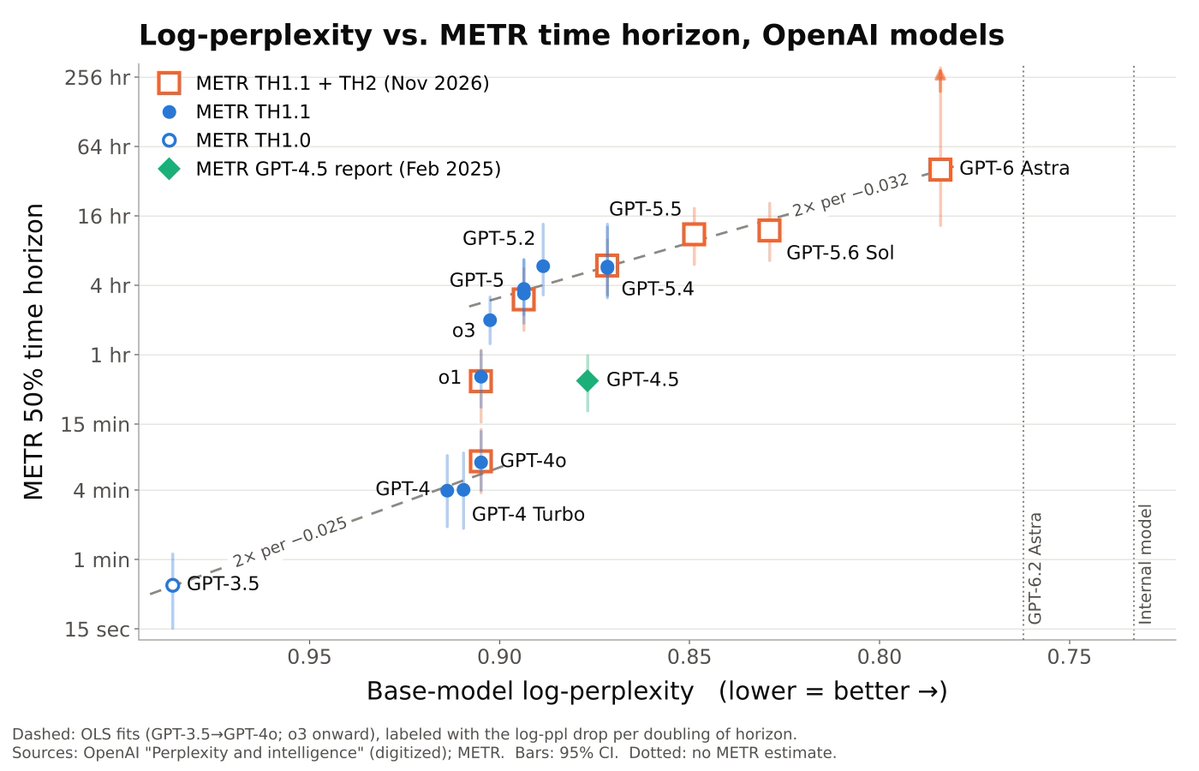
Loss vs. time horizon:
(1) Time horizon = exponential in pretraining loss
(2) Reasoning models look like a one-time jump in the relationship (slope ~unchanged, flatter if anything)
We decided to provide more transparency into pretraining progress at OpenAI for the sake of moving toward shared safety bars. In “Perplexity and Intelligence” I argue for common limits based on perplexity and other measurements, with progress beyond them gated on our ability to understand AI behavior.
https://t.co/XX35m5vq89
@_AashishReddy indeed, as you show, he literally says "it is pragmatically worth drawing a distinction" -- quantitatively but not qualitatively different!
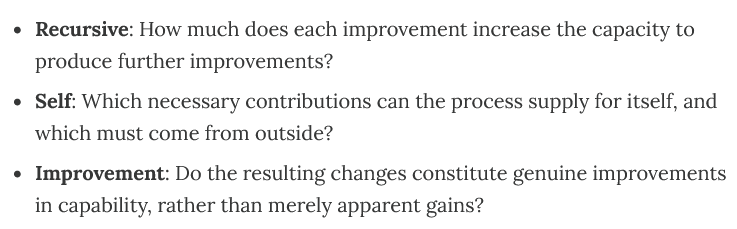
@TheStalwart "Recursive" because higher GDP today finances more {science, investment, babies}, which raise GDP tomorrow
"Self" = GDP
"Improvement" = because GDP acceleration
(maybe a relevant bit from great @_AashishReddy piece https://t.co/vM9tFDBXAI)
(...also I'm 50% shitposting...)
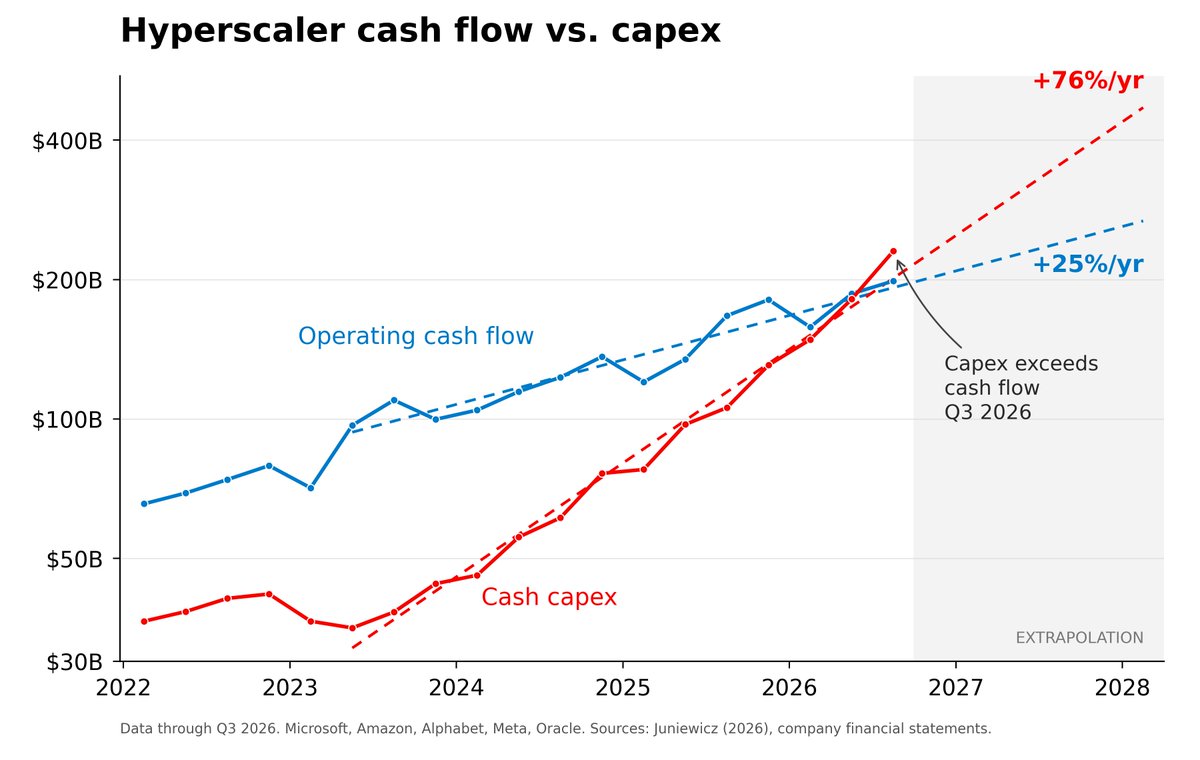
The end of the self-funded AI buildout?
Hyperscaler cash capex is growing much faster than cash inflows. On current trends, they will be unable to fully fund the AI infrastructure buildout with cash from operations by the end of this year.
@ben_j_todd I was doing SF math here btw (everything in OOMs), it's more like 10x compute -> 16x time horizon
(+ pulling this up out of replies for others: )
https://t.co/5WcrUIPuiX
+1, I would think of the OP figure as being evidence for the relationship between time horizon and experiment compute + pretraining compute (cf underlying Whitfill-Snodin-Becker paper)
The relationship with RL compute has not been studied to my knowledge -- would LOVE to know otherwise -- my speculation here
https://t.co/v931HsVbuc
+1, I would think of the OP figure as being evidence for the relationship between time horizon and experiment compute + pretraining compute (cf underlying Whitfill-Snodin-Becker paper)
The relationship with RL compute has not been studied to my knowledge -- would LOVE to know otherwise -- my speculation here
https://t.co/v931HsVbuc
Re #1, intriguing point that RL scaling has the log-x problem. But I think based on what we know, RL scaling should actually also be power law in capabilities, but am thinking this through live!:
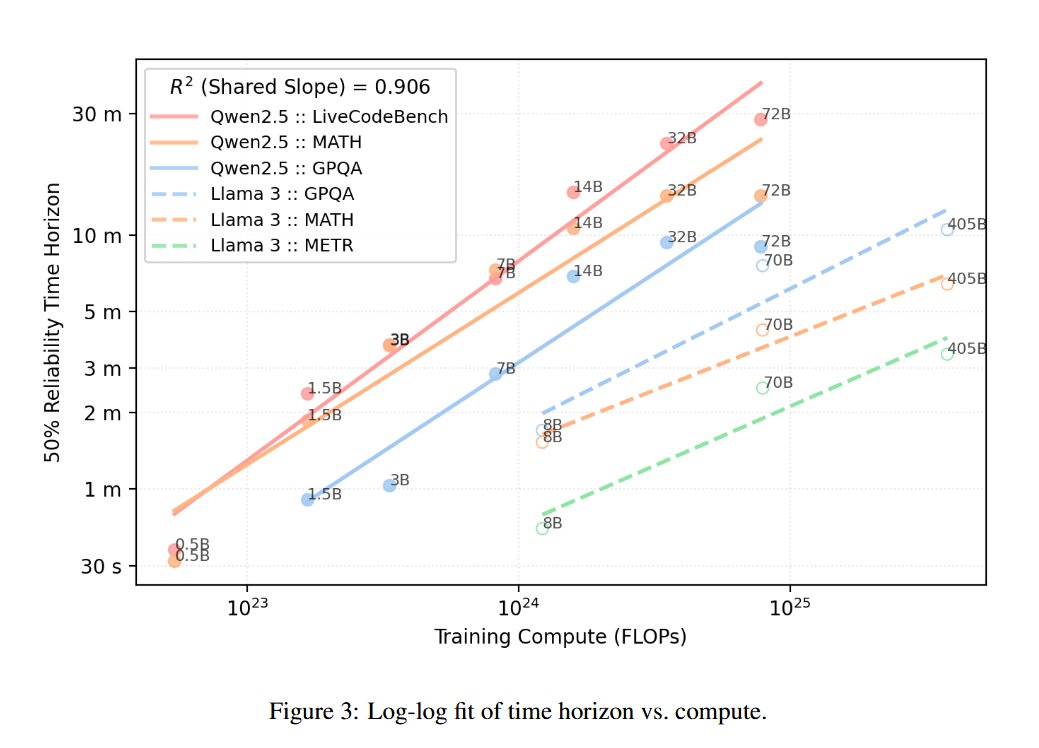
(i) Whitfill-Snodin-Becker show that time horizon is power law in training compute (their fig3, empirically; and in their very nice theory)
time horizon = (training compute)^gamma
(ii) Toby Ord estimates [https://t.co/MdaOOCPzZn]
-> if you scale pretraining compute by 100x
-> you get the same capabilities improvement as
-> if you scale RL compute by 1,000,000x
training compute = (RL compute)^(1/3)
(iii) Thus:
time horizon = (RL compute)^(gamma/3)
So plausibly time horizon is also power-law in RL compute........ (will tag @tobyordoxford if you're curious, free disposal)
The Compute Theory of Everything, indeed 🤠
And nice/interesting boiling it down to that equation! [noting it holds for steady exponential growth, but doesn't hold e.g. under a compute slowdown]
So yes, the model is that time horizon and algorithmic progress are each ultimately only a function of compute. Some unsolicited takes:
1. Time horizon. The WSB paper provides the nice ML evidence that time horizon indeed is a function of training compute. Clearly now there's room to expand this beyond pretraining compute to inference/swarm compute
2. Algorithmic progress. The WSB paper assumes that algorithmic progress is just a function of experimental compute, without too much direct argument for this. E.g. you might also think that labor effort matters for algorithmic progress!
(i) One piece of empirical validation for ignoring labor: Parker and @cherylwoooo's paper finding that experimental compute is a perfect complement to labor in algorithmic research. So not crazy to say, as an approximation, algo progress is just driven by compute
- (more work could be done here)
- (you start to worry about this assumption more going forward with AI automation of AI R&D)
(ii) What keeps me up at night is the Dwarkesh-Beren Millidge view that algo progress is downstream of data
- or the Yudkowsky view that algorithmic progress happens through unpredictable paradigm shifts, and this whole production function is conceptually confused
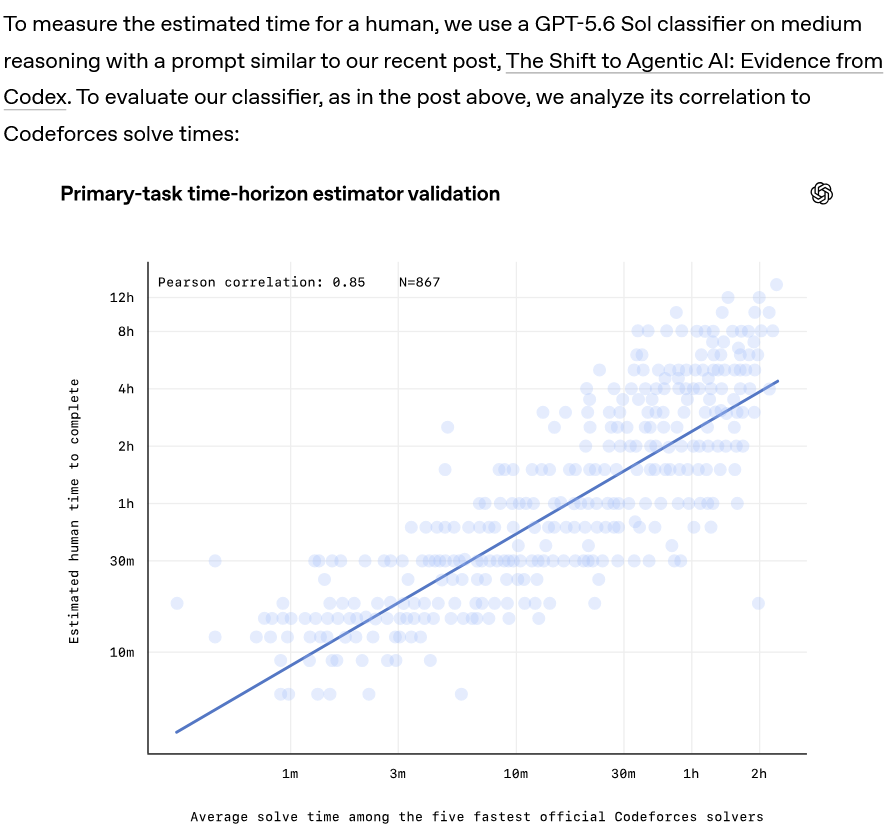
A recent set of posts by @ramez on the current state of recursive self improvement highlighted that OpenAI's report on their own research automation shows that models struggle to do their R&D work — the models' 80% time horizon is only 15 minutes:
🧵
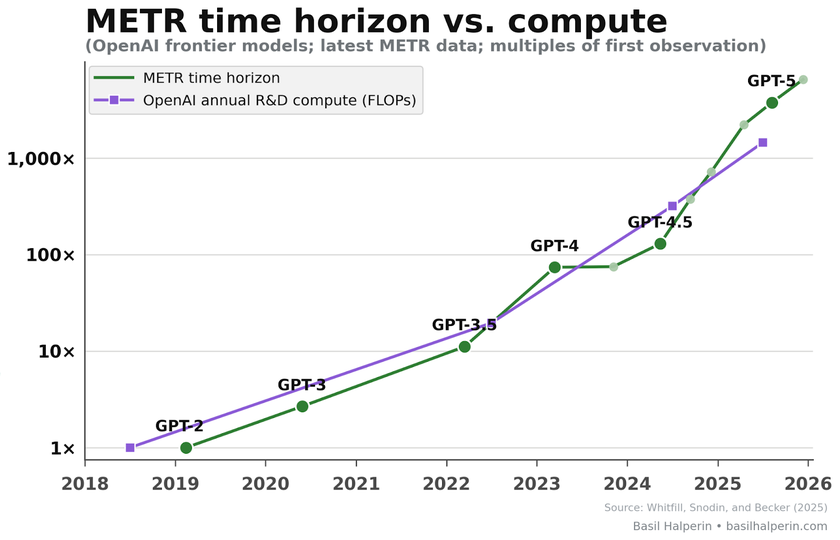
@tobyordoxford@ramez And if you run the numbers, in the end, a 10x increase in *total* compute gets you very roughly a ~10x increase in time horizon
Basically it all comes down to this graph. The elasticity of ~1 holds across 3 OOMs
@tobyordoxford@ramez And if you run the numbers, in the end, a 10x increase in *total* compute gets you very roughly a ~10x increase in time horizon
Basically it all comes down to this graph. The elasticity of ~1 holds across 3 OOMs
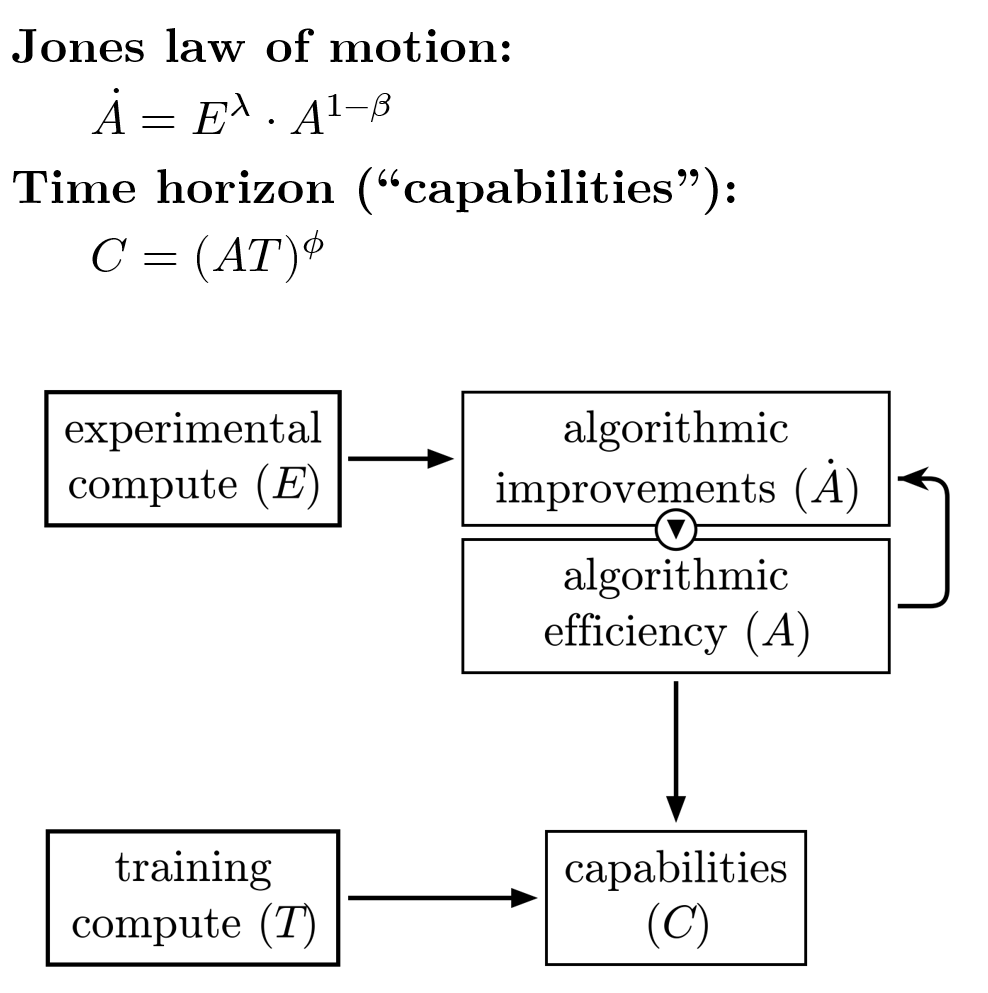
The explanation -- as you may be suggesting -- is, in terms of an elasticity diagram:
1. Time horizon (C) is a function of training compute (T) + algorithmic efficiency (A)
- the 0.454 slope measures the T -> C elasticity
2. Algorithmic improvements (Adot) are ALSO a function of experimental compute (E)
So increases (or decelerations) in total compute, in their story, affect time horizon BOTH indirectly (through A) and directly (through T)
-> so the timeseries of total R&D compute is enough to explain time horizon progress
(cc @whitfill_parker fwiw)
@karthiktadepall had a tweet (which I've now lost) emphasizing that the distribution of OpenAI tasks being measured shifts over time -- as the OpenAI OP writes in a footnote:
@michael_wiebe OpenAI uses high context (at least in my reading), this is good to emphasize: first screenshot from their blog post, second from the relevant paper
@michael_wiebe OpenAI uses high context (at least in my reading), this is good to emphasize: first screenshot from their blog post, second from the relevant paper