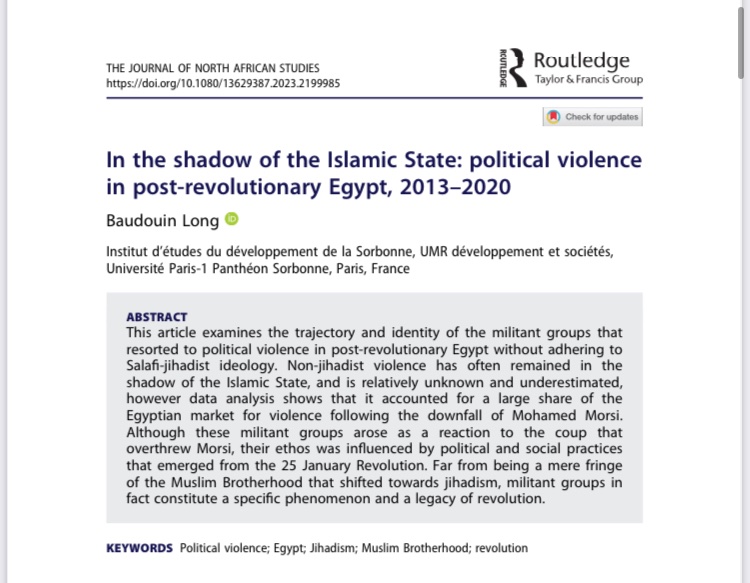
🚨New paper!
Thrilled and honoured to announce that my article about political violence in post revolutionary Egypt is to be published soon @NAfricanStudies
The US State Department has waived human rights conditions for more than $300 million of military aid to Egypt in light of Cairo's "helpful role" since the launch of the US war with Iran, according to a letter to US lawmakers obtained by Reuters. https://t.co/PNtpqsOTyL
Qui se cache vraiment derrière l’affaire Thélyson Orélien ?
Un jeune chercheur révèle au @Grand_Continent pourquoi il a cofondé le collectif Balance ton Claude @Pangramed.
Lecture vraiment très conseillée.
https://t.co/z2QGy5KDvj
BREAKING: Ethiopia expels Egyptian diplomat from Addis Ababa
Ethiopia has expelled a member of Egypt's diplomatic mission in Addis Ababa, Ahmed Moharam Ahmed Soliman, from the country, according to a letter submitted by the Ethiopian Foreign Ministry to the Egyptian embassy. An Egyptian official has confirmed the news to Mada Masr. In the letter, of which Mada Masr obtained a copy, the ministry declared Soliman persona non grata, stating he must leave the country within 48 hours. According to an Ethiopian official, the letter was delivered to the Egyptian embassy in Addis Ababa on Thursday afternoon.
Earlier on Thursday, the Ethiopian Foreign Ministry announced the closure of the Ethiopian embassy in Asmara, citing what it called Eritrea's "direct and indirect acts of hostility and belligerence against Ethiopia," according to a letter sent to the Eritrean embassy and published on official channels. Alongside the decision, 10 Eritrean diplomatic staff were declared persona non grata and ordered to leave the country within 48 hours.
The government informed British Petroleum it would reject a deal that would see the British company sell some of its Egypt based oil and gas assets to Israeli majority-owned Energean, according to two sources informed of the deal who spoke to Mada Masr on condition of anonymity, one of whom who works for the company. This comes as BP seeks to divest part of its energy asset portfolio in Egypt, while the government is pushing to attract more investment into the petroleum sector in order to raise natural gas production amid a major energy shortfall.
https://t.co/OUaI7imZ7p
🇪🇬🇬🇧🇮🇱 Egypt has told British energy giant BP it would reject any sale of some of its Egyptian oil and gas assets to majority Israeli-owned Energean, Mada Masr reports.
Egyptian officials reportedly cited “national security concers” among the reasons for opposing the deal.
“Gulf countries generally agree that Trump shouldn’t escalate militarily against Iran. But oil kingpin Saudi Arabia and the United Arab Emirates are lobbying the Trump administration to keep up the economic pressure on Iran and not agree to concessions that would ease sanctions or the U.S. Navy blockade, the people said.” https://t.co/XGDHgmLp2O @summer_said@benoitfaucon
It looks like constitutional amendments in Egypt are on the cusp. As I predicted, it’s only a matter of time.. but I didn’t think it would be this soon. A national front against it is being formed, and I might cut my studies in D.C. short to participate in Cairo.
Egypt energy import bill increased by $9 billion during the past quarter. It seems it’s not a question of if Egypt will increase energy prices again but when.
I was in Saudi Arabia this week and my firm Pangea Geopolitical Risk is closely monitoring the Yemen developments
Some key points to consider
1) This is more than a Saudi-Houthi conflict, Yemen is a deepened state of hot civil war: the Houthis are gaining ground at the expense of Saudi-aligned government forces and the south Yemeni movement is taking steps to reconstitute and warning that the December 2025 attacks on them worsened security. 100,000 Yemenis are displaced in the latest fighting and the 2022 truce is over. Saudi airstrikes are unlikely to be as sustained as they were after 2015 but will continue as will Houthi cross-border attacks. Riyadh has been targeted by the Houthis for the first time since 2017-18 and the King Khalid Airport incident is a symbolic throwback to those times.
2) Pakistan will continue threading the needle on intervention: Pakistan has vowed solidarity with Saudi Arabia and is rhetorically giving the Mecca Agreement teeth. This means more air defence cover training and the utilization of the thousands of Pakistani security trained forces in Saudi Arabia for collective defence. It does not likely mean Pakistani jets striking Houthi targets or Pakistani boots on the ground. Pakistan's 2015 non-intervention logic partially holds and its backchannel role with Iran is not fully extinguished.
3) Confidence in US Leadership will be shaken further: Trump's first term in 2019 witnessed two successive events that shook confidence in the US within GCC countries: the passive abandonment of the Kurds in Turkey's Syria Operation Peace Spring offensive and the non-response to Abqaiq attack. Trump's refusal to assist Saudi Arabia in this crisis will compound those concerns. Europe-GCC cooperation will grow, as trust in Russia and China as backchannels has been strained by their Iran ties, but does it have substance? EDGE in UAE is making major European plays and both the GCC/Europe are modernizing at the same time.
4) Egypt is the country to watch- Egypt's parlous macroeconomic situation has been further affected by the latest escalations, it sees the Suez Canal and Bab el-Mandeb Strait as economically integrated. Calls for an Arab solution to the Red Sea security crisis are intensifying and Sisi's meeting with MBS is likely to fuel greater Egypt-Saudi Arabia security cooperation. Egypt is happy to continue contributing to maritime security in the Red Sea. The trauma of the 1960s and capacity constraints impede frontal involvement in Yemen. Egyptian officials see military intervention in Yemen as a trap. Possibility of formal Mecca Agreement inclusion grows modestly from last month but not a certainty.
The Iran war may create opportunities for Cairo
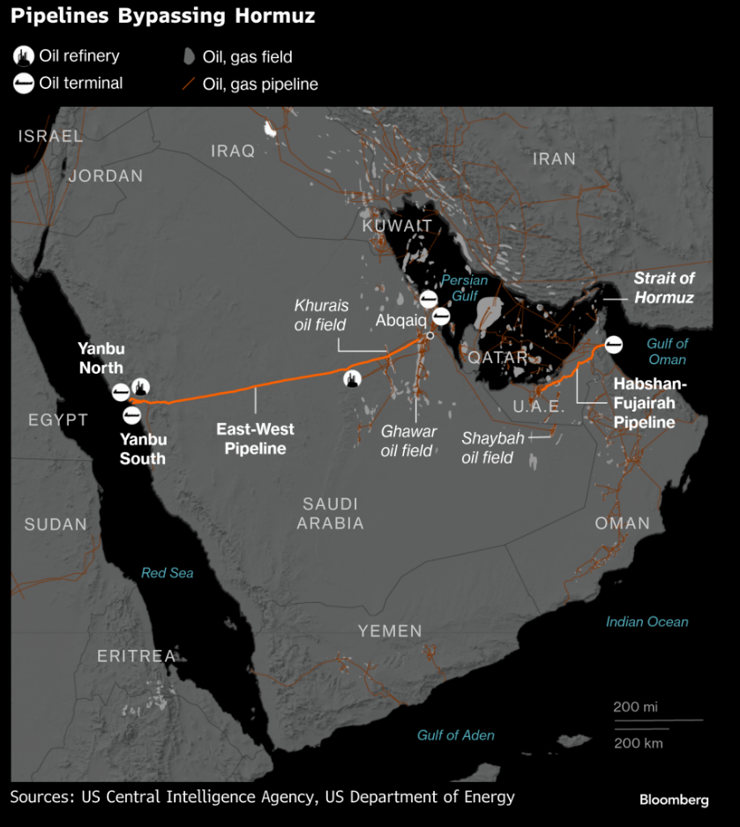
The Gulf will likely build oil and gas storage abroad to bypass conflict disruptions
Egypt has the land, coastlines & location
It could become the energy bridge linking Gulf exporters to European buyers
5/5
Après avoir rencontré, il y a plusieurs mois, des dirigeants du Hamas palestinien, des responsables américains ont rencontré des représentants des Houthis du Yémen à Oman ce week-end, révèle l'agence Reuters, citant cinq sources proches du dossier.
Lors de cette réunion, qui, selon une source, a eu lieu dimanche, les Houthis ont déclaré aux responsables américains qu’ils n’avaient aucune intention d’attaquer des navires américains et qu’ils s’engageaient à respecter le cessez-le-feu de 2025 conclu avec les États-Unis, ont indiqué deux sources.
L’une de ces sources, un Yéménite, a précisé que la milice avait également affirmé qu’elle n’attaquerait pas
les navires israéliens ni aucun navire commercial, à l’exception de ceux appartenant à l’Arabie saoudite.
Cette rencontre, qui n’a pas été rendue publique, s’est tenue à l’ambassade des États-Unis à Mascate, ont indiqué trois de ces sources sous couvert d’anonymat. Deux d’entre elles ont précisé que le gouvernement omanais, médiateur régional de longue date, avait contribué à l’organisation de cette rencontre.
L’administration Trump a désigné les Houthis comme « organisation terroriste étrangère » en mars 2025, érigeant ainsi en infraction pénale tout soutien apporté à ce groupe. Mais Washington a depuis négocié avec eux, parvenant à un cessez-le-feu en mai dernier après avoir bombardé le groupe pendant deux mois afin de mettre un terme à une campagne d’attaques contre le trafic maritime en mer Rouge.
Le président Donald Trump a déclaré samedi que les Houthis avaient contacté son administration par téléphone pour demander aux États-Unis de ne pas s’immiscer dans la guerre au Yémen. Le vice-président JD Vance a déclaré lundi que les États-Unis étaient en contact direct avec le groupe, sans donner plus de détails.
L’une de ces sources a indiqué que la délégation houthiste comprenait un haut responsable basé à Mascate et soumis à des sanctions américaines, Mohammad Abdulsalam.
Une autre source a confirmé la présence d’Abdulsalam ainsi que celle d’un autre haut responsable houthiste, Abdelmalik al-Ajiri.
Interrogé sur la question de savoir si les États-Unis avaient rencontré les Houthis à Oman, un porte-parole du Département d’État n’a pas confirmé cette rencontre, mais a déclaré que la sauvegarde de la liberté de navigation en mer Rouge et la prévention de l’exportation du terrorisme depuis le Moyen-Orient constituaient des intérêts fondamentaux des États-Unis.
#Houthis
I was asked about this by a journalist today. Some brief thoughts on Egypt's position vis-a-vis Yemen and Saudi requests:
What MBS wants from Sisi:
I don't think MBS wants troops from Cairo, which he knows would be a very difficult ask. But Cairo can give wider Arab-level political cover, and then later practical coordination on securing the Bab al-Mandeb corridor with maritime assets after the Houthis have been forced from the area. Even before that, Egyptian naval and intelligence cooperation, is possible and likely.
Why Saudi Arabia is facing this largely alone:
There's genuine international consensus that the Houthis cannot be allowed to hold a chokepoint like Bab al-Mandeb hostage. But Riyadh's own record in Yemen gives would-be partners pause about how a remobilisation actually unfolds in practice.The Houthi threat to shipping is not in dispute; the method of confronting it is what's giving partners pause. MBS is keenly aware of this, and will be trying to make it clear there is a much better plan for going forward. It just depends on how many are convinced.
L’Egypte a eu beaucoup plus récemment sa propre guerre dans le Sinaï contre le groupe Etat islamique, cela lui a pris des années pour l’éliminer. Les Egyptiens savent qu’une guerre au Yémen serait plus difficile et ils n’en ont pas les moyens.
🇪🇬🇾🇪🇸🇦 avec la prise de contrôle de bab el-mandeb par les Houthis et la visite de MBS au Caire se pose la question d’une intervention égyptienne contre les Houthis aux côtés des Saoudiens.
On peut avoir un doute, pas seulement comme on peut le lire ici et là parce que l’Egypte a eu une expérience historique malheureuse au Yémen dans les années 1960.