🏦The UK Gov recently dropped a new report on Wholesale Digital Markets to the Chancellor
And $QNT fingerprints are all over it💥
Three things stood out to me immediately
• GBTD titled "exceptionally important to the UK"
• ISO TC 307 cited as a key standards body
• APIs & API standards as a top priority
• Project Agora referenced
Now here's why each of those matters
Let's start with GBTD
The report's exact words:
"Commercial banks are developing tokenized deposits through the GBTD. This latter initiative is exceptionally important to the UK."
Exceptionally important.
That's the UK Government's own language in a report to the Chancellor
And who orchestrates the strings behind GBTD?
Quant Network's Overledger paired with Payscript.
Then there's the recommendation itself
"Continue to build GBTD at scale."
Not explore it. Not pilot it.
Scale it.
The UK Government is telling the Chancellor to scale the infrastructure Quant is building
But that's far from all...
GBTD is already in the Bank of England's Sync Lab
It integrates with RTGS, Faster Payments & Open Banking under an ISO 20022 compliant scheme.
And if that wasn't enough...
There's clear mentions of ISO TC 307 here under the UK's existing standards initiative.
And the mentions of API standards for interoperability is just the cherry on top, referencing IETF SATP.
Both obviously being standards founded within the Quant Network leadership.
While retail continues watching price,
The UK Gov just told the Chancellor the infrastructure Quant powers is "exceptionally important" to the country.
––––
THAT is the difference between retail crypto & real Enterprise DLT developments.
Quant Network just joined the x402 Foundation as a General Member. ethereum:0x4a220e6096b25eadb88358cb44068a3248254675
The same table as Visa, Mastercard, Stripe, Coinbase, and American Express...
The open standard being built for agentic payments on the internet.
ethereum:0x4a220e6096b25eadb88358cb44068a3248254675 has been building institutional interoperability since 2018.
x402 is the infrastructure that kind of work connects into.
Hedera is aware of the incident affecting Bonzo Lend, an independently operated DeFi application built on Hedera. Based on the findings to date, Hedera’s consensus mechanism and core network services were not compromised, and mainnet remained operational. Bonzo’s preliminary report points to an issue involving a third-party oracle verifier.
Hedera is aware of the incident affecting Bonzo Lend, an independently operated DeFi application built on Hedera. Based on the findings to date, Hedera’s consensus mechanism and core network services were not compromised, and mainnet remained operational. Bonzo’s preliminary report points to an issue involving a third-party oracle verifier.
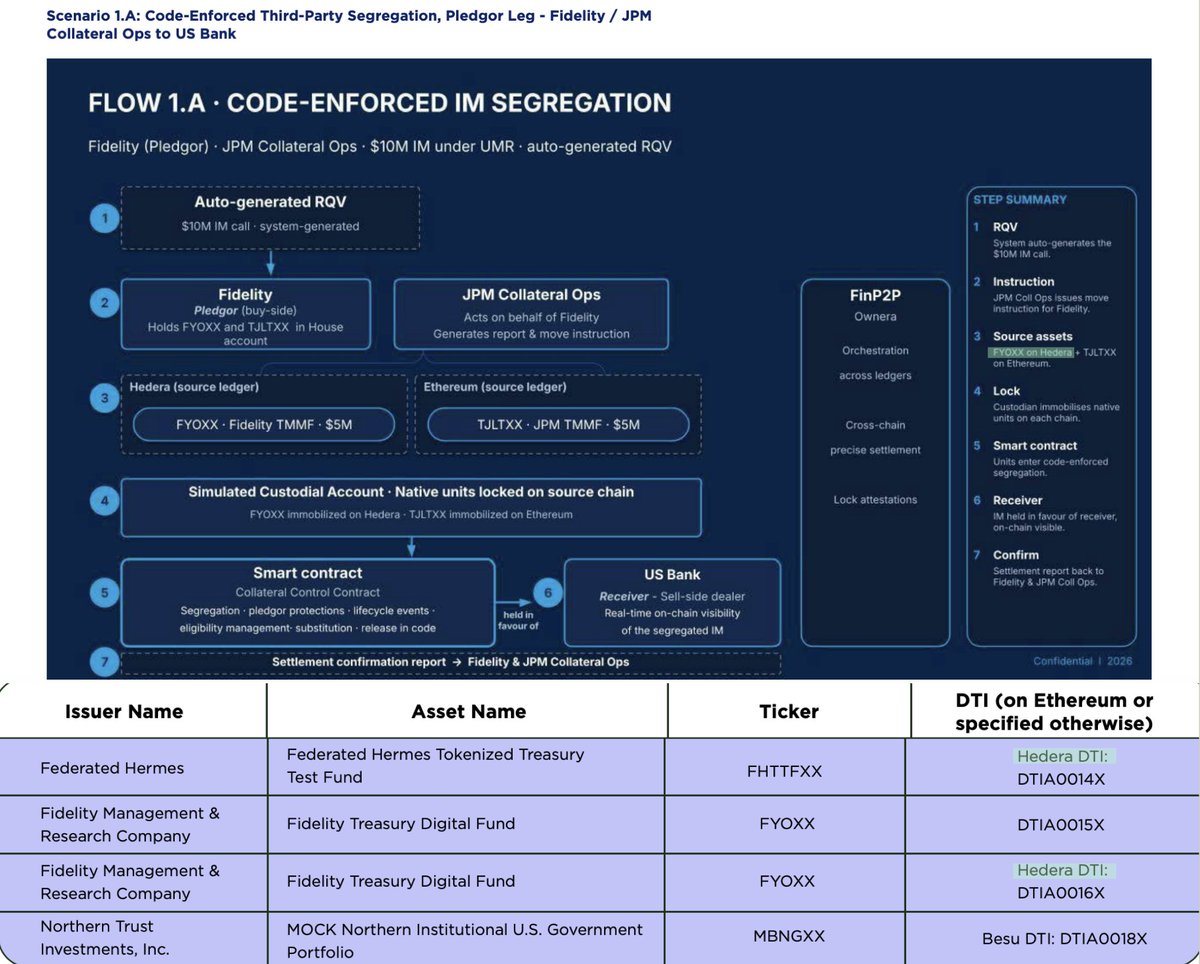
Recently $HBAR was included in an ISDA & GDF study for tokenized money market funds
Other participants included:
• BlackRock
• BitGo
• BNY
• CME
• SWIFT
• JP Morgan
• Archax
Both TradFi & Web3 Finance leaders.
And the DLTs selected?
Ethereum & Hedera Hashgraph
This is quite an eye opening list.
As we've known, Ethereum has been tested across various institutional use cases due to their long standing of being a leading L1.
But Hedera, has moreso been reserved for specific cases in finance by specific TradFi players.
Quite interesting to see they're the ONLY other DLT leveraged in here.
But also remember, Hedera has already proven viable utility for tokenized MMFs at the institutional level.
Just a few months back we saw Hedera in the UK x EU tokenized collateral trial by Global Digital Finance too.
Now Hedera's becoming a preferred choice here🔑
AI agents are already making transactions, executing trades, and settling obligations autonomously and at machine speed. That infrastructure needs to be fit for purpose.
Quant has joined the x402 Foundation, hosted by the @linuxfoundation, connecting internet-native payment protocols to the regulated banking rails that underpin the real economy. Our Fusion multi-ledger rollup already supports x402 out of the box, across 70+ networks.
Interoperability between decentralised and institutional finance is what we're building.
Learn more: https://t.co/7vDkstV8cL
#QuantFusion #x402 #AIAgents #AgenticPayments
(1/5) Keeta now supports x402.
x402 is an open, HTTP-native payment standard built around the 402 Payment Required status code by @CoinbaseDev. It lets any API or endpoint charge for access, per request, per token, or per call, without accounts, API keys, or subscription billing.
Below is a breakdown of how it works on Keeta.
AI agents are increasingly making transactions, executing trades, and settling obligations autonomously and at machine speed. The infrastructure behind these payments needs to be fit for purpose.
Banks authorise transactions and provide safeguards to our money. Agentic AI transactions should be no different, operating within the secure guardrails of bank security and protection.
That's why @quantnetwork has joined the x402 Foundation, hosted by The Linux Foundation.
Our @FusionLayer25 multi-ledger rollup is x402-ready today, across 70+ networks.
Interoperability between decentralised and institutional finance is what we're building.
Learn more: https://t.co/no7GVOCzsI
#QuantFusion #x402 #AgenticPayments #AIAgents #TokenisedDeposits
AI agents are increasingly making transactions, executing trades, and settling obligations autonomously and at machine speed. The infrastructure behind these payments needs to be fit for purpose.
Banks authorise transactions and provide safeguards to our money. Agentic AI transactions should be no different, operating within the secure guardrails of bank security and protection.
That's why @quantnetwork has joined the x402 Foundation, hosted by The Linux Foundation.
Our @FusionLayer25 multi-ledger rollup is x402-ready today, across 70+ networks.
Interoperability between decentralised and institutional finance is what we're building.
Learn more: https://t.co/no7GVOCzsI
#QuantFusion #x402 #AgenticPayments #AIAgents #TokenisedDeposits
What Ondo started, the industry followed.
Robinhood, Binance, Bitget, Coinbase and Kraken all launched tokenized stocks, replicating the same Just-In-Time liquidity model that Ondo pioneered to bring traditional exchange liquidity onchain. For many of these, Ondo's assets remain their most popular tokenized stocks.
A few things are now clear:
1. The market has fully embraced the wrapper model.
2. Ondo has set the industry standard for how liquidity comes onchain.
3. Despite these entries, Ondo's tokenized stocks are the preferred best in class option, commanding ~60% market share of the category (more than all others combined)
Imitation is the ultimate sign of Product Market Fit. While others play catch up to where we started, we're already building what's next. Ondo will continue to raise the bar for the industry, and I'm very excited to share soon what comes next.
Binance Research: "2026 marks RWA tokenization's maturation from a treasury-dominated narrative into a diversified yield ecosystem."
The boring sector just got interesting.
$ONDO. $CFG. $LINK. $XDC. $QNT.
Altseason 2026 isn't for everyone. It's for the narratives that survived the bear.
And for those who positioned early.
Real 24/7 trading for tokenized stocks is here.
In a landmark first for the industry, the most popular Ondo tokenized stocks and ETFs can now be minted & redeemed anytime.
While others have claimed 24/7 trading, this has only ever been for CEX or DEX transfers, with actual minting and redemption limited to traditional market hours. Now, tokenized stocks are truly trading 24/7:
✅ Overnight
✅ Weekends
✅ Public holidays
The first wave of 24/7 assets are SPYon, QQQon, CRCLon, NVDAon, TSLAon, and GOOGLon, with more to follow.
This builds on existing 24/7 permissionless transfers of Ondo tokenized stocks, moving the industry another step closer to the always-on onchain markets that will define the future of global finance.
Live now on Ethereum & BNB Chain, with Solana coming soon.
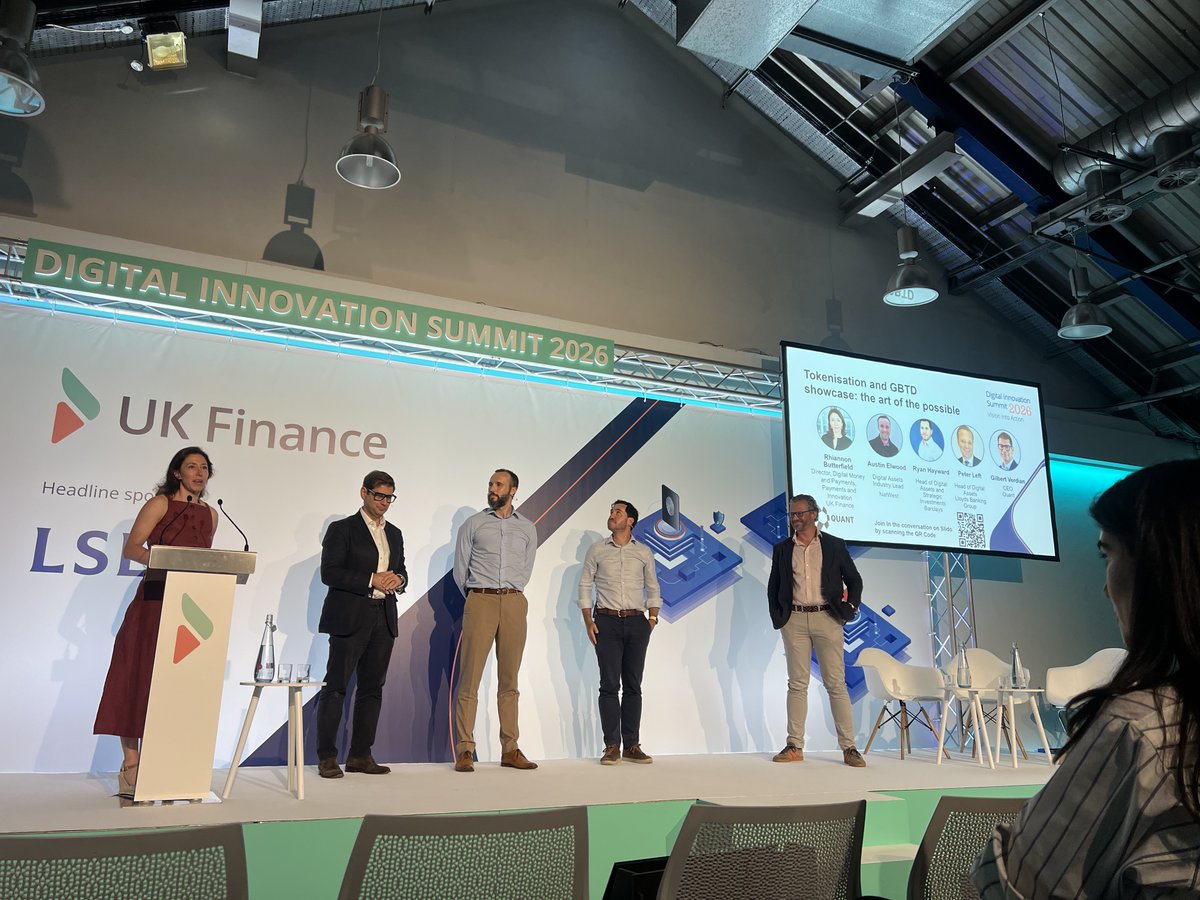
Today, our CEO, @gverdian, joined a panel at the @UKFtweets#DigitalInnovationSummit on tokenisation and GBTD alongside representatives from @Barclays, @LloydsBank and @NatWestGroup.
"This is the world's first tokenised deposit payment system built for industry, by industry - an essential orchestration layer that gives every participant the ability to innovate, differentiate and compete."
Full insights coming soon.
#GBTD #TokenisedDeposits #ProgrammablePayments
Today, our CEO, @gverdian, joined a panel at the @UKFtweets#DigitalInnovationSummit on tokenisation and GBTD alongside representatives from @Barclays, @LloydsBank and @NatWestGroup.
"This is the world's first tokenised deposit payment system built for industry, by industry - an essential orchestration layer that gives every participant the ability to innovate, differentiate and compete."
Full insights coming soon.
#GBTD #TokenisedDeposits #ProgrammablePayments
Our team’s opinion after the recent AI discourse is pretty simple: frontier AI is moving fast, but no one should use a scaling curve to dictate the research pace for everyone else.
Given the state of machine learning as a whole, no one has a license to act like the core problems behind AGI, RSI, or ASI are close to solved.
The more sober view, in our opinion, is that we are moving out of a pure scaling era and back into a research era as Sutskever or Le Cun say. Scaling gave the field a lot. No serious person should dismiss that, and no one serious should be saying “stop scaling” or “stop frontier research.” But current systems still fall short in ways that matter: they can be brittle, they struggle under distribution shift, they do not learn continuously the way humans do, and they still lack the kind of grounded, reusable understanding that transfers reliably across very different contexts.
This is why no one should be dictating the pace of research as if the hard part is already behind us. There is still a massive amount of research left to do.
Sutskever’s “finite data” point is important because it cuts deeper than just “we need more data.” It points to the limits of relying on internet-scale pre-training as the main engine of progress. At some point, the question becomes how systems generalize, how they learn efficiently from limited signals, and whether the learning mechanisms themselves are enough.
The original “world model” crowd (May the meaning of this terminology rest in peace alongside “memory”) says that it’s not just that LLMs have flaws but that intelligence requires machinery for world models, grounding, memory, planning, and prediction in latent space. A system can be very good at modeling language while still missing the structures needed to understand and act in the world.
If clean data, feedback, and training signals were effectively unlimited, distillation and model-extraction attacks would not be such a major strategic concern. The fact that frontier capability itself becomes something others try to copy is a reminder that learned competence is scarce. It also suggests that the main mechanisms LLMs currently rely on to improve may be far from sufficient to reach super-intelligence or efficient learning.
These opinions are more AI-friendly than anything. Looking forward to progress across many areas, while giving the big labs real credit for what they have achieved in language, code is far more positive for the field than pretending we are already close to AGI or ASI when we clearly are not there yet.
And while we are not there yet, the large influx of serious STEM talent into AI is unbelievably good for the industry. Researchers from across math, physics, biology, engineering, and the rest of science are increasingly taking AI seriously, building with it, testing it, and bringing their own standards into the field. That should be celebrated as it means AI is attracting the kind of people needed to solve the rest of the problems.
Domains that are not compatible with prose strengthen the main point. A model can be excellent at language, code, and digital workflows while still being far from robust general intelligence. Physical prediction, causality, affordances, action-conditioned planning, and reasoning across long time horizons are still hard problems.
So yes, today’s models may reshape coding, security, science workflows, and other areas. That is very real indeed but it does not mean we already have the a perfect recipe for autonomy, alignment, continual learning, causal understanding, grounded world models, or reliable long-horizon reasoning.
The public conversation would be much healthier if it could hold both ideas at once: frontier models are good while there is still a lot left to do on all angles.
The financial system has managed #settlement risk for decades through margin and pre-funding. Atomic settlement doesn't reduce that risk. It eliminates the gap that creates it.
Central banks and major financial market infrastructures across the globe are already moving.
Read this article to understand what it means for your institution's infrastructure: https://t.co/xljupgPOnW
#AtomicSettlement #DvP #TokenisedDeposits
(1/9) Keeta and ASK Group @askgroupae, a UAE-based investment group led by His Highness Sheikh Ahmed bin Sultan bin Khalifa bin Zayed Al Nahyan @asknahyan, have created a joint venture aiming to tokenize tens of billions of dollars of commodities and modernize cross-border payments in the Gulf Cooperation Council (GCC) region and beyond, contributing to the UAE's vision and commitment to growth as a global leader in digital finance and real-world asset infrastructure.
Innovation thrives when visionary leadership and transformative technology come together. We are pleased to embark on this journey with Keeta, led by CEO Ty Schenk and supported by the confidence of former Google CEO Eric Schmidt. Together, we aim to contribute to UAE’s vision for digital finance, cross border connectivity, and the tokenization of real world assets.