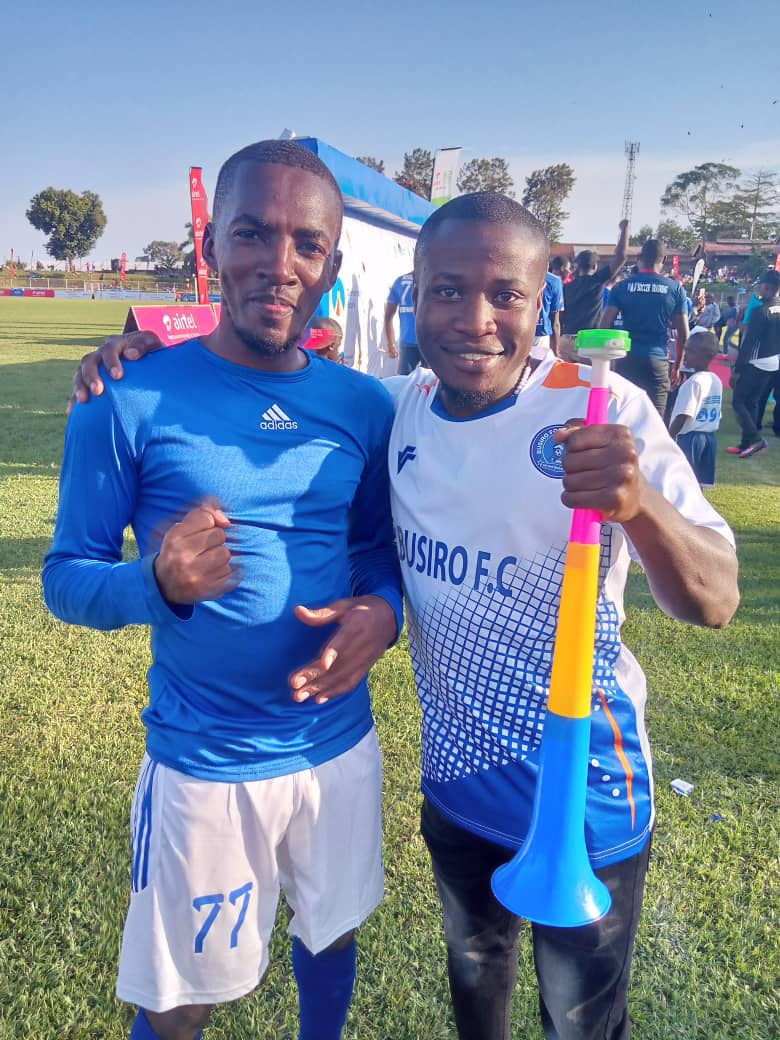
A reminder that Manager of @BusiroF Hon @paulnsub won 2022 masaza cup final last Saturday on 4th/03/2023.
You can defend it and make history Manager 💪
@DavidLumansi@peaceBagala
HRH Prince Richard Ssemakookiro
The prince is the second son and the youngest child of His Majesty. He was born in July 2011.
At a young age, the Prince
Carries out officiall and Royal engagements.
He is a student
Prince Richard Ssemakookiro was named after his great grandfather, Ssekabaka Semakookiro Wasajja . He was the son of Kabaka Kyabaggu . Ssemakookiro was the Kabaka of Buganda between 1797 – 1814 when he died. He is remembered to have had 15 official wives.
He was baptized on August 21, 2017 at a private church service at St. Paul’s Cathedral Namirembe during which Princess Sarah Katrina Ssangalyambogo was confirmed.
Ssemakookiro was baptized by Bishop Wilberforce Kityo Luwalira with assistance from Can. Benon Kityo and Vicar Festo Kalungi.
Uganda has lost one of its great Catholic music composers, Father James Kabuye.
The Second Vatican Ecumenical Council, which began in 1962, the same year Father Kabuye was ordained a priest, would later create opportunities for him to put his musical compositions to greater use. He had learned from the late Father Kyangambiddwa how to write, read and interpret African music. Composing therefore came naturally to him, particularly following the groundbreaking decisions of the Second Vatican Council in 1964.
This presented an opportunity for Father Kabuye, who could compose music in Luganda. The challenge, however, was how to make music in a local language as appealing as it was in Latin.
An idea then struck Father Kabuye: he would compose music that retained elements of the original Catholic Latin canticles but featured a slightly faster tempo.
His compositions feature a responsorial style, in which the congregation sings a short, easy-to-memorize refrain, followed by verses led by a principal singer (a cantor) or by the choir.
Other priests, including Expedito Magembe and Vincent Bakkabulindi, later contributed to this musical development. The Buganda region became the first to adopt a local language in liturgical music.
In subsequent years, the late Monsignor Bonaventure Kasaijja composed several liturgical pieces in Runyoro, Rutooro, Runyakore and Rukiga.
In the 1970s, a heated debate emerged over whether local instruments should be used in churches instead of organs, which were largely reserved for seminarians. Eventually, local instruments were accepted, contributing to the revival and wider appreciation of local church music.
Father Kabuye’s music is a regular part of Catholic church services across different types of Masses, with more than 100 compositions attributed to him.
I met Father James Kabuye in July 2016, and we had a long conversation about his music career and priesthood. I did not want to stop listening to his wisdom. Watch these excerpts from NTV’s Talking Arts.
May his soul rest in eternal peace.
@ugcatholics@UgandaEpiscopal
Time rewards those who refuse to abandon their WHY.
Be patient with the process. Resilient through the storms. And when the journey becomes heavy, revisit the reason you began.
Change the strategy. Adjust the pace. But do not surrender the purpose.
Time eventually separates commitment from excitement.
Stay the course.