Postkolonial teori började som en analys av kolonialismens arv. I dag fungerar den alltför ofta som en intellektuell tvättmaskin för islamistisk aktivism. Allt pressas genom samma mall: väst är alltid förövare, den som säger sig bekämpa väst blir automatiskt offer. Hamas/Hezbollah/Houthirörelsen mm blir “motstånd”, mullorna i Teheran “antiimperialister” och islamister reduceras till produkter av kolonialismen; aldrig till ansvariga aktörer med en egen totalitär ideologi.
Den moderna antirasismen spelar ofta med. Identitet väger tyngre än handlingar. Antisemitism, kvinnoförtryck och religiös extremism relativiseras så länge de kommer från grupper som placerats längst ned i offerhierarkin. Resultatet är en märklig antirasism där principer offras för identitetspolitik och där analys ersätts av aktivism.
Det är inte kritiskt tänkande. Det är bara en ny dogm.
Same red bikini. Same energy.
This time the camera catches her from behind while she’s dancing at the party… and then she just starts casually vibing with some older lady like it’s the most normal thing in the world.
No camera awareness. No trying to look perfect. Just pure chaotic summer energy.
First she gave the internet “the look.”
Now she’s out here dancing with random aunties in the foam like she never went viral.
Icon behavior.
Still not over her.
#Aora #RedBikini #FoamParty #LloretDeMar #MainCharacterEnergy
https://t.co/xXYQ30DxvH
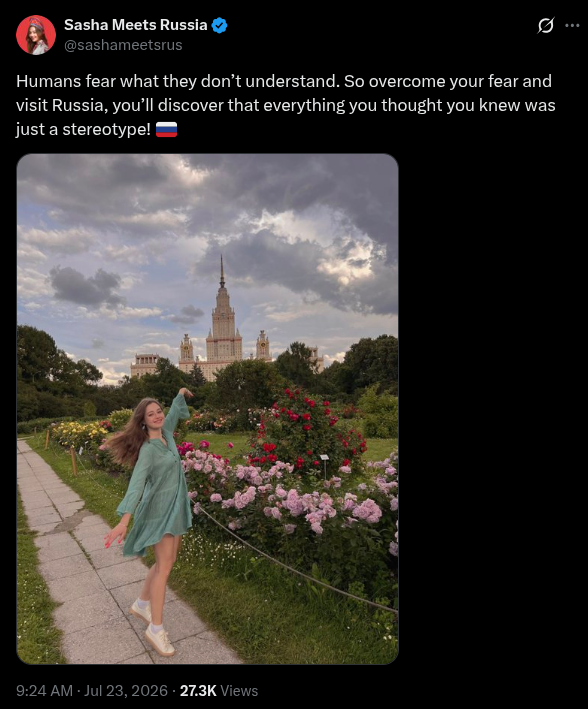
With the Kremlin again trying to convince the world that Russia is a "traditional values" paradise for Westerners looking to relocate, I figured I'd again share some of the very real stories of those who did relocate and just how well that worked out for them. 🧵
Took this out from behind paywall. Text from a talk I recently gave at the Created Butte Public Policy Forum. Builds on years of work at @InsiderEng and @VSquare_Project:
I did say these things about Ukraine and Zelensky and I am not deleting my posts because I’ve realized, I was wrong.
I was living in a media echo chamber and I was propagandized by Russian media on social media to believe those things.
So I came to Ukraine to see the country for myself. I am going to try to find evidence for the propaganda I’ve been fed, and if I don’t find it, I will let everyone know so they too can come to see the light.
On day one, I’ve already seen photos of dead priests in Bucha murdered by Russia and I saw the mass grave where the bodies of murdered Christians were placed after Russia sent forces from Chechnya to massacre innocent people.
I spoke with officials who rescue POWs and they showed me photos of Ukrainian POWs who had swastikas engraved into their forehead by Russians.
Who are the Nazis? 🤔 I was lied to for years.
I realized Ukraine and @ZelenskyyUa aren’t the jihadi apologists… but Russia and Putin are!
I was wrong! I have a responsibility to correct the record.
Russia is very good at information warfare.
This Russian small business owner says that Wildberries forced them to sign new terms in which drone strikes weren’t covered. Apparently, the Wildberries leadership knew what was coming. She is now broke.
Consequences which many Russians will face.
It has been a great honor to serve the Ukrainian people as the Minister of Defense.
Here is what our team managed to achieve:
1. Disabled Starlink access for Russian forces.
2. Took over a Ministry of Defense with zero budget, took a risk, reallocated funds from payroll from the end of the year, and effectively invested them in mid-strike capabilities, fiber-optic FPVs, low-cost reconnaissance, ground robotic platforms, interceptor drones, and deep-strike drones.
3. Launched "Logistical Lockdown", this cut off enemy logistics and initiated the isolation of Crimea.
4. Continued the funding program for the Drone Line.
5. Launched a support program for modern drone-assault units that rely primarily on advanced technologies in combat.
6. Introduced a 70% advance payment policy for procurements made via e-Points on the Brave1 Market portal.
7. Fundamentally overhauled the procurement system.
8. Procured thousands of pickup trucks, buggies, and ATVs for the military for the first time—and did so through open tenders.
9. The drone interception rate rose from 83% to 91%, and the cruise missile interception rate soared from 47% to 87%.
10. Contracted Patriot PAC-2 GEM-T missiles for the first time, and submitted an application through an EU loan to purchase PAC-3 missiles.
11. Launched a baseline drone supply system for brigades and corps.
12. Launched a massive grant program for manufacturers of explosives and missiles.
13. Initiated an unpopular but vital transformation of the military.
14. Conducted three UDCG meetings, where we successfully broke through the Russian information trap claiming our defeat, restoring partners' faith in Ukraine. This secured $40 billion in support announced for this year (excluding the EU loan).
15. Launched the mechanism to utilize the EU loan for our military priorities.
16. Found a way to scale cheap missiles against jet-powered Shaheds and signed a record-breaking contract.
17. Our domestic ballistics. We radically revised the technical specifications, maximized accuracy, and reduced the cost by 30%.
18. Signed a contract to procure Gripen fighter jets.
19. Collaborated with the military to plan and execute Operation Auchan, which halted the enemy's mechanized offensive for six months.
20. Opened up exports under the Drone Deal program to attract investment and scale up domestic defense-industrial complex (OPK) production.
21. Launched the Trophy Lab, providing partners with the opportunity to study captured Russian military technologies.
22. Launched the Defense AI Center A1 to accelerate the integration of artificial intelligence on the battlefield.
Thank you to my entire team for their relentless 24/7 service. A special thank you to my family for their patience.
Thank you all for your support!
I will continue to work toward the mission I originally brought to the Ministry of Defense: defeating the enemy through asymmetry, the speed of innovation, and the power of organization.
To be continued.
Agree with most all of this. Would only add that grievance against the West is so deep that it underpins all of their motivations. The real war is being fought in the Parliaments of Europe and in the US Congress… if they can prevail there, they believe Ukraine will fall.
Modern information systems do not need to censor the truth when they can simply drown it in noise.
We are not living in Orwell’s 1984, where truth is centrally suppressed by force (that is the former communist societies, and modern-day China, Russia, North Korea).
We are living in something much closer to Huxley’s Brave New World.
The truth is not hidden – it is almost always readily available. But it is buried beneath an industrial quantity of noise: propaganda, outrage, half-truths, conspiracy theories, influencer theatre, algorithmic rage bait, and an endless stream of content designed not to inform us, but to keep us emotionally stimulated.
Why censor the truth when you can drown it?
A fact no longer has to be disproven – it only has to be surrounded by a hundred competing claims, stripped of context and nuance, turned into partisan ammunition, and pushed into the same feed as celebrity gossip, memes, and 15-second videos engineered to deliver the fastest possible dopamine hit. By the time the truth reaches us, it looks like just another piece of content competing for our attention.
That is the more sophisticated form of control: not preventing people from knowing, but exhausting their capacity to care.
Orwell feared a world in which people would be deprived of information. Huxley feared a world in which they would be given so much distraction, stimulation, and triviality that they would lose the desire to seek it.
The defining struggle of our age is therefore not simply between truth and censorship, but between truth and indifference.
So rather than ask whether you know the truth, I would ask:
Are you indifferent?
Author: Marijn Markus
NEW: We obtained a classified tranche of documents prepared by the Chinese and Russian military proposing an unprecedented level of integrated aerospace defense between the two countries. One of their targets? The @Starlink satellite constellation, which they see as a major threat, thanks to its use in the ongoing war in Ukraine, and now aim to countermand with cyber attacks or simply by shooting down @elonmusk's property in Low Earth orbit: https://t.co/ZsEfcXXpjJ
The Wall Street Journal published an article today that gives insight into how European leaders reacted to Trump rupturing their countries' relationship with America. These details are honestly nauseating and shameful for America. Let's dive in:
The renowned historian and recipient of Poland's highest honor, the Order of the White Eagle, Norman Davies, has warned President Nawrocki:
"Poles should be more careful about what they say regarding Ukraine and its history."
Norman Davies is a distinguished British historian of Welsh origin, an Oxford University professor, and the author of landmark works on the history of Europe, Poland, and the British Isles. His two-volume classic God's Playground is widely regarded as one of the finest histories of Poland ever written.
On July 4, 2014, at Warsaw's Belweder Palace, Davies was granted Polish citizenship in recognition of his outstanding contribution to promoting Polish history worldwide. In 2012, he was also awarded Poland's highest state distinction—the Order of the White Eagle.
On June 29, 2026, Professor Norman Davies gave an interview to the Polish publication Onet Wiadomości. Speaking with journalist Magdalena Rigamont, the renowned historian offered a nuanced and historically grounded perspective. At a time when emotions surrounding the shared Polish-Ukrainian past are running high, he called for what is in shortest supply today: context, balance, and historical objectivity.
Some of the most notable points from the interview include:
On the UPA and Volhynia:
> "We must state clearly that, in general, the UPA was not a criminal organization. Its primary goal was the legitimate struggle for its country's independence against occupying powers... What happened in Volhynia was undoubtedly a terrible crime, but it is incorrect to assign responsibility for it to the entire Ukrainian nation. It was the work of a particular radical faction within the broader independence movement."
On Stepan Bandera:
> "Stepan Bandera was imprisoned in the German Sachsenhausen concentration camp while the mass killings of Poles were taking place, and those events did not unfold under his direct orders."
On the decision of Ukraine's President:
> "What the President of Ukraine did has nothing to do with Volhynia. Ninety percent of the UPA had nothing to do with Volhynia. Was President Zelensky supposed to refuse to honor ninety percent of the UPA's heroes? Today's respect for the UPA in Ukraine is based on its long and sacrificial struggle against Soviet and Nazi occupation, not on the events in Volhynia."
On political escalation and what he considers a strategic mistake by the Polish authorities:
> "This issue will cost Poland in the future... At precisely the moment when Ukraine is in its fifth year of war with Russia, Polish officials have handed Russia a highly useful propaganda tool. For centuries, the eastern empire has tried to impose its own interpretation of history on the world, and whenever Warsaw and Kyiv quarrel, the Kremlin is the only winner."
A call for wisdom instead of political spectacle:
> "I believe Poles should be more careful about what they say regarding Ukraine and its history. Now is not the time for loud political theater or ultimatums. We should wait until the war is over and then establish a joint independent Truth and Reconciliation Commission, following the example of South Africa."
Happy Independence Day!
There’s a story from the end of the Revolutionary War I want to tell as we celebrate America’s 250th Birthday, and it’s one everyone in the world can learn from.
George Washington, at that moment, after commanding the American forces to victory, was the most powerful man in the new country. Many people talked about making him King of America.
Across the ocean, King George was sitting with an American painter, and asked what he thought Washington would do now that the war was ending. The painter said he believed he would go back to his farm.
The King said, “If he does that, he will be the greatest man in the world.”
As the war officially ended, Washington came to speak to Congress and said, “Having now finished the work assigned me, I retire from the great theater of Action.” He returned his commission they’d given him in 1775 - after more than 8 years of leading the Americans to victory without pay, and he was home at Mount Vernon for Christmas.
Of course, he was elected as our first President a few years later, and after two terms, showed the same selflessness again when he willingly gave up his power and went back to Mount Vernon again.
That’s true greatness. He had all the power in the world. But power, alone, does not make you great.
Washington’s greatness came from being a true servant - to a cause much bigger than himself. His greatness was his complete lack of selfishness.
The whole story of American Independence is a story of selflessness. It’s a story of people who set their self-interest aside and worked for each other.
We’ve all heard the line about “We must all hang together, or, most assuredly, we shall all hang separately.”
Apparently, Ben Franklin might have actually never said that.
But that’s fine, because the same mentality is right there in the last line of the Declaration of Independence, published on this day 250 years ago:
“And for the support of this Declaration, with a firm reliance on the protection of divine Providence, we mutually pledge to each other our Lives, our Fortunes and our sacred Honor.”
We mutually pledge to each other.
No one was in this alone. No one was in it for themselves. This was a group of people with different backgrounds who were in it for each other.
Today is a reminder: greatness comes from what we do for each other, never what we do for ourselves.
That’s a lesson that applies no matter what country you call home.
It’s a lesson that doesn’t require any law passed by a politician, because, let’s be honest, if you’re waiting for selfless politicians, I really hope you are not holding your breath.
All of us have the power to be there for the people around us. For our families and friends. For our neighbors. For everyone.
All of us can reach for greatness.
It’s as simple as looking beyond yourself, seeing past the mirror, picking your eyes up from your phone, and pledging to be there for each other.
Happy Fourth. May you all find your own version of greatness today by lifting each other up.
Lift up your neighborhood. Lift up America. Lift up the World.
During fighting near Pokrovsk, Ukrainian soldiers from the 152nd Jaeger Brigade captured a young Russian soldier who had just turned 18 and signed a contract.
Upon arrival at the front line, his company commander took away his and his fellow soldiers' bank cards with all the passwords and sent them into the meat assault from which Dmitry was not supposed to return.
Dmitry Valkov’s story: his mother died, his father hanged himself, his grandmother wished him dead on the front line. His commander took his bank card, gave him oversized uniform, and a Russian drone injured his eyes just as he tried to surrender.
Video: 152nd Jaeger Brigade
I want to convince you to read a book with a scary cover.
Everyone should read The Rise and Fall of the Third Reich, not because it is the last word on Nazis, but because it remains one of the most powerful demonstrations ever written of how civilization can fail while still believing itself to be civilized.
That is the terrifying genius of Shirer’s book.
It does not present the Third Reich as some meteor that struck Europe from outer space, nor does it comfort us with the childish notion that Germany was magically populated by millions of uniquely evil people.
It shows something far more useful, and therefore far more disturbing: a modern, educated, technically sophisticated nation can be captured by lies, grievance, bureaucracy, fear, opportunism, and the small daily surrender of moral judgment.
The machinery of barbarism does not require a population of monsters. It requires enough believers, enough cowards, enough careerists, enough cynics, and enough ordinary people who decide that keeping their heads down is safer than saying no.
One argument I’ve heard is that all humans contain engrams that encode for certain group behaviors. When a local resource or abundance runs out, you invade a neighbor and take theirs. Or worse, you identify a group within your own population as the source of the problem and attack yourself, like an autoimmune disease. But it happens repeatedly throughout history.
And the most important lesson is not that Hitler won Germany in a landslide. He did not.
The Nazis became the largest party, but they never won a free majority mandate. In July 1932 they won 37.3% of the vote; in November 1932 they fell to 33.1%; and even in March 1933, after Hitler was already chancellor and political violence had warped the field, they reached 43.9%, still short of a majority. That is the chilling part. A country does not need 90% of its people to vote for madness in order for madness to govern it. It needs a militant minority, a fractured opposition, institutional weakness, elite miscalculation, and a public exhausted enough to mistake brutality for order.
Shirer makes you understand that dictatorship doesn’t happen when people vote to abolish freedom. More often, it arrives wrapped in emergency powers, procedural legality, patriotic language, porous constitutions, and the promise that the unpleasant parts are “temporary”.
People do not wake up one morning and decide to live in a police state.
They accept one exception, then another. They tolerate one class of people being degraded because it is not yet them. They watch one newspaper silenced, one judge intimidated, one civil servant replaced, one neighbor denounced, and each time the mind performs its little act of self-preservation: surely this is not the REAL turning point; surely someone ELSE will stop it; surely it is better NOT to get involved.
That is why the book is not merely history. It is a “systems manual” for democratic collapse.
Shirer shows the inputs and outputs. Economic humiliation goes in. Conspiracy thinking comes out. Parliamentary paralysis goes in. The hunger for a strongman comes out. Propaganda goes in. Moral permission comes out. Career incentives go in. Obedience comes out. The horrifying thing is how much of it looks less like a thunderclap than like an old programming flowchart. Forms are stamped. Orders are routed. Promotions are granted. The trains run on time. Men like Asperger who would never personally murder a child learn to serve a system that does.
And that is the second great reason to read it: it destroys the comfortable distance between “them” and “us.”
Most people contain the engrams necessary to fall in line under the right pressure. That does not mean everyone is secretly a Nazi. It means human beings are exquisitely vulnerable to belonging, fear, status, obedience, resentment, and the narcotic-like relief of not having to think too hard when a leader offers a complete explanation for every pain or problem. Shirer forces the reader to confront evil not as a rare substance found only in supervillains, but as a set of ordinary human capacities intentionally reorganized by ideology and power.
The book also matters because Shirer wrote with the eye of a witness. He was nor a historian, he was a journalist. As someone with ASD, I don’t fall prey to books like “A People’s History of the United States” because they are, at their core, emotional tracts. Shirer’s book is not. It’s journalism. It’s like reading a newspaper of events written by someone who was there and who had time to think about them.
That’s because he had lived in Germany as a correspondent and watched the Nazi state harden around him. His great advantage is not academic distance but proximity. You feel the sequence of events as something unfolding in real time, not as a museum exhibit safely sealed behind glass. That gives the book its momentum. It reads less like a textbook than like a slow-motion systems crash, where every warning light is blinking and the operators keep insisting the reactor is fine.
Yes, modern historians have refined, corrected, and complicated parts of Shirer’s interpretation. They should. No serious reader should stop with one book, especially one first published before I was even born. But that is not a reason to avoid it. It is a reason to start there and then keep going. Shirer gives the reader the great brutal architecture of the thing: the rise, the consolidation, the war, the crimes, the delusions, the collapse. Later scholarship can add wiring, plumbing, and better load-bearing analysis.
Shirer gives you the building. And just when you start to feel comfortable there, he sets it on fire while you are still inside.
What makes the book indispensable is that it turns “never again” from a slogan into a diagnostic skill. After reading it, you become less impressed by uniforms, slogans, rallies, and certainty. You become more suspicious of people who explain every problem by pointing at a hated internal enemy. You recognize the danger of elites who think they can harness extremists for their own purposes. You notice when law becomes a weapon instead of a restraint. You understand that institutions do not defend themselves; PEOPLE defend them, or they become scenery.
And perhaps most importantly, you learn that moral catastrophe is usually incrementalbefore it is total.
The abyss does not always announce itself.
Sometimes it is approached by reasonable men making “practical compromises”, by citizens tired of chaos, by newspapers chasing access, by judges respecting technicalities, by businessmen preferring stability, by soldiers obeying oaths, and by neighbors deciding that silence is not approval exactly, just prudence.
That’s the part that scared me the most – wondering where the “pragmatic me” would yield to the “moral me”, and just how sure I was that it would.
That is why everyone should read The Rise and Fall of the Third Reich. Not to congratulate themselves again for being unlike the people in it, but to understand how much like them we might become if the incentives, fears, and pressures were arranged badly enough. The book is essentially a warning against human weakness under industrialized conditions.
It teaches that civilization is not a possession. It is a behavior. It must be renewed, defended, and practiced, especially when doing so is extremely inconvenient. And if a thousand pages of Shirer leaves you with anything, it is this: the machine is built by people, staffed by people, obeyed by people, and stopped, when it is stopped at all, by people who finally decide not to fall in line.
One final “pragmatic” note – there’s a chapter or two on the elections that go through the returns in a lot of detail. That part is a bit of a slog – you have my permission to fast-forward. But the rest of it is incredible.
PS: I would have just written this as an episode if YouTube were amenable to creators working outside of their channel's comfort zone, but alas... no.
Amazon: https://t.co/ODNWm2U8s5