We're sharpening the story.
Begin: self-custodial cross-border pay for freelancers & creators —
get paid worldwide, hold USDC, spend in real life.
Wallet under the hood. Pay in the hero.
Install, receive, you hold the keys.
https://t.co/eBrl0MYxdu
@bits4fun Not as a bank account inside Begin, since it's self-custodial. You can buy USDC in-app through our on-ramp partners where they support your country and payment method, and better EUR in/out is something we're looking at.
We're sharpening the story.
Begin: self-custodial cross-border pay for freelancers & creators —
get paid worldwide, hold USDC, spend in real life.
Wallet under the hood. Pay in the hero.
Install, receive, you hold the keys.
https://t.co/eBrl0MYxdu
Heads up: we're seeing "claim your rewards" and "check your allocation" posts tagging Begin.
They aren't from us. We don't run claims through tagged posts, and we'll never ask for your seed phrase.
Self-custody means your keys stay on your device. Keep it that way.
4/4 Can clients pay me with a link? That's what we're building next. Until we say it's ready, receive in-app. Questions? Reply here. We never ask for seed phrases.
3/4 Is it a remittance service? No. We don't promise FX rates or local bank payouts. You receive and hold crypto and USDC; cashing out depends on partners available in your country.
@you If you're a freelancer who wants this: follow along + install when you're ready. Feedback welcome. We never ask for seed phrases.
https://t.co/eBrl0MXZnW
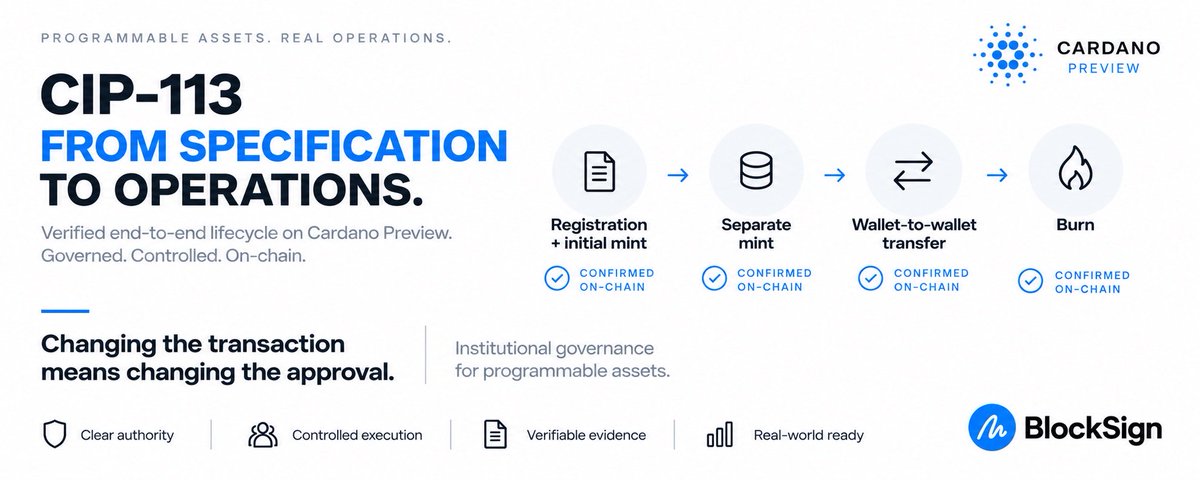
CIP-113 is moving from specification to operations. And that’s where things get interesting.
At BlockSign, we have now successfully executed a governed programmable-token lifecycle on Cardano Preview:
→ Registration + initial mint
→ Separate mint
→ Wallet-to-wallet transfer
→ Burn
All confirmed on-chain. But making a transaction work is only half the challenge. Institutional operations need to answer different questions:
- Who is allowed to initiate it?
- Who must approve it?
- What exactly was approved?
- Can the transaction change after approval?
- Who can execute it?
- And can all of this be proven afterwards?
That’s why BlockSign separates:
Intent → Build → Validate → Approve → Execute → Confirm → Evidence
❗️Changing the transaction means changing the approval.❗️
This week, CIP-113 builders are meeting to discuss improvements to the emerging infrastructure. Our testing is already producing concrete operational learnings around governance, transaction flows and the requirements for using programmable tokens in real-world environments.
The next step is bigger than minting tokens. It’s making programmable assets operationally ready for institutions.
@planetmaaz@michaeldotada@Cardano
Custody vs. non-custody.
BlockSign never has your keys.
Governance is not custody.
On the BlockSign platform, asset owners define and enforce who is allowed to do what: roles, approvals, limits and policies — while remaining in full control of their assets.
For institutional and professional investors that require custody, optional custody is provided by our regulated custody partner @nbxcom.
BlockSign cannot access, move or manage your funds. Never!
Could it be that there is simply more demand for tokenized RWAs such as gold and silver in other ecosystems than we are currently seeing on Cardano?
Begin has been offering $fGLD and $fSLVR from @finest_tokenize for more than a year now, but traction has unfortunately remained very limited.
I’d be curious to hear whether you’re seeing stronger demand for this type of RWA.