🐍 𝗟𝗲𝗮𝗿𝗻 𝗣𝘆𝘁𝗵𝗼𝗻 𝘁𝗵𝗲 𝗦𝗺𝗮𝗿𝘁 𝗪𝗮𝘆 - 𝗡𝗼𝘁 𝘁𝗵𝗲 𝗛𝗮𝗿𝗱 𝗪𝗮𝘆! (𝗪𝗲𝗲𝗸𝗲𝗻𝗱 𝗚𝗶𝘃𝗲𝗮𝘄𝗮𝘆)
200+ essential commands + 5 real hands-on projects inside.
Perfect for beginners, students & upskillers. 🚀
🎁 FREE for the next 20 hours (or 141 slots only)
To grab your copy:
1️⃣ Like ❤️
2️⃣ Repost 🔁
3️⃣ Comment “PythonGuide_for_upskill”
4️⃣ Follow 👉 @TTechFusionist (so I can DM you the guide)
I built this to help anyone go from zero → building real projects without confusion.
Your Python journey starts today. 💪🔥
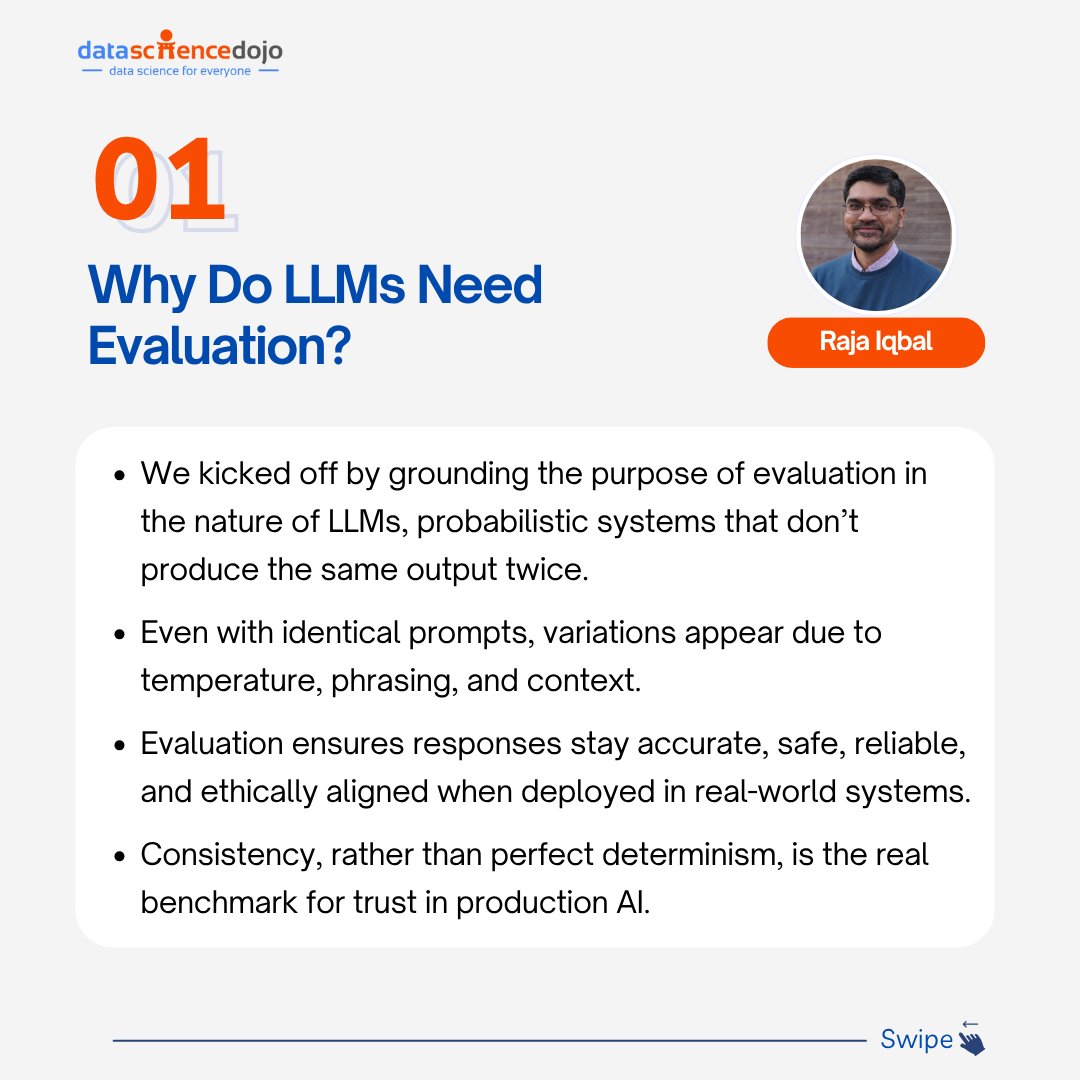
🤔 How do we know if an LLM is good enough?
In this session of the Agentic AI Bootcamp, instructor Raja Iqbal explored the nuances of LLM evaluation — a critical step for building trust, reliability, and ethical alignment in AI systems.
We examined why evaluation matters: LLMs are probabilistic, producing variable outputs depending on prompts, temperature, and context. Evaluation ensures responses remain accurate, safe, and consistent across use cases.
The session covered the challenges of measuring quality: subjectivity in tone, helpfulness, and bias makes deterministic scoring impossible. Standard benchmarks like MMLU, BIG-Bench Hard, and HotpotQA provide reference points, while traditional metrics such as BLEU, ROUGE, and BERTScore offer complementary dimensions of assessment.
Finally, we explored RAGAs, a framework designed for Retrieval-Augmented Generation (RAG) systems. RAGAs evaluates both retrieval and generation, measuring faithfulness, relevance, and precision/recall — enabling fine-grained, production-ready evaluation of complex AI workflows.
📅 Want to join live?
Register now for the upcoming Agentic AI Bootcamp happening on Nov 25th. Don’t miss your chance to build, test, and evaluate intelligent agents! https://t.co/RNQQ0mpy6G
Evaluation is more than a score — it’s the foundation for trustworthy and reliable AI.
#LLMEvaluation #AITrust #RAG #RAGAs #AgenticAI #LanguageModels #BenchmarkingAI #MMLU #BIGBenchHard #HotpotQA #BLEU #ROUGE #BERTScore #AIWorkflows #ResponsibleAI
🤔 How do we know if an LLM is good enough?
In this session of the Agentic AI Bootcamp, instructor Raja Iqbal explored the nuances of LLM evaluation — a critical step for building trust, reliability, and ethical alignment in AI systems.
We examined why evaluation matters: LLMs are probabilistic, producing variable outputs depending on prompts, temperature, and context. Evaluation ensures responses remain accurate, safe, and consistent across use cases.
The session covered the challenges of measuring quality: subjectivity in tone, helpfulness, and bias makes deterministic scoring impossible. Standard benchmarks like MMLU, BIG-Bench Hard, and HotpotQA provide reference points, while traditional metrics such as BLEU, ROUGE, and BERTScore offer complementary dimensions of assessment.
Finally, we explored RAGAs, a framework designed for Retrieval-Augmented Generation (RAG) systems. RAGAs evaluates both retrieval and generation, measuring faithfulness, relevance, and precision/recall — enabling fine-grained, production-ready evaluation of complex AI workflows.
📅 Want to join live?
Register now for the upcoming Agentic AI Bootcamp happening on Nov 25th. Don’t miss your chance to build, test, and evaluate intelligent agents! https://t.co/RNQQ0mpy6G
Evaluation is more than a score — it’s the foundation for trustworthy and reliable AI.
#LLMEvaluation #AITrust #RAG #RAGAs #AgenticAI #LanguageModels #BenchmarkingAI #MMLU #BIGBenchHard #HotpotQA #BLEU #ROUGE #BERTScore #AIWorkflows #ResponsibleAI
Exactly. I learned a ton of math during my PhD, and it was fun and easy *because I had a goal* to use it in my research. Coding it up is also a great way to detect gaps in your understanding. Totally different from learning in class.
Another common fallacy is that you need to follow the logical curriculum and complete all the prerequisites for a topic before learning it. Instead I find that going up and down the curriculum repeatedly is much more effective. That way, you have an understanding of where the basics fit in, and why you're learning it, which helps with comprehension and motivation.
Inspired by the success of LLM pretraining, I even started reading random papers by Grothendieck, Scholze and Mochizuki that are way above my head, soaking my brain in genius vibes so to speak, in the hope of immitation-learning some good representations. Not sure if it has worked but it feels good 😂
ML is vast and I mean really vast. There’s classical ML, Deep Learning, Computer Vision, generative models, NLP, text generation, image-text pairing, Bayesian analysis and so on
And within each of these topics there are plethora of subtopics.
Many deep learning models, many classical ML techniques, so many vision tasks and models like SSD, YOLO, UNet, same for other topics above
It’s borderline impossible to remember it all unless you’re an LLM
But the good thing is you don’t have to remember everything either. I try to just keep in mind the distinct fundamental building blocks, how they work, why they work and it’s enough
Some such blocks are, understanding bayes theorem, discriminative models, decision boundaries, distribution, sampling, few important loss functions, gradient calculation and parametric estimation
Almost all the topics at the top share some of these blocks and will use it to build further.
Harvard Professor reveals the 5-phase path every ML systems engineer follows but almost no one talks about.
Completely free, continuously updated and collaboratively developed on GitHub.
Link in comments
Things I learned this year as an ML Engineer:
(DON'T MISS)
- Focus on data; the solution lies within it.
- XGBoost outperforms many classic ML algorithms and excels at time-series.
- UV is the best tool for Python package management.
- For applied ML, build first, then read research papers.
- Math and statistics/probability are essential skills.
- Caching is critical for ML projects.
- Agentic AI frameworks aren’t needed for LLM function calling.
- FastAPI and PyTorch are a powerful duo.
- When using ChatGPT, provide input and problem statements. Brainstorm pipelines, don’t ask for code.
- Instruct ChatGPT: “You are a 10+ year ML Engineer expert in XYZ domain,” then share the problem.
- Work with quantized LLMs.
- Reinforcement Learning will outlast LLMs in relevance.
- Deploy models first, then improve iteratively.
- Speed currently outweighs accuracy; I can handle errors but not slow inference.
- Data Engineering > AI/ML Engineering.
- Use AI to learn Next.js/React.js for high returns.
More insights to come.
- Apple M-Series chips are powerful but doesn't support CUDA libraries at all.
- MLOps is a must skill for ML Engineers and demand is very high.
What's your experience in ML this year?
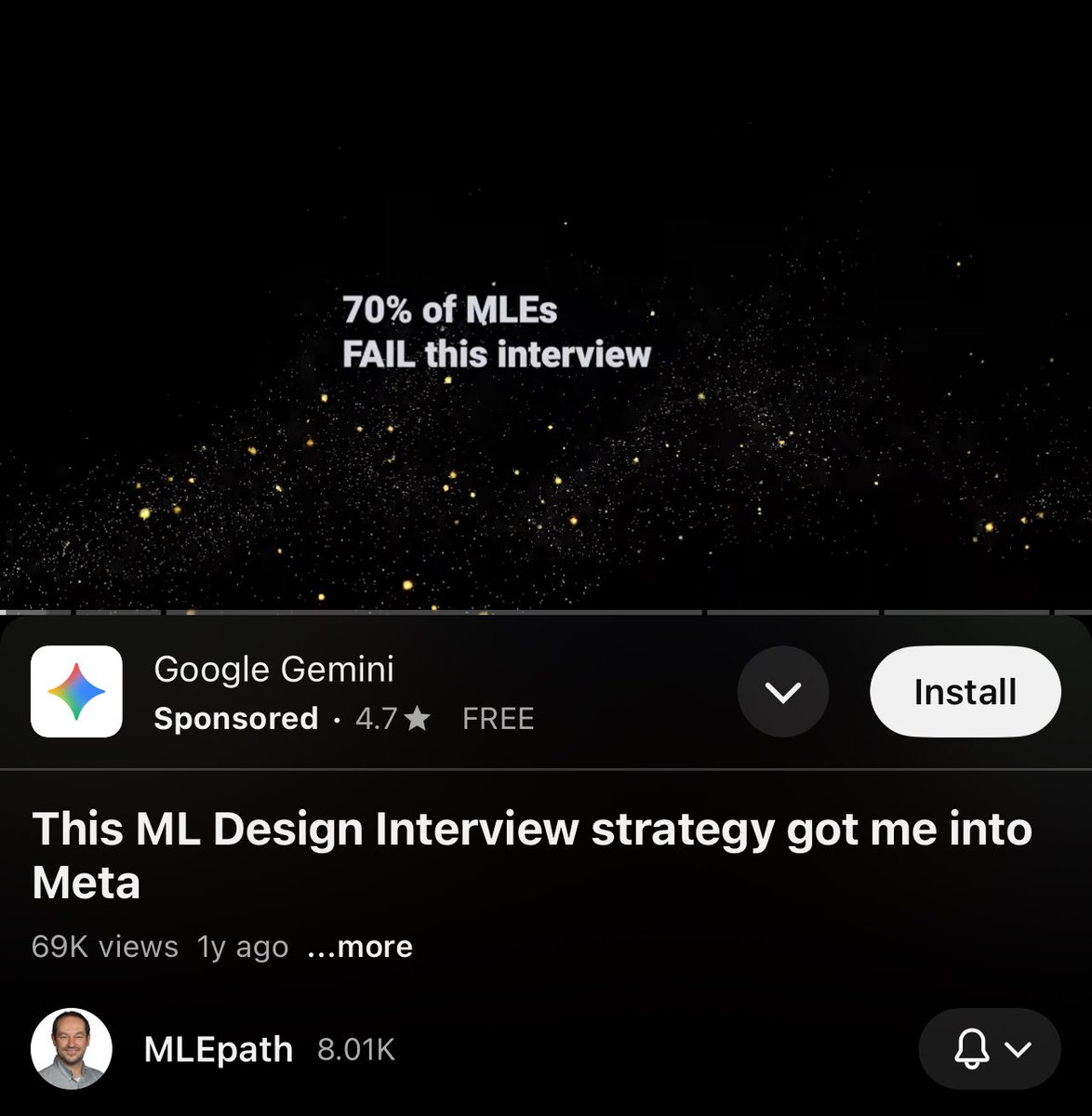
System Design, particularly in ML can have a varying number of requirements- but the ideas generally fall into a number of categories. Depending upon context, specifications change, but baseline components remain unchanged. Watch this video to understand how these interviews are tackled. Great strategy and execution shared.
Holy Shit... Google, Microsoft, OpenAI, and the biggest companies and agencies shared complete AI Agent playbooks.
These are battle-tested formulas for building agents, the major bottlenecks in the industry, and the common patterns of what does and doesn't work in AI products.
1. Google - Startup Technical Guide for AI Agents
2. Microsoft: Agent Governance whitepaper
3. Cohere: Building Enterprise Agents
4. Amazon Web Services (AWS): An Executive's Guide to Agentic AI
5. Deloitte: Unlocking the right Agentic AI Use cases
6. McKinsey & Company: Seizing the Agentic AI Advantage
7. KPMG: The Agentic AI Advantage
8. Capgemini: The rise of Agentic AI
9. Accenture: Technology vision 2025
10. OpenAI - AI in Enterprise
11. Google: AI Agent Handbook
12. BCGX: AI Agents and MCP
13. Thomson Reuters and Reuters: Agentic AI 101
14. ServiceNow : Enterprise AI Maturity Index
15. Infosys - Tech Navigator Agentic Enterprise Playbook
You don't need to read them all, just what is relevant to you, as a manager, AI developer, solo app creator, etc.
If you want this list, subscribe to my newsletter, and you will receive it right away:
https://t.co/lJho0Re5Op