'Lets not pretend some great principle involved here", says EAM Dr S Jaishankar, as he points how US asked India to buy Russian energy, then imposed tariffs, & then revoked them.
Terms Russia as a "steady" supplier of energy
The DS identified this man as a major threat to their easy manipulation of India very early on. They desperately tried to stop him from ever leading the country.
The moment he became CM, they ignited issues, branded him with every possible label, attempted to sanction him, and even revoked his visas.
They unleashed tens of thousands of pages of propaganda reports against him, both inside India and abroad. They weaponised the opposition and the courts to flood him with cases from every direction.
Yet he overcame it all. To become the PM of the world’s largest democracy. Despite all the hit jobs, sabotage, and propaganda, he remains the most popular leader on the planet.
He has turned every adversity into an advantage. "Being Anti-fragile" is his mantra. And he has made India anti-fragile too. We have seen the nation emerge stronger from every crisis thrown at it.
I believe he will also resolve the infowar crisis. The main force behind it will be weakened and broken by him. It will be a fitting feather in his cap before he retires as not only India’s longest serving PM, but its most impactful one.
History will remember him as the one who transformed India not just in infrastructure and development, but forged a confident, self-reliant nation that stands proud on the global stage.
1. RBI action
In today's policy, RBI did not use the policy rate to defend the rupee or attract capital. It kept the repo rate unchanged at 5.25%, retained the neutral stance, and all six MPC members voted for status quo. This means RBI chose not to hike rates despite pressure from the rupee, crude and global uncertainty.
RBI’s macro message was cautious. It cut FY27 GDP growth forecast to 6.6% from 6.9% and raised inflation forecast to 5.1% from 4.6%, reflecting higher crude, rupee weakness and global risk. (on a side note, we now have a distinct possibility of above 10% nominal growth 😀)
To put it in summary: “We will not overtighten monetary policy for capital-flow defence. We will manage macro stability through rates, liquidity and FX tools, while the government removes tax frictions to attract bond capital.”
2. Government of India
GOI promulgated the Income-tax (Amendment) Ordinance, 2026. It is deemed to come into force from 1 April 2026. The ordinance amends the Income-tax Act, 2025.
The ordinance inserts a tax exemption for Foreign Institutional Investors on:
1. Interest on Government securities: Exempt
2. Capital gains from sale, exchange or transfer of Government securities: Exempt
GOI has also given similar treatment to the Bank for International Settlements, exempting BIS from tax on interest and capital gains from Government securities.
Versus the earlier tax position: FII interest income and capital gains from government securities were taxable under normal provisions; interest income was taxable at 20%, STCG could be taxable at 30%, and LTCG at 12.5%. All of this now stands exempt. This a major sweetener for FPIs looking to buy GSec.
3. What changed in practical terms
Before this ordinance, a foreign bond investor had two tax frictions:
Coupon income and capital gains, both were taxed. Now both are exempt.
This is not a small tweak. It improves the post-tax yield, the exit economics, and the relative attractiveness of Indian G-Secs versus other EM local-currency bonds.
4. Why this matters?
The combined policy package is clean:
RBI maintained monetary policy credibility. While GOI used fiscal/tax policy to improve bond-market access and foreign investor economics.
5. The key market implication
This strengthens the FAR/global bond index story. Foreign investors already have access to G-Secs through the General Route and Fully Accessible Route, as the FAQ notes. Current FPI holdings are still low: as of 12 May 2026, FPIs held 0.83% of General Route eligible stock, 6.74% of FAR eligible stock, and 3.34% combined across both routes.
So, the room for flow is still large.
Also refer to point 4 and 5 from the below note.
Rupee REER, high real rates and now improved access and tax outcomes can help India be more conducive to FPI debt flows.
Bill Ackman bought a third of a $20 billion company after it crashed to $100 million - the stock went from 34 cents to $34
it's the most contrarian bet in modern Wall Street history
"I called the CEO, he didn't return my call - I called again, he didn't return my call - six weeks later they spun off the company, the CEO got fired, then he called to thank me for his exit package"
"there are analogies to 2000 - people got excited about internet stocks and Berkshire traded at the lowest valuation in its history because people said that's all old stuff
a similar thing is happening today to Amazon, Meta, Microsoft - they're undervalued"
bookmark and watch it today - 29 minutes that will change how you think about AI, markets, and what makes a great investment ↓
If you're looking for a fund that has a different approach to investing, look at the Capitalmind Flexi Cap Fund, where our strategy ends up with a different way to tackle the market versus the index.
More at : https://t.co/8e5kt2wnEs
No one needs a Rolex to tell time- it’s only to signal status.
In life, we trade in five currencies: wealth, skills, beauty, fame and power. Each attracts the other.
But like it or not, wealth sits at the top, because it can buy much of the rest.
@sidhant They need to be reminded of the contributions of Indians to their country, which again was built by immigrants from across the world. Just sad how a bunch of ppl can be so ignorant to the truth.
Why our mind grabs the 'stories' and shuns 'mere statistics' of reversion to mean?
"Our mind is strongly biased toward causal explanations and does not deal well with “mere statistics.” When our attention is called to an event, associative memory will look for its cause . . . but they [causal explanations] will be wrong because the truth is that regression to the mean has an explanation but does not have a cause."
- Thinking, Fast And Slow
By Kahneman & Tversky
@sidhant very good that you kept pressing him saying that it’s well known and all…enough to make him understand and for everyone to see…and then swiftly switching to the next question for Jayshankar Sir. 🫡
A rather annoying cartoon from a self- satisfied country of 5.6 million people with no historical or civilisational depth, or experience of handling complex and diverse societies or the depth of challenges that a country of 1.4 billion people faces.
Resorting to an offensive snake charmer stereotype of India, that has a racist overtone.
India does not need Norwegian oil. It has huge oil rich countries in its neighbourhood. Doesn’t need to charm them as India is a huge market, being the second largest importer of oil.
The cartoon reflects the shallowness of Norway’s journalism as this is the country’s largest newspaper.
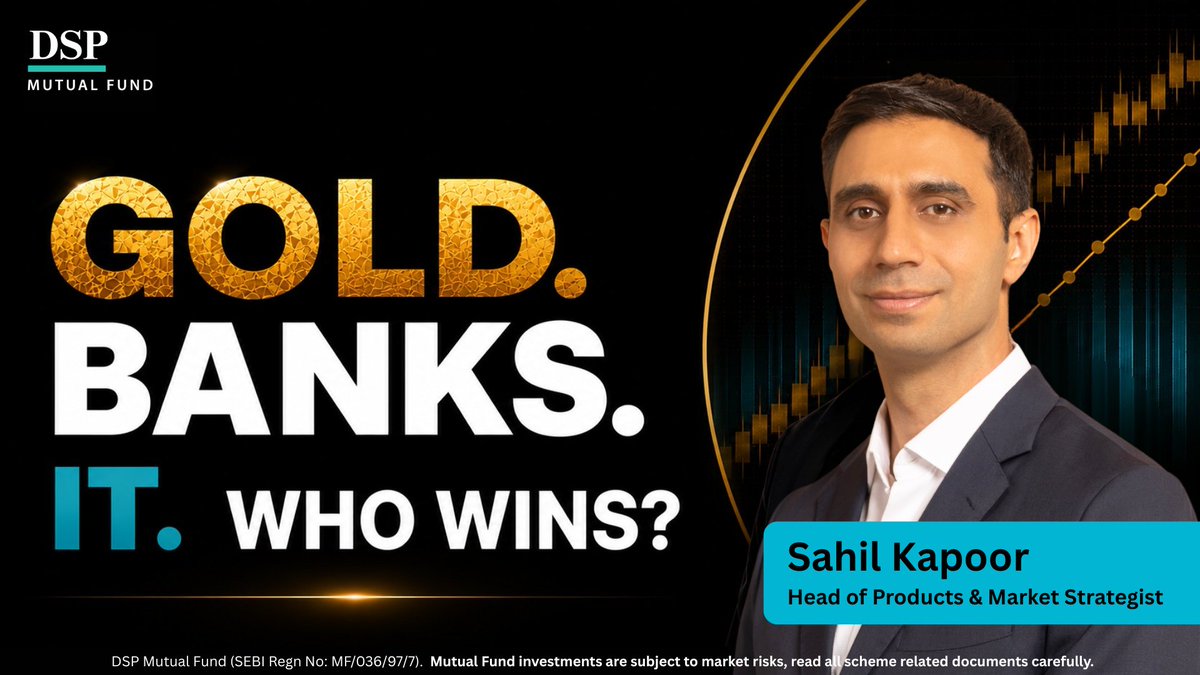
Why does Multi Asset make more sense than ever right now?
@SahilKapoor shared his thoughts LIVE across oil, equities, gold, and bonds.
Grounded in data and cycle positioning. Including a candid Q&A.
If you manage your own portfolio or advise others, this might be worth your time.
🎥 Watch here → https://t.co/iREHduoq2o
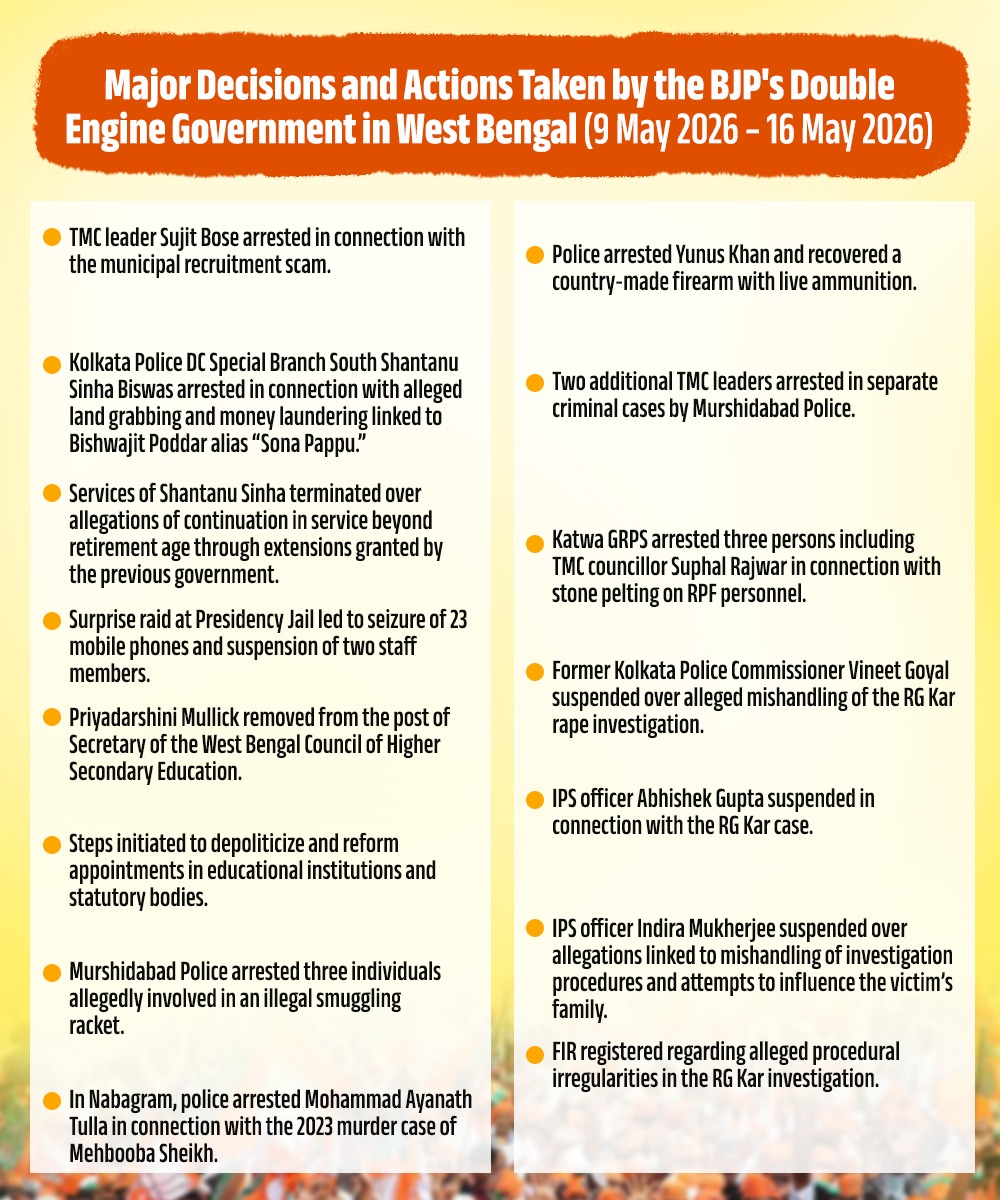
9 May to 16 May. Just 7 days and West Bengal has already witnessing #Poriborton.
➡️ Crackdown on syndicates.
➡️ Action against corruption.
➡️ Border security tightened.
➡️ Big relief for women.
➡️ Mafia networks under attack.
➡️ Administrative discipline returning.
What West Bengal under TMC couldn’t deliver in 15 years, the Double Engine Government has started showing in its very first week. This is the new West Bengal and the speed of real governance.
1987. A room in New Delhi is thick with the smell of old files & cold tea. The United States has just delivered a stinging slap to the face of the Indian Republic. They have officially refused to sell India the 'Cray X-MP' Supercomputer, the most powerful machine on Earth, claiming that India would use it for nuclear weapons.
The American officials mockingly suggest that India does not even have the electricity to keep such a machine running. In the middle of this national humiliation, a young, soft-spoken engineer named Vijay Bhatkar is asked by then Prime Minister Rajiv Gandhi: "Can we build our own?" Bhatkar does not hesitate. He looks at the No of the West & says: "We will not just build it; we will build it faster than you can ship it."
The Americans did not just stop at refusing the sale; they actively lobbied other nations to ensure India remained digitally blind. They believed that w/o their Logic Gates, India would remain a 3rd world backwater.
Bhatkar realized he could not replicate the Single-Processor behemoth of the Cray. Instead, he turned to Parallel Processing. He decided to stitch together 1000s of low-cost, off-the-shelf microprocessors. It was like building a giant's brain out of the neurons of ants.
In 1991, while the West was still celebrating its monopoly, Bhatkar unveiled the PARAM 8000. It was not just a computer; it was a Gigaflop monster.
To prove the PARAM was real, Bhatkar ran a standard global benchmark test. The results were sent to an international conference in Zurich. The PARAM 8000 was ranked as the 2nd most powerful supercomputer in the world, behind only the American machines. But there was a twist: the PARAM cost a fraction of the Cray, performed better in tropical heat, & was built in just 3 years.
When the PARAM 8000 was 1st turned on, the team did not have a high-tech cooling system like the Americans. They used industrial-grade desert coolers & adjusted the airflow manually. It was the ultimate Jugaad that defeated the most sophisticated tech embargo in history.
A major US newspaper ran a story with the headline: "Denied supercomputer, Angry India does it!" The ghost of the Native Engineer had officially entered the silicon temple. Vijay Bhatkar’s history is the story of how India became the IT Capital of the world.
Bhatkar founded the Centre for Development of Advanced Computing (C-DAC). He did not just build a machine; he built an ecosystem. Every software engineer in India today stands on the shoulders of the man who proved we did not need the West's permission to compute. Bhatkar was the 1 who realized that if computers only spoke English, 90% of India would be left behind. He led the development of GIST (Graphics & Intelligence Based Script Technology), allowing computers to work in Indian languages. He gave the Machine a local tongue.
Today, Bhatkar is a Padma Bhushan awardee, but he lives a life of deep spirituality & simplicity. He vanished from the corporate headlines to become a philosopher of the digital age.
The West thought they could freeze India’s future by withholding a single machine. They forgot that the Indian mind does not need a 'Cray' to think; it only needs a 'No' to ignite. Forget building a supercomputer; Bhatkar built a mirror, & for the 1st time, the West had to look into it & see that the primitive colony had become the master of the code.
GAME OVER for Bengal’s toll syndicates. 🚨
The West Bengal Government has ordered an immediate shutdown of all illegal toll gates, drop gates and extortion checkpoints operating without approval. Districts have been told to identify, demolish and stop the re-emergence of these collection rackets.
No permit. No authority. No collection.
The message is loud and clear, the era of syndicate extortion will end.
First move from the Govt post PM’s speech
Basic Customs Duty on Gold, Silver and Precious Metal Imports hiked to 10%
Govt also imposes a 5% Agriculture Infra & Development Cess on Gold & Silver Imports
Effective Import Tax now at 15% vs 6%
Stocks in last two sessions
Titan -11%
Kalyan -15%
Senco -16%
@CNBCTV18Live #StockMarket #FMCGisLife @ShereenBhan