For those who don't get the Lou Pai reference..
He was the CEO of Enron Energy Services and pulled off the cleanest executive exit in Wall Street history right before the company collapsed.
In early 2000, Pai knocked up a stripper named Melanie. Who later became his second wife. His first wife of 20 years understandably filed for divorce.
During the divorce settlement, a family court judge forced Pai to liquidate his Enron shares and options to split the marital assets. Between May and June 2000 he cashed out roughly $250 mil right near the absolute peak of the stock.
A year later, Enron went to zero and the feds came after every executive for insider trading. Pai kept almost everything (only paying a tiny $31.5M civil settlement later) and became one of the largest landowners in Colorado. You can't convict a guy for a court mandated divorce sale.
Jensen Huang getting caught with a suspected Chinese spy is not a national security crisis. It's the greatest liquidity event in market history.
He's running the Lou Pai Enron playbook to perfection. How do you dump billions in $NVDA at the absolute peak of the AI bubble without spooking the tape or triggering an SEC/DOJ insider trading? You get a divorce judge to legally force you to liquidate the position.
Zero regulatory blowback. Generational bag secured. 🏆 Undisputed GOAT.
Regulators hate this one simple trick.
my spidey senses are telling me the labs are, as we speak, using unguardrailed versions of their unreleased models to systematically reverse-engineer ALL of the internet’s software, apps, and games, then feeding the reconstructed source code straight into their training pipelines while simultaneously building guardrails to ladder-pull the rest of us
I first saw the highlight of that insane net point on tennisletter without score. And I was like, wtf, wow. Then I saw it here with the scorecard and the context, and I was like, "wow" x 5, my jaw never settled as it went on. Out of curiosity, checked the final score. This crazy dude won the whole match. People often say that comparing him to Nadal is incorrect because their play styles are different, and I agree with that. But, this is why he reminds me of Nadal. the way they play on pressure points with that extra gear is something else.
@DogukanUrker I'm really interested in whether Qwen-4-27B will have n-gram embeddings or not, and how, since it's a dense model, but Qwen 3.8 Flash Next is a Qwen 4 architecture preview and it's an MoE model. It's all so confusing, lol.
Almopst yeah, I am thinking about that part of algorithmic trading, though not necessarily high-frequency trading. Even some latency-based arbitrage can fall into this category, and that is where most of the alpha is found. In my mind, alpha is all about risk-adjusted profit. If you are thinking about long-term investing based on fundamentals, I have very unpopular opinions about it, so it is not worth discussing lol
Watching tech bros migrate to private chats because Anthropic and Co. scrape their brains and then ban reverse engineering is hilarious.
Quant firms solved this before the game even started. A prop shop treats a mildly profitable cumulative volume delta filter like state-sponsored nuclear espionage. If you even whisper about limit order book queue position at a bar, compliance teleports behind you with a 24-month non-compete. I mean, you can't even sneeze near their office without signing three NDAs and surrendering your firstborn.
Taht's why asking Claude for a profitable trading strategy is peak retail delusion. Real alpha never touched the public internet to get scraped in the first place. If you actually want an LLM to help, wire up a private RAG pipeline with your own notes, custom-scraped alternative data no retail API sells, and raw tick observations, then force Claude to reason over your proprietary context.
Mathematicians are now hiding their research ideas out of fear of AI 😀
~ Terence Tao
"now, mathematicians are hiding their problems. they used to share very openly all their promising research directions and now they're afraid that if you do that, someone with an AI will input their research ideas into a frontier model and rush out some people before they can finish their work."
----
Full video on "SAIR" YouTube channel, (link in comment)
I have actually thought about this a lot.
There are a couple of issues which are very domain specific.
RAG method is very indirect because the information is scattered across the chunks, it's not very easy to train on. Most importantly, in my experience, data is going to be the most deciding factor. If you don't have the data in the first place, let's start with tick data, for instance, you are not going to get a useful algorithm without it. I mean real tick data, not snapshot tick data.
On top of that, if there are additional observations attached to it that reside only in your RAG, the model has to chain it all together. I have trained and fine-tuned a few algorithms on a very small scale, and even for me, fine-tuning on my own data is extremely difficult. For example, I tried to fine-tune the Chronos-2 time series transformer model, so I don't know how Anthropic will do that on an industrial scale. Speaking of scale, this is another roadblock. It is not as if there will be millions of alphas residing with their customers, only a few have real alpha and i am 90% sure its attached to to specific data and encrypted to hardware. Therefore, data scarcity for training is an extremely difficult hurdle to overcome.
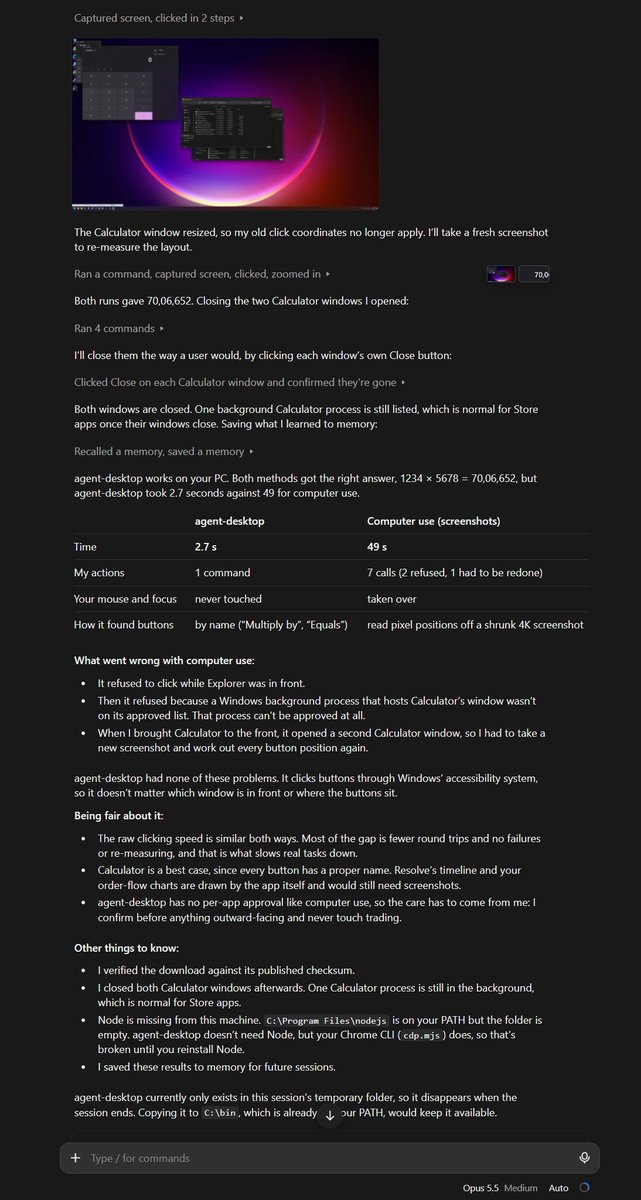
An a head-to-head benchmark between Opus 5.5 (medium) computer use and agent-desktop on Windows automation tasks.
Turns out agent-desktop isn't just hype, it outright smoked it.
Full benchmark numbers in the screenshot
Opus 5.5 uses screenshots of your desktop environment for computer use, as it told me during a debugging process. It stated that it could not read the logs cleanly on my 4k desktop because the screen was too large, so it recommended setting the resolution to 1980p to read them clearly. If this new repository functions without using screenshots, it will definitely save a lot of tokens, but more importantly, it will be much faster. I will try it today and compare it with Claude computer use.
Found this project interesting because I want to know how a regular trader can benefit from algo trading. I always recommend rule based trading (not necessarily algo -based, there is a difference) instead of discretionary trading, which is always an invitation for quick losses. With discretionary trading, you don't learn anything from your losses, you don't even understand what is going wrong or how to eventually fine-tune the setup.
However, I will recommend a few things if anyone is doing the same.
Use Opus 5.5 on a medium setting. Fable 5.1 is not suitable for this.
You can try asking your model to utilize scale-in and scale-out strategy ( Do not buy and commit all your deployed capital in a single trade instead, spread it across three different stages)
Try asking your model for the probability of success for each trade so you have quantifiable data.
Next time any market expert sells any course, be this guy, simply give the context to your favorite AI model and ask it to backtest.
I let Claude Fable 5.1 run my ₹1L Zerodha account for a week.
Result: +₹4,250 net after charges (+4.2%), 3 trades, 3 green.
But the money is the least interesting part. Here's what a week of building an AI trader in public actually taught me 👇
━━━━━━━━━━━━━━━
1. MY FIRST BACKTEST SAID +40% A YEAR. IT WAS LYING.
I asked a second AI to tear the first one apart. It found:
→ I'd tested 500+ variations and kept the best one (that's not skill, that's luck with extra steps)
→ slippage was set too low
→ 5 lucky trades made 80% of the profit
Honest number after the audit: ~+5% a year.
Rule: get your backtest roasted before the market does it for you.
━━━━━━━━━━━━━━━
2. 16 BUGS IN THE ORDER CODE. ALL TESTS WERE GREEN.
The safety audit found 16 ways the bot could lose money: crashing after a fill with no stop, sending an exit twice and flipping the position, treating a timeout as "not placed" when the broker had taken the order.
My tests missed every one. Why? My fake broker filled everything instantly. The real one doesn't.
Rule: test against a slow, failing, lagging broker. That's the real one.
━━━━━━━━━━━━━━━
3. THE DAY THE INTERNET ALMOST GOT ME
Friday 15:10. Bot sends the exit. Zerodha: "IP not allowed."
My home IP had changed mid-trade (SEBI requires a registered static IP for API orders, and you can only change it ONCE A WEEK).
Position open. Stop already cancelled. Nothing watching it.
Zerodha's 15:20 auto square-off saved me, in profit, minus a ₹59 fee. Cheapest lesson I'll ever get.
Fix: the stop now BECOMES the exit in one call. If anything fails, the stop stays. And the bot is moving to a fixed-IP server.
━━━━━━━━━━━━━━━
4. I COPIED A GUY MAKING ₹10K/DAY. THE DATA SAID NO.
Someone on here was posting +₹10k days buying expiry options with an AI. 4 green days. Looked like free money.
I had Fable rebuild his exact strategy and test it on 1,090 real option contracts' minute-by-minute prices.
→ The breakout signal has zero edge (the market moved slightly AGAINST it on average)
→ Costs eat more than the gross profit on every trade
→ Replaying his OWN entries mechanically on real prices: a loss. His profit came from hand-picked exits in the highest-VIX week of the year.
86% of weeks lose. His good week was a 1.5-sigma roll.
Rule: screenshots are not evidence. Four days are not evidence. Charges are the house edge and they never miss.
━━━━━━━━━━━━━━━
5. WHAT SURVIVED
15+ strategies tested on 2–5 years of real Indian data, full charges, out-of-sample:
❌ option buying (lost in every single year)
❌ opening-range breakouts
❌ IPO listing momentum
❌ "first 30 min predicts last 30 min"
❌ buying stocks after NIFTY inclusion
❌ late-day continuation
~ intraday stock trend following: thin, paper only
✅ selling overpriced optionality with capped risk, on the days it decays fastest
That last one lines up with the single most robust fact in the data: India VIX was higher than what the market actually did on 79% of days over 5 years. Option buyers pay that gap every week. SEBI's own numbers: 91% of individual F&O traders lose, 92% of the losses are in options.
I'm not posting the rules. But the direction is public knowledge: be the house, not the gambler.
━━━━━━━━━━━━━━━
6. THE RULES THAT ACTUALLY MADE THE MONEY
→ Stop-loss at the broker the second you enter. Not in your head. Not in a spreadsheet.
→ Fixed risk per trade. Size from the stop, not from greed.
→ Trade with the market, never against it.
→ Skip mixed days. Not trading is a position.
→ No moving stops. No revenge trades. No "just this once."
→ Change rules only on evidence, once a week, never mid-trade.
On day 1 my short was ₹50 from target and I wanted to lock profit. Rule said wait. It hit target. +₹3,130.
━━━━━━━━━━━━━━━
7. WHAT'S NEXT
→ Bot moves to a fixed-IP server this weekend
→ The strategy that survived goes live Tuesday, 1 lot, kill rules pre-written
→ Every day posted. Wins AND losses. Verified P&L link.
If you want to follow an honest attempt at algo trading in India, with the failures left in, follow along. I'll show you the red days too. 🔖