@MaaziEgo Indeed, we are finallly getting the validation these chains deserve
Sharding, the underlying tech of NEAR & SUPRA
Is the promise that ETH failed to deliver made reality today
As it allows us to increase capacity in the millions of TPS without increasing node requirements!
After the birth of Bitcoin ( $BTC ), blockchain technologies has been constantly evolving. Right now, Supra ( $SUPRA ) is among the most advanced. Supra is not being recognised as it deserves and this is the perfect opportunity to jump in before the crowd for great profits ahead!
What the Supra ( $SUPRA ) blockchain has improved on blockchain technology which its competitors are lacking?
Supra ( $SUPRA ) is a high-performance, vertically integrated Layer 1 blockchain that combines a fast smart contract platform with native services like oracles, automation, cross-chain messaging, randomness (dVRF), and more—all under shared security.
Its core differentiator is vertical integration via the "IntraLayer" approach: instead of relying on separate middleware (e.g., external oracles like Chainlink or bridges), Supra embeds these features natively into the L1. This reduces latency, costs, complexity, attack surfaces, and security assumptions compared to most competitors.
Key Improvements and Unique Features
Here’s what Supra emphasizes as advantages over typical L1s (e.g., Ethereum, Solana, Sui, Aptos) and modular setups:
Extreme Performance with Moonshot Consensus + Tribes/Clans Architecture:
Claims up to 500,000 TPS (theoretical/tested with parallel execution) and sub-second finality (600–900 ms oracle data with full finality).
Moonshot: A formally verified (by Microsoft IVy), pipelined BFT consensus optimized for high throughput and low latency.
Tribes & Clans:
Divides validators into smaller dynamic committees (Tribes for ordering with 1/3 fault tolerance; Clans for execution/services with up to 1/2 Byzantine tolerance). This enables better scalability, parallel processing, lower fees, and higher overall fault tolerance than standard monolithic or sharded designs.
Competitors like Solana ( $SOL ) rely on high hardware requirements and can face congestion; many others have slower finality or lower practical throughput.
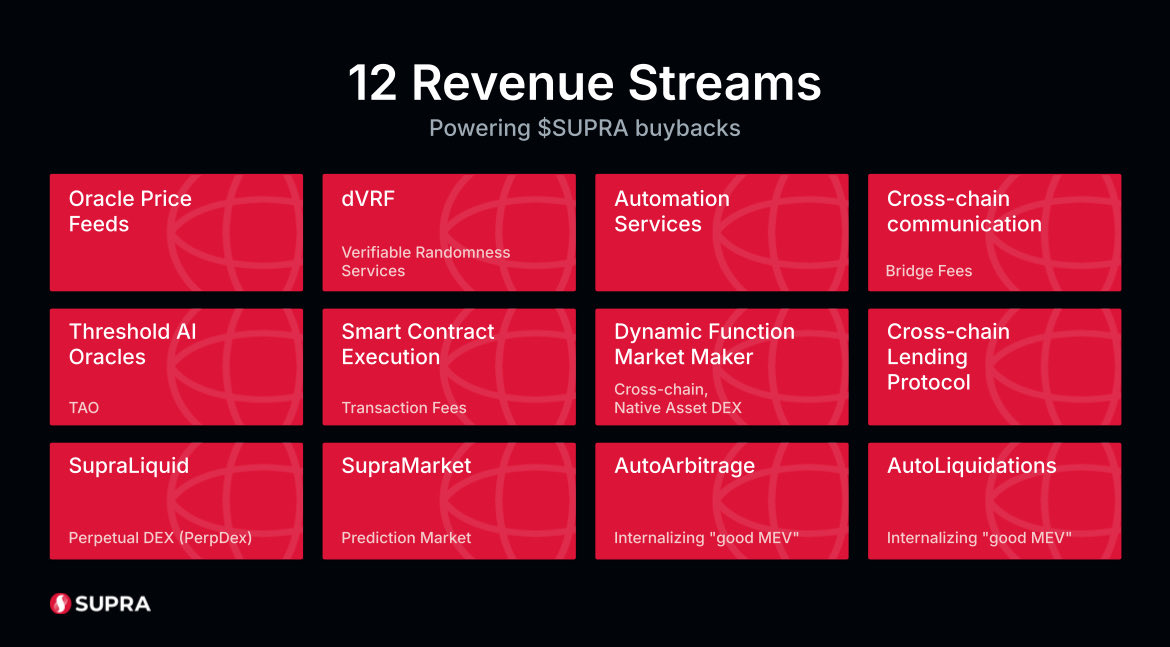
Native Zero-Block-Delay Oracles (DORA Protocol):Decentralized Oracle Agreement provides real-time price feeds (and other data) directly on-chain with millisecond-level response, full finality, and resilience to 51% Byzantine faults.
No need for separate oracle calls or extra latency/security tradeoffs. Updates millions of data pairs daily and serves many chains.
Vs. Chainlink ( $LINK )/ Pyth ( $PYTH ):
Tighter integration, lower overhead, and potentially stronger security guarantees via shared consensus.
Native Automation (AutoFi / Zero-Block-Delay Execution):
Fully on-chain automation for DeFi primitives (e.g., auto-arbitrage, auto-liquidations, auto-rebalancing vaults) that react block-by-block to market events without off-chain bots or human intervention.
This enables "self-operating" DeFi (AutoFi stack) with protocol-level risk management (AutoRisk) and revenue generation internalized to the protocol/Treasury rather than MEV extractors.
Most competitors rely on external keepers/bots, introducing latency, centralization risks, and MEV vulnerabilities.
Bridgeless Cross-Chain (HyperNova / HyperLoop + IntraLayer):
Trust-minimized, "bridgeless" design using direct cryptographic verification (no relay validators or multi-sig assumptions in some cases). HyperNova recomputes source chain consensus for security.
Positions Supra as a hub ("IntraLayer") connecting ecosystems with native messaging and automation. Reduces bridge hacks and fragmentation common elsewhere.
MultiVM + Containers:
Supports EVM, MoveVM (initial), with SolanaVM and others coming—developers can port contracts easily.
Containers:
App-chain-like customization within the L1 (shared security, unified liquidity, lower cost than full appchains or fragmented L2s).
MEV Mitigation and Sustainable Economics:Algorithmic mitigation + auction-based prioritization for automation tasks; revenue (e.g., from auto-liquidations/arbitrage) flows back to protocol, stakers, and builders instead of predatory searchers. Aims to reduce reliance on inflation.
Comparison Summary vs. Competitors
Vs. Solana ( $SOL ):
Higher claimed TPS + native oracles/automation; better fault tolerance via Tribes/Clans; less hardware demand for validators.
Vs. Ethereum ( $ETH )/Sui/ ( $SUI )/Aptos ( $APT ):
Much faster finality + vertical integration avoids modular stack latency/security fragmentation; native services reduce third-party dependencies.
Vs. Chainlink ( $LINK )/ Pyth ( $PYTH ):
Tighter integration, lower overhead, and potentially stronger security guarantees via shared consensus.
Vs. Oracle/Bridge Providers: Everything lives under one security model, cutting costs and risks.
@SUPRA_Labs #Supra #Oracles #dVRF #AutoFiStack #CrossChain #Multivm #MoveVM #EVM #SolanaVM #SupraContainers #Suprascan #PoEL #iAssets #DFMM #AutoFi #SupraNovaai #FTO #AtmosProtocol #SupraLend #CrystaraMarkets #MetaSoul #PumpIt #Dexlyn #SkinFi #MaymunDAO #LOWCAPS #StarKey #RibbitWallet #Leo #NFT #Solana #Sui #Aptos #Chainlink #Pyth #Blockchain #cryptocurrency #Web3 #DeFi #RWA #NFT #Game #Prediction
SHIFT badge drop is live.
• Pre-register on https://t.co/HYzkdMqOV1.
• Complete the tasks.
• Reveal and share your badge.
This is where your points multiplier gets locked in.
🧵
Sign up for a Bybit account and claim exclusive rewards from the Bybit referral program! Plus, claim up to 6,135 USDT bonus at https://t.co/jXHlxQ7PBg.
Weekly recap about Supra Ecosystem
• Network approaching a major milestone: nearing 500 million total transactions (just ~5 million short), signaling strong usage and reliability.
• Continued emphasis on iAssets (yield generating assets like ETH, USDC, USDT, SUPRA, WBTC) and integrations, with growing adoption on platforms like Atmos Protocol (e.g., liquidity and user returns accelerating).
• DeFi core remains active: @AtmosProtocol (all-in-one hub), @SolidoMoney (staking/yield, $CASH minting), @supralend (lending with ~$538k+ TVL and stable yields), and others like @HoudiniSwap (cross-chain privacy swaps) and @supraliquid (perps DEX) drive ecosystem traction.
• @CyberNovaNFT maintaining its low key NFT presence on Supra all reinforcing the chain’s undervalued builder momentum.
• @Supra_pulse amplifying community and onchain updates
• @supravault gaining praise for funding builders and yield redistribution
• Community sentiment: Bullish on undervaluation, AI/blockchain integration, and potential for asymmetric upside despite price volatility (SUPRA ~$0.00077–$0.0008 range, with recent relative strength vs. BTC in dips).
• No major new partnerships or big announcements this week, but builder focus persists (e.g., Super dApp Showdown ongoing influence).
Overall, Supra's ecosystem shows consistent growth in onchain activity and DeFi usage, positioning it for further expansion in AutoFi and real time applications.
Stay tuned for updates via @SUPRA_Labs or https://t.co/eu7qoEMypX.
SUPRA VS MONAD: THE REAL STORY BEHIND TWO 100B SUPPLIES AND TWO COMPLETELY DIFFERENT FUTURES
Every cycle has that one comparison everyone keeps repeating. This time, it’s Supra and Monad. Two chains, two big visions, and one similarity that makes the debate louder: both have a 100B total supply. But if you stop the story there, you miss the whole picture. Because what’s happening underneath the charts is deeper than just supply, price action, or hype. One chain launched with massive backing, glossy narratives, and VC grade marketing. The other chain spent its first year building quietly, releasing infrastructure most L1s don’t even attempt, and surviving a brutal early unlock schedule. And while they look similar on paper, the DNA behind Supra and Monad couldn’t be more different.
If we want to understand where both chains are heading, we have to retrace their stories carefully. Because @SUPRA_Labs didn’t start as an EVM chain at all. It began as a MoveVM chain, then evolved into a MultiVM architecture. SupraEVM is just one engine inside a much bigger system. @monad, on the other hand, is a pure EVM chain with a single execution environment fast, yes, but narrow in scope. And that difference, more than anything else, defines why Supra can outperform Monad in areas Monad was supposed to dominate.
THE SUPPLY IS THE SAME, BUT THE PRESSURE IS NOT
Let’s start with the numbers everyone argues about.
Both Supra and Monad have a 100B total supply. The way they handled circulation is where the paths split. Supra has around 21B circulating today because the team chose to push unlocks early. It hurt the chart, it caused real pain, and it created sell pressure that still affects the market today. The token dropped over 92% from its ATH an ATH where its fully diluted valuation touched nearly $6B in its early surge. These aren’t small moves. Supra absorbed the worst part upfront.
Monad launched with only around 10.8% of supply circulating. Which looks clean on day one, but the consequences come later. Their biggest cliffs begin in late 2026 and stretch deep into 2029. The community is already worried before the unlocks even begin. Their airdrop handling caused frustration. Early holders already complain about price action after only a few days of trading. Now imagine what happens when tens of billions start unlocking into a chart that is already struggling during a period of zero emissions.
Supra dumped early because supply was flowing. Monad is dumping early with no unlocks at all. In crypto, that’s a red flag. It means sentiment is fragile before the real test even starts.
THE DIFFERENCE IN HOW THEY WERE BUILT
This is where the comparison becomes unfair in Supra’s favor. Monad is built for one thing: parallel EVM execution. It’s a strong engineering challenge, and they are pushing it hard. But it stops there. Monad doesn’t try to be an oracle network. Monad doesn’t try to be a randomness provider. Monad doesn’t try to be an automation layer. Monad doesn’t try to be a bridging protocol. And it definitely doesn’t try to become a multiVM chain.
Supra does all of that natively.
Supra started on MoveVM, built a MultiVM architecture where Move, SupraEVM, and soon SolanaVM can all run under one chain.
Supra's EVM Parallel execution (SupraBTM), already benchmarks faster than Monad’s parallel EVM design
So while Monad is a chain trying to be the fastest EVM, Supra is a chain trying to be the complete execution layer for multiple developer ecosystems. This is what people miss. SupraEVM beating Monad’s performance isn’t even the headline. It’s the side effect of a chain that wasn’t built around one VM in the first place.
Both have 100B supplies.
But only one is positioned to become something more than an EVM speed race.
Supra didn’t start as EVM.
Supra started as a MultiVM vision.
That single design choice changed the entire destiny of the chain.
Supra doesn’t promise one thing.
It delivers twenty.
And that is the difference.
Supra’s “AutoBalancer” allows Supra to keep that revenue (venue arbitrage) for Supra stakeholders — otherwise it is being extracted by professional (toxic) MEV professionals.
Here’s a small leak… it’s already starting to work… give it time… imagine what will happen after iAssets go live…
New revenue stream for Supra dapps, node operators, and decentralized Treasury on its way!
Our AutoFi vision is manifesting into view…
https://t.co/UpgRVppPe2
Speculative execution is a bug, not a breakthrough.
Rollback-heavy systems burn cycles they shouldn’t.
The future of blockchain is deterministic, conflict-aware execution.