BREAKING: Look at this.
On July 23, 2025, Trump purchased up to $5 million of Broadcom, $AVGO, Meta, $META, Amazon, $AMZN, Apple, $AAPL, Microsoft, $MSFT, & Nvidia, $NVDA.
Later that day, the Trump admin unveiled its AI Action Plan, a policy that benefited those companies.
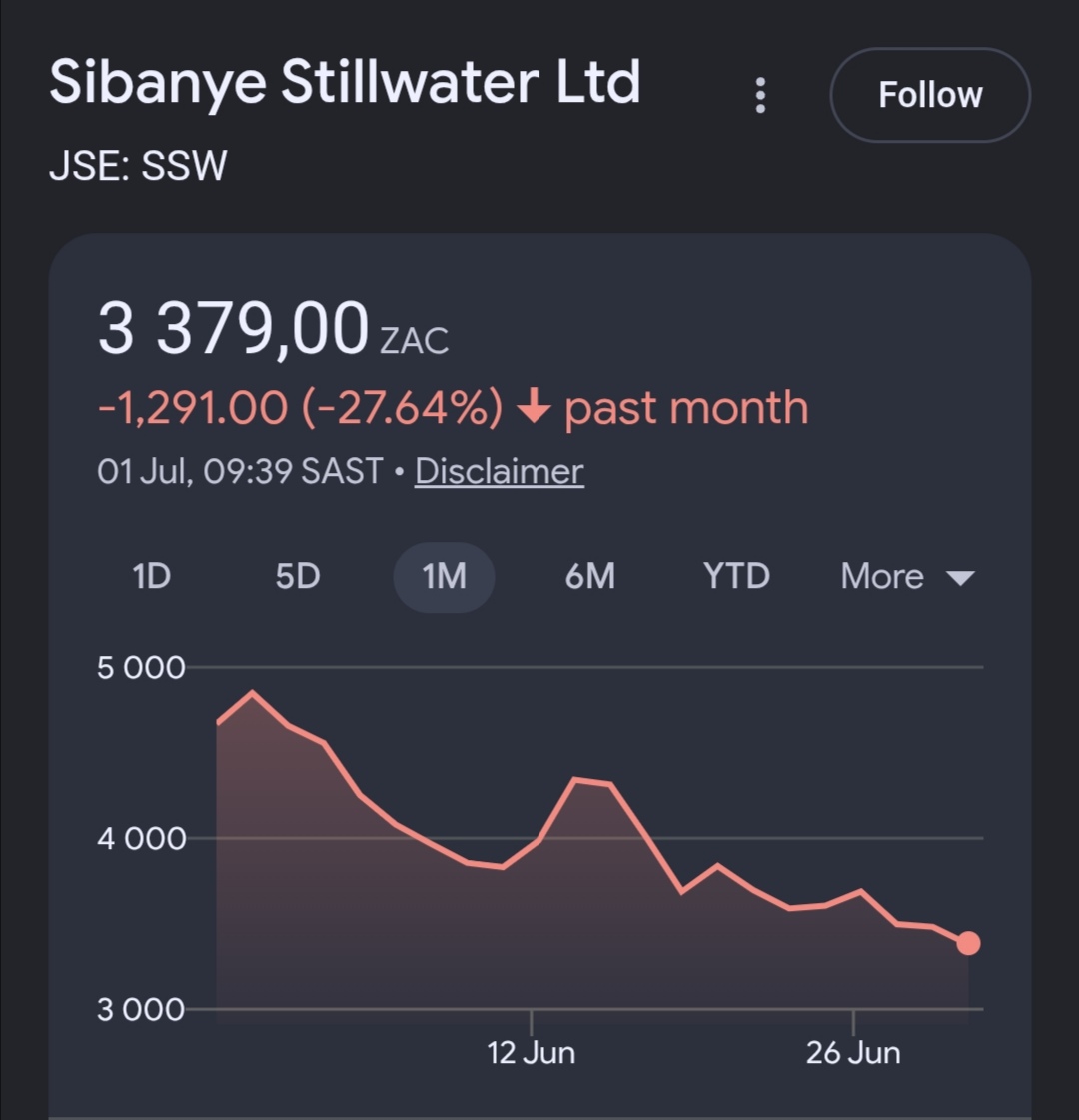
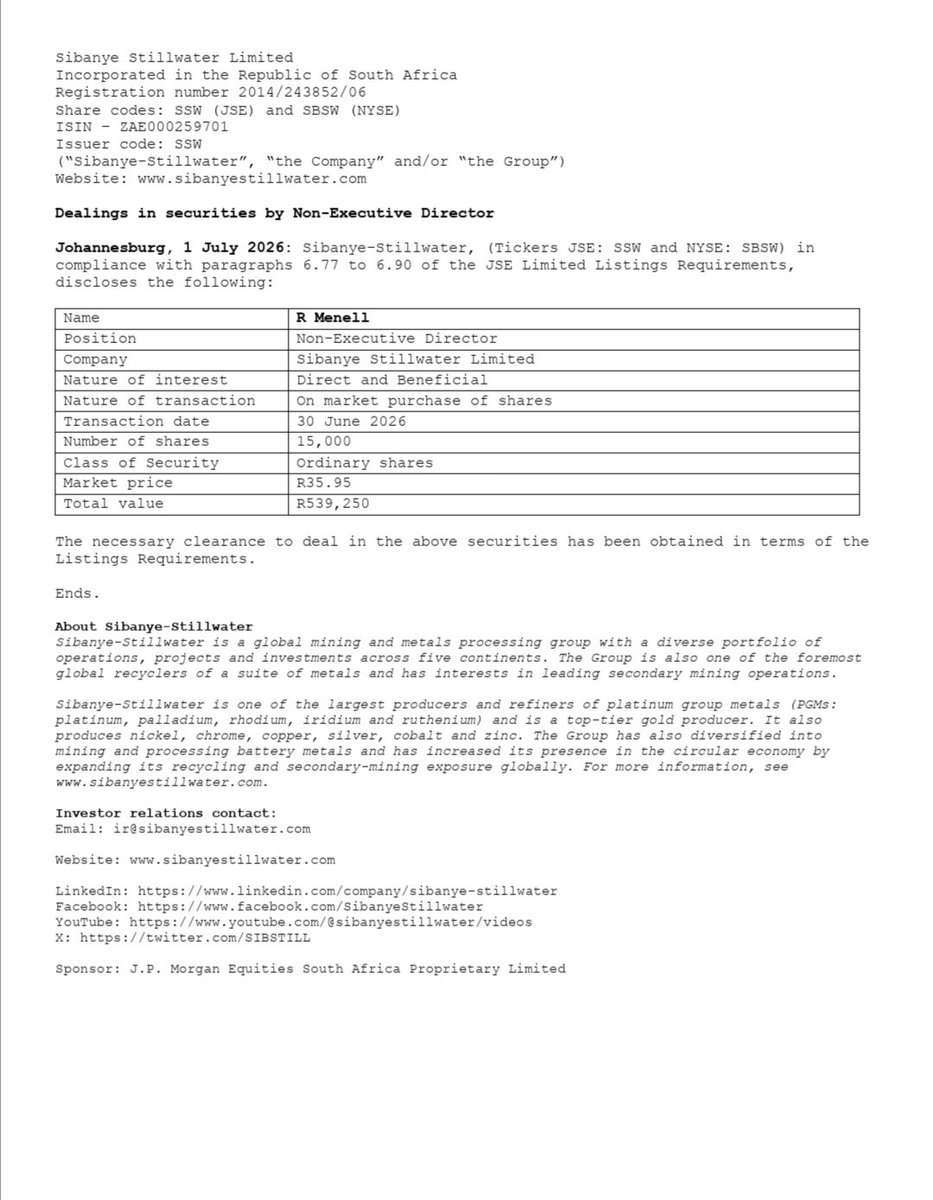
Sibanye Stillwater $JSESSW is getting hammered, down 27% in a month… but the CFO Charl Keyter just bought R7.3m worth and another director added R500k.
That’s nearly R8m of insider buying?!
If governments were actually doing their job, this Palantir document 👇 wouldn't be a manifesto they proudly boast about, but a clear sign of the urgent need to purge its software from the public institutions it has infiltrated.
What are they saying, essentially?
They basically promote a clash of civilization worldview in which there exists a "they" - the supposed enemies of Western civilization, whose cultures the document codes as inferior - and a "we" who must stop indulging in decadent restraint and invest massively in AI weapons and defense software (which conveniently makes Palantir's product catalog the civilizational cure).
Look at point 4 for instance. They write that "the limits of soft power, of soaring rhetoric alone, have been exposed. The ability of free and democratic societies to prevail requires something more than moral appeal. It requires hard power, and hard power in this century will be built on software."
It all rests on a pretty massive assumption: that coexistence is impossible. Why would "free and democratic societies" (by which they obviously mean Western-style liberal-democracies) need to "prevail"? Why can't they simply coexist with other civilizations or political systems out there?
Nowhere in the document do they defend this assumption: it's simply asserted as the starting condition of the argument.
But it's the entire ballgame: if civilizations and political systems can coexist - as they largely have, imperfectly but recognizably, throughout history - then the entire case they make in the document evaporates.
In fact one can argue that, studying history, the big problem was not that civilizations couldn't coexist: it was that, from time to time, one of them decided that others were inferior, threatening, or standing in the way of its rightful expansion - and acted accordingly.
So many catastrophes and so much human suffering in history trace back not to the fact of plural civilizations, but to one of them deciding it could no longer tolerate the others.
The problem, in other words, has almost always been exactly the worldview Palantir is now selling. Their manifesto isn't warning against the cause of some of the worst periods in history: it's arguing for reviving them!
Or take point 15: they explicitly call for the re-armament of Germany and Japan, and an end to "Japanese pacifism". Basically undoing one of the foundational settlements of the post-WW2 order.
I mean, think about the insanity of this for a second: a private company - unelected, answerable only to its shareholders - is casually proposing to overturn the security architecture of two continents. A settlement that took a world war, and tens of millions of dead to establish.
Why do they propose this? There is obviously a commercial motivation: a remilitarized Germany and Japan are massive new defense-software markets.
But the more troubling answer is that point 15 fits into the ideological project the rest of the manifesto lays out - a civilizational contest requires a consolidated Western bloc, and pacifist members are a liability in such a contest.
So taking a step back we now have what's the most influential defense-software company in the world, with its code deeply embedded in all the machinery of Western states - intelligence agencies, militaries, police forces, welfare systems, border controls - openly outing itself as an ideological project.
They're effectively saying "our tools aren't meant to serve your foreign policy. They're meant to enforce ours."
Because, worryingly, that's what they CAN do. Palantir software is all about basically telling states: "these are your threats, these are the people and groups to watch, these are the patterns that matter, these are the targets that warrant action."
For instance the DGSI - the French intelligence services - use Palantir (see: https://t.co/3YJk88k4QY): do you honestly think the software is warning them about, say, the NSA tapping the phones of French government officials? About the weaponization of US extraterritorial law against French companies? Did it warn them about the AUKUS ambush that cost France a sixty-billion-euro submarine contract? Obviously not.
And that's exactly what the manifesto is saying. They've positioned themselves as advocates of Western civilizational unity, so their software can't undermine it. The ideological position and the product roadmap have to align, or the whole project falls apart.
This makes their software not only deeply dangerous for the world as a whole but also, almost by definition, for any country using it. When it comes to your security as a state, it is primordial you base yourself on truth as opposed to ideology. The entire point of an intelligence agency is to tell its government what is true, not what your so-called "allies'" defense contractors would like you to see.
A state that outsources its threat assessment to a company with an explicit ideological agenda is not gathering intelligence, it is essentially subscribing to propaganda.
The conclusion couldn't be more obvious. Every government still running Palantir software in its intelligence, security, or public-service infrastructure needs to start ripping it out, now! Lest they want to be embarked on the delusional and deeply destructive clash-of-civilizations crusade Palantir has now openly committed itself to.
How does war and oil market havoc will affect SouthAfrica? 🇿🇦
🚩Jet A-1 fuel spiked 70% in a single week.
🚩South Africa had 700 000 barrels per day refining capacity over six refineries
🚩Currently SA has approximately 358 000 barrels per day refining capacity
🏴Natref: 108 000 bpd
🏴Aston Energy: 100 000 bpd
🏴Sasol CTL: 150 000 bpd
🚩Indefinitely paused refining capacity
🏴Sapref: 180 000 bpd
🏴Enref: 120 000 bpd
🚩Total energies proves an estimated one billion barrel of oil equivalent in the Outeniqa basin however, in July 2024 they exited the block due to too challenging to economically develop.
🚩Total and Qatar energy turned to Orange basin on the west coast. They hope to mirror 30 billion barrel discovery they made in Namibia.
🚩Central Energy fund has aspirations to upgrade Sapref to refine 450-600 000 bpd.
🚩Mzansi procures 70% of its fuel consumption as finished petroleum products.
Source: Daily Macerick
There's a myth that international laws & norms must be useless because there's no international Leviathan, & thuggish countries flout them (so why shouldn't we?). Responses: 1. People flout laws against murder, assault, & rape, too; that doesn't prove the laws are useless. The relevant question is how much worse life would be without the laws. 2. Most of our social behavior is in practice regulated by norms, not laws: nudity, lewdness, belching & farting, racist & misogynistic jokes, basic table manners, queuing,... either there is no law, or it's unenforceable. The norms are enforced by ostracism, gossip, shows of contempt. 3. Nations depend on each other (trade, terrorism, piracy, pandemics, borders, extradition, ...) so sanctions and exclusion are not toothless. 4. War is in fact NOT the "realist," pragmatic, unromantic alternative, but often leads to catastrophic failures: US in Vietnam, US in Afghanistan, USSR in Afghanistan, Iraq in Kuwait.. https://t.co/blRzIrdMSO
Britain needs nuclear power. Our nuclear projects are the most expensive in the world and among the slowest. Regulators and industry are paralysed by risk aversion. This can change. For Britain to prosper, it must.
Earlier this year, the Prime Minister appointed me to lead a Taskforce to set out a path to getting affordable, fast nuclear power Britain.
Our final report today sets out 47 recommendations, among them:
- Creating a one-stop shop for nuclear approvals, to end the regulatory merry-go-round that delays projects at the moment.
- Simplifying environmental rules to avoid extreme outcomes like Hinkley Point C spending £700m on systems to protect one salmon every ten years, while enhancing nuclear's impact on nature.
- Limiting the ability of spurious legal challenges to delay nuclear projects, which adds huge cost and delay throughout the supply chain.
- Approving fleets of reactors, so that Britain’s nuclear industry can benefit from certainty and economies of scale.
- Directing regulators to factor in cost to their behaviour, and changing their culture to allow building cheaply, quickly and safely.
- Changing the culture of the nuclear industry to end gold-plating and focus on efficient, safe delivery.
If the government adopts our report in full, it will send a signal to investors that it is serious about pro-growth reform and taking on vested interests for the public good.
A thriving British nuclear industry producing abundant, affordable energy would be good for jobs, good for manufacturing, good for the climate, and good for the cost of living. And it could enable Britain to become an AI and technology superpower.
Britain can be a world leader in this new Industrial Revolution, but only if it has the energy to power it.
Our report is bold, but balanced. Our recommendations, taken together and properly implemented, will forge a clear path for stronger economic growth through improved productivity and innovation. This is a prize worth fighting for.
https://t.co/9wPTtkTDMU
The idea that the country that burns more coal than the rest of the world combined was going to fill any climate leadership was/is ludicrous.
China has four main objectives at climate talks: a) preserve status as a developing country; b) keep discussion away from its domestic coal; c) seek foreign markets for its home-grown clean-tech; d) torpedo trade initiatives linked to emissions.
MINING M&A: The world's largest mining company, BHP Group, has made a renewed takeover approach to Anglo American, its smaller rival that is itself seeking to reshape the industry with an acquisition Teck Resources.
https://t.co/kj5sFVDtCf
How South African's missed the bullet!
The powerships contracted by South Africa's Independent Power Producer Procurement Office under the Risk Mitigation Independent Power Producer Procurement Programme (RMIPPPP) refer to the three Karpowership projects:
1. Karpowership SA Coega (450 MW)
2. Karpowership SA Richards Bay (450 MW), and
3. Karpowership SA Saldanha Bay (320 MW).
These were announced as preferred bidders in March 2021 for 20-year power purchase agreements.
The effective tariffs for these projects—calculated for the first year of the proposed contracts and incorporating the take-or-pay mechanism (guaranteeing payment for 72.72% of capacity regardless of actual dispatch)—exclude pass-through fuel costs (primarily LNG, accounting for about 60% of total expenses) but reflect the uplift from the bid evaluation tariffs due to the minimum capacity commitment.
Specifically, the effective tariffs on a take-or-pay basis were R2.77/kWh for Karpowership SA Coega, R2.77/kWh for Karpowership SA Richards Bay, and R2.84/kWh for Karpowership SA Saldanha Bay.
In hindsight, these tariffs would have imposed a significant financial burden on South Africa in 2025, especially as Eskom's Energy Availability Factor (EAF) has improved to a month-to-date average of 70.45%—marking 140 consecutive days without loadshedding.
Fortunately, the projects were ultimately canceled following a Pretoria High Court ruling in August 2025, which set aside the R200 billion deal due to regulatory and procedural flaws.
This outcome has allowed South Africa to avoid an unnecessary escalation in electricity costs amid the ongoing recovery of its power system.
I really wonder which criminal syndicate stood to benefit?
South African's really missed the bullet here!