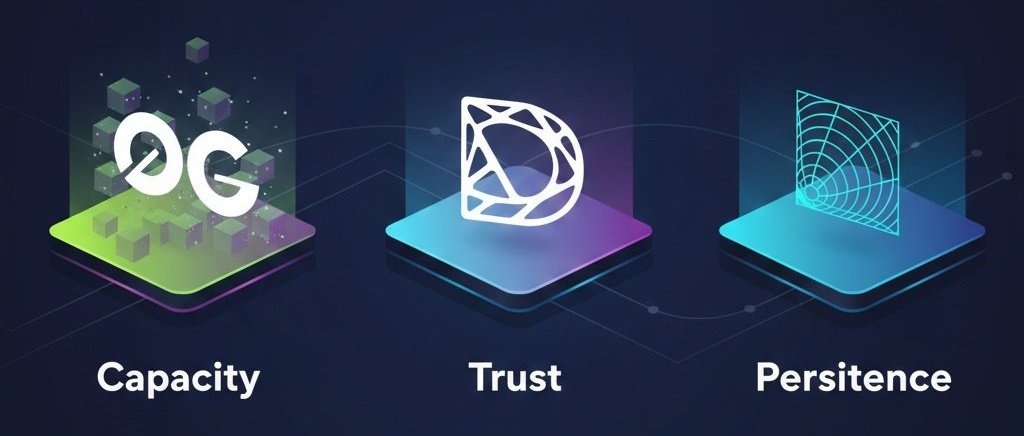
What’s holding the entire pawn together across Permacastapp, 0G_labs, Xmaquina, and Dgrid_ai is not just shared ambition, it’s the emergence of a unified layer of verifiable intelligence that reduces uncertainty across decentralized systems. The real breakthrough isn’t any single innovation, but how each project closes a specific gap in the lifecycle of data, computation, execution, and memory, forming a continuous loop of trust.
0G_labs anchors this system at the foundational level by redefining how data availability and modular AI infrastructure interact. Its architecture doesn’t just scale compute; it makes data verifiable, composable, and accessible in a way that removes friction between models and the information they depend on. This transforms raw data into a reliable substrate for intelligent systems, ensuring that every downstream action is grounded in integrity rather than assumption.
Dgrid_ai builds on that foundation by coordinating decentralized AI resources into functional intelligence networks. Instead of isolated compute nodes, it creates a layer where distributed intelligence becomes collaborative and usable. The key insight here is orchestration turning scattered capacity into synchronized output so intelligence is not just available, but efficiently aligned toward meaningful tasks.
@xmaquina translates this intelligence into action through autonomous agents that operate beyond static code. It represents the execution layer where decisions are no longer theoretical but enacted in dynamic environments. By enabling agents to interact, adapt, and respond in real time, it closes the gap between intelligence and utility, making decentralized AI systems capable of producing tangible outcomes. $DEUS
Permacastapp completes the loop by preserving the flow of knowledge that these systems generate. In a space where information is often transient, it introduces persistence and context, ensuring that insights compound rather than disappear. This transforms intelligence from a momentary output into a continuously evolving asset, reinforcing the reliability of the entire stack over time.
What ultimately holds the pawn together is engineered trust built through verifiable data, coordinated intelligence, autonomous execution, and persistent memory. Each project strengthens a different layer, but together they form a self-reinforcing system where uncertainty is systematically reduced. When that loop becomes stable, the system stops being experimental and starts defining the next phase of decentralized intelligence.
PermacastApp demonstrates that decentralized storage is not just about data, but about preserving culture in a tamper-resistant format. By making content durable and verifiable, it strengthens trust between creators and audiences. OG_Labs advances the technical substrate required to support such applications at scale, focusing on modularity and performance optimization for next-generation Web3 systems. @xmaquina pioneers the integration of robotics and AI into decentralized coordination frameworks, turning machines into economic actors rather than passive tools. $DEUS provides the programmable liquidity and alignment mechanisms that bind these layers together, while Dgrid_ai decentralizes computational intelligence to avoid concentration risk. When viewed collectively, these projects outline a credible path toward a decentralized digital economy where media, infrastructure, machine intelligence, and tokenized incentives co-evolve instead of competing for narrative dominance.
good morning CT...
Web3 didn’t just introduce tokens it redesigned coordination.
Value transfer was solved by blockchains. Ownership was solved by smart contracts. Now the next frontier is intelligence but intelligence without permanence and performance is fragile.
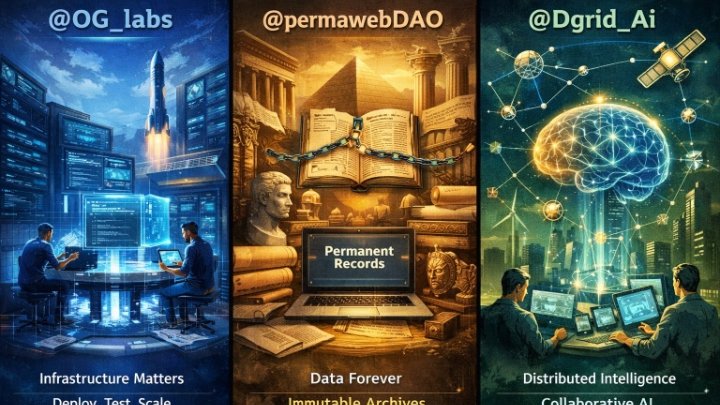
📌 dgrid_ai is targeting the missing layer: a shared intelligence framework where incentives align, outputs are verifiable, and ownership is programmable. Decentralized AI cannot scale on raw model performance alone. It must solve coordination. If intelligence becomes infrastructure, then verification, composability, and incentive design become the true moats. DGrid’s thesis is structural: resilient systems outlast loud narratives.
📌 0G_labs complements this by addressing the execution bottleneck. Speed, security, and composability aren’t luxuries they’re prerequisites for AI-native Web3. When infrastructure can handle high-throughput data availability and modular execution, experimentation compounds. Builders stop worrying about constraints and start designing complex, agent-driven systems. Reliable performance multiplies innovation.
📌 Permaweb_DAO anchors the stack with permanence. Intelligence without censorship resistance is conditional. Storage without gatekeepers transforms AI outputs into immutable public goods. When data persists independently of centralized authority, knowledge becomes sovereign. That permanence reshapes power dynamics across digital ecosystems.
Together, this forms a vertical thesis:
DGrid AI 👉decentralized intelligence & verification
0G Labs 👉 scalable execution & composability
PermawebDAO 👉 permanent, censorship-resistant data
We’re moving toward markets where machines don’t just assist humans they negotiate, allocate, and execute alongside them.
For that to work, decentralized networks must evolve.
OG Labs, DGrid AI, and Permacast by PermawebDAO are building the rails for machine-native economies.
0G Serving introduces a decentralized AI marketplace where providers offer inference and fine-tuning services. Users prepay via smart contracts. Providers sign outputs. ZK proofs settle results, ensuring tamper-resistant verification.
This eliminates black-box AI execution.
In centralized AI systems, you receive outputs without insight into process integrity. 0G replaces that opacity with cryptographic assurance.
But settlement is only the first layer of trust.
Permacast adds temporal trust.
Inference results can be stored as structured media objects with metadata and semantic tagging. Version history tracks revisions. Interaction data records engagement. Identity systems link outputs to creator profiles and governance participation.
Now imagine this pipeline:
1. AI inference executed via 0G Serving
2. ZK settlement verifies authenticity
3. Output encoded and permanently stored via Permacast
4. Semantic engine enables transparent recommendation logic
5. Identity layer ties output to long-term reputation
The result is not simply decentralized AI. It is historically auditable AI.
Execution is provable in the moment.
Interpretation is preserved across time.
Good morning! ☕️
- the permanent storage for your media. ensuring verifiable and decentralized data lives on the permaweb forever.
- smart network enables verifiable AI. decentralized and transparent.
- aggregating onchain liquidity
permawebdao x dgrid_ai x dango
permacastapp is building the definitive archive for Web3 media. by combining permanent storage on the permaweb with intuitive creation tools, the platform attracts creators who value longevity. every upload becomes part of a growing library of verifiable content that will survive any single point of failure. PWT governance ensures that the community directs which media categories to prioritize and how to onboard new creators. whether you are launching a podcast or preserving oral histories, #permacast offers the infrastructure you need. Stop treating your media as temporary. give it the permanent home it deserves with permacast.
dgrid_AI's decentralized smart network opens AI access to developers worldwide regardless of location or resources. traditional AI providers often restrict access based on geography or require corporate relationships. dgrid AI treats every user equally, routing inference requests through its global node network. DGAI tokens facilitate frictionless payments without banking intermediaries. the platform's verifiable architecture ensures that users in emerging markets receive the same quality of service as those in tech hubs. democratizing AI means more than lowering costs; it means removing barriers entirely. #dgrid_ai builds the infrastructure for truly accessible artificial intelligence.
the dango L1 achieves high performance without sacrificing decentralization. through innovative consensus mechanisms and parallel execution, the chain processes thousands of transactions per second with sub second finality. this performance enables the kind of high frequency trading typically associated with centralized exchanges. dangbros can execute complex strategies with confidence, knowing that the underlying infrastructure can keep pace. deep onchain liquidity ensures that even large orders execute efficiently. dango proves that L1 blockchains can deliver both decentralization and institutional grade performance. drade at the speed of DeFi with dango.
Permanent storage for media with verifiable data and DGAI smart network, decentralized permaweb with full transparency.
Aggregates deep onchain liquidity - Dangbros trade on this high speed L1 Dex.
Permacastapp ⛓️ DGrid_ai ⛓️ Dango
- PermacastApp
The Permacast ecosystem extends beyond simple storage to include social features and discovery mechanisms. Users can follow favorite creators, tip with PWT, and curate playlists that live forever on the permaweb. Every interaction is recorded on the decentralized network, creating a rich layer of metadata that enhances discoverability.
Verifiable permanent storage ensures that even the social graph remains intact for future generations. As Web3 evolves, Permacast continues to add features that serve creators and consumers alike. Join a platform that respects your data and your attention. Experience media storage designed for permanence.
- DGrid_Ai
Dgrid AI's decentralized smart network solves the centralization crisis in artificial intelligence. Today, a handful of corporations control the most powerful AI models, creating black box services with opaque pricing and arbitrary censorship. Dgrid AI rebuilds AI infrastructure from the ground up on #Web3 principles. The platform offers verifiable inference through a community owned gateway layer that任何人都 can participate in. DGAI governance ensures that decisions about the protocol reflect user interests rather than shareholder demands. Experience AI that is truly decentralized, cost-effective, and transparent. Choose Dgrid AI for verifiable intelligence.
- Dango
Gas free transactions on Dango remove one of DeFi's biggest friction points. Traditional chains require users to hold native tokens for gas, creating barriers to entry and complicating tax reporting. Dango's L1 abstracts away these complexities, allowing Dangbros to focus on trading rather than infrastructure management. The platform covers transaction costs through its economic design, making DeFi accessible to everyone. Combined with deep onchain liquidity and institutional grade trading tools, gas free execution makes Dango the most user friendly L1 for financial applications. Stop worrying about gas and start trading with Dango.
Centralized systems promise efficiency. Decentralized systems promise resilience. Most pick efficiency then wonder why they're fragile.
Dgrid proves the choice is false, distributed architecture that's faster because it's distributed, stronger because power can't concentrate.
Podcasters shouldn't have to choose between widespread distribution and permanent preservation. Between platform reach and content ownership.
Permacast delivers both decentralized storage that's globally accessible, permanently archived, individually owned. No tradeoffs.
This analysis strips away the application layer completely to examine the deep, underlying network topologies, consensus optimizations and mathematical proofs governing these systems.
This set dissects Optimistic Concurrency Control for 0G, Optimistic TEE-Rollups (OTR) for DGrid and Blockshadowing Topology for Permacast.
0G Labs.
Most blockchains are designed as simple state machines (moving tokens from Wallet A to Wallet B). They are structurally incapable of handling the complex, parallel data mutations required by AI workloads. 0G Labs bridges this gap by introducing Optimistic Concurrency Control (OCC) for ACID Transactions.
Instead of forcing every piece of data through a sequential, single-file bottleneck (like Ethereum), 0G's mutable Key-Value (KV) storage layer allows multiple AI agents or decentralized applications to read and write to the database simultaneously. The OCC protocol assumes that transaction conflicts will be rare. It executes operations in parallel and only verifies for conflicts immediately before committing the final state to the immutable log layer.
This represents The Database Paradigm Shift in Web3. By guaranteeing true ACID (Atomicity, Consistency, Isolation, Durability) compliance at a decentralized level, 0G allows on-chain AI to operate with the fluid, collaborative, and real-time read/write speeds of a traditional Web2 PostgreSQL database, all without sacrificing cryptographic security.
DGrid AI.
The expansion of commercial Large Language Models (LLMs) into decentralized networks is currently paralyzed by the Verifiability Trilemma: the structural inability to simultaneously achieve computational integrity, sub-second latency, and low cost. DGrid AI mathematically resolves this via a hybrid architecture known as Optimistic TEE-Rollups (OTR).
If you force a Zero-Knowledge (ZK) proof on every single AI inference, the computational cost and latency destroy the user experience. Instead, DGrid executes the inference inside a Trusted Execution Environment (TEE) for instant, low-cost processing. This output is accepted optimistically. However, the network employs a decentralized fleet of Fisherman nodes that continuously sample these outputs. If a Fisherman detects an anomaly during the optimistic time window, it triggers a rigorous, mathematically undeniable ZK-Spot-Check to dispute the execution trace.
This is Asymmetric Cryptographic Deterrence. It ensures that node operators behave perfectly because the financial penalty for failing a ZK-Spot-Check (slashing) far outweighs the cost of simply processing the inference correctly. DGrid delivers the speed of a Web2 API with the deterministic security of a Zero-Knowledge network.
Permacast.
The historical failure of blockchain-based storage is bandwidth saturation. If a creator uploads a 2-gigabyte podcast to a decentralized network, broadcasting that massive file to every single node for consensus would instantly crash the network. Permacast App, utilizing the Arweave protocol, bypasses this physical limitation through Blockshadow Topology.
Instead of broadcasting a full block containing the heavy media file, the protocol broadcasts a Blockshadow, a tiny cryptographic blueprint (often just a few kilobytes). This shadow simply contains a list of transaction hashes and the instructions required to reconstruct the block. Because the decentralized nodes already received the raw transaction data when it was initially submitted to the mempool, they use the Blockshadow to locally reassemble the heavy block themselves.
This is Topological Decoupling. It mathematically separates data distribution from network consensus. By communicating in lightweight cryptographic shadows rather than heavy raw data, Permacast ensures that the Permaweb can scale to infinite storage capacities without ever congesting the core network's bandwidth.
Episode 36
OG_LABS ✓✓ PERMAWEBDAO ✓✓ DGRID_AI ✓✓
From Fragmented Primitives to Intelligent Coordination
Web3 has mastered decentralization of ownership.
It has not mastered decentralization of intelligence.
Liquidity is composable.
Protocols are interoperable.
AI models are powerful.
Yet economic coordination remains fragmented because memory, compute, and reasoning do not share a unified substrate.
The structural problem is discontinuity.
Data is stored but not systemically leveraged.
Compute is available but not coherently orchestrated.
AI is deployed but not infrastructure-native.
The next phase of decentralized finance and AI infrastructure emerges when these constraints are solved as one architectural problem.
PermawebDAO resolves the durable knowledge constraint.
Governance records and ecosystem research often dissolve into transient interfaces. Historical context becomes socially dependent rather than machine-verifiable.
PermawebDAO anchors coordination artifacts into permanent storage layers.
State becomes immutable and queryable.
Immutable state creates longitudinal economic memory.
OG Labs resolves the composable compute constraint.
Adaptive financial systems require deterministic backend environments capable of processing persistent datasets across services and chains.
OG_LABS builds interoperable infrastructure where workloads operate within structured execution boundaries.
Compute becomes enforceable coordination logic.
Enforceable logic allows infrastructure-level reasoning to scale predictably.
DGrid AI resolves the embedded reasoning constraint.
AI often analyzes decentralized systems from the outside. It generates insight without governing state transitions.
DGRID_AI integrates decentralized AI models directly with persistent state and modular compute environments.
Reasoning becomes infrastructure-resident.
Now observe the convergence.
Permanent knowledge supplies historical context.
Composable compute processes context with deterministic guarantees.
Embedded reasoning transforms it into adaptive coordination.
This closed loop produces cumulative intelligence.
DeFi evolves from transactional liquidity rails into adaptive economic networks.
AI evolves from an external analytic layer into protocol-native cognition.
When memory persists, compute orchestrates coherently, and reasoning operates within the stack, decentralized systems begin to self-optimize.
Adoption follows coherence.
Infrastructure compounds when intelligence is embedded across data, execution, and coordination simultaneously.
The next era will reward stacks that integrate permanence, computation, and decentralized reasoning into one self-reinforcing system.
Intelligent coordination is the new base layer.