Resistance and aerobic exercise with protein in older adults with obesity during energy restriction. The REPOWER study registered at #ISRCTN by @BelfieldArchie
https://t.co/MJ69rpatRa
#ClinicalTrials
New Paper⬇️We found that the human gut microbiome remains unchanged in the face of an intensive energy restriction and vigorous exercise intervention that markedly improved body composition and metabolic health in people with overweight/obesity.
https://t.co/hYy0iaJsMC
🚨Funded PhD opportunity @LboroSSEHS - starting October 2025!
🔓Exploring iron status and supplementation in athletic individuals.
✨Supervisory team: myself, @LJJ_nutrition and Lettie Bishop.
🔗 https://t.co/mw4usb64AB
Our new review is out:
Introducing the maximal anabolic intake 💪
✅Protein requirements vs maximal anabolic intake
✅Nitrogen balance vs IAAO method
✅Why 95% CI =/= safety margin
Let's break it down. 👇
1/🧵
Have you ever thought about how your muscles change when you lose weight and keep doing aerobic exercise?
We did too, and investigated it.
See the preprint for our latest work here:
https://t.co/PxoqW4M9zD
1/10 Excited to write this thread summarizing our new paper in @NatMetabolism, which identifies a potentially critical part of the signaling pathway that drives skeletal muscle growth in response to resistance exercise!
Free link https://t.co/JWca6dVU2a
#Myotwitter@NIH_NIAMS
Excited to share the culmination of all the food weighing, resistance exercise training and muscle prepping as part of my PhD is now available to read online and in a great home in The American Journal of Clinical Nutrition!
https://t.co/vdAC0fTMfY
New study in EJSS!
2 weeks of bed rest causes ~5% leg muscle loss in healthy adults.
DXA, CT & MRI detect similar decline.
MRI-based automated analysis offers a fast, reliable alternative to manual muscle quantification.
🔗 https://t.co/WvGQUetCDz
#musclehealth#MRI#research
PhD applications open for Black British Researchers at UoB.
Project Title: Examining the impact of physical activity and sedentary behaviour on the clinical health of people with Lupus.
https://t.co/aqfZ2NZwj9
Please contact me for more information: [email protected]
2024 Protein Nutrition Review!
What's new in dietary protein? 🥩🫘
A brief overview of SEVEN insightful muscle protein synthesis (MPS) studies (references and links included) 👇🏽
That’s a wrap on PhD data collection🥳 After a long year of testing, 162 muscle samples, 162 blood samples, 297 saliva samples, 2160 knee extensions and a LOT of protein powder later, my 4th and final study is finished! Next up, analysis!
I am happy to see my second PhD study published with @gareth_wallis and AndyBlannin!
“Effects of overnight-fasted versus fed-state exercise on the components of energy balance and interstitial glucose across four days in healthy adults”
#carbohydrate
https://t.co/qFJvUfJ1uP
New paper providing age-referenced centiles enabling interpretation of the volume and intensity of accelerometer-assessed physical activity of UK adults relative to their peers.
https://t.co/Gzz0hICie1
Excited to share our latest review in the Journal of Cachexia, Sarcopenia and Muscle @JCSM_cachexia. Here we show how mass spectrometry can be used to profile ubiquitin signalling in skeletal muscle. Great team effort with @HarveyEJohnston and @SamantLab
https://t.co/Bux0pmImGf
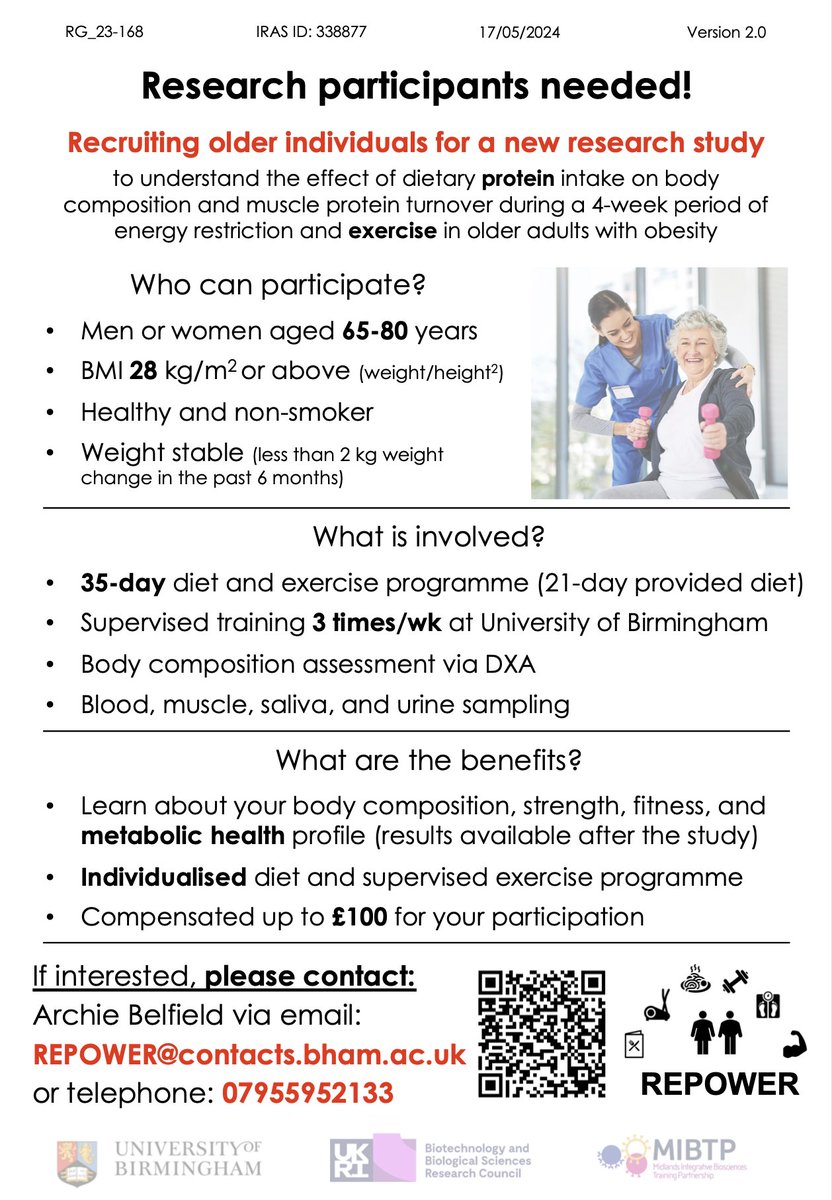
Research participants needed!
Researchers are recruiting older individuals for a study to understand the effects of protein and exercise during weight loss.
If you are interested, please contact Archie Belfield at [email protected]
https://t.co/pTtQ8QUmxR
We suggest HGS and CST cannot be used interchangeably to assess for low muscle strength in individuals with T2D and with a high prevalence of overweight or obesity.
We found a higher prevalence of probable sarcopenia using CST vs HGS (31.7% vs 7.1%) and found CST, but not HGS, was associated with all measures of adiposity (BMI, WC etc) in both unadjusted and adjusted models.