Thrilled to share our latest publication in Nature: https://t.co/GDbQL0fUIO. This work reflects a fantastic collaboration—special thanks to David Baker and @TimothyPJenkins. Hoping it sparks attention to this neglected health issue and drives solutions in the years ahead!
For the past year, @ADHansonLab and I have been co-editing a Current Opinion in Biotechnology issue on Plant Synthetic Biology 🌱🧬The full collection of perspectives from predominantly early career scientists is now online: https://t.co/71Ax6xzkc4
In 2003, this year’s chemistry laureate David Baker succeeded in designing a new protein that was unlike any other protein. This was the first step in something that can only be described as an extraordinary development. A few of the many spectacular proteins created in Baker’s laboratory using his computer software Rosetta can be seen in the picture.
He also released the code for Rosetta, so a global research community has continued to develop the software, finding new areas of application.
Baker’s research group has produced one imaginative protein creation after another, including proteins that can be used as pharmaceuticals, vaccines, nanomaterials and tiny sensors.
BREAKING NEWS
The Royal Swedish Academy of Sciences has decided to award the 2024 #NobelPrize in Chemistry with one half to David Baker “for computational protein design” and the other half jointly to Demis Hassabis and John M. Jumper “for protein structure prediction.”
This year’s medicine laureates Victor Ambros and Gary Ruvkun studied a relatively unassuming 1 mm long roundworm, C. elegans.
Despite its small size, C. elegans possesses many specialised cell types such as nerve and muscle cells also found in larger, more complex animals, making it a useful model for investigating how tissues develop and mature in multicellular organisms.
Read how the 2024 medicine laureates’ investigations into C. elegans revealed an entirely new dimension to gene regulation: https://t.co/8RwUplwYQA
#NobelPrize
BREAKING NEWS
The 2024 #NobelPrize in Physiology or Medicine has been awarded to Victor Ambros and Gary Ruvkun for the discovery of microRNA and its role in post-transcriptional gene regulation.
Just published! AGOs loaded with tinyRNAs recognize specific target sequences in the 5' upstream region of the target site 𝒊𝒏𝒅𝒆𝒑𝒆𝒏𝒅𝒆𝒏𝒕𝒍𝒚 of the guide. We devised 𝑩𝒐𝒐𝒔𝒕𝒆𝒓𝒔 to load cityRNAs into endogenous AGOs, causing gene silencing. https://t.co/Z1kMSVJWIo
The Biology Dept at UMass Amherst is hiring (again!). We have TWO TT faculty positions: Developmental Cell Biology and Plant Biology. Please share and apply!
https://t.co/D8AfmwsGHi
https://t.co/k2qo1HAsZ4
https://t.co/ofsQ9R0kn5
Opportunity for emerging SEM leaders in the Americas!
The Connections to Sustain Science in Latin America Symposium 2025 will be held March 11-13, 2025, in Lima, Peru, in partnership with the University of Engineering and Technology.
Apply today: https://t.co/00XVbRiSzn
@ThePlantJournal is calling for new reviewers to expand the breadth of our reviewers wrt expertise/diversity/location/career stage. Reviewers are crucial and much appreciated & as a @SEBiology journal, reviewing efforts also support science & scientists
https://t.co/Y0DwJF1AaA
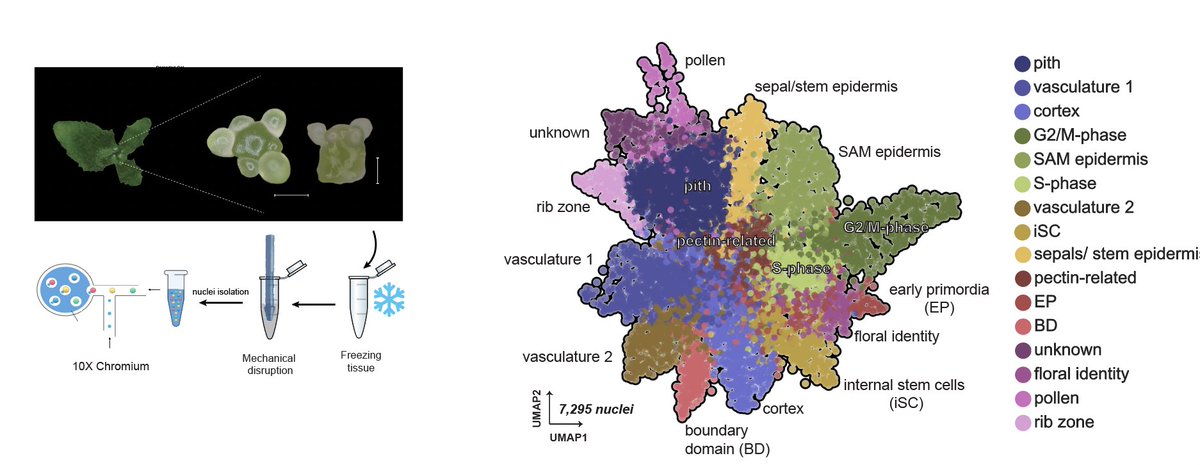
🚀Exciting news! I'm thrilled to share my first preprint as a post-doc at @slcuplants. We used snRNA-seq to capture, for the first time, the transcriptome of dissected wild-type shoot apical meristems (SAM) in Arabidopsis thaliana at the single-cell level.
https://t.co/9TnCbIAJtC
I am *beyond thrilled* to have the work from my PhD finally out!! 💫
We found that MLA3, a plant immune receptor, mimics a virulence target of Magnaporthe oryzae to set a trap for this fungus and trigger disease resistance. How cool is that?! 🤓
🧵1/15
https://t.co/zjXi1edmuo
Thrilled to see our click editing paper out today in @NatureBiotech! 🚀 Click Editors (CEs) are a new class of genome writers which combine DNA polymerases and HUH endonucleases with RNA-programmable nickases for precise edits without DNA DSBs🧬✨ https://t.co/CXqicVhjZU