Ins and outs for designing bacterial metabolisms for C1-assimilation, from a multilevel perspective, now pieced together in this review from our @LabNikel! Check it out at https://t.co/FWpCjhyRX9
Streamlined and efficient genome editing in #Cupriavidus necator H16 using an optimised SIBR-Cas system—spearheaded by @dellavallesimo & @enricoorsi & led by Costas Patinios + Wei Huang @TrendsinBiotech#SynBio
https://t.co/OW8LANTTn5
Really happy to share that our work on constructing six glyoxylate / glycolate sensors covering a three order of magnitude concentration range is out now in @NatureComms ! 🔥
Read below to see how we developed the sensors and what they are good for 🥳.
https://t.co/DEGQujQ8x9
Really happy to share that our work on constructing six glyoxylate / glycolate sensors covering a three order of magnitude concentration range is out now in @NatureComms ! 🔥
Read below to see how we developed the sensors and what they are good for 🥳.
https://t.co/DEGQujQ8x9
Super exciting work by @OscarPuiggene from @LabNikel on advancing #methanol use by Pseudomonas Putida by engineering #serinecycle variants! Many congratulations, excited to be a part of this !
Congratulations @PabloINik on this great achievement!
We are thrilled to congratulate our group leader, @PabloINik, for being elected Fellow of ASM! A well-earned recognition of your outstanding contributions to our field! 🥳
Honored to be elected as Fellow of the #American Academy of #Microbiology! This recognition reflects the incredible work of my past and present collaborators, students, and mentors. Deep gratitude to my nominators and the microbiology community for their support! @ASMicrobiology
Amazing tool for multiple cycles of genetic engineering of Gram negative bacteria developed by @FilFederici and Francesco, now fully available! @LabNikel
We hope this thread is helpful to everyone interested in synthetic biology and metabolic engineering, or simply curious about what our group has been up to in 2024. Have some relax in this break to charge your energies back! 🎉
Finally, this piece from @NicoKrink provides a guided overview of CRISPR-based editing tools for bacteria, offering orientation on their diverse applications, challenges, and improvements, inspired by The Hitchhiker’s Guide to the Galaxy
https://t.co/dHaezofHUN
And also Meliawati led this work on Paenibacillus polymyxafor isobutanol production by genes KO and KI, optimizing NADPH regeneration, and identifying key metabolic bottlenecks, offering insights for further biotechnological applications of this bacterium
https://t.co/IY9PPeEM39
Touching on new bugs, here @enricoorsi and @dellavallesimo led the work for creating a new CRISPR/Cas toolkit for the emerging C1 platform C. necator, showing unprecedented efficiencies and turnover times for gene deletions
https://t.co/B4IjEqcuqT
And in this chapter, w/ @DeMaria_SynBio they outline use of L-threonine aldolases (LTAs) from E.coli and P.putida to efficiently synthesize 4-F-L-threonine in vitro + protocols for adapting these activities to produce other fluorometabolites in vivo
10.1016/bs.mie.2024.02.016
@ManuelNietoDom1 explores here enzymatic synthesis of F-alanine enantiomers using few dehydrogenases, demonstrating efficient production with high enantiomeric excess, and introduces a novel fluorine biocatalysis method for trifluorinated alanine
https://t.co/rc6BgZMpl0
Going back to P. putida, this minireview w/ @vdlorenzo_CNB and @PabloINik traces the evolution of KT2440 from a model organism for biodegradation studies to a SynBio #chassis, highlighting its adaptability and importance in various applications
https://t.co/0eKs6Uw9fv
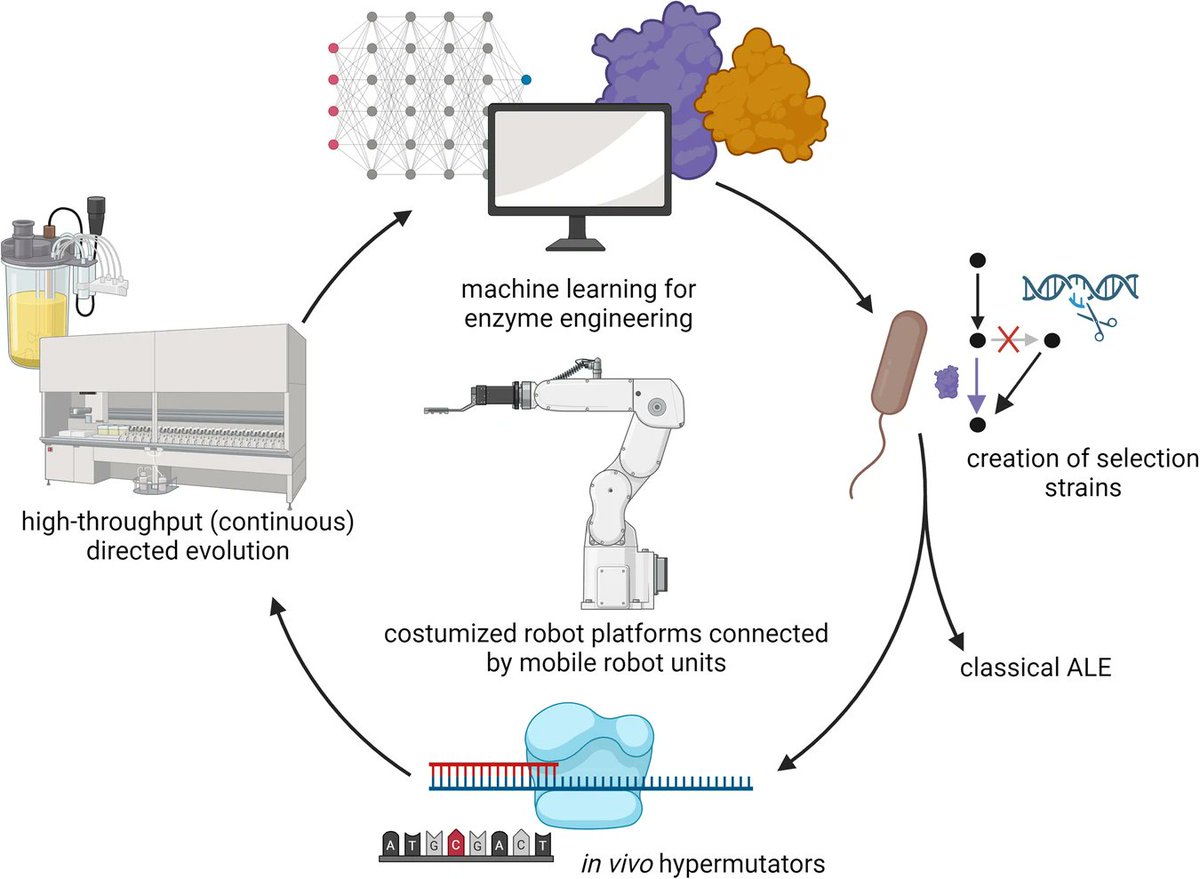
These types of sensors are ideal platform to harness for #evolution campaigns. Here, @enricoorsi led this #perspective article that proposes integration of ML, automation, high-throughput screenings and in vivo evolution to develop superior biocatalyst
https://t.co/hjCM1uIhCA