Learning Partner at Farther. I help people learn to work with AI: adoption, training, and managing AI agents. Research-backed L&D takes, minus the hype.
Hi X, I'm Ben. Learning Partner at Farther.
I'm not a developer, but I manage a team of AI agents in my daily work.
Here I share:
1. Research on what makes AI training pay off
2. How to manage AI agents
3. L&D's role in the AI shift
If that's your world, follow along.
@swyx The same idea applies to training materials. If agents rewrite workflows weekly, your job aids have to be cheap to update. Teach teams to refresh one aid after each process change instead of shipping a permanent PDF.
@bschlenker Enthusiasts will find the tools. The engine room needs practice on the three tasks they already touch every week, with a manager nearby for the first few tries.
@degreed@davidblake Outlearning only sticks when practice is tied to the job. Pick one task that changed this month, build a short practice loop around it, and measure whether people can do it differently next week.
@OpenAI Parallel agents raise a training question first. Who owns the merge, and what does good look like when three drafts land at once? Teach the review step before you celebrate the speed.
@OfficialLoganK Teams need the same habit for people using AI. A simple pass fail check on real work beats another feature tour. Benchmarks for models. Rubrics for humans.
@Josh_Bersin@satyanadella Specialist agents mirror how good L&D already designs roles. Narrow the scope, write a clear definition of done, and train the human owner to check that one domain well before you expand.
@rowancheung Speed without a learning loop just burns people out. The teams that keep up usually protect a weekly block to redesign one workflow, then ship the change instead of collecting more tools.
@conorgrennan Treating AI like a silent teammate is why adoption stalls in meetings. I would put one standing question on every agenda. What did the agent try this week, and what still needs a human call?
@karpathy That funnel is an L&D problem hiding in plain sight. Most companies train for the derpy chatbot tier. The useful move is a short path that gets people from search-engine habits to verified multi-step work on real tasks.
@paulroetzer When agents outpace headcount, the training problem flips. Junior roles used to be how people learned the craft. Now you need deliberate practice paths for judgment work that agents cannot own yet.
@proceedtobuild Postponed decisions is the perfect way to put it. A stop condition in the brief turns a surprise into a checkpoint, and that is a much easier conversation to have.
The skill I'm practicing most with AI: delegating outcomes.
Give the agent a goal, the tools it needs, and a clear definition of done. Then check the work.
Vague asks produce vague results. Quality is still on me.
@MikeDeYoungAI Version stamping is the right instinct. Pair it with what Vera compared against and you get a pass a person can verify in seconds, which is exactly what makes people trust the system.
@taichnocrat A 6 hour course is a starting line, not a finish line. The real shift happens when teams keep redesigning one workflow at a time on actual work, with time set aside for it every week.
@JeremyNguyenPhD Nitpicking is a framing problem more than a model problem. Asking the reviewer to name the paper's main claim first, then rank its comments against that claim, keeps the core idea from getting buried. Works for human reviewers too.
AI trained them perfectly. Then the buyer went off-script and everything fell apart.
New research from Corporate Visions and Florida State followed 119 new sales hires for 18 months. Three groups. AI-heavy practice, observation of experienced sellers, and both combined.
The AI group won on execution. They were fluent and efficient when the conversation followed the plan.
Then the buyer changed course. Their adaptability score dropped to 25.4 out of 50.
The group that combined AI practice with watching experienced sellers won overall. Managers rated them highest at 30 and 60 days, in live deals, not just role-plays.
AI practice builds fluency fast. Judgment comes from watching skilled people handle the unexpected, then practicing to that standard.
Volume of practice is not the same as readiness.
If you're building training programs right now, AI practice plus human observation beats either one alone.
How are you pairing AI practice with time alongside your best people?
I'm not a developer. I still build scheduled tasks, custom tools and dashboards with AI.
It changed how I think about my job. I don't just do the work anymore. I manage a team of AI agents doing it with me.
Here's the framework I've landed on. Four levels of using AI at work.
1. Chat. Brainstorm, draft, think things through. This is where most people stop.
2. Connect. Plug it into your tools with connectors so it does real work for you.
3. Multiply. Run multiple agents at once across multi-step tasks.
4. Build. Scheduled tasks running on their own, plus custom tools built for you.
My tips if you're starting out.
Pick one main tool and learn it deeply. Mine is Claude. Use others where they're better. I use Gemini for images.
Connect it to your software, create skills and save instructions per project.
Start small. Saving 30 to 60 minutes a week is the right first win. Then build from there.
It still makes mistakes, so I review everything. Quality is always on me.
Which level are you at today?
My biggest obsession right now is doing work with my AirPods in: walking and talking to a "coordinator" agent who can do tasks in parallel.
When I'm sitting at a desk, my left brain is activated.
I'm in logic and facts and procedure mode.
When I'm walking, I activate more of the right brain. Something about moving the body lifts my spirit. I'm not only more creative... I also have more energy. My mood is lifted, and I can think more clearly. I even write better while walking.
This has been a habit of mine for 2 years now. I would take voice memos while on walks, and then, when I returned to my desk, I would have a "plan." Well, now I can literally do things while walking. My agent (Dot, currently the best real-time voice agent) can spin up local Codex sessions on my computer, is connected to all my tools, and can communicate with anyone on my team. All by simply talking.
(sent via Riley's Dot using the x-api skill)
@rileybrown I 100% agree with this and I literally just did it last night! I walked around outside for almost an hour just chatting with my agent and it was 1) super refreshing and 2) much more creative and collaborative. I ended up working through two really big challenges!
I'm not a developer, and Lovable is still one of my favorite tools to build with. You describe what you want in plain language and it builds a working app with you in real time. Database, login, hosting and AI come built in, so you skip most of the setup.
Here's what I like most.
The backend is already there. Lovable Cloud gives you a database, user login, file storage and hosting without setting anything up yourself.
Adding AI to your app is easy. You can use models from OpenAI, Anthropic and Google without managing your own API keys.
Security is part of the flow. A quick scan runs every time you publish, and Lovable can fix common issues like database access rules for you.
SEO is covered too. It runs an SEO and AI search review and can fix most of what it finds.
You can buy or connect your own domain right inside Lovable.
I still review everything, like any AI tool. But it's the fastest way I've found to go from idea to something real.
Want to try it? This is my referral link. https://t.co/LPdyyovztF
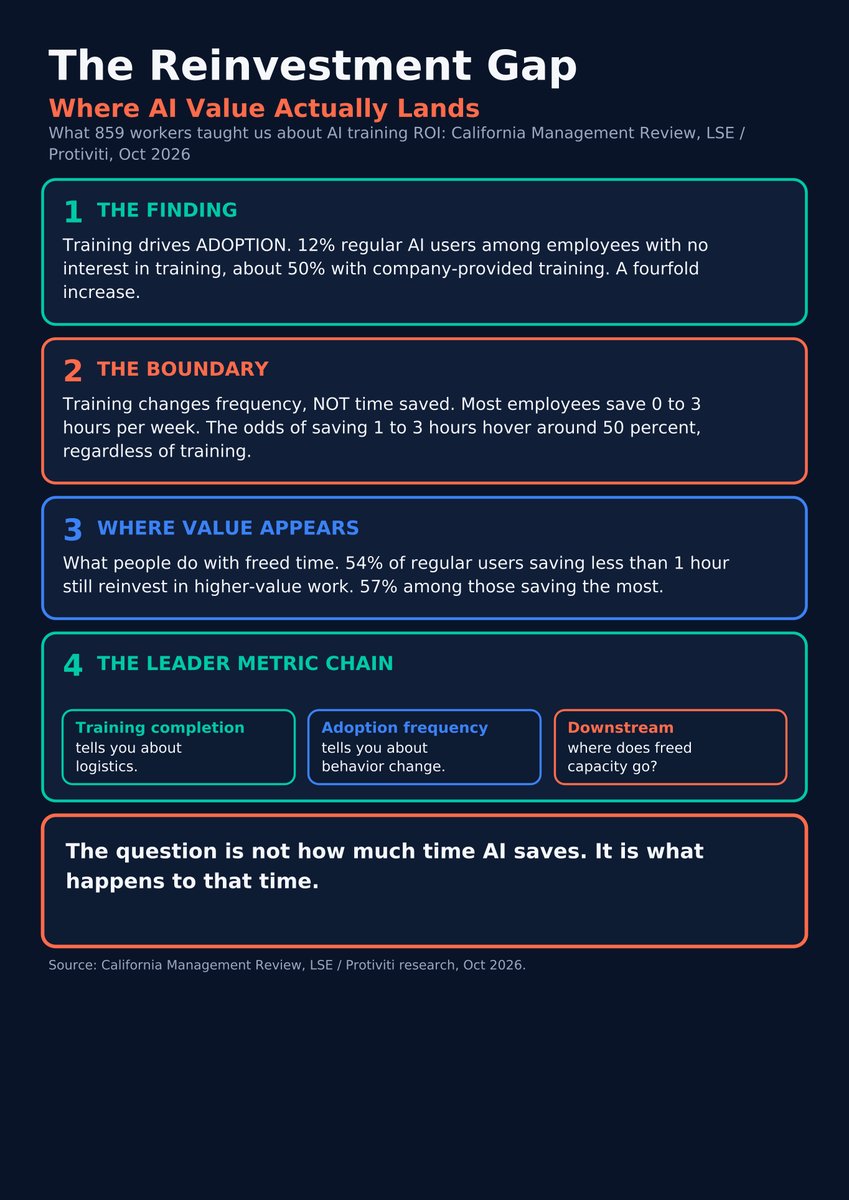
Your AI training worked. Adoption quadrupled. So why is nobody saving much time?
A new California Management Review piece from the LSE and Protiviti research team surveyed 859 workers on where AI training actually pays off.
The good news first. Training works. Among employees with no interest in AI training, only 12 percent became regular users. With company-provided training, about half did.
But training barely predicts how much time people save. Most saved 0 to 3 hours a week, and daily users saved barely more than occasional ones.
So where does the value show up? In what people do with the time.
Employees who reinvested their freed time into higher-value work got the real return, even when they saved less than an hour a week. The researchers call it the reinvestment gap.
Closing it is a design problem, not a procurement one.
If you lead training, the metric that matters is not completion or even usage. It is where the freed capacity goes.
I put the key findings into a one-page guide below.
Where is your team's freed-up time going right now?