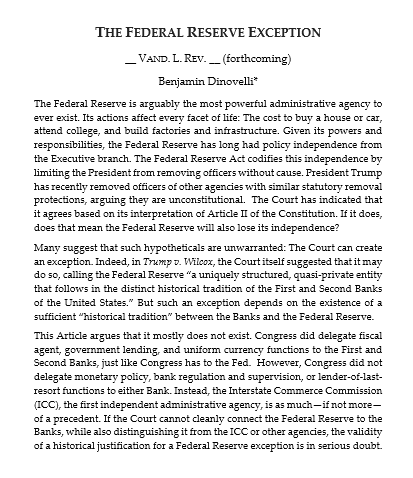
Happy to share that my paper, The Federal Reserve Exception, is forthcoming in @VandLRev!
I question the strength of the Supreme Court's analogy of the Federal Reserve to the First & Second Banks, especially when it is compared to the ICC and 20th century regulatory agencies.
@MichaelGiberso3@CBLROnline@SSRN The story is more complicated than I could fit into the abstract. In the paper, I talk about how utility regulation and the Rural Electrification Administration (which imposed utility-like service requirements on the coops) both played a role in closing the electrification gap.
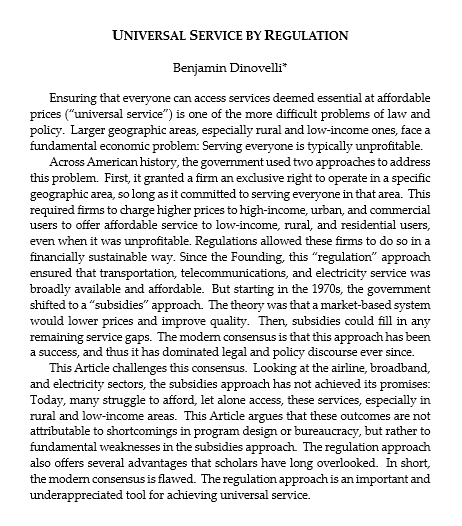
Excited to share that my latest paper, Universal Service by Regulation, is forthcoming in Columbia Business Law Review (@CBLROnline)!
The abstract is below. I need to revise it for recent developments. So it's not on @SSRN yet. Please reach out if you'd like the latest draft.
In addition to his contempt for democracy and egalitarianism, Yglesias' right-wing take reveals historical ignorance. The United States achieved universal electrification because this technical subject became the stuff of popular politics in the 1920s, 30s, and 40s.
@mattyglesias@MattBruenig Not here to defend the old CAB system but even so ... there are tradeoffs. AI tells me the best evidence is that deregulation lowered average fares by 20%. But a signif. portion of this was from reduction of service to smaller communities. Can view that as socially costly.
It's a banal point but competition is often dysfunctional in network industries and the more dysfunctional it is, the more likely it is that economic regulation (which has both advantages and disadvantages) may compare favorably.
If politicians want to deliver on their affordability promises, they'll need to actually drop prices in a few markets. In a paper out today and covered by the AP, I propose they take up property insurance, where prices are $150 billion too high. A thread.
https://t.co/vhhGnXcW09
Happy to share that my paper, The Federal Reserve Exception, is forthcoming in @VandLRev!
I question the strength of the Supreme Court's analogy of the Federal Reserve to the First & Second Banks, especially when it is compared to the ICC and 20th century regulatory agencies.
Excellent new piece on @ProMarket_org by @KateMConlow on the rampant conflicts of interests among academic economists. Would add that this issue isn't endemic to economics, it's multidisciplinary problem.
https://t.co/ujW8wHBxGm
For months, financiers, policymakers, & technologists have warned about an AI bubble as trillions in investment chase billions in revenue. But almost no one is asking what to do after it bursts. My new paper lays out how a crash might happen & bold proposals for after the crash.
Academics at Vanderbilt Law have a blunt message: lawmakers should begin preparing now for a potential AI-driven shock, rather than scramble to piece together a response after the fact
Today’s MM top from me and @YasminKhorram
https://t.co/GA5wgUYA0v
@NatPurser Agreed. But BEAD also limits judicial review (APA doesn’t apply + IIJA specifies a very deferential stnd of review). So unfortunately it’s not an entirely straightforward case
New paper alert!
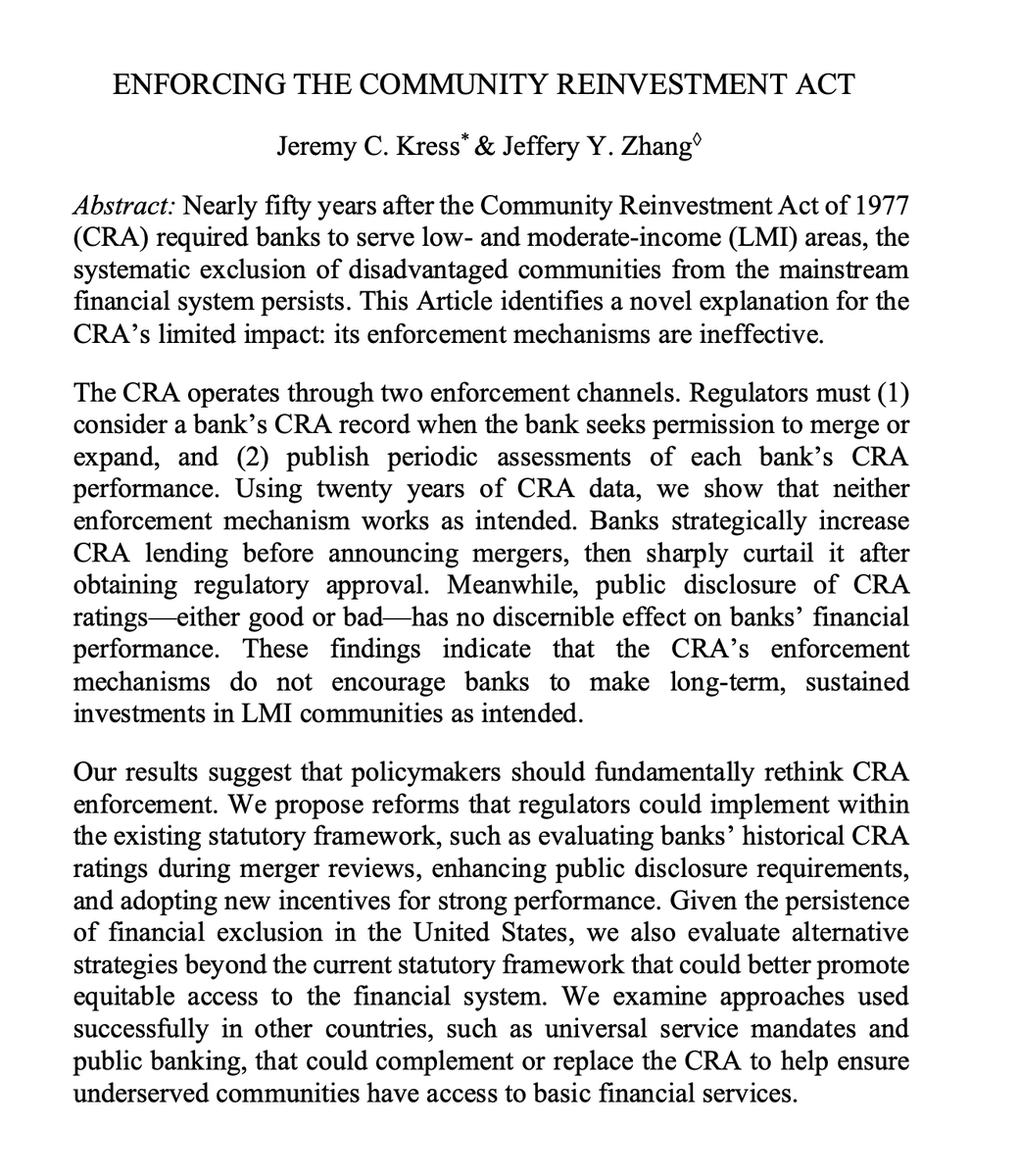
My latest, "Enforcing the Community Reinvestment Act," w/ Jeff Zhang is forthcoming in @WashULRev.
TL;DR: Using 20 years of data, we find that the CRA's enforcement mechanisms do not incentivize banks to invest in low-income communities.
https://t.co/rhGG22Mkek
@beau_baumann@dilanesper Totally agree. I should’ve worded a better. I meant to convey that it’s bad when the Court uses incorrect logic as a general matter (not about how the institution is polling). And to your point, that means we should call a spade a spade