Even Arab leaders admit it.
Everyone is sharing the Bill Clinton clip where he describes how Yasser Arafat rejected a generous peace offer at Camp David that would have given the Palestinians a state on 96 percent of the West Bank, land swaps, and a capital in East Jerusalem. Clinton says Arafat lied to him and that the Palestinian leadership never actually wanted a two-state solution. They wanted to destroy Israel. It’s a video often shared by people like @VividProwess, and it’s an important one for people to see.
Of course, critics immediately dismiss it. They claim Clinton is biased or he’s pro-Israel. They’ll tell you that you cannot trust the American perspective.
Ok, so let us set that aside.
Now watch this.
In this powerful interview, former Egyptian President Hosni Mubarak, a major Arab leader who was directly involved in negotiations, says exactly the same thing from the Arab side. He talks about the Mena House Conference in Cairo as well as the Camp David negotiations of 1978. All failed because of the Palestinians repeatedly rejecting any offer. The Oslo accords were signed but because Hamas and the Palestinian Islamic Jihad were not involved, they derailed the accords and any chance for peace by initiating 4 years of terrorist suicide attacks in Israel. Then came the second Camp David negotiations in 2000 which Arafat agreed to, then rejected and instead initiated the Second Intifada.
Mubarak explains how the Palestinians refused to even participate in the Mena House conference of 1977. He describes repeated opportunities they were given, including a detailed document that called for Israeli withdrawal from the Samaria, Judea and Gaza, security arrangements during a transitional period, and other major concessions. The Israelis were willing to negotiate on difficult issues like who would control security. The Palestinians, according to Mubarak, kept saying no and wasting chance after chance.
He speaks with clear frustration about how for decades the Palestinian side has rejected peace initiatives and realistic compromises.
The video further shows footage from the PLO representative in 1977, as well as old footage of Egyptian president Sadat who was involved in the Mena House and first Camp David negotiations of 1978.
This perhaps is far more impactful than Clinton’s account because it is not a Western or Israeli voice. It is prominent Arab leaders who lived the negotiations, who represented the broader Arab world, and who had zero incentive to defend Israel.
When leaders from both sides of the table describe the same pattern of Palestinian rejectionism and violence, it becomes much harder to dismiss as bias.
The pattern is clear across decades and across different voices… generous offers, repeated refusals, and continued demands for everything while giving nothing in return.
This is not ancient history. It is the core reason the conflict continues today.
If you value the truth, please share.
Endless aid money for Gaza? In countless Washington conversations about Gaza’s reconstruction, one thing has become unmistakably clear: attitudes and institutional thinking have barely shifted since the horror of October 7 and the devastation that followed. Too many policymakers and aid veterans still frame Gaza’s future as a matter of restoring large aid flows — a technocratic problem of resource allocation — rather than confronting the deeper failure of the NGO, charity, aid, and development industries that entrenched Hamas’s rule for two decades and helped set the conditions for October 7.
It is astonishing that many of the same personalities who profited from “developing” Gaza now expect to return as architects of its recovery. At a recent think‑tank event, I met one such figure — someone who oversaw vast reconstruction contracts and whose negligence enabled Hamas to divert enormous quantities of materials into its tunnel network. This individual casually remarked that “aid should be restored to pre‑war levels, and that should be enough,” revealing a mindset concerned only with reviving their personal fiefdom, not rebuilding Gaza.
Under Hamas, every NGO operating in Gaza had to register first with the Palestinian Authority in Ramallah and then with Hamas in Gaza. Hamas demanded board lists, funders, staff names, and full financial transparency — and assigned an internal security officer to monitor each organization. International NGOs complied with these requirements, even as those same NGOs refused similar requests from the Israeli military after the ceasefire. Compliance with Hamas became the price of doing business.
Meanwhile, the sheer volume of aid flowing into Gaza allowed Hamas to survive financial sanctions and maintain multiple revenue streams — from the PA, the UN, Qatar, Iran, local taxation, and the group’s own foreign donors. Add to this the sprawling ecosystem of international NGOs, and the outcome was predictable: no sustainable development, no equitable distribution of aid, no functioning institutions, and no pathway to peace.
Instead, aid became a welfare system that trapped Gazans while enriching an industrial complex of NGOs, consultants, Hamas operatives, and a compromised civil society incapable of resisting Hamas’s diversion of billions toward tunnels, weapons, and preparations for October 7 — all in violation of humanitarian neutrality.
Gaza’s reconstruction cannot rely on the same apparatuses, personnel, systems, or approaches that failed so catastrophically. Repeating them will simply allow Hamas to reconstitute itself and ensure that radicalization persists, while Gaza remains stuck without transformation, cultural renewal, economic revival, strategic reinvention, or a viable future in the region.
There is a claim that keeps circulating, presented as sophisticated analysis: antisemitic violence is caused by Israel’s actions. If Israel behaved differently, Jewish communities around the world would somehow be safer. This argument is not analysis. It is a moral inversion. And it collapses the moment you apply it consistently.
When China imprisons Uyghurs, does anyone warn Muslim communities in Paris to expect attacks? When Russia invaded Ukraine, did anyone tell Russian restaurants to brace for violence? No. Never. The causal chain between a government’s actions and violence against a diaspora is only ever constructed for Jews. Every other minority is extended the basic moral courtesy of being treated as individuals rather than proxies.
Now look at what the data actually shows. The SPCJ, which tracks antisemitic incidents in France in coordination with the Interior Ministry, has documented a consistent and damning pattern: it is antisemitic violence that inspires more antisemitic violence, not Israeli policy. After Mohamed Merah murdered Jewish children at point-blank range at the Ozar Hatorah school in Toulouse in 2012, antisemitic acts surged by 200%. There was no Gaza operation. No Israeli military action. The massacre of Jews in France produced more attacks on Jews in France.
The same logic held after the Hypercacher attack in January 2015: antisemitic acts increased by nearly 300%. Massacres of Jews do not shock antisemites into restraint. They embolden them. They signal impunity. They normalize hatred. And everyone in a position of responsibility knows it.
Which brings us to October 7. From the day of the Hamas attack, antisemitic acts in France increased by over 1,000%. A daily average of approximately 25 antisemitic acts was recorded in the 30 days that followed, reaching nearly 40 on some days. In the three months after the attack, the number of antisemitic acts equaled those recorded over the previous three years combined.
And here is another detail that makes the “Israel causes antisemitism” argument impossible to sustain: the spike began on October 7 itself, the very day of the attack. Israel had not yet responded. Not a single soldier had entered Gaza. Interior Minister Darmanin sent an urgent message to prefects that same day asking them to immediately reinforce protection of Jewish community sites. Synagogues. Schools. Community centers. By October 10, 10,000 police officers had been deployed to protect 500 Jewish sites across the country.
Before any Israeli response existed, the French government already knew that Jewish communities needed protecting. Not because of what Israel was about to do. Because of what had just been done to Jews.
Antisemitic violence has one cause. Antisemitism.
A few days ago, the IDF chief of staff, Eyal Zamir, spoke at a military conference and slammed the serious discipline issues and the erosion of professional conduct by Israeli soldiers throughout the multi-front wars in recent years. He decried the behavior that soldiers were capturing themselves on cameras and sharing on social media, including unnecessary destruction, looting, wearing incendiary patches, making offensive statements, and much more – all of which he described as a “rebellion” against the army’s values. While he acknowledged the context of the incidents as the “product of a long and complex period,” referring to the wars following the October 7, 2023, attack, he stressed that this “does not justify them” and that the IDF must not compromise on its values, cautioning that the “erosion of norms could be no less dangerous than operational threats.”
What’s noteworthy about Zamir’s remarks is that he is acknowledging the terrifying scale at which these “incidents” keep happening, signaling that there’s a systemic problem far worse than a few bad apples. He has long warned about the military's exhaustion, which is overstretched, suffering from a manpower shortage and fatigue, and has never had to fight at such a sustained, continuous rate of deployment. I share this because, unfortunately and predictably, anytime an incident comes to light showcasing horrific behavior by IDF soldiers, many are quick to jump to “whataboutism” or to dismiss this behavior as something isolated and would be addressed by an internal investigation. What many who may describe themselves as being “pro-Israel” may struggle with grasping is that the scale of the problem is not fixable by simply promising to investigate individual transgressions and violations; you also cannot bury your head in the sand and say, "What about Hamas, or what about Hezbollah, or Iran.|
The solution is to relieve soldiers from extended deployments; reset expectations across the IDF as far as ethical behavior and rejuvenate the commitment to professional conduct; institute operational security measures like the US and other armies and forbid personal phones and social media activities while on duty; institute serious consequences far beyond army service for violators whose action compromise Israel’s global standing; and offer transparency with investigations and their outcomes.
But insisting on hollow slogans that purport unmatched moral supremacy of the IDF while the entire world is taking notice is neither effective nor does it contribute to solving a serious problem that may change Israel’s character forever.
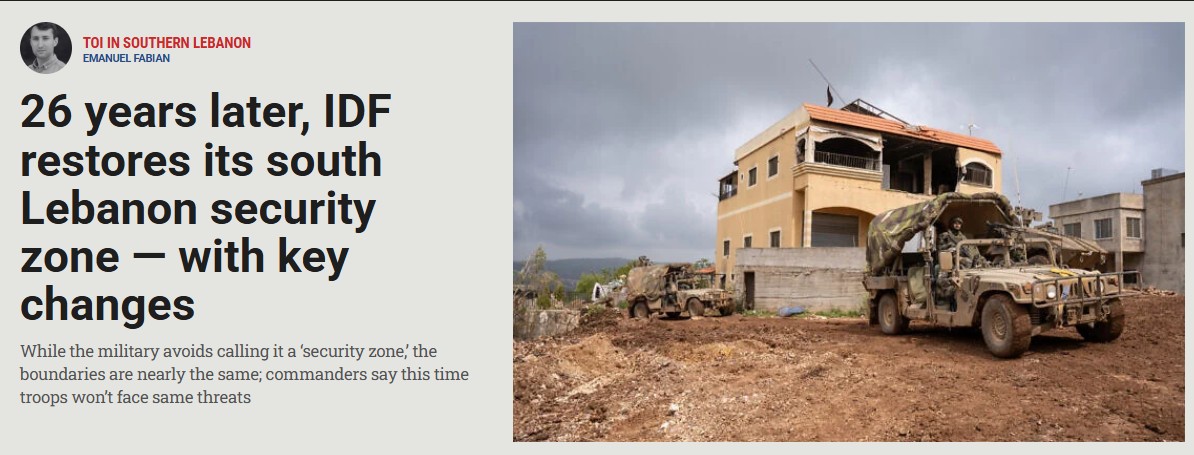
Israel is back in control of southern Lebanon 26 years after it left in 2000, just as Israel is back in control of the Gaza Strip 21 years after it left it in 2005. This control, military occupation, or whatever you want to call it, is the direct result of irresponsible and criminal decisions made by Hezbollah and Hamas terrorists who failed to leverage newly acquired freedom and territories in pursuit of nation-building, sustainable futures, and peace. “Resistance” was not only a slogan, but it became an industrial complex, with money, narratives, propaganda, foreign interference, and terror infrastructure.
Even if you believe in resistance, that should have stopped in Lebanon after 2000, and it should have stopped in Gaza after 2005 – the whole point of resistance is to no longer live under a direct military occupation. What kind of pathetic, ill-conceived, unintelligent, and moronic resistance invites the occupation back into one’s country decades later, causing complete and utter devastation? This is further proof that Hezbollah and Hamas, while made up of and endorsed by many in Lebanon and Palestine, were never truly organic to their respective societies and only existed as tools for foreign agendas, masters, and enablers.