Your career is your most important decision. Especially for your impact.
But most career advice sucks, so millions waste it.
I’ve spent 15 years researching how to find the best career.
This book sums up everything I’ve learned. It feels like my life’s work.
And it’s out now.
I see 7 actual updates relevant to AGI timelines this year:
1. Exploding revenue and GPU rental $
2. METR time horizons saturate
3. The Mythos 'jump'
4. Sparks of RSI
5. AI still sucks at business
6. AI makes some math breakthroughs
7. Inference scaling remains cheap
I wanted to understand whether these things truly show what people think they show, and how they should affect my timelines, so I made this video.
On balance my timelines have contracted about 1 year since last December.
IMO these are the 4 topics that most split AGI bulls from bears:
1. What skills are needed for RSI
2. Whether AI still lacks crucial skills in areas with poor feedback density
3. Whether RLVR will generalise to messy domains
4. Whether RSI will produce a positive feedback loop
It's no surprise people disagree about this stuff as there's little public evidence to settle them either way.
On the 80,000 Hours Podcast, links below. Enjoy!
@incredutility@EthanAlley In theory you can have a bubble entirely in earnings rather than valuations but the norm seems to be rapidly expanding valuations.
@EthanAlley Exactly, the analysts are essentially predicting one more year of growth and then a plateau. If growth stops now, it's still cheap. If the boom continues beyond the next year it looks extremely cheap. Of course if there's a big AI revenue crash now it would fall a lot.
Interesting.
Situational Awareness says that even after including its July losses, the fund is still up about 80% year to date.
The letter also reportedly blamed short sellers who were targeting the firm.
@mbwheats SMH is only up 45% YTD, so naive ~2x SMH theoretically gets you to +90%, but you would have been margin called in the draw downs so would have ended up below that
Many are confusing:
1) AI is much worse at hard-to-verify tasks
2) AI is improving much more slowly at hard-to-verify tasks
(1) is true. (2) we don't know, but my read of the available evidence suggests it's false.
There's been a talk about how LLMs are only advancing in verifiable areas like math or coding, but that isn't what the data suggests.
As models have gotten better at that, they are also better at solving business cases in unbounded fields, generating ideas, medicine, law, etc.
@LepoulpePoulpo Fair but that's also good stock selection Vs OAI, and also good identification that frontier software revs would grow faster than broad semis.
@kartographien Recovering the July losses requires a 3x return, so it's not trivial even at their previous rates of return, and they're now using less leverage.
And they now appear to have billions of dollar of cash from the Citadel sale, plus their entire private book in tact. It would not be surprising if losses were recouped within a year or so.
No, they might have started from different bases, or have different absolute difficulty levels.
E.g. maybe open ended strategy requires 10^29 FLOP of training compute to unlock, and coding only requires 10^27.
Coding arrives ~4 years earlier, but they're both improving at approx the same rate.
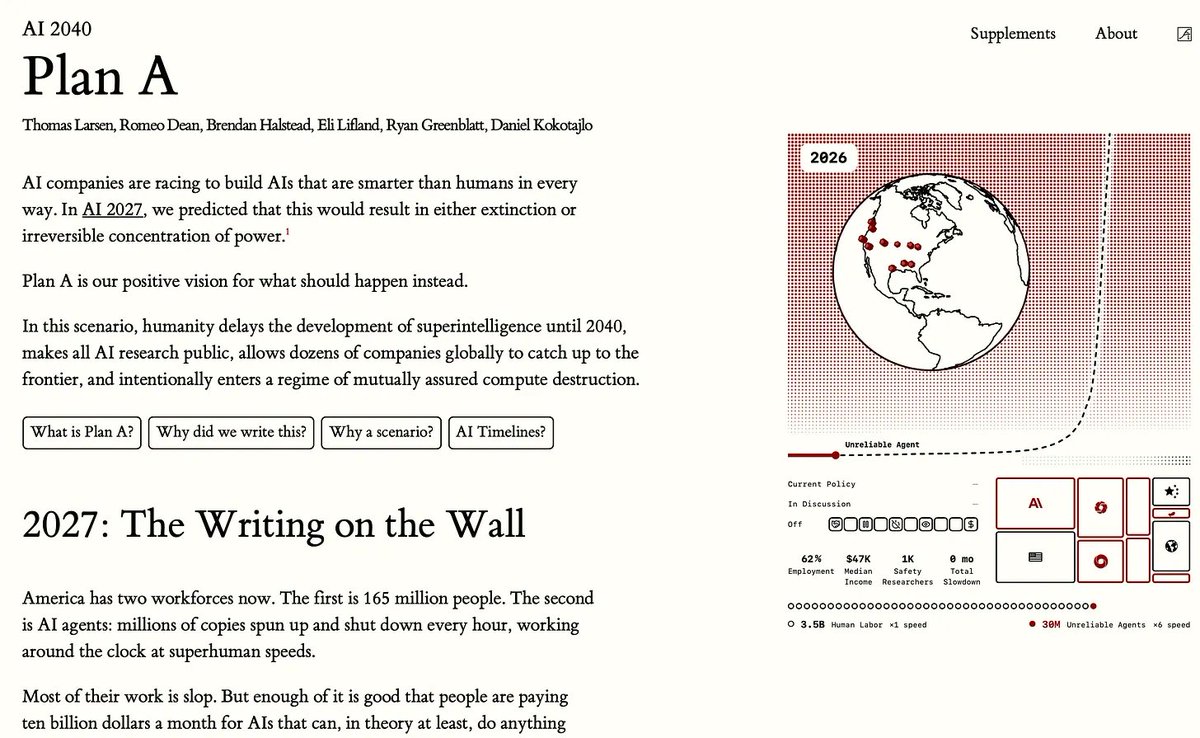
We're over $1 trillion into the AI build out, and this is the best we have for a concrete vision of what'll happen and what to do about it. Insane situation.