Shape the future of healthcare by sharing what everyone else is afraid to say.
This is the space for real conversations.
Join me: https://t.co/XDwLamEcx7
Code: UQTLEEA
#LifeAITestnet#HealthcareAI
🚀 Only 500,000,000 AVN Reserved for Miners!
Half of the total supply is dedicated to the community — and once it’s mined, it’s gone.
⛏️ Don’t waste time.
🔥 Mine daily.
👥 Invite your squad.
💎 Grow your AVN balance before it’s too late.
The early miners always win.
Join Aventra Network now and secure your share of the 500M AVN mining pool!
#Aventra #AVN #Airdrops #Binance
🩺 Community Question:
Elon Musk recently said that, based on current human constraints, AI-powered robotics could become better surgeons than the best human surgeons within three years at scale.
Do you agree with him?
Viewpoint A:
Agree. With few great surgeons, slow and costly human training, and unavoidable human error, AI and robotics could learn faster and scale surgical skill beyond human limits.
Viewpoint B:
Disagree. Even acknowledging the human constraints Elon Musk points out, surgery is not only about speed, scale, or error reduction. It also depends on judgment, responsibility, and trust in high-stakes situations, which remain difficult to validate and deploy safely at scale.
Is this a near-term breakthrough or a vision that overestimates how quickly surgical autonomy can be safely scaled?
👇 Drop A, B, or share your perspective.
🩺 Community Question:
Elon Musk recently said that, based on current human constraints, AI-powered robotics could become better surgeons than the best human surgeons within three years at scale.
Do you agree with him?
Viewpoint A:
Agree. With few great surgeons, slow and costly human training, and unavoidable human error, AI and robotics could learn faster and scale surgical skill beyond human limits.
Viewpoint B:
Disagree. Even acknowledging the human constraints Elon Musk points out, surgery is not only about speed, scale, or error reduction. It also depends on judgment, responsibility, and trust in high-stakes situations, which remain difficult to validate and deploy safely at scale.
Is this a near-term breakthrough or a vision that overestimates how quickly surgical autonomy can be safely scaled?
👇 Drop A, B, or share your perspective.
💊 Community Question:
Can AI help discover and develop new medicines much faster and cheaper than traditional methods?
Viewpoint A:
Yes. AI can rapidly test millions of drug ideas, cut early research time and costs dramatically, and in some cases bring medicines to patients years faster.
Viewpoint B:
Not fully. AI helps at the start, but human trials are still slow, expensive, and unpredictable, keeping overall drug development costly and time-consuming.
If AI is expected to change how medicines are made, is the impact already real or mostly promise?
👇 Drop A, B, or share your perspective.
💊 Community Question:
Can AI help discover and develop new medicines much faster and cheaper than traditional methods?
Viewpoint A:
Yes. AI can rapidly test millions of drug ideas, cut early research time and costs dramatically, and in some cases bring medicines to patients years faster.
Viewpoint B:
Not fully. AI helps at the start, but human trials are still slow, expensive, and unpredictable, keeping overall drug development costly and time-consuming.
If AI is expected to change how medicines are made, is the impact already real or mostly promise?
👇 Drop A, B, or share your perspective.
🩺 Community Question
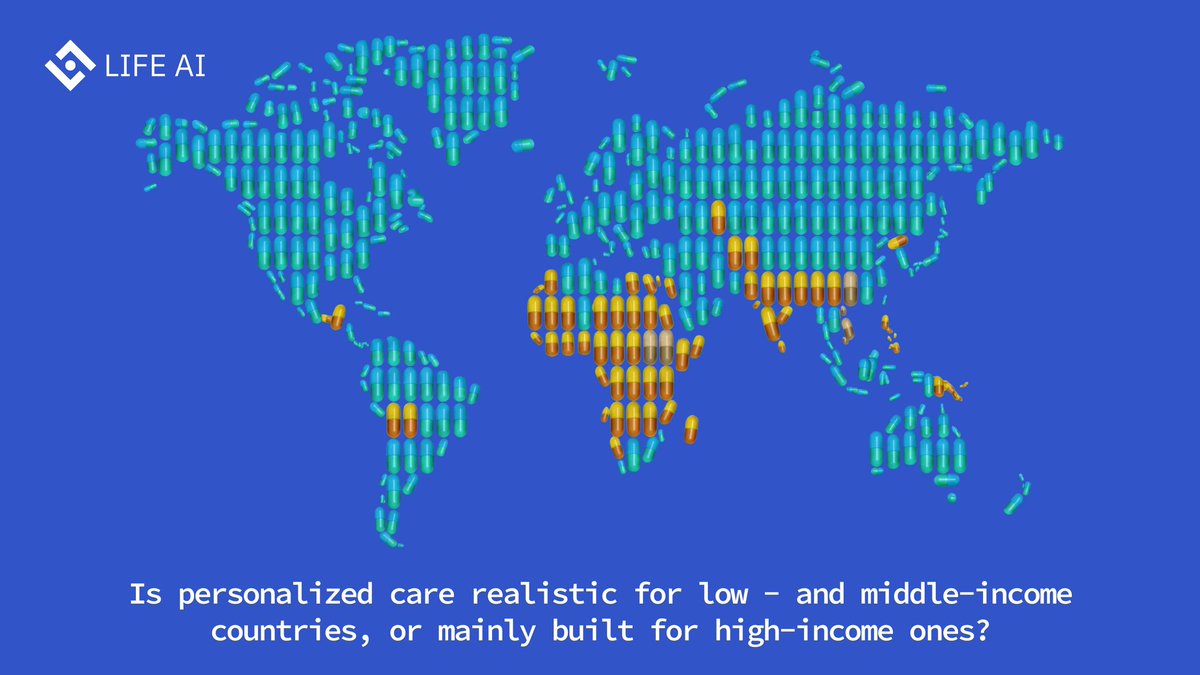
Is personalized care realistic for low- and middle-income countries (LMICs), or is it still a model built mainly for high-income countries (HICs)?
Viewpoint A: Gradually achievable in LMICs
Personalized care can scale over time. Costs of genetic and digital tools are falling, AI-driven insights are becoming more accessible, and hybrid models already work in areas like oncology and chronic care. With the right partnerships and focus, personalization doesn’t have to remain a luxury.
Viewpoint B: Not practical for most LMICs
For many LMICs, personalized care remains unrealistic. High costs, limited infrastructure, workforce gaps, and unequal access make large-scale adoption difficult. Healthcare systems should prioritize proven, low-cost interventions like vaccination, screening, and basic prevention.
Or is the future of healthcare built by combining both approaches?
👇 Drop A, B, or share your perspective.
Tag someone who should weigh in on this.
Some people call it healthcare. Others call it sickcare. Either way, it needs rethinking. Your lived experience counts more than experts admit.
Join me and debate with @LifeNetwork_AI: https://t.co/XDwLamEKmF
Code: UQTLEEA
#LifeAITestnet#HealthcareAI
Your voice can earn by showing what healthcare should feel like, not just how it works.
Let's talk about the human side.
Jump in and discuss: https://t.co/XDwLamEKmF
Code: UQTLEEA
#LifeAITestnet#HealthcareAI
Healthcare isn't just science, it's culture, habits, lifestyle, emotions.
Why do systems forget that?
Discuss and earn on @LifeNetwork_AI: https://t.co/XDwLamEKmF
Code: UQTLEEA
#LifeAITestnet#HealthcareAI
Every person has a moment when healthcare felt complicated or out of reach.
Your voice can turn those moments into something meaningful.
Join me on @LifeNetwork_AI: https://t.co/XDwLamEKmF
Code: UQTLEEA
#LifeAITestnet#HealthcareAI