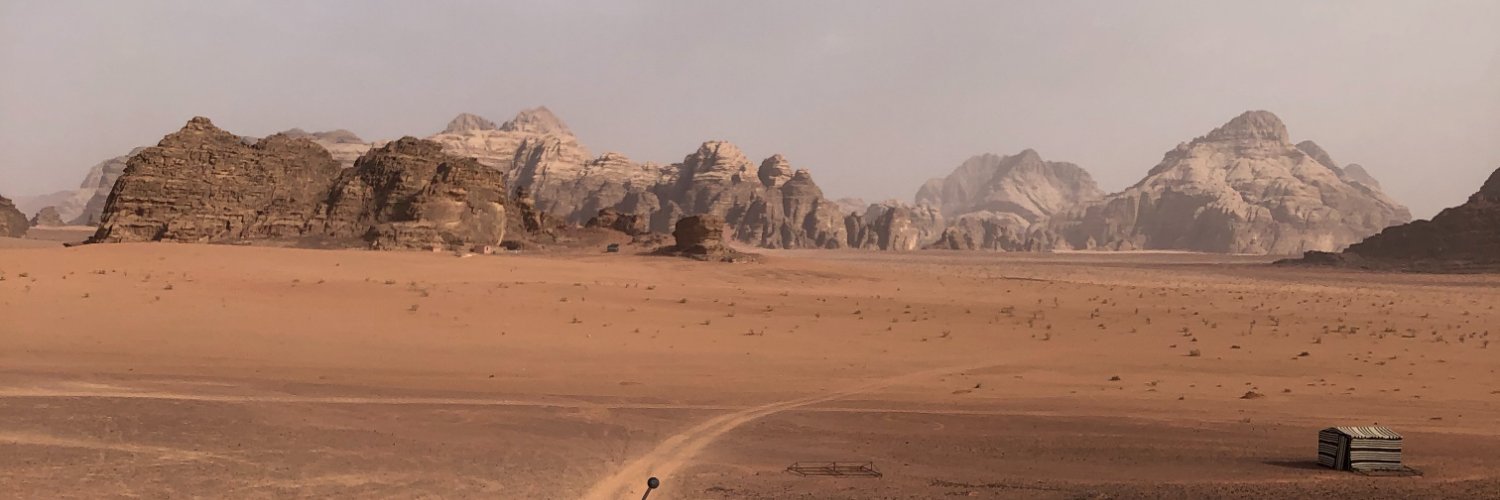
A year of precipitation anomalies in Syria
Is it raining more or less than usual? This year, it seems to be raining much more. Rain has been pouring down.
On the flip side, the money farmers are owed is only trickling in.
The consequences? Read: https://t.co/AczgY2ANVH
Part of my interview with @radwanziadeh on the UN's failure in Syria is now available in Arabic, translated by @DarFikr, the publisher of his new book.
ترجمت دار الفكر جزءاً من حواري مع الدكتور رضوان زيادة حول كتابه «فشل الأمم المتحدة في سورية».
https://t.co/4qImEdNye1
A year of precipitation anomalies in Syria
Is it raining more or less than usual? This year, it seems to be raining much more. Rain has been pouring down.
On the flip side, the money farmers are owed is only trickling in.
The consequences? Read: https://t.co/AczgY2ANVH
The opposition was always described as too divided to negotiate. Dr @radwanziadeh argues the UN’s own envoys helped divide it through the Moscow, Cairo and Riyadh “platforms.”
From our interview on his new book: https://t.co/qC5L1eJ4Qn
“Look with favor on the merchants in the land […], for through their trading the land becomes prosperous, […] and by them wealth within the land is increased.”
in The Ottoman Empire: Sultan, Society, and Economy.
Radwan Ziadeh on the UN’s Failure in Syria, the Cost of Inaction, and the Case for a New Beginning
On a paralysed Security Council, envoys who bent with the times, the red line that became a green light, an aid system Assad learned to exploit, and the apology Syrians are still waiting for
https://t.co/ksUl8O512R
The Syria Dispatch's added value? Helping you understand developments like this one.
That’s why subscribing keeps you ahead of the curve and sharp on Syria.
Do it. It’s free (until I cave to the people who keep telling me to paywall it 👀)
https://t.co/q4gBvoOKFR
Good news for Syria’s cement sector: yesterday, the foundation stone was laid in Jisr al-Shughur (Idlib) for a privately funded plant being built by Diyan Cement. Reports put the investment at $230–300m and capacity at around 10,000 t/day (≈3.6m t/year), with production expected within 18 months.
https://t.co/jPpcnR6VTa
It’s one of the largest investments to move forward in Syria to date, and I find it quite interesting that we hadn’t heard anything about it before. I suppose that’s because the project is fully owned and led by the private sector, with no state partner?
Once running, it would be the second private cement plant in operation in Syria (after Al-Badia Cement (((ahem, let’s not talk about Lafarge)))).
The sequencing of the plant’s activity is quite interesting, given that the first phase is a grinding mill running on imported clinker, with kilns (which produce clinker, the base material for cement) installed in parallel.
(This makes total sense given what I explained in The Syria Dispatch last month: https://t.co/Hn0VyY2AgR)
And sure, a new cement plant is welcome given the needs and the lack of local production (also covered in The Syria Dispatch). But until those kilns are running, the plant only swaps cement imports for clinker imports, and clinker imports are already rising fast: partner-country data show at least 800,000 t shipped to Syria in Jan–Aug 2026, more than in any pre-war year.
Clinker is extremely power-hungry (70–78% of a cement plant’s energy use). At current electricity and fuel prices, importing it is cheaper than producing it (which is why Omran stopped making its own clinker this year).
Diyan seems to know this, since the project includes its own thermal power plant. For the sector as a whole, though, real import substitution and solid margins depend on cheaper electricity.
More on why Syria is rebuilding with imported clinker 👇
https://t.co/Hn0VyY2AgR
6/6 None of this means Syria should turn its back on the UN. Damascus needs it to deal with the destruction Assad left behind, Radwan argues, but the UN first has to face up to its record.
Both sides need “a new beginning.”
Full conversation:
https://t.co/qC5L1eJCFV
1/6 I sat down with Dr @radwanziadeh to talk about his new book on the UN’s failure in Syria, an idea he first sketched in an article back in 2018.
We ended up covering sieges, aid, Washington, and whether the UN can ever win back Syrians’ trust. 🧵
5/6 The book launched in Damascus a week after the UN Secretary-General’s visit, and Radwan opened by saying Guterres should have apologised to Syrians.
Its keenest readers since then? UN officials, while former UN staff keep writing to him with their own stories.
@HarrisAdam5904 He kept it updated until September 2026 at least :)
I might be French, but given your handle (even though I’m convinced you’re a bot), you’re not in a position to assume things people ‘in Syria’ do or not do :)
Syria’s new Economy Minister, Rawad Ramadan, is taking on his SEVENTEENTH CONCURRENT position, according to his LinkedIn profile.
His roles span companies, investment firms and business councils, mostly in Türkiye.
And here I am, barely coping with two assignments at once...
Syria has a new Minister of Economy.
Nidal al-Shaar, who had held the post since March 2025, was replaced on November 5 by Rawad Ramadan, the current Director-General of the Syrian Investment Authority.
Under the presidential decree, Ramadan will retain his SIA position.
Happy to see my recent article on Syria-China trade and recent economic developments picked up by the media, the Arabic media Business2Business!
B2B Arabic article: https://t.co/NeWdDnTS1x
Original The Syria Dispatch piece: https://t.co/01A5E0xCJg
Absolutely exhilarated by this find in Syria: A map of Lebanon from 1860–1861 (revised in 1913 and 1915), originally drawn by the French expeditionary corps sent to Lebanon in the context of the Mount Lebanon massacres of 1860.
According to a quick Google search, this map was also used as a template for the borders of Greater Lebanon in 1920.
So much history on a single map, and I am geeking out! It really makes me want to reread Eugene Rogan's The Damascus Events, but this time, following the map closely.
Still, this map has suffered some serious water damage, which I'll need to have restored. In the meantime, it'll go into a nice frame.
If anyone has any idea what the red markings might indicate, let me know. Perhaps something related to post-WW1 deployments?
Oh, and a nice fun fact (but one that would have been almost too good to be true) is that I bought this map as an early birthday present to myself, my birthday being on November 8, which is almost (though not quite!) the same date as that of French General de Beaufort d'Hautpoul (November 9), who led the expedition to Lebanon and whose corps drew the map. Quite a coincidence!
#Syrie : ce que la paix coûte aux Syriens.
Entretien avec @BenjaminFeve , consultant et chercheur indépendant, spécialiste de l'économie syrienne et fondateur de The Syria Dispatch.
https://t.co/w6o0g57FKo