One Layer. All Chains. Zero Friction. Unlimited Scalability. Welcome to @FrameCommunity FRAME / @FrameCorporate @TheCryptoCo ✨ Jesus is King ✊ - @PureWalletPlus
📲 USER
A user taps send. No gas auctions, no mempool queue - the journey starts immediately.
🔐 PQ SIGN
Sealed with a Dilithium 5 post-quantum signature - secure even against quantum computers that don't exist yet.
🛣️ LANE
Assigned a lane by BLAKE3 hash. There is no public mempool - nothing to see, nothing to front-run, no MEV.
🤝 LANE BFT
Lane validators reach BFT consensus - while every other lane does the same, in parallel. Status: ADMITTED.
🎲 COMMITTEE
A committee of 60 randomly drawn validators verifies every transaction. The draw can't be predicted or gamed - validators commit their randomness before knowing their roles.
🔍 SPOT AUDIT
5+ independent spot auditors re-check the block against its header. Any fraud is provable within 300ms - and slashed.
🌍 GLOBAL BLOCK
Folded into the global block. Confirmed once - and that single confirmation is mathematically final. No reorgs, no waiting for 12 more. Total: 1.3 seconds.
@FrameCommunity@FrameCorporate@TheCryptoCo
https://t.co/vNRvq9ncnc
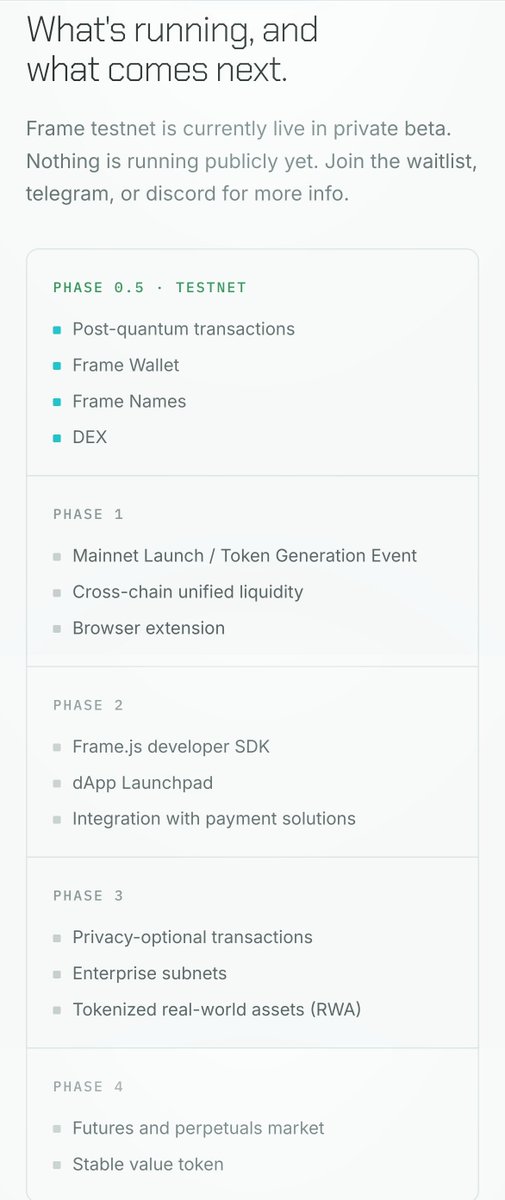
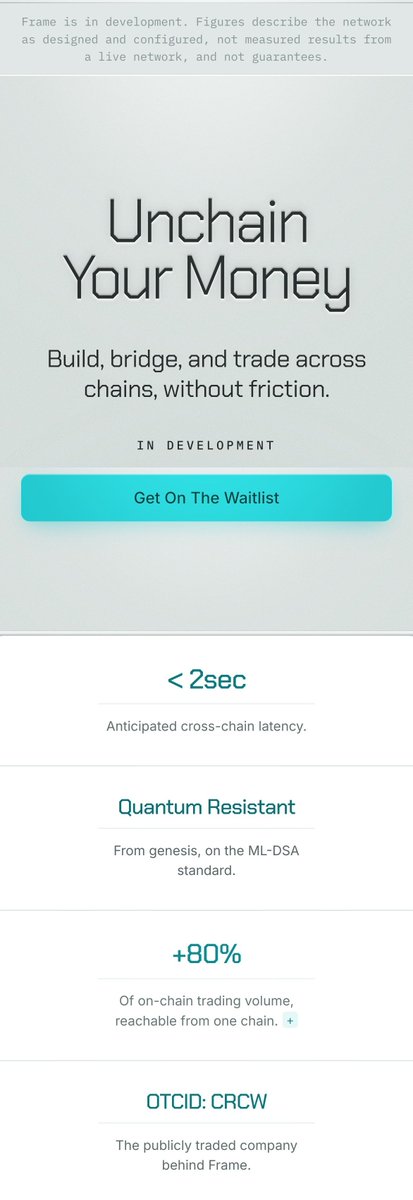
🚨 𝗠𝗮𝗷𝗼𝗿 𝗨𝗽𝗱𝗮𝘁𝗲: 𝗧𝗵𝗲 𝗼𝗳𝗳𝗶𝗰𝗶𝗮𝗹 𝗧𝗲𝘀𝘁𝗻𝗲𝘁 𝘄𝗮𝗶𝘁𝗹𝗶𝘀𝘁 𝗼𝗻 https://t.co/zPpWqZDl2y 𝗶𝘀 𝗹𝗶𝘃𝗲! 🚨
@FrameCorporate@FrameCommunity
Early access registration for the upcoming Frame Testnet and next-gen wallet infrastructure is officially open. A post-quantum Layer 1 built to unify a multichain world.
Key Highlights:
• Testnet Early Access: Register via the "Join Waitlist" button to secure your spot for the Testnet rollout.
• Institutional Steward: Officially backed and stewarded by The Crypto Company (TCC) | OTCID: CRCW.
• Speed & Cost: ~0.20s finality with < $0.001 transaction fees built for high-volume scale.
• Next-Gen Security: Built on hardened ML-DSA-87 post-quantum signatures.
• Unified Liquidity: Native cross-chain settlement designed to eliminate traditional bridge vulnerabilities.
• Enterprise Architecture: Dedicated subnets tailored for Banking, Payroll, Exchange, and Gaming.
Check the screenshots below. Secure your spot on the Testnet waitlist! ⏳👇
🔗 https://t.co/zPpWqZDl2y
#Crypto #Web3 #Blockchain #Quantum
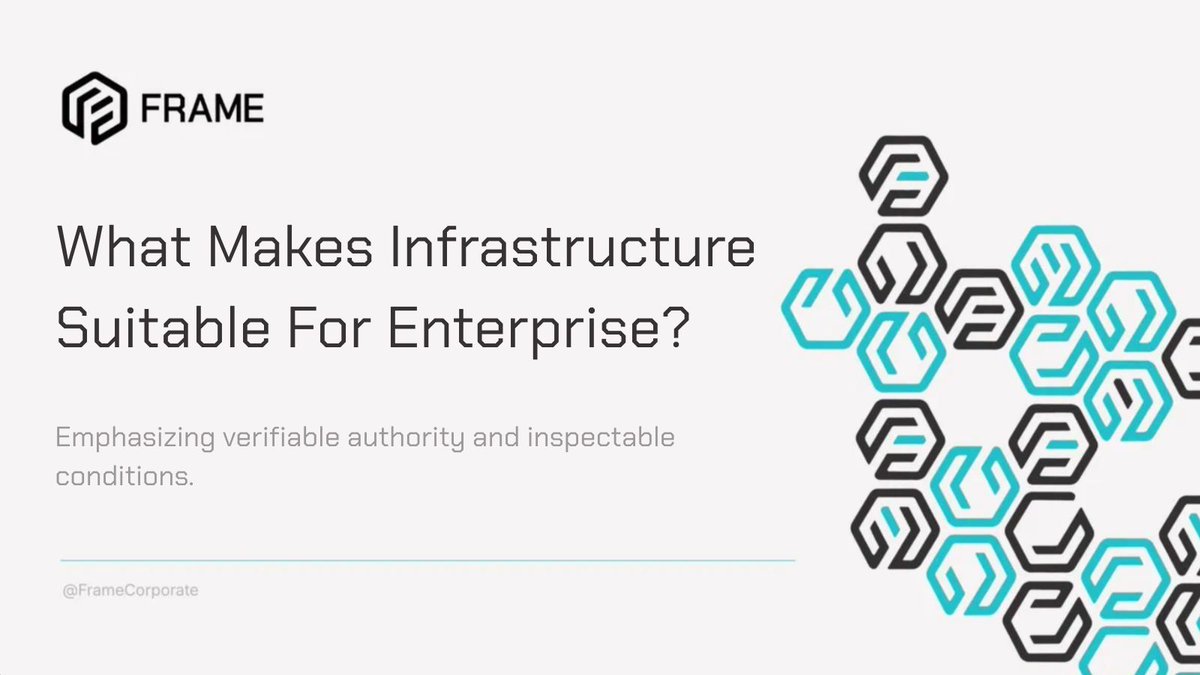
What might make an infrastructure layer more suitable for enterprise use?
Frame’s design is intended to emphasize verifiable authority, clear governance, and inspectable conditions.
#blockchain#Web3
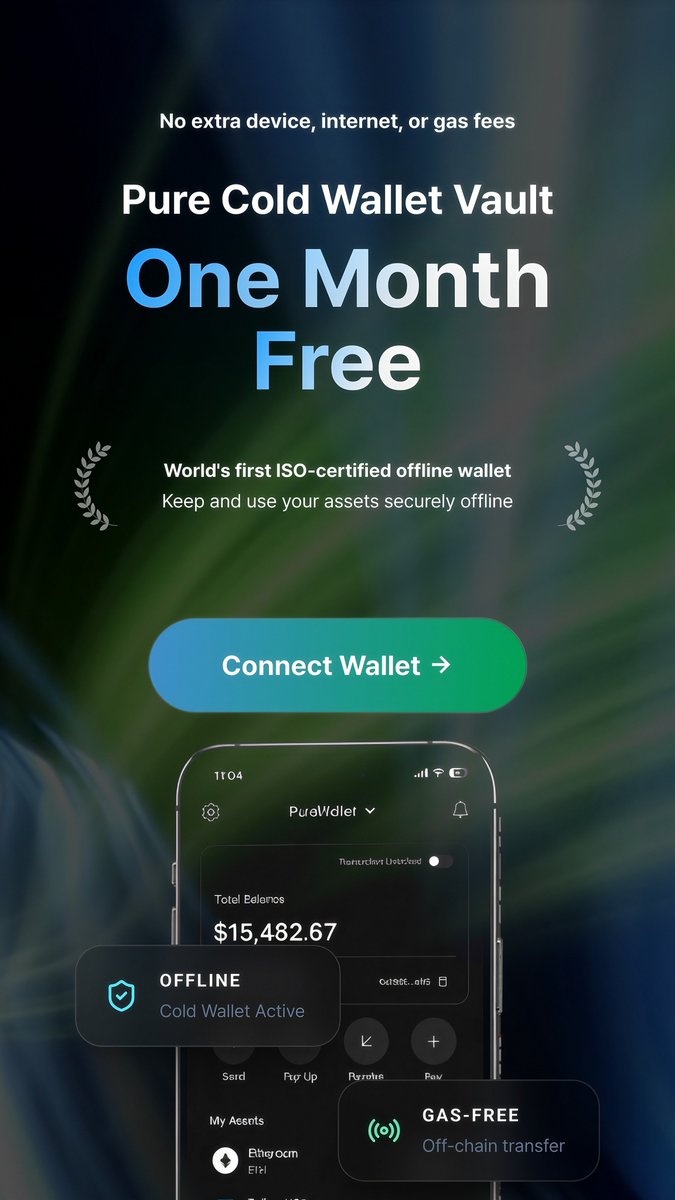
Transactions don’t have to stay online.
Pure Wallet introduces a new way to move digital assets — directly between devices, using QR or Bluetooth.
No internet connection. No network fees.
And yes, even Bitcoin.
Experience Offline Wallet on Pure Wallet.
Direct. Seamless. Offline.
Why consider separating network execution from local optimization?
Frame is being built toward an architecture intended to support stability as individual components scale.
#blockchain#Web3
Ethereum’s L1 & L2 Evolution: From Fragmentation to Unified Strength (2026 Update) By @LarryPureLabs
Over the past two years, Ethereum’s rapid L2 growth has raised big questions: Is L2 eroding L1’s core value? Is the network’s composability suffering from fragmentation?
The old model was clear — L1 handled security, settlement, and decentralization; L2s delivered low-cost, high-throughput execution. This division fueled massive scaling but created a fragmented multi-layer ecosystem.
Now, Ethereum is quietly rebuilding its architecture.
1. L1 Is Leveling Up — No Longer Just Settlement
Ethereum is breaking its conservative stance:
• Raising the gas limit
• Advancing stateless upgrades
• Implementing zkEVM verification
• Consolidating scaling efforts into a unified “Scale” system
L1 is boosting its own execution capacity while preserving decentralization and security. “Low cost + high throughput” is no longer L2’s exclusive advantage.
2. New Division of Labor
L2s are shifting focus:
• From pure scaling → differentiation (custom scenarios, native privacy, flexible governance, and economic models)
• L1 becomes the unified core hub: settlement, shared state, liquidity, and DeFi foundations
• L2s evolve into a spectrum — native rollups (max security), customized environments, and more independent compatible chains
L1 and L2 are now complementary, not competitive.
3. Solving Fragmentation: True Interoperability
Multi-L2 has scattered assets, accounts, and user experience. Ethereum’s 2026 focus:
• Account Abstraction (EIP-7702, EIP-8141) for seamless smart accounts
• Open Intent Framework (OIF) and Ethereum Interoperability Layer (EIL) for trustless, single-chain-like UX
• Faster L1 confirmations (tens of seconds) and accelerated finality (seconds-level goal)
The aim: Compress final state certainty, eliminate cross-chain friction, and deliver unified liquidity and composability.
4. The Big Idea: L1 as Its Own Rollup
With maturing zkEVM and real-time proofs, L1 is adopting Rollup-like mechanics:
• High-performance nodes execute transactions and generate proofs
• Light validators verify efficiently
This blurs traditional L1/L2 boundaries. Rollup architecture becomes a general model for execution + verification across the ecosystem — all sharing unified security and settlement.
The Future Vision
Ethereum is entering an “integration cycle”:
• Preserve scaling gains from L2s
• Reconnect fragmented assets, accounts, and apps
• Deliver high-performance, high-security, and high-uniformity for users
Users won’t need to worry about underlying layers. The ecosystem will feel unified while maintaining clear security boundaries and exit paths.
L1 won’t eliminate L2s, and L2s won’t replace L1. Instead, layered boundaries are dissolving into a stronger, cohesive Ethereum.
What do you think — is this the end of L1 vs L2 debates? 👇
#Ethereum #L2 #Rollups #Crypto #Blockchain #Web3
Shopify’s Big Move: USDC Stablecoin Payments via Coinbase & Stripe
By @LarryPureLabs
Shopify has partnered with Coinbase and Stripe to enable USDC payments on the Base network. Buyers can pay directly from supported wallets, while merchants receive funds seamlessly into their existing checkout and fulfillment systems.
Why This Matters for Merchants
• Faster, cheaper cross-border payments with reduced settlement friction.
• Irreversible transactions after confirmation — no more chargebacks weeks later like with credit cards, meaning more certainty once goods are shipped.
This feels like a win: fewer “refusals to pay” and simpler paths. But stablecoins don’t eliminate buyer-merchant disputes — they just change the mechanics.
New Opportunities = New Risks
Fraudsters adapt quickly. Wallet theft, phishing, malicious authorizations, and on-chain tricks can target e-commerce flows. Merchants must stay vigilant.
Key takeaway: Don’t treat payment methods in silos. Unified risk management is essential:
• Verify real buyers & authorized transactions
• Maintain clear order, logistics, and communication records
• Build strong on- and off-chain evidence chains for disputes, compliance, or reviews
Whether it’s credit cards, PayPal, or stablecoins — solid evidence and processes protect your business.
PureWallet’s Role in Secure Crypto Payments
In a world of growing stablecoin adoption, true security and control matter more than ever. PureWallet’s offline mobile cold storage (ISO 27001-certified) gives users gas-free P2P transfers via Bluetooth/NFC/QR and strong protection against online threats — perfect for safe, everyday crypto and stablecoin use.
PureWallet PWT Presale is LIVE (~$0.046) with TGE targeted for September 15, 2026. Position yourself for the offline crypto revolution — secure, accessible, and built for global commerce.
What are your thoughts on stablecoins in e-commerce? Drop them below 👇
#PureWallet #USDC #Stablecoins #CryptoPayments #Shopify
"A fair launch means nobody starts ahead of you."
That's how Sean opens his latest blog. No insiders on cheap tokens, or fund waiting to dump the second there's liquidity. Everybody walks up to the same starting line, and the network earns its way up from there.
Sean explains how we spent a year turning down venture money to protect that. The offers came with governance grabs, locked treasuries, and discounted tokens built to be offloaded onto the community. Frame said no to every one.
The structure that finally made a fair launch fundable was a public company. Its value lives in the growth of the business, not in an insider allocation to unload on retail. 📈