🌌 Advocate for humanity's future in space. 🚀 Once we're up there in a big way, the sky will no longer be the limit. Let's build a boundless future together!
24/7 webcams should be installed at all Archaeological sites around the world
1) We should all have a right to witness excavations. And, it would be awesome
2) It will mitigate black-market looting
3) It would be a win-win for Archaeologists and ancient history enthusiasts alike.
Archaeologists get to show off their work with a world-wide audience, and enthusiasts get to watch, learn, and enjoy the discoveries 🙌🏻
- It would also grow interest into the Field of Archaeology, and motivate more people to become Archaeologists
- Webcams are cheap and easy. Our entire society has cameras everywhere.
Besides, why wouldn’t we have them at sites containing extremely valuable ancient artifacts?
Who could possibly oppose having web-cameras at archaeological sites?
Hi Jimi,
I’ve been a big fan of your work for a long time — your content has been a real inspiration while writing my book.
I’m currently finishing Before the Flood, which explores evidence of advanced ancient civilizations, global networks, and how cataclysms may have disrupted earlier knowledge. In Chapter 8 (“Global Networks”), I discuss the striking similarities in polygonal masonry between Peru and Easter Island (especially Ahu Vinapu), and how this style also appears in parts of the Mediterranean.
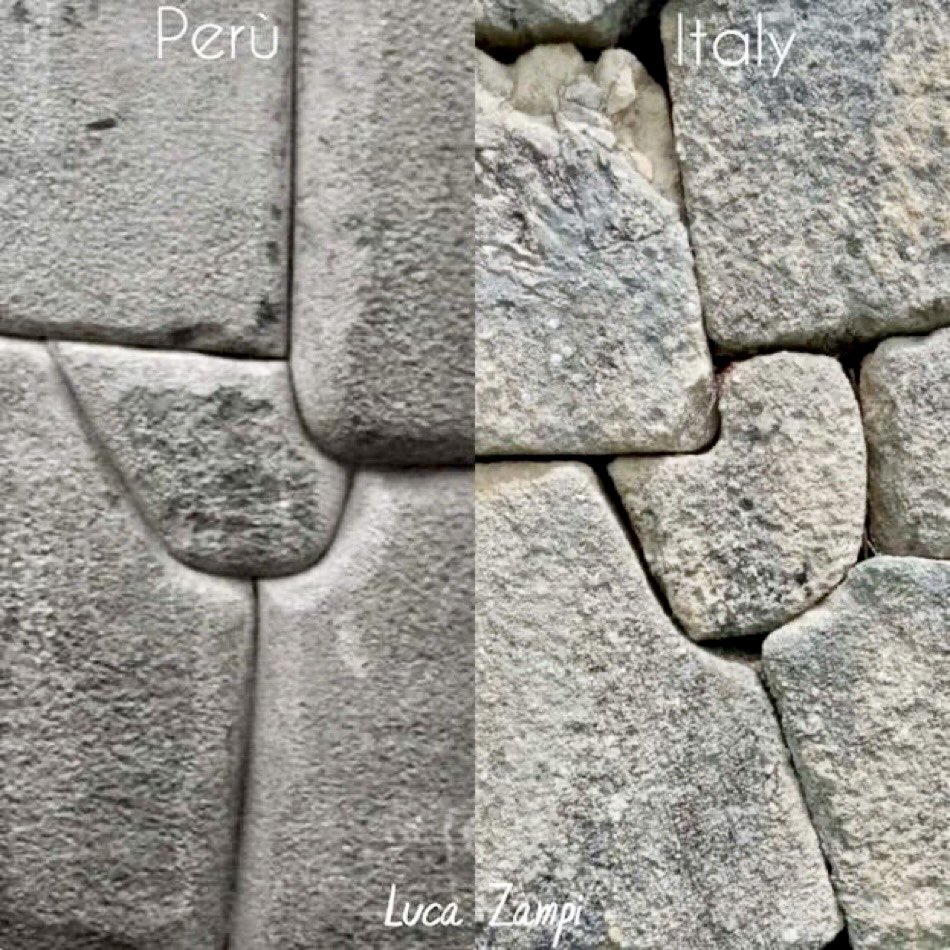
Your side-by-side comparison of the stonework from Peru and Italy would fit perfectly in that chapter. It visually ties together the global nature of this advanced stone-working tradition in a way that’s very hard to ignore. I’d love to include it with proper credit.
Would you be open to letting me use that image in the book? I’m happy to credit you however you prefer and can send you the exact context and caption I’m planning to use.
Thanks so much for considering it — and for all the great work you put out. It’s genuinely appreciated.
Best regards, Jason Bennetch
Jimi, this is a powerful comparison.
The polygonal masonry style in Peru shows up in other distant places too — including at Ahu Vinapu on Easter Island, where the precision and fitting of the stones is strikingly similar to some of the finest work in Peru. When you see the same techniques appearing across the Pacific and even in parts of the Mediterranean, it becomes harder to accept that these were completely isolated developments.
In Before the Flood, I explore this pattern across multiple sites and argue that the most advanced stone-working often appears earliest, then declines — which suggests later cultures were inheriting (and sometimes struggling to replicate) knowledge from something older.
These similarities seem to point to a much deeper, shared tradition that was later disrupted. Would love to hear your thoughts on whether this reflects direct ancient contact or something even more ancient that multiple cultures drew from.
This is exactly the kind of evidence that makes you wonder how much has been lost or deliberately downplayed.
In my book Before the Flood, I look at sites like Hueyatlaco in Mexico — where sophisticated stone tools were found alongside butchered mastodons and dated between 250,000–400,000 years old using multiple independent methods. That’s not “scattered tribes.” That’s organized, skilled people who were already here long before the Clovis timeline.
The bigger question I keep coming back to is: How much of the real story got erased by the massive cataclysms at the end of the last Ice Age? The same forces that carved the Channeled Scablands in Washington could have wiped out entire chapters of human history.
Would love to hear what you think about how deep this actually goes.
This is one of the countless ancient sundials or solar clocks that can be found all over the Cusco area. I share how they operated in my latest episode 👉🏽 https://t.co/J9PrdLfNcX
Cataclysms have certainly reset humanity before.
~11,600 years ago the Younger Dryas ended in abrupt warming, massive meltwater floods, and megafauna extinctions. Right at that boundary, Göbekli Tepe appears in Turkey — monumental T-pillars, sophisticated carvings, and astronomical knowledge built by people long assumed to be simple hunter-gatherers.
Worldwide sediment layers show platinum spikes, nanodiamonds, and shock-fractured quartz — markers consistent with cosmic airbursts or impacts. Global flood myths echo the same story.
Was this the great reset?
In Before the Flood we follow the geological, archaeological, and mythological evidence for advanced societies that came before.
The lion stands guard. The pyramid hints at lost mastery. The flood changed everything.
What part of the record convinces you a cataclysm rewrote our past?
#BeforeTheFlood #YoungerDryas #GöbekliTepe #LostCivilizations
Are we being lied to about our Ancient history?
“Transoceanic sea-travel was NOT possible until 1492, when Christopher Columbus sailed the Ocean blue” 🌊
PERU👇🏻 🤔 ITALY👇🏻
Brazil has a 46-meter wall of stone covered in 400+ undeciphered symbols carved beside a flooding river.
Pedra do Ingá is ~6,000 years old. Researchers have found what appears to be a solar calendar, star maps, and constellation groupings carved into basalt.
No one knows who made it. No one knows what it says
🌊 What if civilization didn't begin ~10,000 years ago... but was reset by a cataclysm ~11,600 years ago?
In Before the Flood, explore the Richat Structure (Eye of the Sahara) as a potential cradle of advanced pre-flood society, global cart ruts carved by unknown tech, Göbekli Tepe's sudden sophistication, and rigorous geological + archaeological links to Younger Dryas impacts.
Challenging mainstream timelines with evidence-based inquiry.
What forgotten chapter of human origins awaits? 📖 #BeforeTheFlood #AncientCivilizations #LostHistory
🪨 The “Stone of the Pregnant Woman” at Baalbek, Lebanon — over 1,000 tons, still sitting unfinished in the quarry. Nearby, the even larger “Forgotten Stone” at ~1,650 tons, the biggest worked monolith known from antiquity.
The Romans built their Temple of Jupiter on top of a massive megalithic platform (the Trilithon stones ~750-800 tons each). But they almost certainly did not quarry or move these giants. No records explain it, and nothing else in Roman engineering comes close.
Today, moving a 1,500+ ton block would require massive cranes, SPMT transporters, reinforced roads, and millions of dollars in planning. Yet we're told ancients did it with wood, rope, and manpower?
These stones feel like remnants of something far older. Who really built this platform — and how much older is it?
This is the kind of deep enigma I'm unpacking in Before the Flood.
What do you think moved these?
#Baalbek #Megaliths #AncientMysteries #BeforeTheFlood
Weighing more than 1,000 tons, this massive stone located in Baalbek dates back to approximately 27 BC, during the height of the Roman Empire. Its colossal dimensions provoke fascinating inquiries into the engineering methods employed by ancient civilizations.
What strategies did they employ to transport such an enormous monolith? This persistent enigma invites us to reconsider what we know about the technological prowess of societies from the past.
🪨 The “Stone of the Pregnant Woman” at Baalbek, Lebanon — over 1,000 tons, still sitting unfinished in the quarry. Nearby, the even larger “Forgotten Stone” at ~1,650 tons, the biggest worked monolith known from antiquity.
The Romans built their Temple of Jupiter on top of a massive megalithic platform (the Trilithon stones ~750-800 tons each). But they almost certainly did not quarry or move these giants. No records explain it, and nothing else in Roman engineering comes close.
Today, moving a 1,500+ ton block would require massive cranes, SPMT transporters, reinforced roads, and millions of dollars in planning. Yet we're told ancients did it with wood, rope, and manpower?
These stones feel like remnants of something far older. Who really built this platform — and how much older is it?
This is the kind of deep enigma I'm unpacking in Before the Flood.
What do you think moved these? [Attach your picture of the Stone of the Pregnant Woman]
#Baalbek #Megaliths #AncientMysteries #BeforeTheFlood