Almost 2y, ~280 pages, ~110 diagrams, tens of conferences around the world, 16 workshops, uncountable evenings and weekends spent on my laptop… and it is finally READY 🚀 🎉
Building Micro-Frontends is the book where I reversed all my experience on #microfrontends
🧵👇
AI Engineers design, build, and deploy AI models and systems to solve complex real-world problems.
And if you want to get into the field, this handbook is for you.
In it, @tatevkaren7 discusses must-have skills, shares tips for getting started, and goes through use cases for AI tools & technologies.
https://t.co/55cgy12Cxh
Proxies help you test local experiences, collect public data, and run automated workflows at scale.
In this guide, @manishmshiva compares five proxy providers and where each works best.
You'll learn how to evaluate reliability, API quality, geo-targeting, session control, and cost predictability, too.
https://t.co/GvXi2a7chm
No one wants to hear they're being placed on a Performance Improvement Plan.
Moshe certainly didn't at first - until he dug in, worked harder than ever before, and started seeing improvement.
In this article, he discusses his PIP experience at Google - what he learned, where he is now, & how to not let a PIP get you down.
https://t.co/c2Py4ZFfsK
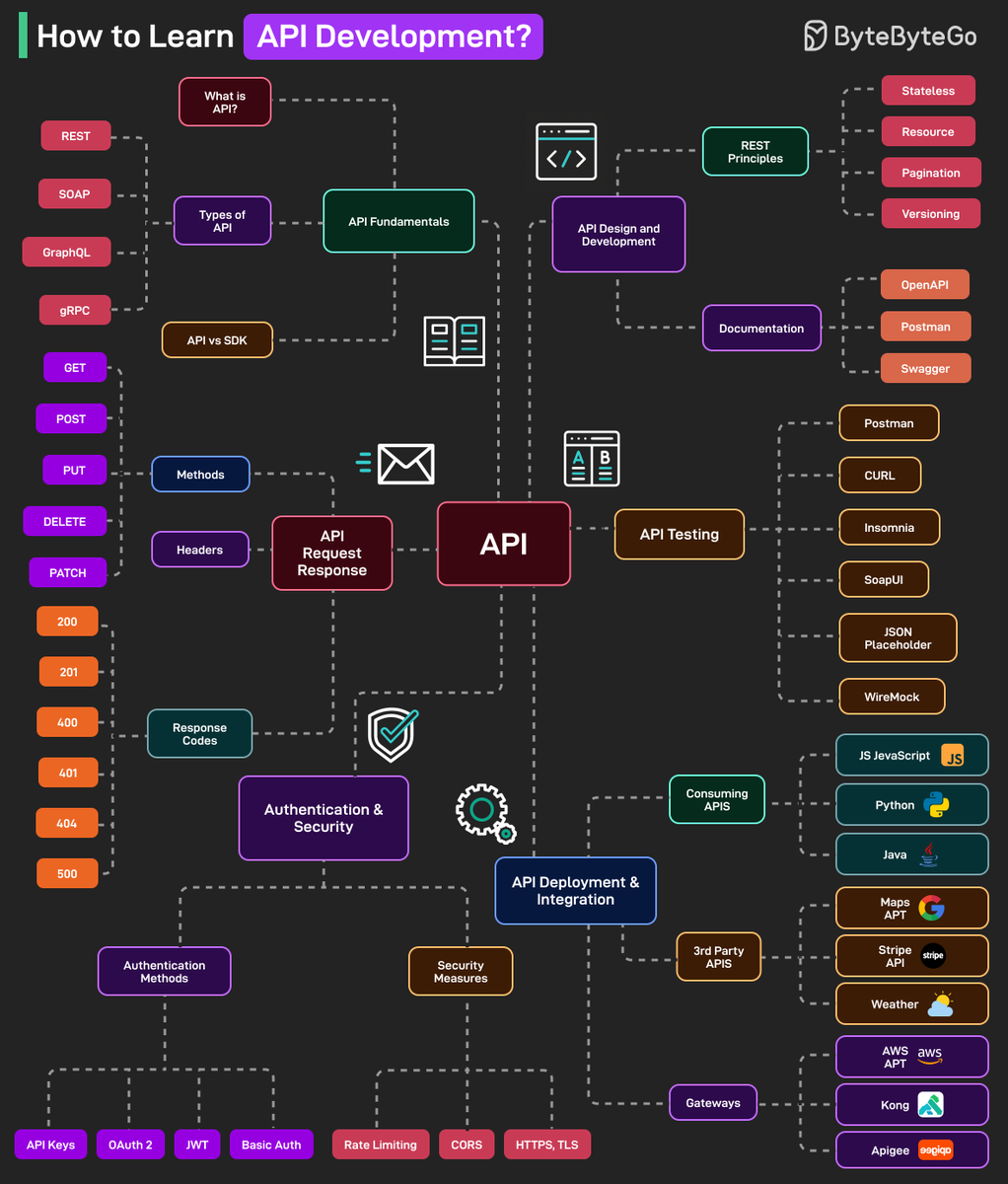
APIs and the Model Context Protocol both help different systems communicate with each other.
But these two tools were built for different purposes: in short, APIs are for developers, and MCP is for AI models.
In this article, Manish explains how each one works and why they're both necessary.
https://t.co/vE6sHlSo0U
@_devJNS Linux so i would recommand to every web dev as beginner or Advanced is you have to get to know how linux Actuly works bhiend the sence i think that's the first things you have to learn it before anything else
good luck web dev i wish you the best
Sometimes you'll need to get more detailed info about your Linux system.
Maybe you've just gotten a new system, you're doing a security test, or you just want to know more about your machine.
In this in-depth guide, @hira_zaira teaches you how to get info about your OS, kernel, CPU, memory, processes, networks, & more using the command line.
https://t.co/pF9khYGoQd
In Node.js, the event loop basically listens for actions, then processes tasks or outputs.
And it's a key concept to understand if you're working with Node - but it can be tricky to grasp.
In this guide, @amanda_adoyi uses analogies and examples to show how the event loop works.
https://t.co/0iUBOuncLY
freeCodeCamp now has daily coding challenges that you can complete in the mobile app or in /learn.
These will help you test and improve your skills as you work through the curriculum - or just in your day-to-day work.
Check out today's (the IPv4 Validator) and see if you can solve it!
https://t.co/fy4rtJIX4i
A computer's operating system manages hardware & software and provides key services for various programs.
And in this course, you'll learn all about how an OS works.
It covers types of OSs, process management, CPU scheduling, memory management, & more.
https://t.co/UcvV0YFzxQ
Building a social media app is a great way to practice your coding skills.
And in this course you'll build an Instagram clone with React and Firebase.
You'll learn about handling user interactions, authentication, data storage, search, and lots more.
https://t.co/esUwAhsbSE
The MERN stack - MongoDB, Express, React, and Node.js - is a popular way to build full-stack apps.
And to help you practice developing with it, @casweb_dev created this in-depth tutorial.
He walks you through building a todo app & covers coding the UI, displaying tasks, setting up MongoDB Atlas, and more.
https://t.co/cBgz4brEmw
APIs allow different software applications to talk to each other and exchange info.
And APIs, like all software, need helpful documentation.
In this course, you'll learn useful strategies & best practices, tools that make writing docs easier, and more.
https://t.co/kp5vhpepR0
Hey ambitious folks: this weekend level up your programming chops with this FREE book that freeCodeCamp just published. 🏕️ And here are some other open source learning resources we published this week, too:
1. Learn AI-assisted coding from a software engineer who's maintained freeCodeCamp's platform and infrastructure for the past 7 years. Mrugesh was initially skeptical of AI tools but has recently used them to great effect. And he wrote this handbook to help you do the same. He says experienced developers can complete tasks faster with AI assistance. But they need to know how to use these tools effectively. And they also need strong foundational programming skills. This handbook is a no-nonsense guide to emerging tools and best practices. (full-length handbook): https://t.co/B9sDuCZEqQ
2. freeCodeCamp also published a course on building your own AI agent from scratch using Python. You'll implement the agentic loop. Then you'll endow your agent with the ability to read, write, and execute code. Finally, you'll supervise your agent as it goes through and makes fixes to an intentionally buggy codebase. (3 hour YouTube course): https://t.co/sc3lhlXip1
3. On this week's podcast I talk with Ankur Tyagi, a freelance developer and prolific contributor to freeCodeCamp's open source learning resources. He's worked at Volvo, Barclays, Accenture, and other multinationals. He shares his own tips for leveraging AI tools, and why he doesn't think they'll result in fewer jobs for devs. He also has tons of tips for running your own developer consultancy. (1 hour watch or listen in your favorite podcast app): https://t.co/nQVqDgG3nV
4. The freeCodeCamp community also just published our first-ever Mandarin Chinese course. It's aimed at absolute beginners. It'll teach you fundamentals of the language and help you prepare for the standardized HSK exam. As you may recall, we've published beginner courses on Spanish and German as well. We eventually hope to have courses on a wide range of world languages at many levels of proficiency. I started learning Mandarin 23 years ago and I can tell you this course just scratches the surface. But it should be a good starting point for you if you're curious. (11 hour YouTube course): https://t.co/BEOlFQoQv5
5. Learn the graph algorithms that power Netflix's video recommendation engine and Google Maps' routing logic. This Python tutorial will introduce you to Breadth-First Search, Depth-First Search, Dijkstra’s Algorithm, and other key computer science concepts. It includes plenty of code examples to help you understand these powerful programming structures. (20 minute read): https://t.co/RHOxVROM3D
Did you know that 10,889 people care so much about the freeCodeCamp community and our open source learning resources that they donate each month to support our charity? Join these kind folks in supporting our mission: https://t.co/PJXlqTfhI9
Docker tutorials everywhere, but where do you actually START?
I get it. You want to learn Docker but feel overwhelmed by:
🟠 Hundreds of random tutorials
🟠 Examples that don't make sense
🟠 No clear learning path
Been there. That's why I created this roadmap.
🎯 One video. Complete journey. Beginner to confident → https://t.co/ZnLhQEyWue
In the video I'll show you the exact order to learn and why.
No random tutorials. No scattered learning. Just a clear path forward.
🎁 Bonus: FREE Docker Roadmap PDF with all code snippets and resources.
💬 Where are you in your #docker journey? Complete beginner or stuck somewhere?
If you want to practice your full-stack development skills, this one's for you.
In it, @dayvid_JS walks you through all the details of building a social learning platform.
You'll use Next.js, Stream, and Supabase and set up real-time chat, a video conferencing feature, and more.
https://t.co/Qtxa63BPj8