The Mucin Glycobiology Lab (aka Bergstrom lab), focuses on interface biology—where host & microbe meet, with mucins and their glycans at the centre of it all!
🎉 Super excited to announce that our study "Colibactin-driven colon cancer requires adhesin-mediated epithelial binding" is now published in Nature! Huge congratulations to first authors @MaudeJans and @magdalenakolata for their fantastic work! 1/6🧵🎉
https://t.co/mhCUpxsKXX
#ThrowbackThursdayScience. 1992. Insightful work from influential pioneers in mucus biology, Anthony P. Corfield and Lansing C. Hoskins, revealing the tremendous digestive capabilities of the microbiota and its relationship to mucus. We know now that mucus--via it's O-glycan forest-- is a workhorse that simultaneously feeds our microbiota through its niche functions, and shields our tissues from the microbiota (and its digestive enzymes) through its barrier functions – constantly protecting our bodies from infection and chronic intestinal diseases like #IBD and #ColonCancer. #thankfulformucus
https://t.co/Df09cxV2pQ
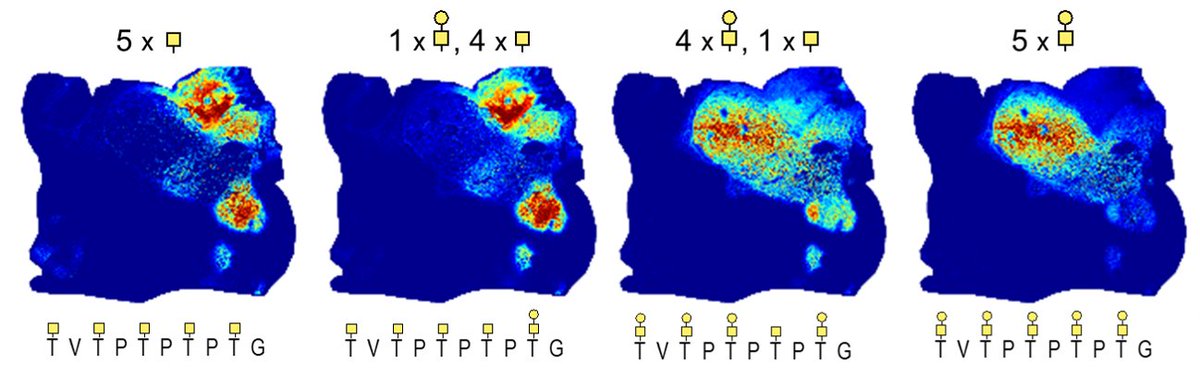
🚨Check out our new #glycotime preprint: Glycosite Mapping and in situ Imaging of MUC2 Glycopeptides via On-slide Digestion with Mucinase StcE! 🥳@SC_Lowery et al used MALDI IMS and intact glycoproteomics to understand spatial distribution of mucins: https://t.co/bvGfNM6PmE 🧵👇
#ThrowbackThursdayScience 2002. The lab of Richard Cummings identifies Cosmc, a crucial chaperone required by mammalian core 1 beta 1,3 galactosyltransferase to synthesize core 1 and all complex O-glycans emanating from this structure (Ju & Cummings, PNAS, 2002). Not only that, but the Cosmc gene (C1GALTC1) was found to be X-linked! The importance of this study for our understanding of O-GalNAc glycan biosynthesis, mucus function, and IBD, cannot be understated and impacts our work today. #glycotime #mucins #mucus @SFGlycobiology
https://t.co/WrtKDAnF7V
🚨🚨I’m excited to present our lab’s new paper where we tried to provide a mechanistic explanation for the link between antibiotic use and risk of developing inflammatory bowel diseases (#IBD). A 🧵/1
https://t.co/k2wUPoIwTm
👏Hot off the press! The biofunction of #Akkermansiamuciniphila in intestinal-related diseases
https://t.co/0MNUcJEngH
🤲This review provides an overview of the research history and understanding of A. muciniphila and its association with various intestinal-related diseases.
@HayleySGorman Thanks Haley! For science, not that I've seen...but I certainly think is good for science to remember the foundations laid by past researchers, how far we have come (or not come!), and perhaps remember what inspired us to pursue this crazy career!
Throwback_Thursday: 2005. This beautiful study came out that demonstrated the flexibility of Bacteroides thetaiotaomicron to switch between utilizing dietary and mucin glycans depending on the dietary fiber load. Fascinating to think about what is going on inside B. theta as it senses its glycan microenvironment. Highly influential to me as a young graduate student. #glycotime #mucins #mucusmatters @LabSonnenburg
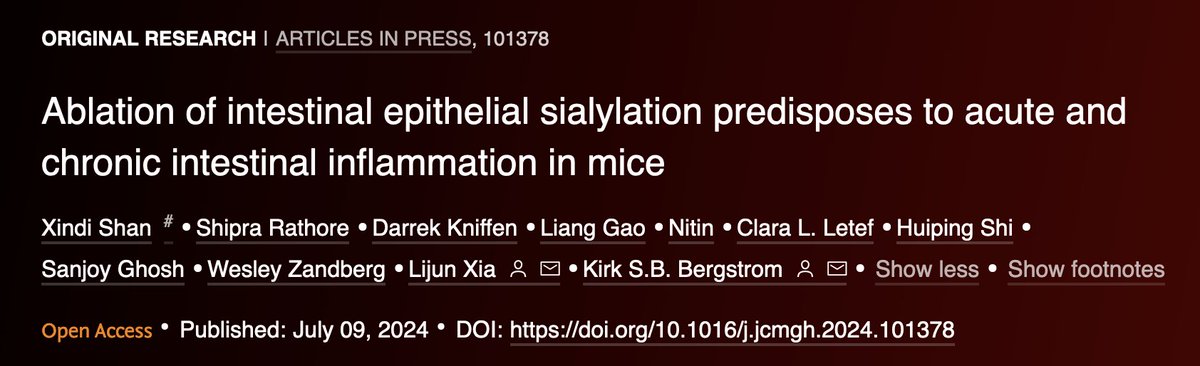
🚨🚨News from MucinGlycoLab🚨🚨 - New insights into how the intestinal epithelial sialome protects from spontanous colitis, mucositis, and tumor development: We uncover unexpected roles of sialylation in impacting b1 mucus functions, the microbiota, and the stem cell niche! #mucin #glycotime @getgutsycanada@HlthResearchBC
Amazing journey with my fantastic team @ubcokanagan and with Oklahoma collaborators @OMRF, including my longtime friend and fellow mucinglyco-research warrior Xindi (Dylan) Shan @DylanShanxindi 🪖🪖
Uncorrected Proof:
https://t.co/aj3W4wzYco
Fascinating and important body of work from the Birchenough Lab @GobletCellGuy@MucinBiology studying goblet cell-mucus-microbiota relationships in neonatal mice! A must-read!
🥳 New preprint from the lab now online! 🥳
https://t.co/hwJ1OyZ64V
Ever wondered when/how the colonic mucus barrier and other goblet cell-intrinsic defences develop? Look no further (for some answers at least...) #neonatal#mucus#gobletcell#microbiome
Another innovative study from the talented Allbritton Lab @UWBioE – this time using a novel in-vitro model of fecal-coated mucus to stimulate MUC2 and cytokine secretion from colonic epithelium! #mucin#UWBioE
https://t.co/Ha9a0sozdC
🚨🚨Ever wondered what human MUC2 is doing at baseline and under pathologic conditions? Some big mucus news to share from the MucinGlycoLab _UBC! #mucusmatters#mucus#IBD 1/11
https://t.co/DzhtUL95LB
@GobletCellGuy Thank you GobletCellGuy! We are happy to add mucus to the microbes, antibodies, proteases, glycosidases, lipids, and metabolites and other biomarkers so richly found in our stools!