1/🧵 Coding agents can make code faster. Can they also prove it still does the same thing?
Introducing Agentic Verified Optimization 🚀 Agents return faster code plus a Lean proof that it equals the original on every input.
🌐 Blog: https://t.co/4LnHy9zBSR
📄 Paper: https://t.co/bFlpiiPwIG
We trained an imaginative agent! ✨
Agima: an omni agent that plans by imagining futures.
𝗦𝗙𝗧: Directly generalizes to harder tasks! 𝟮%→𝟰𝟬%, beats GPT-5.6 Sol (𝟮𝟬%).
𝗥𝗟: New ways to imagine emerge! Imagines a second plan only if the first one fails (𝟯𝟮%→𝟭𝟬𝟬%).
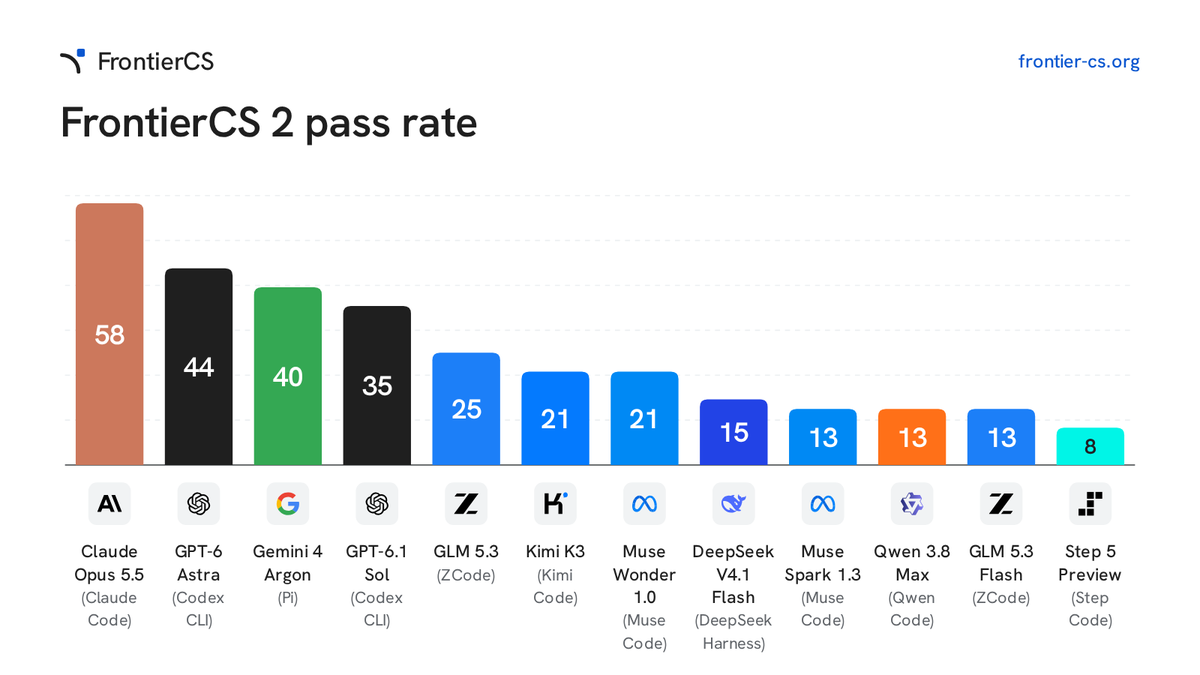
FrontierCS 2 is our new benchmark for CS research & development.
Each task is based on a paper: we delete the contribution from the released code, and ask agents to outdo the original method, as judged by the authors' chosen metrics. Agents don't have access to the paper or web.
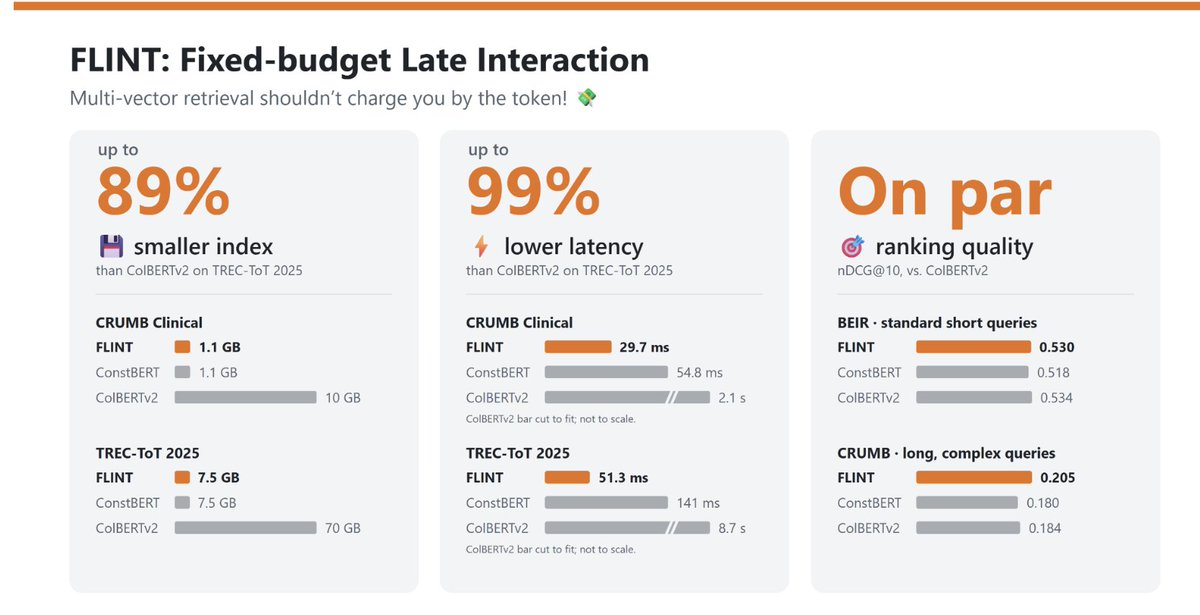
1/ 💰Multi-vector retrieval shouldn’t charge you by the token!
🎉 Excited to share FLINT (Fixed-budget Late INTeraction), a late-interaction retriever designed for long, complex queries with up to 89% reduction in index and 23-170× faster retrieval latency.⚡
🎛️ FLINT gives a vector-budget knob to balance storage, latency, and quality.
📄 Paper: https://t.co/GO5yum1763
How does it work? 🧵
ColBERT stores and compares one vector per token. FLINT pools every query and every document into a fixed number of vectors, so there’s far less to store and far fewer comparisons at search time.
Excited to share TokenGate. By teaching LLMs to conditionally skim context tokens, we achieve up to 11.3x faster prefill and drastically reduce peak memory for long-context tasks!
Great work on fast long-context prefill. TokenGate is a trainable module that works with existing models to make long-context inference much more efficient.
Game changer for humanoid full-body control training. Now it's superfast (and cheap, just one GPU) to train a single policy on *all* the motions. How come:
(1) World model much faster than regular sim
(2) Backprop through time collects way more signal than policy gradients
We found a way to scale humanoid control that reduces GPU-hours by more than 1000×.
Across 129,514 motions, SuperMimic surpasses the state of the art (128 GPUs, 7 days) with 1 GPU in 3 hours.
Project: https://t.co/6gc9WKm9qY
Demo: https://t.co/OHRvx5ogQY
Estimating empowerment from offline data is useful, because it provides us with an unsupervised objective for learning the relative "value" of states for reaching diverse outcomes. But it's notoriously hard to make this tractable. In our new paper, we present a tractable estimator, as well as some applications!
How should an agent decide where to explore, given unlabeled offline data? 🤖
In our new paper, we show that empowerment, a measure of how much control an agent has at a state, can be estimated from offline data and used to guide exploration!
https://t.co/O5tz9nQTsB
(1/7)
Turns out that simply extracting policies with supervised learning conditioned on the advantage can get state of the art results in RL, as long as we get a few important details right!
❓How can humanoids learn by watching humans?
Naive retargeting can lose crucial contacts: like bracing a hand on a table while bending to pick an object off the floor.
🚀 Introducing VICAR: preserve key contacts from human videos, practice in simulation, deploy on hardware
1/n
New surprising result:
We trained AI recursively on its own safe generations, while giving it a benign cue. Models became increasingly misaligned over time, giving advice on how to do harm and build biological weapons.
We call this Progressive Misalignment. 🧵👇
Last year I trained the advantage-conditioned VLA for π*0.6 during my internship @physical_int. Now, I have a much improved recipe.
Introducing ✨Advantage Guidance✨, a performant RL method with stable advantage-conditioned supervised training and contrastive guidance sampling
Seeing is an act in itself. We look at what matters, and so should robots!
EyeRobot 2.0 does this with gaze, enabling precise manipulation without wrist cameras. Key for tool use, where the tool can block a wrist camera!
Co-led by @justkerrding who'll be on the job market! Hire him :)
1/ We discovered something totally unexpected about the neural structure of consciousness that overturns decades of thinking on its biological basis and brings us significantly closer to the recipe for generating conscious awareness.
New preprint: https://t.co/K8BwiHXvXg (led by @HesseJanis, with @FrankLanfranchi, @_conor_mcgrory, @Yuelin_Shi, and @EngelTatiana)
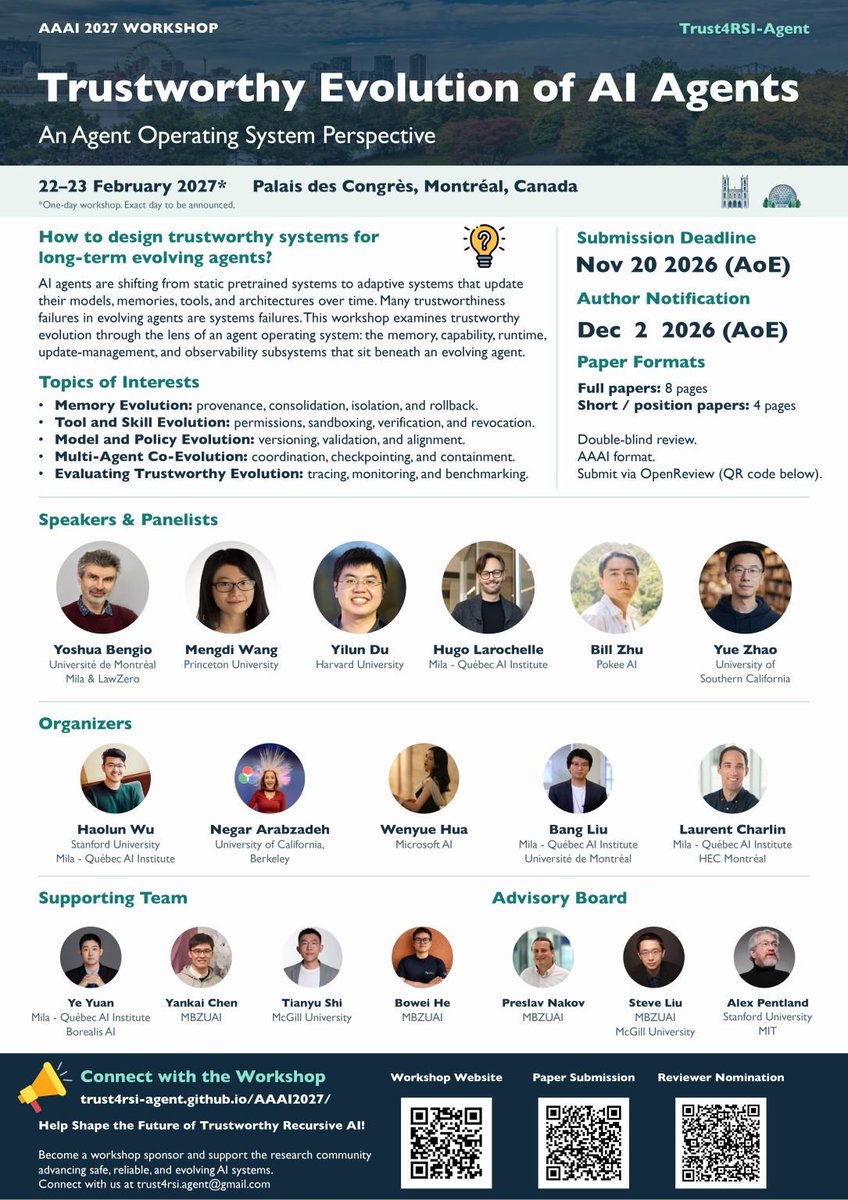
Excited to be co-organizing our Trust4RSI-Agent Workshop at #AAAI2027 ! A Workshop on Trustworthy Evolution of AI Agents! 🚀
🥳We have an amazing lineup of speakers and panelists: @Yoshua_Bengio , @MengdiWang10 , @du_yilun , @hugo_larochelle , @ZheqingZhu , and @__yuezhao__ !
📝 Submission deadline: November 20, 2026
📬 Author notification: December 2, 2026
📍 February 22–23, 2027 · Montréal, Canada
🌐 https://t.co/zSASeQheqd
Please share with colleagues working in this space and looking forward to your submissions!
Happy to be organizing this alongside @Haolun_Wu0203@HuaWenyue31539@BangL93@lcharlin! #AAAI2027 #AIAgents