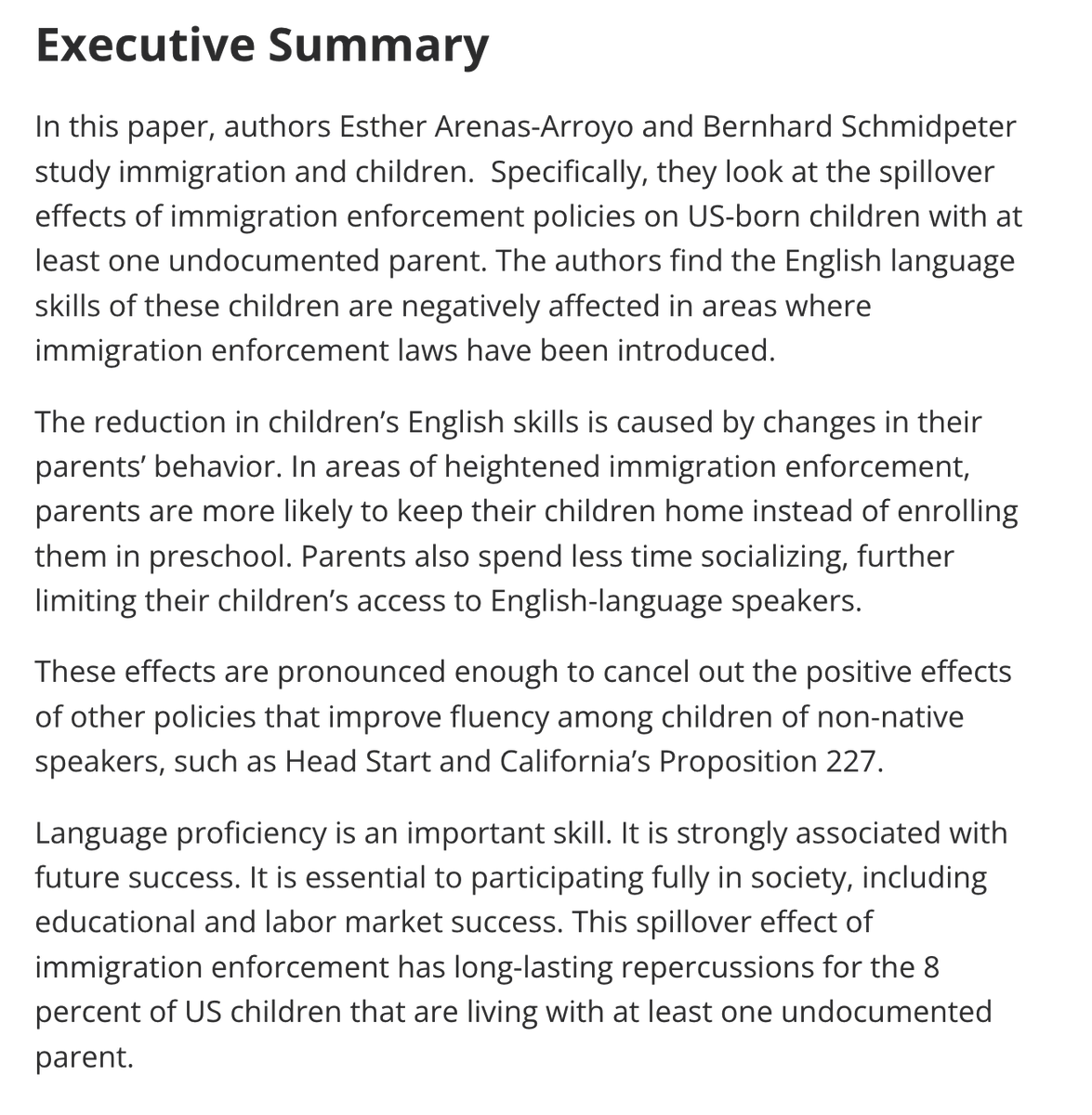
Summary of our new work about the negative spillover effects of immigration policies
If you are interested and want to read more, here's the link to our @RWI_Leibniz_en WP:https://t.co/2LaXwSznLw
Chilling Effects of immigration enforcement policy in the US negatively impact parental investments and long-run children outcomes.
My new @BorderCrim blog with @BernhardEcon
https://t.co/HrkBW3EW3j
🔥17:30 CEST @e_arenasarroyo shows that immigration policies lower language skills and long-run educational success of U.S.-children with likely undocumented parents.
Follow the talk 👉https://t.co/5Ov4mIuT30 #IZAEducationEconomics#EconTwitter@profsimonb @IngoIsphording
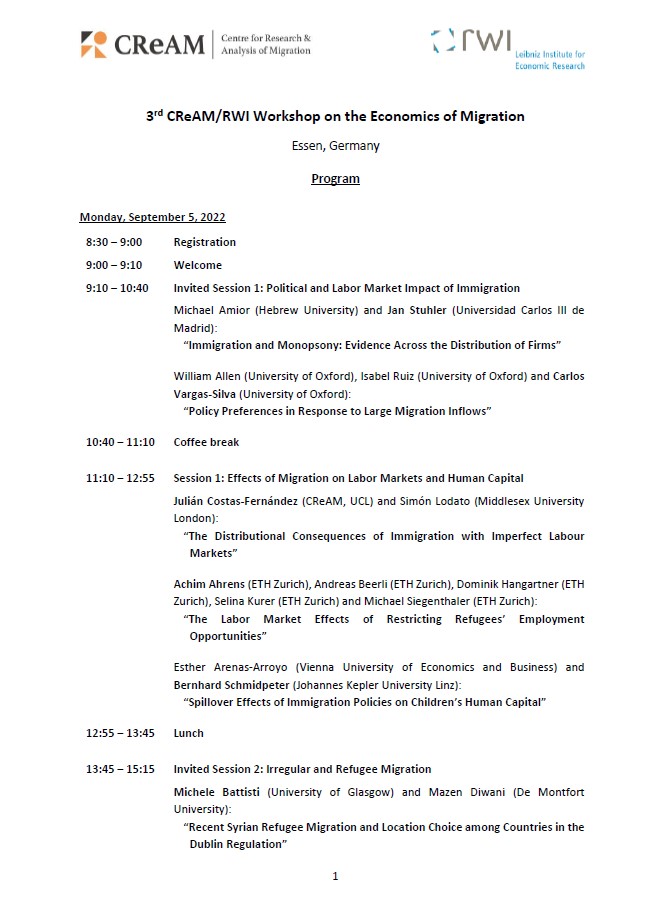
Really looking forward to the workshop and to presenting my joint work with @e_arenasarroyo on spillover effects of immigration policies on children's human capital
After a week of great talks at #NBERSI , looking forward to present our paper on spillover effects of #immigrationpolicies on children’s human capital in the children session @BernhardEcon
https://t.co/pMRlpRLMfD
My new work with @e_arenasarroyo about the spillover effects of immigration enforcement on children's human capital! Great summary by @smithtjosh@cgousu
🚨New research by @e_arenasarroyo and @BernhardEcon out today from @cgousu!
Heavy-handed immigration enforcement reduces integration by reducing English skills.
Finally out in European Economic Review (with Bernhard Schmidpeter): Automation, unemployment, and the role of labor market training
https://t.co/SLk3waLjvI
Why do employers offer flexible jobs? To help workers find work-life balance or to shift cost & risk?
@BalgovaMaria@QianMatthias & I take a machine learning approach to analyze the text of 46million UK job ads to provide some answers. 1/n
1/ Higher education is in enormous financial trouble.
You might think "free college" is the solution.
In the 2020 @Monthly College Guide, I argue that's wrong -- and propose what to do instead.
https://t.co/MQDzwDbOqz
Which is the effect of grandmotherhood on the labor supply decision of older workers? Find it out in my new work together with @WFrimmel, @HallaMartin and @EbmerWinter at @J_HumanResource https://t.co/c7wtqSwtj5
Nice piece in @diepresse_com from @EbmerWinter (@jku_econ) featuring our work on the consequences of automation and the role of public policies (in German): https://t.co/acj9wOq1Kc
Link to our WP: https://t.co/XC4JPcPw0R
"While tasks are highly automatable, only roughly 5 percent of jobs are fully automatable at present." @MarcDCase & Sarah Nzau investigate the potential impact of AI on jobs: https://t.co/mMiAzipcAU